Showing posts with label writers. Show all posts

Thursday, November 8, 2018

Armistice Day One Hundred Years Later

Thursday, November 8, 2018
Welcome Home Our Gallant Boys
Loretta reports:

Sunday marks the 100th anniversary of the signing of the Armistice ending World War I—known as the Great War and the War to End War, until only a couple of decades later, when another great war broke out.

World War I was a horrendous war, even by war’s horrendous standards, as Wilfred Owen’s poetry makes more than clear. His war isn’t heroic or romantic. It’s ghastly and heartbreaking. For a time, his work fell out of favor for this reason. But only for a time.
An English professor introduced me to "Anthem for Doomed Youth" fifty or so years after it was written, at a time when it struck a chord with those protesting the Vietnam War. Owen’s and others’ poetry led me, some years later, to Robert Graves’s Good-Bye to All That, which offered insights into both the war and that generation of Englishmen. Unlike Owen, Graves survived.

For me, these works and others began an education that continues. Visits to English and Scottish churches, stately homes, and memorials have given me a powerful sense of the toll this particular war took on the other side of the Atlantic.
Anthem for Doomed Youth 1917

We keep hoping, but so far, no war has ended war. All we seem to be able to do is mourn and remember. The Tower of London remembers, beautifully and movingly, again this year, as you will discover if you search “Beyond the Deepening Shadow,” for images from the centenary commemoration.

Wilfred Owen


Images: Welcome Home Our Gallant Boys, 1918 poster, courtesy courtesy Library of Congress Prints and Photographs Division Washington, D.C. 20540 USA; "Anthem for Doomed Youth" and photograph of Wilfred Owen from Poems by Wilfred Owen, 1920.

Clicking on the image will enlarge it.  Clicking on a caption link will take you to the source, where you can learn more and enlarge images as needed. And, just so you know, if you order a book through one of my posts, I might get a small share of the sale.

Thursday, October 25, 2018

Frankenstein and the Critics

Thursday, October 25, 2018
Frankenstein, annotated 2017
Loretta reports:

Mary Shelley’s reviewers had extremely different reactions to Frankenstein.

Following a plot summary, John Croker has this to say:
“Our readers will guess from this summary, what a tissue of horrible and disgusting absurdity this work presents ... The dreams of insanity are embodied in the strong and striking language of the insane, and the author, notwithstanding the rationality of his preface, often leaves us in doubt whether he is not as mad as his hero." 
Following samples of the prose style:
“... we take the liberty of assuring [the author] ... that the style which he has adopted in the present publication merely tends to defeat his own purpose, if he really had any other object in view than that of leaving the wearied reader, after a struggle between laughter and loathing, in doubt whether the head or the heart of the author be the most diseased."
Quarterly Review 18 (January [delayed until 12 June] 1818): 379-385. From the Mary Shelley Chronology and Resource Site, Scholarly Resources, Romantic Circles.

Walter Scott, however, is thrilled:
“So concludes this extraordinary tale, in which the author seems to us to disclose uncommon powers of poetic imagination. The feeling with which we perused the unexpected and fearful, yet, allowing the possibility of the event, very natural conclusion of Frankenstein's experiment, shook a little even our firm nerves ...

It is no slight merit in our eyes, that the tale, though wild in incident, is written in plain and forcible English, without exhibiting that mixture of hyperbolical Germanisms with which tales of wonder are usually told, as if it were necessary that the language should be as extravagant as the fiction. The ideas of the author are always clearly as well as forcibly expressed; and his descriptions of landscape have in them the choice requisites of truth, freshness, precision, and beauty ... 

Upon the whole, the work impresses us with a high idea of the author's original genius and happy power of expression ... If Gray's definition of Paradise, to lie on a couch, namely, and read new novels, come any thing near truth, no small praise is due to him, who, like the author of Frankenstein, has enlarged the sphere of that fascinating enjoyment."
Start of review in La Belle Assemblée
Blackwood’s Edinburgh Magazine 2 (March 1818)
His whole review is well worth reading, as are others. You can read them here at the Romantic Circles website.

If you are in New York between now and the last week of January, you might want to stop by the Morgan Library for the exhibition, “It’s Alive! Frankenstein at 200.”

Images: Cover of 2017 annotated edition of Frankenstein; Beginning of La Belle Assemblée review of Frankenstein, Vol. 17, March 1818

Clicking on the image will enlarge it.  Clicking on a caption link will take you to the source, where you can learn more and enlarge images as needed. And just so you know, if you order a book through one of my posts, I might get a small share of the sale.

Monday, October 22, 2018

The Lunatic Asylum Nightmare

Monday, October 22, 2018
Goya, Courtyard with Lunatics
Loretta reports:

The nightmare theme of a sane person being locked up in a lunatic asylum appears in fiction again and again. This is because it touched a chord. For all too many, especially women, this was a grim reality.

My Experiences in a Lunatic Asylum, which I came upon via the Public Domain Review, describes in disturbing detail a man’s experience in the Victorian era. For a woman’s point of view, you might want to look at Nellie Bly’s Ten Days in a Mad-House.

In the fictional world, the theme is prominent in Wilkie Collins’s The Woman in White.
"I suppose that we most of us...quietly comforted ourselves with the reflection that 'in the nineteenth century' (an expression which is used as a sort of talisman, apparently, like the 'Briton' of Palmerston's day) such things are impossible.  It requires a personal experience of their amenities, such as fell to my lot, seriously to believe that the adventures of a novel may be transferred to the pages of an 'article," and be as strange--and true. Villainous conspiracies, for personal motive, to set the lunacy law in motion, are rare enough, I do not doubt. But the law favours them. What is not rare, I doubt even less, is the imprisonment in these fearful places of people who are perfectly sane, but suffering from some temporary disorder of the brain, the most delicate and intricate part of all the mechanism, and the least understood; and if asylums are a sad necessity for the really mad,—and even that I cannot help doubting; for from what I have seen I believe that they require a much more loving and more direction personal supervision than they can get, poor people,--for the nervous sufferers who are not mad they are terrible."—My experiences in a Lunatic Asylum, by a Sane Patient (1879)
Experiences in a Lunatic Asylum


Clicking on the image will enlarge it.  Clicking on a caption link will take you to the source, where you can learn more and enlarge images as needed. And, just so you know, if you order a book through one of my posts, I might get a small share of the sale.

Wednesday, September 19, 2018

"Moral Poison": The Evils of Reading Novels, 1864

Wednesday, September 19, 2018
Susan reporting,

Loretta and I have written so many posts for this blog over the years - nearly a decade's worth! - that we've forgotten a good many of them. Fortunately, our readers haven't. This one surfaced yesterday on Twitter (thank you, Lucy Paquette), and I thought it deserved another appearance here as I wallow through deadline-itis.

In an earlier post, I shared an 18thc warning against women reading romances. By 1860, those who worried about everyone else's reading habits had expanded their concerns, including all novels read not only by women, but by men as well. Apparently novels were dangerous.

The warnings below come from a religious tract published in New York in 1864. A Pastor's Jottings; or, Striking Scenes during a Ministry of Thirty-Five Years was printed anonymously because, as the prefatory note explains, the author "could thus write with more freedom." That same note assures us that "the statements of this volume are all literally true."

Among the many things (this book is nearly 350 pages long) that distress this unknown pastor, novels - that "moral poison" - are right there at the top of the list: "The minds of novel readers are intoxicated, their rest is broken, their health shattered, and their prospect of usefulness blighted."

But he doesn't want us simply to take his word for it. Apparently even novels by Charles Dickens are suspect, and he quotes the famous educator Dr. Thomas Arnold of Rugby School fame to prove it:

Childishness in boys even of good ability seems to be a growing fault; and I do not know what to ascribe it, except to the great number of exciting books of amusement, like Pickwick, Nickleby, Bentley's Magazine, etc...that leave [a boy] totally palled, not only for his regular work, but for literature of all sorts.

Nor are women exempt from the terrible influences of novel-reading. In fact (remember, this is all LITERALLY TRUE), according to the pastor, women suffer even more:

Listen to the evidence given by a physician in Massachusetts: 'I have seen a young lady with her table loaded with volumes of fictitious trash, poring day after day and night after night over highly wrought scenes and skillfully portrayed pictures of romance, until her cheeks grew pale, her eyes became wild and restless, and her mind wandered and was lost – the light of intelligence passed behind a cloud, and her soul was forever benighted. She was insane, incurably insane from reading novels.'

But insanity is only the beginning:

Not very long since, a double suicide was committed...by a young married couple from Ohio, who were clearly proved to be led to ruin and death by these most pernicious books....Police officers too in London and some of our own large cities, have given mournful evidence of the results of some of these novels when dramatized and performed on the stage, as leading to burglaries and murder.

Suicide, madness, burglaries, and murder! As an unrepentant novelist, I clearly have much to answer for. While for obvious reasons, I don't want you to see the error of your ways, but if you'd like to read more of the Unnamed Pastor's edifying work, here's the link to his book, available to read for free via Google Books.

Thanks to Clive Thompson, who shared quotes from A Pastor's Jottings on Twitter.

Above: The Pink Domino; print made by William Henry Mote after Frank Stone, c1833-1835. The British Museum.

Tuesday, June 5, 2018

From the Archives: As Used by Jane Austen: Pins, the Regency Post-It

Tuesday, June 5, 2018


Susan reporting,

Another oldie but goodie from the archives....

I've written before about the importance of pins in everyday 18th c. life. Straight pins were widely used to fasten all kinds of clothing, from women's bodices to infant's diapers, and also used in hand sewing. Pins were considered so indispensable that when Abigail Adams wrote from colonial Massachusetts to her husband John Adams in Philadelphia in 1775, the one thing she requested was for him to "purchase me a bundle of pins and put in your trunk for me." (Read the rest of the letter here.)

Pins for clothing and sewing, yes. But I hadn't realized that pins were also an essential tool for 18th c. writers. Thanks to (or cursed by, depending on your point of view) computers, most modern writers submit manuscripts electronically. Rewrites and copy edits are all conducted now through the magic of track changes and transmissions. Gone are the days of hauling manuscript boxes to the post office, not to mention pages that bristled with pink "flags", the comments and queries pasted to the edges of pages by editors. I've gotten to the point where the only words on paper I see in the entire process are in the finished book – and the way things are going, that may soon vanish, too.

But what did writers do in the days before paper clips and Post-Its? How did an early novelist who was already struggling to make sense of a handwritten manuscript mark revisions and additions? According to the librarians of Oxford's Bodleian Library, the answer is pins – and lots of them. All those notes and insertions and extra copy were handwritten on scraps of paper and pinned in the margin with a straight pin. The pins, above, were all plucked from the library's holdings, and date from 1692 to 1853.

In 2011, the Bodleian acquired a true Jane Austen rarity: the manuscript draft of her abandoned novel, The Watsons. (See here for more about the auction and the staggering realized price, as well as a page of the manuscript itself.) In addition to the clues to cross-outs and rewrites on the draft provide, there were also a wealth of pinned-on additions. For purposes of preserving the manuscript, these pins were carefully removed with their notes, studied, catalogued, and saved – a librarian's scholarly labor of love.

But as a fellow-writer, I like to imagine Jane at work at her small writing table. I wonder: did she use the same pins she used for her clothing, or did she have another stash of pins reserved for writing? Did she keep a pin cushion on the table with a stack of scrap-paper sheets beside her inkwell, prepared and ready to make changes? Or did she tuck them into her sleeve like a hurried seamstress might, keeping them literally at hand when she needed them?

Here is the link to the original article about literary pinning by Christopher Fletcher, Keeper of Special Collections at the Bodleian Library. Thanks to Deb Barnum for first sharing this story with us. 

Above: Manuscript pins, c. 1690-1850. Bodleian Library.

Thursday, October 5, 2017

From the Archives: Alexander Hamilton Seeks a Wife, 1779

Thursday, October 5, 2017
Susan reporting:

One of the questions that authors are asked most frequently is "Where do you get your ideas?" Most of the time, there's no specific answer. I really don't know, especially since years can pass between that first flickering idea to a full-fledged book. 

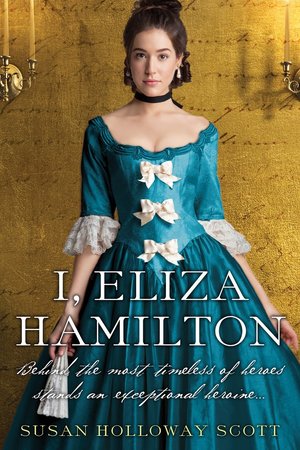
While searching for something else (as if often the case),  I found this blog post from February 2011. I'd forgotten entirely about it (which often happens, too), but clearly I was already thinking about Elizabeth Schuyler and Alexander Hamilton more than six years ago, and likely longer. I certainly didn't know then that a blog post would eventually grow into my new historical novel, I, Eliza Hamilton, but here you are: the birth of a book-idea. Maybe.

No matter the time period, finding the perfect spouse seems to have been a constant challenge for men and women alike. Matchmaking today may have become one more internet transaction, but in the past, most people turned to friends and family to help them find a suitable mate. And in the past, just as today, the laundry-list of requirements in a potential spouse that the hopeful bride or groom sought must have sorely tried the patience of a good many friends.

Alexander Hamilton (1757-1804), left, was one of early America's Founding Fathers, and is most remembered today as the first U.S. Secretary of the Treasury. But in April, 1779, he was an ambitious young lieutenant colonel serving in the Continental Army as an aide to General George Washington, and one of the ways he hoped to rise in the world was to make a favorable marriage. In a letter to his good friend and fellow officer John Laurens, he enlisted Laurens' assistance in finding just the right lady:

"Such a wife as I want will, I know, be difficult to be found, but if you succeed, it will be the stronger proof of your zeal and dexterity. Take her description – She must be young, handsome (I lay most stress upon a good shape) sensible (a little learning will do), well bred (but she must have an aversion to the word ton) chaste and tender (I am an enthusiast in my notions of fidelity and fondness) of some good nature, a great deal of generosity (she must neither love money nor scolding, for I dislike equally a termagant and an economist). In politics, I am indifferent what side she may be of; I think I have arguments that will easily convert her to mine. As to religion a moderate stock will satisfy me. She must believe in God and hate a saint. But as to fortune, the larger stock of that the better. You know my temper and circumstances and will therefore pay special attention to this article in the treaty. Though I run no risk of going to Purgatory for my avarice; yet as  money is an essential ingredient to happiness in this world – as I have not much of my own and as I am very little calculated to get more either by my address or industry; it must needs be, that my wife, if I get one, bring at least a sufficiency to administer to her own extravagancies."

Amazingly, Hamilton soon did find himself a wife who met nearly all of these stipulations. Elizabeth Schuyler (1757-1854), right, was the daughter of General Philip Schuyler, and a member of one of the wealthiest and most influential families in New York. Hamilton wed her in December, 1780, in her family's mansion. The marriage produced eight children and survived Hamilton's various scandals and a very public infidelity, and for the duration of Elizabeth's long life (she outlived her husband – killed in the famous duel with Aaron Burr – by fifty years), she defended Hamilton and refused to believe the gossip about him, no matter how true it might have been.

So perhaps despite the seemingly mercenary beginning, Alexander Hamilton really did get lucky and wed the girl of his dreams....

Read more about Eliza Schuyler and Alexander Hamilton in my latest historical novel, I, Eliza Hamilton, now available everywhere.

Thursday, December 1, 2016

Into the Writing Vortex with Jo March & Louisa May Alcott, 1869

Thursday, December 1, 2016
Isabella reporting,

As Loretta and I have mentioned here before, we are each furiously racing towards our separate book deadlines. We commiserate with one another long distance (she's in Massachusetts, and I'm in Pennsylvania), but for the most part we're so deep in the writing morass that we're not very sociable.

We're not alone in this, of course. Yes, writers write, but there is also much wailing and gnashing of teeth. That's why I love this particular passage from Little Women, the classic novel by Louisa May Alcott. First published in two volumes in 1868 and 1869, Little Women features the March sisters, four young women who remain among the most memorable female characters in American literature. Jo aspires to be a writer, and because Alcott based Jo loosely upon herself, Jo's writing process has the ring of truth to it. So does the illustration, left, from the first edition. Substitute old sweats for Jo's "scribbling suit" and a laptop for her pen, and you have a pretty good idea of how things are going for Loretta and me this month.

"Every few weeks [Jo] would shut herself up in her room, put on her scribbling suit, and 'fall into a vortex', as she expressed it, writing away at her novel with all her heart and soul, for til that was finished she could fine no peace. Her 'scribbling suit' consisted of a black woolen pinafore on which she could wipe her pen at will, and a cap of the same material, adorned with a cheerful red bow, into which she bundled her hair when the decks were cleared for action. This cap was a beacon to the inquiring eyes of her family, who during these periods kept their distance, merely popping in their heads semi-occasionally to ask, with interest, Does genius burn, Jo? They did not always venture even to ask this question, but took an observation of the cap, and judged accordingly. If this expressive article of dress was drawn low upon her forehead, it was a sign that hard work was going on, in exciting moments it was pushed rakishly askew, and when despair seized the author it was plucked wholly off, and cast upon the floor. At such times the intruder silently withdrew, and not until the red bow was seen gaily erect upon the gifted brow, did anyone dare address Jo.

"She did not think herself a genius by any means, but when the writing fit came on, she gave herself up to it with entire abandon, and led a blissful life, unconscious of want, care, or bad weather, while she sat safe and happy in an imaginary world, full of friends almost as real and dear to her as any in the flesh. Sleep forsook her eyes, meals stood untasted, day and night were all too short to enjoy the happiness which blessed her only at such times, and made these hours worth living, even if they bore no other fruit. The divine afflatus usually lasted a week or two, and then she emerged from her 'vortex', hungry, sleepy, cross, or despondent."

Now back into the vortex....

Above: "Jo in a Vortex" from the 1869 first printing of Little Women, Part Second. Louisa May Alcott Collection, Hale Library Special Collections, Kansas State University.

Thursday, August 18, 2016

E.B. White on White & Brown Eggs

Thursday, August 18, 2016
Loretta reports:

I’m writing this while up in Blue Hill, Maine, in a local library, where works of E.B. White, who lived not far from where I'm hanging out on a cloudy day, stand on shelves in a lovely room focused on the area and its many talented residents and long-time visitors.

The essay, written in 1971, touches on something we history nerds constantly encounter in our research: attempts by visitors to explain the natives. Just because the writer is highly regarded, well-read, and observant, doesn’t mean he/she has a clue.

In this excerpt from a slightly longer essay, "Riposte" (which I highly recommend), Mr. White takes up the Englishman J.B. Priestley’s comments in the New York Times about eggs in the U.S.
~~~
In America [Priestley] says, “brown eggs are despised, sold off cheaply, perhaps sometimes thrown away.” Well now. In New England, where I live and which is part of America, the brown egg, far from being despised, is king. The Boston market is a brown-egg market.
“The Americans, well outside the ghettos,” writes Mr. Priestley, “despise brown eggs just because they do seem closer to nature. White eggs are much better, especially if they are to be given to precious children, because their very whiteness suggests hygiene and purity.” My goodness. Granting that an Englishman is entitled to his reflective moments, and being myself well outside the ghettos, I suspect there is a more plausible explanation for the popularity of the white egg in America. I ascribe the whole business to a busy little female—the White Leghorn hen. She is nervous, she is flighty, she is the greatest egg machine on two legs, and it just happens that she lays a white egg. She’s never too distracted to do her job. A Leghorn hen, if she were on her way to a fire, would pause long enough to lay an egg. This endears her to the poultrymen of America, who are out to produce the greatest number of eggs fro the least money paid out for feed. Result: much of America, apart from New England, is flooded with white eggs.

 Image: White Leghorns, courtesy Wikipedia

Friday, April 8, 2016

2NHG Historical Myth Busters in Burlington, Massachusetts!

Friday, April 8, 2016
W.Heath, Waist & Extravagance 1830
Loretta & Isabella report:

If you’ve been reading this blog fairly regularly, you’re aware that our research has contradicted some cherished beliefs about history. Over time, we’ve learned that many of the historical facts we’ve heard forever may be only partly true, or true with qualifications, or not actually connected to reality as we know it.

Some of these exaggerations, distortions, and fairy tales were perpetrated by Victorians, but not all.  Sometimes caricatures mislead us. Sometimes, too, the enemy are us: We might make assumptions about our ancestors that Ain’t Necessarily So.

We 2NHGs come upon these assumptions/myths fairly often in social media, and of course we post blogs about them. But then we got the bright idea of taking our show on the road—this once at least.

The occasion is the New England Chapter of Romance Writers of America Annual Conference, where we’ll be offering a workshop for conference attendees about a few of the many persistent historical myths.

(We’ll also be signing books at the Book Fair for Literacy.)

WHAT
Workshop: Is It True? The Two Nerdy History Girls Bust a Historical Myth or Two
NEC/RWA 2016 Conference

WHEN
Conference dates: 29-30 April 2016

WHERE
Boston Marriott
One Burlington Mall Road
Burlington MA 01803

Sunday, February 7, 2016

Advice for Writers of Romantic Fiction, 1790 - and 2016

Sunday, February 7, 2016
Isabella reporting,

Publishers, editors, and critics have always been ready with suggestions for writers - handy rules that, if followed, are sure to guarantee a story that readers will devour. The advice in the clipping, below right, comes from an 18thc newspaper, The World, appearing in the September 17, 1790 edition. Although nearly 250 years old, modern writers and readers of romantic fiction may find these rules surprisingly (or perhaps depressingly) current.

I've transcribed them below:

"It is absolutely necessary for female NAMES to be culled with delicacy, that they may be more interesting – HARRIET, ISABELLA, LEONORA, AUGUSTA, INDAMORA, FLORINDA, WILHEMINA, ALMERIA, SOPHONISBA, &C. And as for surnames, take the NEVILLES, the GRENVILLES, the BELVILLES, the SAVILLES, the HOWARDS, the GODOLPHINS, the MOWBRAYS, and the MONTGOMERIES; be particularly careful, that they are all Honourable, or Right Honourable, or Dutchesses, or Countesses, or Baronesses, or Baronetesses, by which means the dignity of the story is preserved; for who could with any decency be supposed to love HANNAH GRIMES,  or MARTHA DICKENS, or MARGARET SIMS! As for the MEN, they must all be Lords, Knights, Captains, Colonels, or Counts, and should generally keep phaetons and four, or elegant little gigs; they must have fought duels without end, and be fond of deep play; and if, from excess of sensibility, they have occasioned a FEW DIVORCES, it makes the work infinitely more interesting.

The more things change....

Many thanks to another of our friends of the blog, writer/historian Emily Brand, who spotted this item for us.

Above: Young Girl Writing a Love Letter, by Pietro Antonio Rotari, c1755, Norton Simon Art Foundation.


Wednesday, December 16, 2015

Recreating Emily Dickinson's 1883 Black Cake

Wednesday, December 16, 2015

Isabella reporting,

Last week, quite by accident, I attended a 185th birthday party for American poet Emily Dickinson (1830-1886). While visiting Harvard's Houghton Library to see their current exhibition (more about that in a future post), I was invited to join the festivities by friend-of-the-blog Andrea Cawelti, Ward Music Cataloger at Houghton. How could I resist?

Such a celebration wasn't surprising. The Emily Dickinson Collection at Houghton is the largest in the world devoted to the poet, and contains everything from hand-stitched manuscript copies of her poems to the small desk on which she wrote them. But the centerpiece of this party wasn't a  poem. It was a recipe.

Emily Dickinson's handwritten recipe for Black Cake - the name comes from the dark color created by the ingredients - is a typical 19thc. cake for holidays and celebrations, rich in dried fruit and spices and laced with equal parts of molasses and rum. It's also dauntingly large, requiring nineteen eggs (!) and producing over twelve pounds of batter.

Two intrepid members of Houghton's staff recreated the recipe in all its glory (and beat all those eggs by hand) for the party. Emilie Hardman, Research, Instruction, and Digital Initiatives Librarian and Emily Walhout, Reference Assistant, are the stars of the above video, showing exactly how they made the cake - or rather, several cakes, since the amount of batter exceeded any modern cake pans.

Much like the Rich Cake for Twelfth Night that I featured here last week, this cake needed a month to "mature" and meld the flavors and alcohol. It was worth the wait: I can report that the cake was absolutely delicious, and as  you can see, left, I wasn't the only one to think so.

If you want to try the cake yourself, here's the digital version of Emily Dickinson's original handwritten recipe, and here's the post from Houghton Library's blog with more information about the cake.

Thursday, December 3, 2015

Fanny Bullock Workman Climbs the Himalayas

Thursday, December 3, 2015
Loretta reports:

[Note: Due to my brain's temporary—I hope— malfunction, this post accidentally ran in Monday's email. I do beg your pardon for the seeming repeat, but I did mean it for today.]

During my Halloween visit to Worcester’s Rural Cemetery, I happened upon this unusual gravestone. And so of course I took a closer look, and boy, was I surprised.

As you might expect, the gravestone was only the tip of the iceberg (sorry). A search took me to an extensive Wikipedia biography of Fanny Workman Bullock.
She turns out to be the famous one, appearing in at least a dozen books, along with having written several of her own, with her husband. He, by the way, doesn’t even get a Wikipedia page.

I am not going to attempt to condense the extensive story because I wouldn’t know what to leave out.  In a nutshell, along with being a mountaineer who climbed the Himalayas in the early 1900s, she was a Suffragist and a New Woman.

I’ll excerpt one little bit:
 ~~~
 Fanny led them across the Sia La pass (18,700 feet or 5,700 metres) near the head of the Siachen Glacier and through a previously unexplored region to the Kaberi Glacier. This exploration and the resulting book were among her greatest accomplishments. As she wrote in her book about the trip, Two Summers in the Ice-Wilds of Eastern Karakoram, she organized and led this expedition: "Dr. Hunter Workman accompanied me, this time, in charge with me of commissariat and as photographer and glacialist, but I was the responsible leader of this expedition, and on my efforts, in a large measure, must depend the success or failure of it". At one 21,000-foot (6,400 m) plateau, Fanny unfurled a "Votes for Women" newspaper and her husband snapped an iconic picture.
Fanny Workman & Tent
Fanny at 21,000 feet

Fanny & William Workman


Photos of Workman gravestone by Walter M. Henritze III.

Fanny & Tent and Fanny & William, both from The Call of the Snowy Hispar 1911.  On Silver Throne plateau at nearly 21,000 feet, courtesy Library of Congress Prints and Photographs Division Washington, D.C. 20540 USA.

Clicking on the image will enlarge it.  Clicking on the caption will take you to the source, where you can learn more and enlarge images as needed.

Tuesday, July 21, 2015

From the Archives: As Used by Jane Austen: Pins, the Regency Post-It

Tuesday, July 21, 2015


Since so many of our readers are new (and this blog is nearly six years old!) Loretta and I have agreed to dip into our archives for our posts this week. Sometimes something old can be new!

Isabella reporting,

I've written before about the importance of pins in everyday 18th c. life. Straight pins were widely used to fasten all kinds of clothing, from women's bodices to infant's diapers, and also used in hand sewing. Pins were considered so indispensable that when Abigail Adams wrote from colonial Massachusetts to her husband John Adams in Philadelphia in 1775, the one thing she requested was for him to "purchase me a bundle of pins and put in your trunk for me." (Read the rest of the letter here.)

Pins for clothing and sewing, yes. But I hadn't realized that pins were also an essential tool for 18th c. writers. Thanks to (or cursed by, depending on your point of view) computers, most modern writers submit manuscripts electronically. Rewrites and copy edits are all conducted now through the magic of track changes and transmissions. Gone are the days of hauling manuscript boxes to the post office, not to mention pages that bristled with pink "flags", the comments and queries pasted to the edges of pages by editors. I've gotten to the point where the only words on paper I see in the entire process are in the finished book – and the way things are going, that may soon vanish, too.

But what did writers do in the days before paper clips and Post-Its? How did an early novelist who was already struggling to make sense of a handwritten manuscript mark revisions and additions? According to the librarians of Oxford's Bodleian Library, the answer is pins – and lots of them. All those notes and insertions and extra copy were handwritten on scraps of paper and pinned in the margin with a straight pin. The pins, above, were all plucked from the library's holdings, and date from 1692 to 1853.

In 2011, the Bodleian acquired a true Jane Austen rarity: the manuscript draft of her abandoned novel, The Watsons. (See here for more about the auction and the staggering realized price, as well as a page of the manuscript itself.) In addition to the clues to cross-outs and rewrites on the draft provide, there were also a wealth of pinned-on additions. For purposes of preserving the manuscript, these pins were carefully removed with their notes, studied, catalogued, and saved – a librarian's scholarly labor of love.

But as a fellow-writer, I like to imagine Jane at work at her small writing table. I wonder: did she use the same pins she used for her clothing, or did she have another stash of pins reserved for writing? Did she keep a pin cushion on the table with a stack of scrap-paper sheets beside her inkwell, prepared and ready to make changes? Or did she tuck them into her sleeve like a hurried seamstress might, keeping them literally at hand when she needed them?

Here is the link to the original article about literary pinning by Christopher Fletcher, Keeper of Special Collections at the Bodleian Library. Thanks to Deb Barnum for first sharing this story with us. 

Above: Manuscript pins, c. 1690-1850. Bodleian Library.

Thursday, July 16, 2015

Jane Austen and the Pelisse

Thursday, July 16, 2015
Walking Dress March 1809
Loretta reports:

Readers of Regency era stories will have encountered pelisses from time to time, but not all will have a clear picture in mind.

According to Jane Ashelford’s The Art of Dress, “During the first five years of the nineteenth century the pelisse was half-way between an over-tunic* and a coat. It was usually made with long sleeves and a high waist, and was knee-length, extending to the ankles only after 1810.”**

Nancy Bradfield’s Costume in Detail offers on page 97 an illustration of the construction of this 1816 caped coat or pelisse. And on pages 133-34 she provides a detailed look at this ca 1826-28 blue woolen cloth coat or pelisse.

Here’s a beautiful pelisse ca 1820, probably American.

For this quick tour of the pelisse world, you can thank alert reader Jill Sardella, who sent me to a set of blog posts about a pelisse believed to have belonged to Jane Austen, the project to reconstruct it, and the resulting article.  The garment is a historical mystery: Will we ever be absolutely certain it was hers? My optimistic self believes that one of these days, a really good portrait of Jane Austen will turn up somewhere. And so of course I believe we’ll one day know definitely whether she wore this pelisse.
Morning Dress 1800

*I’ve seen the shorter lengths called “demi-pelisse.”

**The 1800 November fashion plate description reads: "Pelise of shot-silk, lined with pink. A ruff round the neck, and full at the bosom." You will note that it reaches the ground, which contradicts Ms. Ashelford's dating.

Image at top courtesy Internet Archive. Image below courtesy Google Books.

Clicking on the image will enlarge it.  Clicking on the caption will take you to the source, where you can learn more and enlarge images as needed.

Tuesday, July 14, 2015

Woody Guthrie & That Famous Song

Tuesday, July 14, 2015

Woody Guthrie 1943
Loretta reports:

Some years ago, I visited an exhibition about Woody Guthrie. I hadn't high expectations. My folk-singing days were (luckily for the listening public) centuries behind me, and I thought I knew as much about him as I needed to: He was a folk music hero, he was Arlo Guthrie’s father, he was a strong early influence on Bob Dylan, and he wrote “This Land Is Your Land.”

The show was an eye-opener. Woody Guthrie turned out to be vastly more interesting than I’d supposed. But I won’t attempt to summarize his short, extremely creative life in a blog post. There’s abundant material in this Wikipedia entry, and this New Yorker review offers some insights and anecdotes.

Today, on his birthday, I just want to talk about the famous song. If you don’t know it, you can find all kinds of versions on YouTube.

What you probably won’t find easily is a version of “This Land is Your Land”containing the lyrics he originally wrote. It wasn't quite the paean to the U.S.A most of us assume it is.

One version of the last stanza is:

One bright sunny morning in the shadow of the steeple
By the Relief Office I saw my people —
As they stood hungry, I stood there wondering if
God blessed America for me.

Here’s an article on the subject. You can read other versions of the lyrics here, and here’s what seems to be the first draft.

As to the copyright, here's what he wrote: "This song is Copyrighted in U.S., under Seal of Copyright # 154085, for a period of 28 years, and anybody caught singin’ it without our permission, will be mighty good friends of ourn, cause we don’t give a dern. Publish it. Write it. Sing it. Swing to it. Yodel it. We wrote it, that’s all we wanted to do."

You can hear Woody Guthrie singing it here (minus that last stanza):

Image: Woodrow Wilson "Woody" Guthrie, 1943 courtesy Library of Congress Prints and Photographs Division Washington, D.C. 20540 USA

Clicking on the image will enlarge it.  Clicking on the caption will take you to the source, where you can learn more and enlarge images as needed.

Friday, June 27, 2014

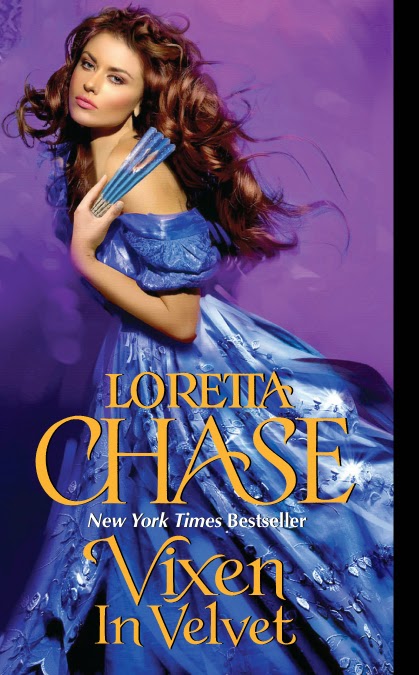
Vixen in Velvet—the story, the research, & other things

Friday, June 27, 2014
Dressmaker Book #3
Loretta reports:

Here on the blog we focus on the bits of history we encounter while doing research for our books—or just researching for fun.  Now and again we talk about the ways we connect our investigations to our main jobs of writing novels.  With the launch of Vixen in Velvet, I’ve had several opportunities to talk about the way I integrate my historical research (especially fashion) into my stories, as well as other topics.

Today I offer the lineup of Vixen in Velvet-related activities.  They include a short video, which is your Casual Friday Video.  Sorry.  It's me.   

Coming in late with another one, from the Kindle blog:  my Q& A with talented Avon author Sarah MacLean.

Lady Avon Interviews Loretta about Vixen in Velvet.  Even my publisher has questions.

Avon Loves Librarians—a video excerpt from the tea Avon hosted for Sarah MacLean and me during Book Expo America. 


My blog post for Heroes & Heartbreakers (their title because I forgot!—and yes, “flare” should probably be“flair” but it still works if you imagine fireworks.)

Isabella interrogates me here, in case you missed it.

Romance Unlaced: Interview with Loretta Chase—Madeline Hunter interrogates me at Happy Ever After.

My wonderfully nerdy interview at All About Romance.

Interviews at Writer at Play, Part 1 and Part 2.


And if you're not sick of me talking about me & my writing, or if you still have unanswered questions, please ask—or join me here next week for more about the things I've learned about the 1830s and what I do with them.


Thursday, June 5, 2014

Paying Charles Dickens

Thursday, June 5, 2014
Dickens in his study at Gad's Hill
Loretta reports:

A commenter on one of my recent posts wrote:  “Paid by the word, that was done in my youth when I wrote a newspaper column. Are you saying that it wasn't done in Dickens' time, or that it was not done with Dickens?”

The idea of Dickens being paid by the word may be based on misunderstandings about his career as well as the 21st century view of his prose style.

Dickens started out as a freelance reporter, and these men were penny-a-liners, often viewed as hacks.  He was soon hired, though, for a regular salary.

His fiction followed a different route.  For his first few published fictional pieces—which eventually became part of Sketches by Boz—his only pay was the delight of seeing his work in print.  But not long thereafter he was paid an extra two guineas a week for these sketches.

He received one hundred pounds for the copyright to the Sketches by Boz printed to that point, then £100 for the second edition, then £150 “for a new volume of previously uncollected sketches.”  For The Pickwick Papers, he was to provide 1-1/2 sheets (16 pages of finished product) per month at 9 guineas per sheet.  The rates soon went up.

By the 1840s, he received an advance of £1800 for American Notes. In 1863,  “he proposed that [his publishers] pay him £6000 for the half copyright throughout and outright" for Our Mutual Friend

As to his verbosity: We 21st C authors are expected step briskly into the story, and to keep digressions and subplots to a bare minimum.  Not at all the case in his time.  Readers had longer attention spans; they wanted big stories and lots of detail.  But he told big stories and conveyed detail in a lively way, and his style seemed fresh and vibrant and modern to his readers.  His early newspaper pieces sometimes make fun of the over-ornate style of the time—and it’s a joke he uses again and again in his fiction, especially in portraying hypocrites, humbugs, and windbags.


While there seem to be an infinite number of Dickens biographies, I relied for the above information on two I had close at hand, Fred Kaplan’s Dickens: A Biography, and Peter Akroyd’s Dickens.

Image courtesy Library of Congress Prints and Photographs Division Washington, D.C. 20540 USA.  Clicking on the caption will take you to the information page there.

Monday, April 28, 2014

Miseries of Life: Writing

Monday, April 28, 2014
View at source here

Loretta reports:

My post title refers not my personal writing miseries, but those of the perennial sufferers Timothy Testy and Samuel Sensitive, in James Beresford's extremely popular The Miseries of Human Life.  I've excerpted from this book before* and will again, because it shows how human miseries have and haven't changed since the early 19th century. The perils of writing, for instance.  Mending pens is a skill few of us can boast. These days, our trials and tribulations tend to be keyboard and touchscreen related.  Even when we do take up pencil or pen, our frustrations are not the same.  And yet I can relate to the caricature of the bad pens.  I'm still looking for The Perfect Pen.

In the meantime, we can decide whether we do or do not prefer the writing miseries of Jane Austen's time.

View at source here

The Miseries of Human Life; or The Groans of Timothy Testy, and Samuel Sensitive [by J. Beresford].  James Beresford 1806.  Courtesy Internet Archive.

* Here, here, here, and here.


Thursday, August 15, 2013

Another Brief Hiatus, or, Gone Workin'

Thursday, August 15, 2013
Gypsy Rose Lee
Loretta & Isabella report:

For some stupid reason, we Two Nerdy History Girls are still working for a living, rather than living the life of leisure in Pick-Your-Expensive-Luxurious-Leisure-Location.

Gypsy Rose Lee makes writing look glamorous.  Pretend we’re glamorous, too, as we polish our beautiful prose and deliver our manuscripts right on time.

Or take a look at the other photograph, where Ms. Miller's facial expression, if not her attire, approaches nearer the reality.

In other words, we’re writing and researching madly, and thus need, once again, to take some time off from blogging.  Look for fresh posts about old stuff toward the end of the month.

Flora Payne Whitney Miller

Photos courtesy Library of Congress Prints and Photographs Division Washington, D.C. 20540 USA.  Clicking on captions will take you to their LOC information page.

Thursday, May 30, 2013

As Used by Jane Austen: Pins, the Regency Post-It

Thursday, May 30, 2013

Isabella reporting,

I've written before about the importance of pins in everyday 18th c. life. Straight pins were widely used to fasten all kinds of clothing, from women's bodices to infant's diapers, and also used in hand sewing. Pins were considered so indispensable that when Abigail Adams wrote from colonial Massachusetts to her husband John Adams in London in 1775, the one thing she requested was for him to "purchase me a bundle of pins and put in your trunk for me." (Read the rest of the letter here.)

Pins for clothing and sewing, yes. But I hadn't realized that pins were also an essential tool for 18th c. writers. Thanks to (or cursed by, depending on your point of view) computers, most modern writers submit manuscripts electronically. Rewrites and copy edits are all conducted now through the magic of track changes and transmissions. Gone are the days of hauling manuscript boxes to the post office, not to mention pages that bristled with pink "flags", the comments and queries pasted to the edges of pages by editors. I've gotten to the point where the only words on paper I see in the entire process are in the finished book – and the way things are going, that may soon vanish, too.

But what did writers do in the days before paper clips and Post-Its? How did an early novelist who was already struggling to make sense of a handwritten manuscript mark revisions and additions? According to the librarians of Oxford's Bodleian Library, the answer is pins – and lots of them. All those notes and insertions and extra copy were handwritten on scraps of paper and pinned in the margin with a straight pin. The pins, above, were all plucked from the library's holdings, and date from 1692 to 1853.

In 2011, the Bodleian acquired a true Jane Austen rarity: the manuscript draft of her abandoned novel, The Watsons. (See here for more about the auction and the staggering realized price, as well as a page of the manuscript itself.) In addition to the clues to cross-outs and rewrites on the draft provide, there were also a wealth of pinned-on additions. For purposes of preserving the manuscript, these pins were carefully removed with their notes, studied, catalogued, and saved – a librarian's scholarly labor of love.

But as a fellow-writer, I like to imagine Jane at work at her small writing table. I wonder: did she use the same pins she used for her clothing, or did she have another stash of pins reserved for writing? Did she keep a pin cushion on the table with a stack of scrap-paper sheets beside her inkwell, prepared and ready to make changes? Or did she tuck them into her sleeve like a hurried seamstress might, keeping them literally at hand when she needed them?

Here is the link to the original article about literary pinning by Christopher Fletcher, Keeper of Special Collections at the Bodleian Library. Thanks to Deb Barnum for first sharing this story with us. 

Above: Manuscript pins, c. 1690-1850. Bodleian Library.
 
Two Nerdy History Girls. Design by Pocket