Showing posts with label men behaving badly. Show all posts

Monday, October 22, 2018

The Lunatic Asylum Nightmare

Monday, October 22, 2018
Goya, Courtyard with Lunatics
Loretta reports:

The nightmare theme of a sane person being locked up in a lunatic asylum appears in fiction again and again. This is because it touched a chord. For all too many, especially women, this was a grim reality.

My Experiences in a Lunatic Asylum, which I came upon via the Public Domain Review, describes in disturbing detail a man’s experience in the Victorian era. For a woman’s point of view, you might want to look at Nellie Bly’s Ten Days in a Mad-House.

In the fictional world, the theme is prominent in Wilkie Collins’s The Woman in White.
"I suppose that we most of us...quietly comforted ourselves with the reflection that 'in the nineteenth century' (an expression which is used as a sort of talisman, apparently, like the 'Briton' of Palmerston's day) such things are impossible.  It requires a personal experience of their amenities, such as fell to my lot, seriously to believe that the adventures of a novel may be transferred to the pages of an 'article," and be as strange--and true. Villainous conspiracies, for personal motive, to set the lunacy law in motion, are rare enough, I do not doubt. But the law favours them. What is not rare, I doubt even less, is the imprisonment in these fearful places of people who are perfectly sane, but suffering from some temporary disorder of the brain, the most delicate and intricate part of all the mechanism, and the least understood; and if asylums are a sad necessity for the really mad,—and even that I cannot help doubting; for from what I have seen I believe that they require a much more loving and more direction personal supervision than they can get, poor people,--for the nervous sufferers who are not mad they are terrible."—My experiences in a Lunatic Asylum, by a Sane Patient (1879)
Experiences in a Lunatic Asylum


Clicking on the image will enlarge it.  Clicking on a caption link will take you to the source, where you can learn more and enlarge images as needed. And, just so you know, if you order a book through one of my posts, I might get a small share of the sale.

Friday, October 5, 2018

Friday Video: Self-Defense for Women

Friday, October 5, 2018
Loretta reports:

In the course of researching some 19th century self-defense materials, I learned that, even before Victorian times, women could learn self-defense techniques. It wasn’t easy, and it wasn’t exactly respectable, but it could be done. However, by the Edwardian era, women are beginning to get formal instruction in martial arts, like ju jitsu (you can learn a great deal more about this at the Bartitsu Society website).

 Some women, trained in these arts, provided protection for suffragists.

This film is a bit later—1933—but the moves employ the same principles.


Self-Defence Tutorial from 1933 | British Pathé

Image is a still from the video.

Readers who receive our blog via email might see a rectangle, square, or nothing where the video ought to be. To watch the video, please click on the title to this post (which will take you to our blog) or the video title (which will take you to YouTube).

Thursday, August 16, 2018

Votes for Women: The 19th Amendment

Thursday, August 16, 2018
The Awakening 1915
 Loretta reports:

In a few days, we mark a milestone in women’s rights.  On 18 August 1920, the state of Tennessee ratified the Nineteenth Amendment to the U.S. constitution, providing the three-quarters majority needed for adoption.

Here’s what it says:
  
"The right of citizens of the United States to vote shall not be denied or abridged by the United States or by any State on account of sex.
 "Congress shall have power to enforce this article by appropriate legislation."
It Doesn't Unsex Her
Senator Aaron A. Sargent of California, whose wife, Ellen Clark Sargent, was a suffragist, first introduced the amendment to Congress in 1878. Yes, it took only forty-two years. And the women’s fight for the right to vote had begun decades earlier. But long, long fights have been the case with a great many other milestones in legislation, like abolishing slavery.

We all know the suffragists were ridiculed and abused all the way to the ballot box, but you might want to look at samples of what some people found hilarious, here (let's also ridicule women's fashion while we're at it), here, here, here, here, and here. Note that suffragists are always unattractive, sometimes monstrous. Elderly spinsters appear frequently. Wearing eyeglasses.

Yet a few years later we find images mocking the anti-suffrage side, here, here, here, here, here, and this powerful (and surprising, given the date) image of native American women.

You'll notice that Puck, which had published some of the more infuriating images in this collection, either couldn't make up its mind or finally changed its tune.

I Did Not Raise My Girl To Be a Voter
Images: Hy Mayer, The Awakening, 20 February 1915, courtesy Library of Congress Prints and Photographs Division Washington, D.C. 20540 USA; Milhouse, Katherine, It Doesn't Unsex Her, 1915, via Wikipedia;  "I did not raise my girl to be a voter." Soprano solo with vociferous supporting chorus of male voices, 1915, courtesy Library of Congress Prints and Photographs Division Washington, D.C. 20540 USA .
Clicking on the image will enlarge it.  Clicking on the caption will take you to the source, where you can learn more and enlarge images as needed.

Tuesday, May 15, 2018

Boswell's London Romps & Repentance

Tuesday, May 15, 2018
James Boswell 1765 by George Willison
Loretta reports:

James Boswell, famed for his biography of Samuel Johnson, was a piece of work. I’ve posted from his London Journals before.  Please read and form your own conclusions.

Here's another bit from Boswell’s London Journal 1762-1763, (my Yale University  first edition of 1950). I love that he skipped the countess’s party because his hair wasn’t just right, but it didn’t stop him from heading for the streets, and “fresh, young” girls.
TUESDAY 17 MAY [1763]
I should have been at Lady Northumberland’s rout tonight, but my barber fell sick; so I sallied to the streets, and just at the bottom of our own, I picked up a fresh, agreeable young girl called Alice Gibbs. We went down a lane to a snug place, and I took out my armour,* but she begged that I might not put it on, as the sport was much pleasanter without it, and as she was quite safe. I was so rash as to trust her, and had a very agreeable congress.

WEDNESDAY 18 MAY [1763]
Much concern was I in from the apprehension of being again reduced to misery**, and in so silly a way too ...

THURSDAY 19 MAY [1763]
 ... I then sallied forth to the Piazzas in rich flow of animal spirits and burning with fierce desire. I met two very pretty little girls who asked me to take them with me. “My dear girls,” said I, “I am a poor fellow. I can give you no money. But if you choose to have a glass of wine and my company and let us be gay and obliging to each other without money, I am your man.” They agreed with great good humor. So back to the Shakespeare I went. “Waiter,” said I, “I have got here a couple of human beings; I don’t know how they’ll do.” “I’ll look, your Honour,” cried he, and with inimitable effrontery stared them in the face and then cried, “They’ll do very well.” “What,” said I, “are they good fellow-creatures? Bring them up, then.” We were shown into a good room and had a bottle of sherry before us in a minute. I surveyed my seraglio and found them both good subjects for amorous play. I toyed with them and drank about and sung Youth’s the Season, and thought myself Captain Macheath,[9] and then I solaced my existence with them, one after the other, according to their seniority. I was quite raised, as the phrase is: thought I was in a London tavern, the Shakespeare’s Head, enjoying high debauchery after my sober winter.[1] I parted with my ladies politely and came home in a glow of spirits.
A Sketch from Nature (Carey, after Rowlandson) 1784
FRIDAY 3 JUNE [1763]
…I am always resolving to study propriety of conduct. But I never persist with any steadiness. I hope, however, to attain it. I shall perhaps go abroad a year or two, which may confirm me in proper habits. In the mean time let me strive to do my best.
[9] “Youth’s the season made for joys” is a song and chorus in The Beggar’s Opera. Macheath is in a tavern near Newgate, surrounded by ladies of the town.

[1] "High debauchery” is debauchery with genteel ceremonial; “low debauchery” is debauchery without.

*armour = condom
**another bout of venereal disease

Images: George Willison, James Boswell, 1765, painting in the National Galleries Scotland. William Paulet Carey, after Thomas Rowlandson, A Sketch from Nature, 1784, Metropolitan Museum of Art.
Clicking on the image will enlarge it.  Clicking on the caption will take you to the source, where you can learn more and enlarge images as needed.


Thursday, March 15, 2018

Regency Satire: The Triumph of the Whale

Thursday, March 15, 2018
Cruikshank, The Prince of Whales 1812
Loretta reports:

On this date in 1812 the Examiner published Charles Lamb’s poem “The Triumph of the Whale,” which inspired this George Cruikshank satirical print of 1 May 1812. The image appeared in Cruikshank's satirical magazine, The Scourge.
 
The caricature and poem about the then Prince Regent (later King George IV) remind us all that mocking the great and powerful, in picture and print (and these days, in internet memes), is nothing new. Given the libel and sedition laws of the time, it’s amazing what Regency satirists got away with. And let’s not forget one of the Privileges of Peers I reported on a while back:
“3. To secure the honour of, and prevent the spreading of any scandal upon peers, or any great officer of the realm, by reports, there is an express law, called scandalum magnatum, by which any man convicted of making a scandalous report against a peer of the realm (though true) is condemned to an arbitrary fine, and to remain in custody till the same be paid.”

Scandalum magnatum notwithstanding, the faces in this caricature would have been familiar to the audience of the time, and everybody would understand the political implications. We, however, need a translation, which the Brighton Museums website provides succinctly:

“Portrayed as a whale in a ‘Sea of Politics’ George spouts the ‘Liquor of Oblivion’ on playwright and Whig supporter Richard Sheridan, and blows the ‘Dew of favour’ on Spencer Perceval the Tory Prime Minister. The prince ignores his former lover, Mrs Fitzherbert, and looks lovingly at his mistress Lady Hertford, who is shown next to her cuckold husband.”
The figures on the right—the Tories—viewed as the fat cats of the time, expect to profit further by the Regent’s decision to shun his Whig associates. The Marquess of Hertford is wearing cuckold horns. You can read a much more detailed description at the British Museum website (please click on "More" for the full description and check out the curator's comments as well). Clearly, this is pretty strong stuff, though not as strong, I think, as Lamb’s poem.

 
The 1812 blog offers a concise summary of Charles Lamb’s life and the poem. Most of the references are clear enough, although I haven't yet figured out why the muse Lamb summons is Io, one of Zeus’s many loves, who was transformed into a white heifer.

Update: As I hoped, a reader provided the following clarification—
"It's a song. 'Io' is an exclamation you find in Latin songs, and probably in Roman life as well, but spoken words don't survive. It means something like 'Hurray' or even 'Yay'.
In my country a Latin student song still survives. Its first line is 'Io vivat' which translates to 'Hurray, long live'. It dates to the days when all subjects at the universities were taught in Latin."

These pages are from The Poetical Works of Bowles, Lamb, and Hartley Coleridge Selected 1887

Image: George Cruikshank, The Prince of Whales, from the Scourge of 1 May 1812.
Clicking on the image will enlarge it.  Clicking on the caption will take you to the source, where you can learn more and enlarge images as needed.

Monday, February 26, 2018

A Duke's Household

Monday, February 26, 2018
Morris, Woburn Abbey 1866
Loretta reports:

In A Duke in Shining Armor, my heroine says, “It’s good to be a duke.”

Though dukes, by and large, are nothing like as numerous or as attractive as we paint them in romance novels (as I describe at RT Book Reviews), and any number have fallen on hard times in the past and present, things were not so bad for the 11th Duke of Bedford.

Reading Lucy Lethbridge’s Servants: A Downstairs History of Britain from the Nineteenth Century to Modern Times, I came upon this:

“At Woburn Abbey, the eleventh Duke of Bedford maintained until his death in 1940 not only a household of at least sixty indoor servants to attend solely to his wife and himself, but two separate, fully staffed residences in Belgrave Square, including four cars and eight chauffeurs; the Woburn parlourmaids were all Amazonian at over five foot ten, as had always been the Bedfords’ stipulation.”

According to the 13th Duke, (who sounds like a pip, and whose books I intend to read):
“‘Guests never travelled with your suitcase, that was not considered the thing to do. It had to come in another car, so you had a chauffeur and a footman with yourself, and a chauffeur and a footman with the suitcase, with another four to meet you. Eight people involved in moving one person from London to Woburn.’”
11th Duke of Bedford in Coronation Robes
While other noble families changed or economized as the times demanded, the Bedfords continued in the lavish late Victorian/Edwardian style until 1940. “The [11th] Duke always started meals with his own cup of beef consommé and a plate of raw vegetables served to him on a three-tiered dumb-waiter. The Duchess’s secretary-companion had her own quarters that included a cook and a maid.” The duke’s mistress had her own rooms with her own staff—on the premises, I assume?

Apparently, the 11th Duke of Bedford is also responsible for the grey squirrel invasion of England.

Images: Woburn Abbey, from Francis Orpen Morris, The County Seats of the Noblemen and Gentlemen of Great Britain and Ireland 1866; 11th Duke of  Beford in Coronation Robes, Photo credit: Middlesex Guildhall Art Collection.

Clicking on the image will enlarge it.  Clicking on the caption will take you to the source, where you can learn more and enlarge images as needed.

Monday, January 29, 2018

The Green Man Inn, Putney Heath

Monday, January 29, 2018

Loretta reports,

The Green Man Inn at the northern end of Putney Heath features in a crucial scene of A Duke in Shining Armor. Like many of the places I use in my books, it did exist. Like not quite so many, it still exists, and so of course I was thrilled to actually pay a visit there during my stay in London last summer.

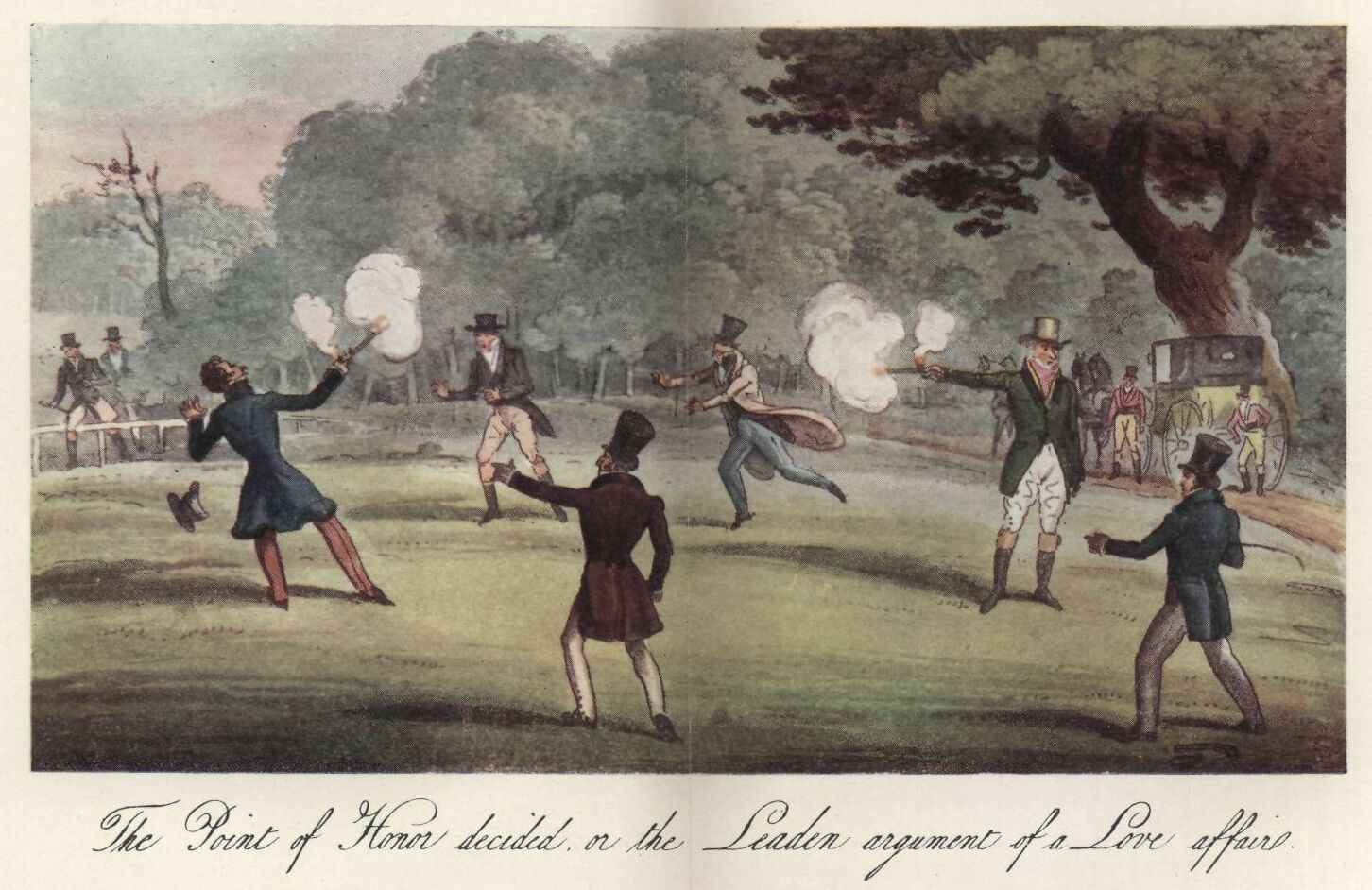
Many of the old travel books online emphasize the inn’s importance as a resort of highwaymen. However, I’ve focused on its use as a place for bolstering one’s courage before a duel and—for the survivors, a place to calm the nerves with a brandy and soda (as is recommended by my favorite book on dueling, The Art of Dueling).

Duels took place nearby in Putney Heath at dawn or (less usually) dusk. Duelists chose out-of-the way places, like Putney Heath or Battersea Fields because they were reasonably close to London, yet far enough away to reduce chances of the authorities blundering in and spoiling the fun of men trying to kill each other. Duels, though they remained a popular way for gentlemen to settle disputes, were against the law.

Doubtless the landscape has changed over the last century and a half—fewer trees then, for instance, in many places than there are today. Still, given the heath’s reputation as a favorite spot for highwaymen, I suspected it was as easy to find a suitable place, not far from the road yet not visible from it, as it was during our visit. A short walk took us to what looked like an ideal spot: A good sized clearing where the ground was level, offering both combatants a clear sight. Yet the road wasn’t far away, and it was easy to imagine the carriages standing by, ready to take the duelists, alive, wounded, or dead, away.

Images:
The Green Man photograph © 2018 Walter M. Henritze
Green Man, Putney from Charles G. Harper's The Old Inns of Old England : a picturesque account of the ancient and storied hostelries of our own country 1906
Cruikshank, The Point of Honor decided, or the Leaden argument of a Love affaire, from The English Spy, 1825

Please click on images to enlarge.

Thursday, June 8, 2017

Baron Charles de Berenger's Gun

Thursday, June 8, 2017
Loretta reports from London:

Don't know about you, but when I venture into a library's archives, I'm not expecting firearms. OK, so there weren't a lot in immediate sight, but I'll tell you there was more than one.

The place: The Kensington Central Library. My host: archivist/librarian Dave Walker, of The Library Time Machine blog, one of our favorite blogs. My firearm: a musket once the property of the Baron Charles de Berenger. His name was engraved in brass near the firing mechanism.

Thanks to Mr. Walker, I have discovered a most colorful character from the 1830s, the era in which I set my books.  You can read a bit about the baron here.  Among other activities--like a fraud or two-- he wrote an early book on self-defense, titled Helps and Hints: How to Protect Life and Property, which you can read here.

I'll be reporting more on my visit to the Kensington Central Library in coming days. I'm still reeling from the wealth of material in the archives--and I haven't even got to my own research yet!

Tuesday, May 16, 2017

Loretta's New Book: A Duke in Shining Armor

Tuesday, May 16, 2017
Loretta reports:

When I wasn’t looking, my publisher put up the cover to my new book on the various online bookstore sites. Fortunately, some of my readers were looking, and alerted me. Since I hadn't expected this to happen quite so soon for a book coming out at the very end of November, a mad scramble resulted to get my website updated. Yes, readers can get the basic information at the online bookstores, but I like to provide a little something extra for those who visit my website.

That’s now done, and I can officially invite you to a preview of my newest book, A Duke in Shining Armor. The little something extra is an excerpt.

Set during the 1833 London Season, A Duke in Shining Armor kicks off a new series, titled Difficult Dukes.

Readers like dukes. This is why we historical romance writers have created so many. Hundreds. The reality is, there were twenty-one, if I have counted correctly. At any rate, it’s in that vicinity. A limited number, because being a duke is a very big deal.

My dukes are a big deal, but not necessarily in a good way. The excerpt will offer some clues. I hope you enjoy it.

Clicking on the image will enlarge it.

Thursday, May 11, 2017

Wills and Married Women in the 1800s

Thursday, May 11, 2017
Loretta reports:

Certain of my early 1800s characters—the heroines, usually—will refer in some way to their lack of legal power. Yes, we know they couldn’t vote. But it’s hard for us to grasp just how little control they had over their lives. This excerpt from Tomlins’s Law Dictionary, 1835 edition, dealing with wills, is only one of many I could present. A glance at Caroline Norton’s situation offers several examples of the difficulties women faced.

Even Queen Victoria believed she ought to submit to her husband’s will…to a point. (For an eye-opening, beautifully written exploration of that marriage, I recommend Gillian Gill’s We Two: Victoria and Albert: Rulers, Partners, Rivals).

Married women & wills


Image: Rowlandson, “The Wedding,” from The English Dance of Death 1815

Clicking on the image will enlarge it.  Clicking on the caption will take you to the source, where you can learn more and enlarge images as needed.

Tuesday, March 28, 2017

Feasts and Feats of Drinking

Tuesday, March 28, 2017
Midnight Modern Conversation ca 1732
Loretta reports:

Though Easter Tuesday comes rather later this year, I’m working with Hone’s date, since it seems equally applicable to all feast-days. I think, too, this offers a good example of phrases that sound modern, but actually have been around for a long time. Unlike so many other expressions, “hair of the dog” is as familiar to us as it was to Hone’s readers in 1826.  The OED traces it to the 16th century.

As to the “feats of potation”—given the level of drinking in Hone's time, one can only imagine what his ancestors might have consumed, to impress him so deeply.
Easter Tuesday

Image:
Unknown artist after William Hogarth, A Midnight Modern Conversation ca. 1732courtesy Yale Center for British Art, Paul Mellon Collection Accession No. B1981.25.351

Clicking on the image will enlarge it.  Clicking on the caption will take you to the source, where you can learn more and enlarge images as needed.

Tuesday, May 31, 2016

Politicians Take It Easy in 1835

Tuesday, May 31, 2016
Taking It Easy
 Loretta reports:

Figaro in London was one of several 19th-century publications featuring satire and caricature. Among the  famous names in this business were George Cruikshank (whose caricatures have often adorned our blog posts), William Hone, and Leigh Hunt.

Since we’re unfamiliar with the individuals and issues being mocked, with varying degrees of savagery, much of the satire can be impenetrable to us.

In this case, though, I think readers will have no problem relating to Figaro’s satire about legislators—fair or unfair—who seem to have mastered the art of, as Charles Dickens put it, How Not To Do It (please scroll down to Chapter X).
Lord Melbourne


Lord Russell


Images: Head shot of Lord Melbourne from Wikipedia (detail from copy of larger portrait by John Partridge at National Portrait Gallery).

Head shot of Lord Russell via Wikipedia (detail from larger portrait by Lowes Cato Dickinson at National Portrait Gallery).

If you look  up these gentlemen at the National Portrait Gallery, you’ll find numerous paintings and sketches, including somewhat younger versions of themselves, closer to the time of the Figaro piece.

Satiric image, "Taking It Easy ," from Figaro in London.

Clicking on the image will enlarge it.  Clicking on the caption will allow you to read at the source, where you can learn more and enlarge images as needed.


Thursday, May 26, 2016

Wanstead House, Its Heiress, & Her Unfortunate Choice in Men

Thursday, May 26, 2016
Richard Westall, Wanstead House
Loretta reports:

The clipping from the Annual Register sent me off in 2NHG search of more, as you’d expect, and boy, did I find a story, straight out of melodrama: Young Heiress Ruined By Fortune-Hunting Scoundrel.

A site devoted to Wanstead House tells the story here.

Annual Register May 1823
Further searching led me back to a beautifully illustrated site for Wicked William Pole-Tylney, which Isabella had very recently called to my attention for an altogether different nerdy historical reason (a lovely post on coaching inns). And which included an advertisement for the auction of the house’s contents the previous year.

Geraldine Roberts, who’s written a book about Catherine Tylney Long, The Angel and the Cadoutlines the heiress's story on her website, with many fine images, including the (rare) one of Catherine below.

William Pole-Tylney
Catherine Tylney Long
Image at top: Richard Westall, Wanstead House, undated (I’d guess about 1790s), courtesy Yale Center for British Art.

Clicking on the image will enlarge it.  Clicking on the caption will take you to the source, where you can learn more and enlarge images as needed.

Sunday, May 1, 2016

From the Archives: Men (and Women) Behaving Badly: May Poles

Sunday, May 1, 2016
Isabella reporting:

We've just begun the merry month of May Day and May poles. While most of us today think of May poles with school children clutching the ribbons, that sweetly pretty version is a Victorian invention. Earlier May poles were much less innocent, with pagan antecedents so distant that no one knows exactly when the first was, ahem, erected.

But there's no mistaking their symbolism: a phallic pole firmly planted in Mother Earth, part of the annual celebration of fertility, procreation, and returning spring. Most May Rites were in that spirit, too, with much drinking and bawdy carousing. Puritanical Christians were appalled, as this description from Anatomy of Abuses (1583) by conservative pamphleteer Philip Stubbs (c.1555-1610) attests:

"All the young men and maids, old men and wives, run gadding over night to the woods, grove, hills, and mountains, where they spend all the night in pleasant pastimes; and in the morning they return, bringing with them...their May pole, which they bring home with great veneration, as thus: they have twenty or forty yoke of oxen, every ox having a sweet nose-gay of flowers placed on the tip of his horns, and these oxen draw home this May pole (this stinking idol, rather) which is covered allover with flowers and herbs, bound round with strings, from the top to the bottom, and sometimes painted with variable colours, with three hundred men, women, and children following with great devotion. And thus being reared up...they fall to dance about it, like as the heathen people did at the dedication of the Idols....I have heard it credibly reported (viva voce)...that of forty, three-score, or a hundred maids going to the wood over night, there have scarcely the third part of them returned home again undefiled. These be the fruits with which these cursed pastimes bring forth."

Could there be any coincidence that May with its May pole and night-long "gadding" is soon followed by June, the traditional month of weddings? 

Above: The May-pole Dance, c. 1620. While there are many written descriptions of 17th c. May poles, both in their favor and against them, this demure illustration is the only contemporary one that I could find. Perhaps all the artists were too busy running into the woods?

Tuesday, April 19, 2016

At a Police Office, 1828

Tuesday, April 19, 2016
Tom Getting the Best of a Charley
Loretta reports:

A gentleman, summoned by a friend who got caught in a police raid on a gambling establishment, recounts his first experience there. I’ve excerpted only the account of the “young sparks” who decided to copy one famous scene from Life in London and ended up experiencing another—a visit to Bow Street.

LIFE AT A POLICE OFFICE.
I was awakened a short time back by a note being delivered to me from a young friend of mine, telling me that he was in trouble—i.e., in St. Martin's watch-house—and requesting me to come down to Bow-street to be his bail, if need were; and, at all events, to give him my advice and assistance to get out of the scrape.  ...
This was the first time I had ever been at Bow-street, and the scene was sufficiently striking. The low ill-lighted room, with its dingy walls and barred windows, was a place well adapted to the figures of want, vice, and wretchedness with which it was filled.  ...
After [a young forger] were brought up three young sparks for a street row. They had been enacting the parts of Tom, Jerry, and Logic, and the scene had ended, as usual, in the watchhouse. One of them exhibited the marks of the prowess of the "Charlies" in a eye portentously swollen and blackened. The two others seemed to have undergone complete immersion in the kennel; the mud of which, being now dried on their clothes, gave their evening finery a most dilapidated aspect. It appeared that these young men had been vastly taken with the refined humour, brilliant wit, and gentlemanly knowledge of the world in the production called " Life in London;" and that they had determined to emulate the deeds of its triumvirate of worthies as soon as opportunity served. In pursuance of this exalted ambition, they had sallied forth the night before with the determination of having " a spree." Accordingly, in the Strand, they had overtaken a watchman, a feeble old man, who was instantly, in the most manly manner, floored by a broad-shouldered young fellow of six feet high. The prostrate Charley, however, incontinently sprang his rattle, which brought to his assistance a sufficient number of his brethren to lodge, after a desperate resistance, the Corinthian and his friends in the watch-house. And here it appeared that their-behaviour was by no means peaceable and resigned; indeed, the constable averred, that be was finally necessitated to consign them to the strong room for safety.
Tom & Jerry In Trouble After a Spree

"At length the morn and cool reflection came,"
and found our heroes " fully sated" with their manly and gentlemanly exploit, and still more so with its consequences. These, however, terminated only at Bow-street; for, besides large pecuniary remuneration to make to the persons whom they had assaulted, they underwent a most severe and well-deserved rebuke from the magistrate for their folly, brutality, and blackguardism.—Gentleman’s Pocket Magazine 1828


Tuesday, March 8, 2016

An 1828 Guide to London Pitfalls & Scams

Tuesday, March 8, 2016
Doctor Syntax Overboard
Loretta reports:

In my Endnotes to Dukes Prefer Blondes, I quote from John Bee’s A Living Picture of London, 1828, which is well worth exploring.

To begin with, there’s the full title:
A LIVING PICTURE OF LONDON FOR 1828 
AND
STRANGER’S GUIDE
THROUGH THE STREETS OF THE METROPOLIS;
SHEWING THE FRAUDS, THE ARTS, THE SNARES AND WILES OF ALL 
DESCRIPTIONS OF ROGUES, THAT EVERY
WHERE ABOUND; 
WITH
SUITABLE ADMONITIONS, PRECAUTIONS, AND ADVICE HOW TO 
AVOID OR DEFEAT THEIR ATTEMPTS; 
Interspersed with 
SKETCHES OF COCKNEY MANNERS, LIFE, SOCIETY,
AND CUSTOMS;
And supported throughout by numerous
CASES, ANECDOTES, AND PERSONAL ADVENTURES. 
By JON BEE, Esq.
AUTHOR OF A DICTIONARY OF THE VARIETIES OF LIFE, &c. 
~
To which is appended, the Author's former 
“HINTS FOR THE IMPROVEMENT OF THE POLICE;”
WITH FURTHER SUGGESTIONS, FACTS, AND REMEDIES.

The short excerpt below, from the chapter about what to expect when you get off the boat, is a fine example. You can find the “regulated fares of watermen” here.

Out-door Delinquencies


Jon Bee, A Living Picture of London, for 1828, and Stranger's Guide.

Image, possibly by Robert Cruikshank, from Doctor Syntax Through London, “Doctor Syntax Shoots London Bridge & Pops Overboard.

Clicking on the image will enlarge it.  Clicking on the caption will take you to the source, where you can learn more and enlarge images as needed.

Thursday, November 19, 2015

Highway Robbery in Kent, 1811

Thursday, November 19, 2015
Dr Syntax Stopt by Highwaymen
Loretta reports:

The way this is written, the robbery seems to have been a relatively civilized encounter. The robber, for instance, did not shoot his victim upon learning he had an undesirable watch and insufficient money. And nobody bothered Mrs. Atkins.
~~~
 Kent
     As Mr. and Mrs. Atkins, of Maidstone, were returning from London, on Thursday, Nov. 14, in their single horse chaise, just as they had reached the 15th mile-stone, corner of Birch Wood, about half past one o’clock in the afternoon, a man came out of a gap-way on the left-hand side of the road from London, and without saying a word, seized the horse by the head. Mr. Atkins immediately stood up in the chaise, and said he would not be robbed, and began to flog the man with his chaise-whip, in hopes of making him let go his horse’s head, upon which he drew his right hand from behind him and presented a horse-pistol. At that instant a companion of his (whom Mr. Atkins had not seen before) made his appearance, and going round the horse to Mr. Atkins’s side, demanded his money. Mr. A. finding his resistance useless, gave him four guineas; not satisfied with that, the robber said you have more. Mr. A. replied, yes, I have a little silver, and gave him to the amount of 10 s. The robber afterwards demanded his watch, which being in a tortoise-shell case, said he would be d—d if he would have, and repeatedly questioned him as to his having more money; but on Mr. A. assuring him he had not, he was suffered to proceed. The man who seized the horse never spoke a word all the time, but held the horse with his left hand and the pistol with his right; the other, who took the money, said, it was distress drove them to it. Neither of them attempted to rob Mrs. Atkins, nor did they say any thing to her. —La Belle Assemblée, Volume 2

Image: Thomas Rowlandson, "Dr. Syntax Stopt by Highwaymen," from The Tour of Dr. Syntax in Search of the Picturesque.

Clicking on the image will enlarge it.  Clicking on the caption will take you to the source, where you can learn more and enlarge images as needed.

Friday, October 16, 2015

Friday Video: Top 10 Duels in History

Friday, October 16, 2015
Cruikshank, Duel
Loretta reports:

In Gentlemen’s Blood, author Barbara Holland says,

“There was much to like about the duel. It was a regulated way for one man to prevail over another when he felt the need to do so, and an improvement over the informal ambush, or sending out henchmen to break the enemy’s skull by night on the highway.”

In Samuel Johnson’s opinion dueling was “more justifiable than war in which thousands go forth without any personal quarrel.”

Our readers will hold varying opinions on the subject. Please feel free to explore the topic in the comments—that, or duels you’d have put in your Top 10 list, or maybe other movies with excellent dueling scenes?


Image: Cruikshank, The Point of Honor decided, or the Leaden argument of a Love affaire, from The English Spy, 1825

For [many] more of our blog posts on the subject, just type in “duel” in the search box.

Readers who receive our blog via email might see a rectangle, square, or nothing where the video ought to be.  To watch the video, please click on the title to this post.

Clicking on the image will enlarge it.  Clicking on the caption will take you to the source, where you can learn more and enlarge images as needed.


Wednesday, July 22, 2015

Rude Songs of the Regency: The Plenipotentiary (from the archives)

Wednesday, July 22, 2015
The Plenipotentiary

Loretta reports:

Thanks to Vic Gatrell’s, City of Laughter: Sex and Satire in Eighteenth-Century London,* I was aware that the Prince of Wales (later the Prince Regent, then King George IV) bought satirical prints in vast quantities.  Every day he got a batch, to keep him in touch with public opinion.

It’s a miracle this collection survived.  Other historical documents did not:  “In a fit of witless vandalism in 1913, George V, his queen and his secretary one evening sat in a parlour at Windsor and systematically burned the contents of thirty-seven boxes of George IV’s love letters . . . on the grounds that George was ‘the meanest and vilest of reprobates’.”  King George V later sold 9,900 of his ancestor’s prints to the Library of Congress—to pay for his stamp collection.

Recently I made another interesting discovery:  Our Prinny’s favorite bard was Captain Charles Morris (1744-1838), to whom he paid a £200 annuity. Morris’s poems and songs were famous, reprinted repeatedly in collections such as The Festival of Anacreon, Containing a Collection of Modern Songs, written for the Anacreontic Society,***the Beef-Steak and Humbug Clubs (8th ed. c. 1810); and many, many others, including a collection the poet Robert Burns published in 1799.

A sample of Morris’s lyric powers: 

THE PLENIPOTENTIARY

The Dey of Algiers, when afraid of his ears,
A messenger sent to the Court, sir,
As he knew in our state the women had weight,
He chose one well hung for the sport, sir.
He searched the Divan till he found out a man,
Whose b******s were heavy and hairy,
And he lately came, o'er from the Barbary shore,
As the great Plenipotentiary.

. . .
When to England he came, with his p***k in a flame,
He shewed it his Hostess on landing,
Who spread its renown thro' all parts of the town,
As a pintle past all understanding.
So much there was said of its snout and its head,
That they called it the great Janissary:
Not a lady could sleep till she got a sly peep
At the great Plenipotentiary.

These are some of the more delicate verses.  You can read one version of the full poem here on page 36, or choose a version from here. Longtime 2NHG readers may recall a similarly bawdy epic by Lord Rochester.

*My quotations are from the Gatrell book.
**See a recent post for an illustration of a society members' meeting.
Illustration: Cruikshank, A Peep at the Plenipo-!!! Courtesy of The Lewis Walpole Library, Yale University.

Clicking on the image will enlarge it.  Clicking on the caption will take you to the source, where you can learn more and enlarge images as needed.

Wednesday, May 27, 2015

Crockford's Club in St. James's Street

Wednesday, May 27, 2015
Hazard Room at Crockford's
Loretta reports:

Crockford’s Club, No. 50 St. James’s Street, was a famous gaming house.* It’s played a role in my Dressmakers series—being practically next door to the fictional shop—as well as others of my books. It appears in many accounts of gaming and 19th century London history.  You can read a history of Crockford and the club here, and an architectural account here. The following explains its popularity.
~~~
There is one thing, and one only, to be said in favour of Mr. Crockford's enterprise, which is, that this establishment did away with the practice of gentlemen playing against each other for large sums. At Crockford's the game was one of Gentlemen versus Players, the players being always Mr. Crockford's officials at the French hazard table, and the sole object of his business was to win the money of his patrons. He had no other sources of profit; his establishment was an exclusive club with a very low subscription, and was open to such gentlemen only as could convince the committee of their eligibility. For their subscription, which was so small that members who did not gamble were accustomed to make a sort of offering of conscience money, by flinging a ten pound note on the play table at the end of the season, the best cookery and the finest wines in London were supplied to them gratis, and they had the companionship of the most fashionable male society of the day. Crockford was wise enough to leave all the social arrangements to a committee of gentlemen who conducted the ballots, elected and rejected whom they chose, and made entry to Crockford's as difficult as to White's or
Crockford's Club
Brooks's. The new club, in fact, at once took a tone similar to that of those aristocratic bodies, whose members were made eligible for election to Crockford's by one of its first rules. In exchange for the princely accommodation of his house, and such fare as was unobtainable at any other club in London for love or money, Crockford asked for nothing in return but that gentlemen should condescend to take a cast at his table at French hazard.
—William Biggs Boulton, The Amusements of Old London (1901)

*The building still stands.

Images: T. J. Rawlins, The Hazard Room at Crockford's, 1837, courtesy Yale Center for British Art, Paul Mellon Collection. T. H. Shepherd, Crockford’s Club, Metropolitan Improvements; or London in the 19th Century 1827, via Internet Archive.

Clicking on the image will enlarge it.  Clicking on the caption will allow you to read at the source, where you can learn more and enlarge images as needed.
 
Two Nerdy History Girls. Design by Pocket