Showing posts with label beauty aids. Show all posts

Tuesday, February 20, 2018

Pre-Victorians Becoming Posture Perfect

Tuesday, February 20, 2018

C.E. Drummond, Scene at Scotsbridge 1830
Loretta reports:
“A horrible instrument was devised which I had to wear while doing my lessons.  It was a steel rod which ran down my spine and was strapped at my waist and over my shoulders—another strap went around my forehead to the rod. I had to hold my book high when reading, and it was almost impossible to write in so uncomfortable a position. However, I probably owe my straight back to those many hours of discomfort.”—Consuelo Vanderbilt Balsan, The Glitter and the Gold
C.E. Drummond, watercolour drawing 1828-1830

This sort of thing fit the late Victorian and Edwardian eras, when everything seems to have become so very strict: divisions between classes, excruciatingly complicated etiquette, and fashion.

But I had not thought about posture devices for the earlier period. After all, Susan and I are well aware that acutely straight posture was the order of the day in the 18th and 19th centuries. Women’s shoulder blades were supposed to come as close as possible to meeting in the back, and dress designs reflected this. The corset and especially the busk were all part of maintaining elegant posture.

Then, thanks to Susan's alerting me to an image, I bought and started reading Susan Lasdun’s Making Victorians: The Drummond Children’s World 1827-1832. It has proved enlightening on a number of counts, not least the posture devices used on girls in the pre-Victorian era.

An especially poignant image, a watercolor by Cecile Elizabeth Drummond (at top), brought the point home forcibly—as it evidently did to the errant child. At her feet lies her backboard, which she’s apparently abandoned. And there is Mama, holding a birch rod—a bundle of twigs with which the little girl will be punished for her misbehavior.
C.E. Drummond, watercolour drawing 1828-1830

Lady Lasdun describes the backboard as a “painful” device, yet I’ve seen images of modern children wearing such backboards, in re-enactments (here, here, and here, for example). If it truly were painful, would the re-enactment have been allowed? And would someone be selling them as "only suitable for use by children."?

No doubt the backboard wasn’t comfortable—in the book are several images of children who’ve discarded their backboards and are anticipating a whipping—but it was probably less painful than the whipping, and certainly more comfortable than the iron monstrosity Consuelo Vanderbilt endured. Frankly, I suspect this sort of thing would have benefited my posture enough to compensate for the unpleasantness…though of course I wouldn’t have thought so at the time!

Images: watercolors by Cecil Elizabeth Drummond, 1828-30 (made); Prints, Drawings & Paintings Collection; Given by Miss Barbara Drummond, © Victoria and Albert Museum, London. 

Clicking on the image will enlarge it.  Clicking on the caption will take you to the source, where you can learn more and enlarge images as needed.

Thursday, December 7, 2017

The French Corset in A Duke in Shining Armor

Thursday, December 7, 2017
Phillipon, L'utile, marchande de corsets
Loretta reports:

Some time ago, Susan sent me the image you see, of a French corset seller with her wares, as an inspiration for the Dressmakers series I was working on. It looked perfect to me: not only the elegant 1830s corsets but the seller: her hair, her facial expression—that flirtatious glance. I kept it in view, especially when I was writing Leonie’s story, Vixen in Velvet, because she was the corset artiste of the trio.

However, I never wrote about the corset itself. At that time, I was focused on the seller, because my dressmakers were businesswomen.

But its moment came, in a flash of inspiration, when I was working on A Duke in Shining Armor, and had to get my heroine, Olympia, out of her wet clothes and into a fresh set of garments, right down to the underwear.

So far as I had been able to ascertain, ladies’ stays were white, as were all of their undergarments. The examples I’ve seen tend not to be especially sexy—except in the sense of being underwear in the 1800s and therefore sexy to the gentlemen—and not colorful. Maybe a little lace or embroidery would adorn, say, one’s chemise and petticoats, and pretty stitching, as in this example from the V&A online collection.

The undergarments I’d seen had all belonged to respectable women, though, including queens and aristocrats. Ordinary women were more likely to wear their clothes until they were not worth preserving.

Corset ca 1825-35
But what about the not-so-respectable women? What about the courtesans and others who had busy love lives? Expected to dress more dashingly and daringly, they might want to purchase less subdued styles, in colors or at least with colorful trim. This image told me that the Paris corset sellers were well able to oblige them.

As to why Olympia ends up in French underwear, or why she’s wet in the first place—it’s all in the book.

While the above image appears in several places, including my Pinterest board for A Duke in Shining Armor, I recommend you click on this link to the FIT blog and scroll down. You can enlarge it to an enormous size!

Images: L’utile, marchande de Corsets, Charles Phillipon 1830, courtesy Les Musêes de la ville de Paris

White corset, ca 1825-35 courtesy Victoria and Albert Museum online collections.

Clicking on the image will enlarge it.  Clicking on the caption will take you to the source, where you can learn more and enlarge images as needed.


Thursday, May 25, 2017

Dressing to Look Slender in 1924

Thursday, May 25, 2017
Loretta reports:

No doubt a great many women can relate to the issue of slenderness, whose definition seems to have shrunk (pound-wise, that is) over the years.

It seemed to me that this must have been an especially sore spot in the 1920s, when the fashion was for a boyish figure, instead of the emphasis  only a decade or so earlier on curvaceousness. I gained some insight when I came upon a 1920s book on the Internet Archive whose introduction details the author's frustrations with weight gain, dieting, and trying to look good in fashionable clothing.

“I left [my doctor’s] office crestfallen and disappointed, thinking that if he only knew how much the heavy woman wants to appear thin enough to wear smart clothes, if he could only know how she actually longs for the lovely things that fashion creates for the slender types, he would be more sympathetic.”

But the doctor wasn’t, and friends and family were rather shockingly blunt about her weight gain. And so, author Jane Warren Wells decided “If I could not safely reduce, I would at least give the appearance of having reduced. If I could not actually take off thirty pounds, I would make myself look thirty pounds lighter in the eyes of others.”

The result was the book, Dress and Look Slender.

I’ve clipped for your perusal the pages on colors, but the entire book is quite interesting. As well as offering insight into the mindset of a 1920s lady who liked to look elegant & stylish, it offers useful hints as well as commentary many of us can relate to, nearly 100 years later. Her last tip (on page 185) works, I think, for any era.

Slenderizing with color

Slenderizing with color

Fashion image from La Gazette du Bon Ton 1922

Clicking on the image will enlarge it.  Clicking on the caption will take you to the source, where you can learn more and enlarge images as needed.

Friday, May 19, 2017

Friday Video: Styling Early Victorian Hair

Friday, May 19, 2017
Loretta reports:

My most recent books are set in the 1830s, just before Victoria ascended the throne. Nearly up until about the time she became queen, women’s hair styles were upward bound, wild and crazy and, in my and my heroes’ opinions, highly entertaining.

But about 1836-37 the wild exuberance disappears. Hair sinks from its lofty heights to cling to the scalp, and even the fanciful braids and loops hang rather than leap into the stratosphere.

Still, whether I love the style or not—and I do see the appeal of this as I do other fashions—I love discovering the method of creating it. This video is particularly interesting to us Nerdy History Girls, because it explains how to make the Victorian equivalent of hair spray.

My ladies (1820s-1830s) rely upon pomatums (or pomades), a rather thick concoction, described here and here. Ms Goodman offers quite a different product, called bandoline, of which I was unaware. Also, she’s a treat to watch.

BTW, though I’ve owned Ms. Goodman's How to Be a Victorian for some time, all I’ve had time to do so far is skim. This one is going on the plane with me to England, for sure!


Still  and video from Ruth Goodman's Victorian Hairstyling 101 video on YouTube.


Readers who receive our blog via email might see a rectangle, square, or nothing where the video ought to be.  To watch the video, please click on the title to this post.

Thursday, March 23, 2017

From Paris to New York City: Hedgehog Hair, c1785

Thursday, March 23, 2017
Susan reporting,

It's a still-too-popular myth that early Americans were unfashionably plain and self-sufficient, wearing simply braided hair and clothes of homespun fabric. In this unrealistic vision of 18thc life, women not only tended the sheep, but spun the wool, wove the thread into fabric, and then cut and sewed all the clothes for their family.

Well, no. Very little fabric was produced at home, and nearly all of it was imported. People who lived along the coast were eager to follow the fashions of Paris and London, and the latest styles were imported along with fine woolens, silks, cottons, and linen. Even settlers and Native Americans living on the frontier traded for woolen cloth made in England. European visitors were surprised by how fashionable Americans were, and how the ladies in Philadelphia, Charleston, and New York followed the same trends as their sisters abroad.

These two portraits show how swiftly and thoroughly fashion came across the Atlantic. The portrait, left, of Marie-Antoinette, Queen of France, was painted by Élisabeth Vigée Le Brun in 1785. The queen wears her hair in the latest style, a la hérisson, or the hedgehog, devised by her hairdresser Léonard-Alexis Autié. Monsieur Léonard (as he was known at court) cut the front of the queen's hair shorter, brushed it with a scented "hard" pomade made from beeswax, curled it on narrow rollers or with heated tongs, and frizzed it for extravagant volume. Unlike today, frizz was an 18thc lady's best friend, and the more, the better. Loose falling side curls towards the back soften the effect. Finally the entire hair is dusted with a starchy powder to whiten it. (See here, here, and here for more about 18thc hair powder and pomade.)

The queen not only favored this hairstyle, but found it was a good "support" for the oversized turbans, plumes, and poufs she liked to wear during this period. While white-powdered hair was beginning to fall from fashion - it disappeared for good with the French Revolution - the queen continued to powder her fair hair to an even whiter pallor, the better to show off her complexion in contrast.

Variations on the hedgehog style were popular throughout the 1780s. Many of the ladies in portraits by Thomas Gainsborough sport hedgehog-inspired hair, and the hairdressers of the recent movie The Duchess gave Kiera Knightley wigs with stupendous hedgehogs.

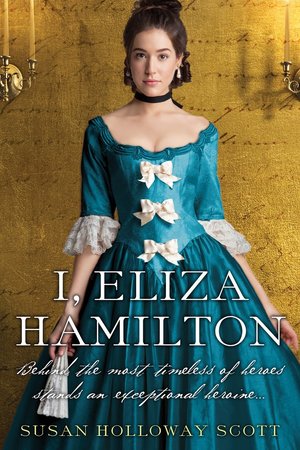
In 1787, the style was being worn in New York City, too. The second portrait, right, by American artist Ralph Earl, is of Elizabeth Schuyler Hamilton, wife of then-member of the Continental Congress Alexander Hamilton; she's also the heroine of my upcoming book I, ELIZA HAMILTON. The Hamiltons were a fashionable young couple in Federalist New York City and in Philadelphia, attending the theatre, balls, and dinners with equally fashionable friends, and would have been very aware of European styles in hair and dress.

In her portrait, Eliza has clearly followed the royal trend-setter. Some historians (male, and dismissive of fashion history) describe her as wearing a wig, but that's her own hair, frizzed and powdered into an elegant hedgehog. It's a surprisingly close copy of the queen's hair, down to the horizontal falling curls at the back, although Eliza chose a simpler headdress of fine linen or silk gauze instead of Marie-Antoinette's plumed turban.

That snowy white hair must have taken a considerable amount of powder to achieve, too, for beneath it Eliza's natural hair color was described as a very dark brown, almost black - you can see it showing through the powder. So much powder made a statement of affluence as well. Hair powder was considered a luxury good, and while flour could be substituted as a low-cost alternative in a pinch, the best powder was imported, a finely ground mixture of starch, bone, and orris root for scent. It's likely that Eliza wore her hair this heavily powdered only for special occasions, and by the time she sat for another portrait in the 1790s, she'd given it up, and is shown wearing her own dark hair. There is, however, a record of Eliza receiving a gift of hair powder in 1780 from Martha Washington - a thoughtful present from another 18thc lady who enjoyed a good powdering.

Above left: Marie Antoinette with a Rose by Élisabeth Vigée Le Brun, 1783, Metropolitan Museum of Art.
Lower right: Portrait of Elizabeth Schuyler Hamilton (Mrs. Alexander Hamilton by Ralph Earl, c1787, Museum of the City of New York.

Monday, November 7, 2016

From the Archives: Creating Fashionable Coiffures in 1828

Monday, November 7, 2016


1828 hair styles & headwear
Loretta reports:

In my book Lord of Scoundrels, set in 1828, the hero finds the heroine's clothing and hair amusing. I know that when our readers see the fashion plates for the 1820s and 1830s, many feel the same way. But I love Romantic Era fashion, especially the extravagant sleeves and nutty hairstyles. There's an exuberance I find irresistible. The hair, especially, climbing ever upwards, charms me. But one does wonder how this sort of architectural arrangement was managed in the days before hair spray and gels.

Isabella/Susan to the rescue! She sent me a link to a site where historical hairstyles are recreated.  This inspired me to investigate how it was done and what hair products they used.  So I turned to my trusty The Lady’s Stratagem.
One style we see again and again involves two or more big loops sprouting from the top of the head.  In fashion plates, these present an interesting hairstyling puzzle, which the recreations (Photo 2, top row.  Photos 1 & 2, second row) help solve.  According to The Lady’s Stratagem, the hair can be tied first or:

“Just as commonly, the hair is not tied:  you gather it and hold it very firmly In your left hand, twist it with this same hand, and immediately place the comb on it to hold it.  Then you make nœuds d’Apollon or Apollo knots; so are called the large loops of hair on the summit of the head.  This style has been in fashion for a long time; every one says that it will last.”
And it did, well into the 1830s, until about 1836-7, when fashion went droopy.
Since the instructions quoted in The Lady’s Stratagem are lengthy, I can only refer you to that book for the details on creating this style—or, if your French is better than mine, you can follow the directions in Arte de se coiffer soi-même, enseigné aux dames (1828) (here or here).

From what I can determine, one of the hair oils we’ve seen advertised or similar product or a pomade was used to keep hair smoothly in place.

Images: upper left, courtesy Los Angeles Public Library; lower right from Arte de se coiffer soi-même, enseigné aux dames, courtesy Bibliothèque nationale de france.

Clicking on the image will enlarge it. Clicking on the caption will take you to the source, where you enlarge further and find out more.


Sunday, March 13, 2016

From the Archives: Hair Care in the 1820s-1830s

Sunday, March 13, 2016
Hair for evening 1828
Loretta reports:

Susan’s posts (here and here )about 1770s hair care sent me to my beloved The Lady’s Stratagem by Frances Grimble.* to see how much had changed (or not) in the 1820s-1830s, the setting for my books.

For those fluent in French, the text from the original, Elisabeth Celnart's Manuel des dames (published between 1827-1833), is here.  Those, like me, who aren’t fluent, will be grateful for Ms. Grimble’s translation.  You will note that, as Isabella pointed out, clean doesn’t necessarily mean what a modern reader thinks it means.  Recipes abound for oils and pomatums.  Shampoo?  Not so much.  It’s more or less a last resort, as you’ll see.

“Your principal task must be to keep your hair extremely clean.  Every morning, before arranging your hair, disentangle it with a large comb, holding it upright in a straight line in order not to break the hairs...When your hair has been well cleansed*...rub it with a square brush with a handle, whose bristles are very soft, or better yet are replaced with fine rice roots...

“When night comes, very gently undo your coiffure, first removing all the black pins which you find there, and shaking out the locks as you let them down.  These steps are especially necessary when your hair has been dressed by a hair-dresser.”


After this the lady is urged to comb her hair well and plait it.  Unplaited hair becomes damaged.  It also easily escapes one’s night cap and soils the pillow.
Hair product c. 1860

“When by nature, or by the prolonged or exaggerated use of oils and pomatums, your hair is greasy to the point of being dull, dense, and flat, you must resort to soap solutions.  Pour a demi-tasse of lukewarm water into a saucer.  Soak a very lightly-perfumed toilet-soap in the water for a few moments, and stir it a little.  Soon the water will be foamy.   Then spread the locks of your hair well apart, and with a sponge dampened with the soapy water, wash them well from all sides.”

You dry the hair with warm linen, then brush it with the rice brush.

Madame recommends that blond hair be “washed very rarely.”

*More about this fabulous compendium here and  here and here and here.)

**by combing

Wednesday, November 4, 2015

A Gift from Marie-Antoinette: An Elegant Traveling Case, c. 1780

Wednesday, November 4, 2015
Isabella reporting,

On Tuesday, Christie's held a sale in Paris entitled Collection Marie-Antoinette, featuring dozens of artworks and other items that were linked in one way or another to the doomed French queen. Not surprisingly, a number of items sold above the estimate, and in a few cases, far, far above. A humble woven basket with a history of having been used by the queen during her last imprisonment at la Conciergerie had a pre-sale estimate of $884-$1,326, but instead sold for $11,736!

According to the engraved brass plaque on the lid, this traveling case was a gift from the queen to Madame Auguie of Lascans sometime between 1773-1786. In French, the case is more elegantly called a necessaire de voyage, and for a lady traveling in the 18thc., it did in fact contain every little necessity for a journey. Wealthy travelers didn't expect many amenities along the way, and planned accordingly - and luxuriously.

This mahogany case is a wonderful example of what to bring. Among the things packed inside the relatively small case (it's about 18" long) are a small teapot, two teacups, and a box for loose tea; a box with perforated lid for hair powder; an oval mirror; a basin for washing; a pair of candlesticks with bases that unscrewed to for packing; a gilt fruit knife; an inkwell, a funnel, and an hourglass, as well as assorted boxes and jars for cosmetics and creams. In addition there's a smaller shagreen-covered case that housed more personal items, such as manicure tools, a comb, and a razor.

Everything has its fitted place within the case, making it easier for a maid to find and repack each item, and to keep it all secure while being jostled in a carriage. Not surprisingly, the case and its components were the work of a small team of the best specialized craftsmen in 18thc. Paris, including Jean-Etienne Langlois, Gabriel Gerbu, Antoine-Gaspard Lorett, Francois Corbett, and Pierre-Claude Mottie.

Christie's description of the case notes that a few things have been lost over time, but it's hard to imagine what else a lady might need. The case was passed down through the family until it was finally sold to a private collector in 1955, and now again today. I would guess that its connection to Marie-Antoinette made it a treasured heirloom, even a relic, which helped it remain so complete today.

If you're curious to see more from the sale, the results have already been posted online here. And if you'd like to compare this case to later traveling cases, here's a blog post featuring one from 1870, and another from 1920.

Above: Traveling case (necessaire de voyage), made in Paris, 1773-1786. Photograph courtesy of Christie's.

Sunday, November 1, 2015

Rococo Beauty: Mme. de Pompadour at her Dressing Table, 1750

Sunday, November 1, 2015
Isabella reporting,

Jeanne Antoinette Poisson, Marquise de Pompadour (1721-1764), is best remembered as the chief mistress of King Louis XV. This portrait of her - painted by one of her favorite artists, François Boucher - shows her as the epitome of the doll-like beauty so popular in the mid-18thc. French court.

Obviously the goal wasn't a "natural" look. The very fact that the marquise chose to be captured in the intimate act of painting her face shows that artifice was expected, even prized.

As she sits at her looking glass, a lace-edged cape around her shoulders to protect her gown from powder, her gaze is both frank and serene. Her table has not only an oversized swan's-down puff for powder, but also an assortment of silk flowers (more artifice)  that she will be tucking into her hair. On her wrist is a bracelet featuring a cameo of the king, making it clear where her heart - or at least her best interests - lies.

What caught my eye first when I saw this painting, however, was the gold box and brush in her hands. Holding rouge for reddening the cheeks, the box and brush are very similar to one that I'd seen several years ago at the Metropolitan Museum of Art; my blog post about that box is here. While the Met's box dates to several decades after Mme. de Pompadour's death, it's still tantalizing to imagine another lady sitting at her glass in much the same pose - art and an artifact combining to bring a lost world back to life.

This portrait is on display in the newly refurbished Harvard Art Museums on the Harvard University campus in Cambridge, MA, well worth a visit if you're in Boston. More imagining: picture the pious Puritan worthies of the Massachusetts Bay Colony who established the college in the 17thc., coming face to face with the lovely, wanton French marquise holding court in their midst....

Above: Jeanne Antoinette Poisson, Marquise de Pompadour by François Boucher, c1750. Harvard Art Museums. Photograph by Lydia Scott.
Lower detail copyright President and Fellows of Harvard College.

Thursday, August 20, 2015

From the Archives: The Truth about the Big Hair of the 1770s: Part II: How They Did It

Thursday, August 20, 2015

Isabella reporting,

Here's the second part of our popular "big hair" posts, continuing where Part One left off. Thanks again to Abby Cox for sharing her research with us!

Considering the towering hairstyles worn by women in the 1770s, the question that inevitably comes to mind is "how did they do it?" For the answer, I turned to two of our friends from Colonial Williamsburg, the manuta-maker's apprentices of the Margaret Hunter shop: Abby Cox and Sarah Woodyard.

These two young women not only dress in the clothing of the 1770s on a daily basis, but they are constantly researching the period to make their "look" as authentic as possible. Because they participated in the fashion trades, 18th c. milliners, mantua-makers, and their shop assistants dressed in the latest styles as a form of advertising as well as personal preference. This can be seen in prints like the one, right, where the milliners are wearing elaborate hair and caps. (For a photograph of the Margaret Hunter shop's interpretation of this print for a recent conference, see here - plenty more big hair!)

As part of her apprenticeship, Abby has been searching primary sources and prints for the secrets of these hairstyles, and of Georgian hair-care in general. Here are a few of her findings (and many thank to her for sharing them!)

First, forget 21st notions of bouncy, squeaky-clean hair. Eighteenth-century women did not scrub their hair clean, so much as cleanse it. Instead of daily lathering of soap and water (which can damage hair), they worked pomatum into the hair with their fingers, added powder, and then brushed and combed vigorously. The pomatum could have been made at home or purchased, and consisted of animal fat plus fragrance. The powder would have included some sort of finely-ground starch, with ground sheep or beef bones and ground orris-root for a light floral scent.

Following an 18th c. recipe, Abby made pomatum of mutton fat and pig's lard with essence of lemon and clove oil, to be kept in a jar. I can report that this mixture smelled absolutely, delightfully spicy – plus, as Abby noted, clove oil is a natural flea and tick repellent. The recipe for her hair powder came from The Toilet of Flora, first published in 1772 (and here online.) Think of the pomatum as a rich, deep conditioner applied as a kind of scalp massage, followed by the powder as dry shampoo. This treatment is hardly limited to the Georgians, either. Indian women, known for their beautiful, long hair, have long followed a similar cleansing regimen of oiling and combing.

This process was done frequently, too. No matter how elaborate the style, Georgian women always took their hair down at night and combed it out. For many women, this was likely a relaxing, aromatherapeutic ritual for the end of the day - although there were no doubt some lazy, slovenly hussies who didn't, giving rise to the myths about maggots.

Hair that had been treated like this made styling much easier, just as modern hairdressers rely on powdered dry shampoo to add texture and body before attempting up-dos. More powder was dusted on before styling to achieve the fashionable matte, "dusty" look of powder and to make dark hair paler. Unlike the beehives of the 1950's-60's, Georgian women did not tease their hair, but added extra volume with padded forms called rollers and cushions, middle right. Think of them as the 18th c. answer to Bumpits.

Sewn of wool cloth to match the wearer's hair, these were shaped pillows stuffed lightly with down or sheep's wool. The hair was wrapped around, (that's Abby demonstrating, middle left), or pulled through the forms, and smoothed and pinned (with u-shaped hairpins) into the desired shape. Side curls could be rolled and pinned into place, and extra touches could include braids or false curls. (Wearing a more elaborate style, above left, is the third of the shop's summer interns, Rebecca Starkins, a PhD candidate at N.Y.U. in English literature.) There was no mousse, gel, or hairspray; the pomatum and the powder offered the necessary staying-power.

How long would all this take a busy 18th c. apprentice before she appeared for work? If Abby and Sarah are any indication, not long at all. They accomplished these elaborate styles in about ten to fifteen minutes, or less time than many modern young women spend with blow-dryers and flat-irons. A skilled 18th c. professional hairdresser would have been able to perform the basics in less time, plus construct a more towering edifice of hair complete with flowers, ribbons, and strands of pearls.

More impressive still is the fact that both Abby and Sarah have both given up modern hair care products altogether, and "practice what they preach" with pomatum and powder. When they go visit their (modern) hairdressers for a cut, they're greeted with amazement, for their hair is healthy, strong, and thick - and, they swear, in better condition than ever. Hmm...perhaps the old ways ARE the best.

For the record: The length of Abby's hair is just below her shoulders, Sarah's is to the middle of her back, and Rebecca's is to her waist. Many thanks to them all!

Upper right: detail, A Morning Ramble, or - The Milliners' Shop, published by Carington Bowles, 1782. The British Museum.
Photographs by the Margaret Hunter Shop and Susan Holloway Scott.
 
Two Nerdy History Girls. Design by Pocket