Showing posts with label weddings and marriage. Show all posts

Tuesday, June 12, 2018

From the Archives: They Do It Differently in France, Part One

Tuesday, June 12, 2018
Frances Trollope ca 1832
Loretta reports:

[Note: This post is from 2010, when I was researching my Dressmakers series. In light of recent discussions about the differences in the way married and unmarried women dressed, it seemed worth a return engagement.]

I had occasion to reopen my yellowed copy of Fanny Trollope’s  Paris and the Parisians recently, and was reminded what a delightful account she offers of Paris in 1835.  I suggest you read the entire Letter XXXV —which I have had to hack up mercilessly below.  It points out a very interesting cultural difference.

By this time, in England, arranged marriages were a thing of the past, but not in France.  This led to some interesting differences in social behavior.  In France, Fanny tells us, the unmarried girls are the last to get dancing partners.  It’s the married women—and many of them no spring chickens—to whom all the young gallants flock.  She discusses this oddity with an unnamed French woman of her acquaintance, who asks, "Will you then have the kindness to explain to me the difference in this respect between France and England ?"

Fanny: " The only difference between us which I mean to advocate is, that with us the amusement which throws young people together under circumstances the most likely, perhaps, to elicit expressions of gallantry and admiration from the men, and a gracious reception of them from the women, is considered as befitting the single rather than the married part of the community."

 " With us, indeed, it is exactly the reverse," replied she,—" at least as respects the young ladies. By addressing the idle, unmeaning gallantry inspired by the dance to a young girl, we should deem the cautious delicacy of restraint in which she is enshrined transgressed and broken in upon. A young girl should be given to her husband before her passions have been awakened or her imagination excited by the voice of gallantry.…When a girl is first married, her feelings, her thoughts, her imagination, are wholly occupied by her husband. Her mode of education has ensured this; and afterward it is at the choice of her husband whether he will secure and retain her young heart for himself. In no country have husbands so little reason to complain of their wives as in France ; for in no country does the manner in which they live with them depend so wholly on themselves.”

Marie J. Lafont-Porcher ca 1835
After politely debating which country has got it all wrong, the Unnamed Lady concludes:  “…as we go on exchanging fashions so amicably, who knows but we may live to see your young ladies shut up a little more, while their mothers and fathers look out for a suitable marriage for them, instead of inflicting the awkward task upon themselves?* And in return, perhaps, our young wives may lay aside their little coquetries, and become mères respectables somewhat earlier than they do now. But, in truth, they all come to it at last."

*Italics mine.

Images: Frances Trollope, by Auguste Hervieu circa 1832, courtesy National Portrait Gallery NPG 3906 via Wikipedia. François Kinson, Portrait of Marie J. Lafont-Porcher circa 1835, courtesy Groeningemuseum, via Wikipedia.

Tuesday, May 22, 2018

What the Groom Wore: Prince Harry's Frock Coat

Tuesday, May 22, 2018
Susan reporting,

Like millions of other people willing to get up extra early on a Saturday morning, Loretta and I have been enthralled by this week's royal wedding of Ms. Meghan Markle and His Royal Highness Prince Henry of Wales. One thing that fascinated us the most was the dashing dark uniform that Prince Harry chose to wear to his wedding.

The long coat is described as a frock coat, and is particular to the Household Cavalry, which is formed of two regiments - The Life Guards and The Blues and Royals - while another version with slightly different cuffs is also worn by the Foot Guards. (The style of the knee-length frock coat evolved from men's 19thc fashion, with additional inspiration from the Ottomans.) It was worn in "Undress" instead of Full Dress, most likely because the choice of Windsor Castle made the wedding a less formal affair. This was not a state occasion, nor will Harry be king. Harry's brother William, Duke of Cambridge, wore the same uniform for the ceremony, and miniature adaptations were created for the bride's page boys.

Both brothers' uniforms were created by traditional military tailors Dege & Skinner on Savile Row, and were said to have taken over 100 hours to stitch and tailor by hand. Details are everything, even in a seemingly monochrome coat: the intricate interwoven braid on the sleeves (which was barely visible on television) took a single skilled craftsman over a week to create. The frock coat's primary fabric is doeskin, a fine satin-weave woolen cloth, and the lining is silk.

The frock coat is closed with hidden hooks instead of buttons. Many Americans were perplexed by what they saw as "ribbon bows" on the front of the jacket. This is instead a braiding made of black mohair, and is unique to the Household Cavalry and the Life Guards. While the braid loops appear to fasten to the olivets (the toggle-style buttons on the far sides of the chest), they are purely decorative.

The illustrations, right, are from Dress Regulations for Officers of the Army 1900, and show the approved pattern of the Frock Coat of the Household Cavalry. The illustrations show the details of the frock coat that weren't visible in the wedding broadcast (click on the image to enlarge.)

While the very dark navy color made for a striking contrast to Meghan's bright white gown, it's not simply a style choice, but a uniform that Harry has earned the right to wear. He served as a Captain in The Blues and Royals, and after retiring from active duty in 2015, he received the honorary military title of Major from the Queen, as signified by the crown on his shoulder. According to Kensington Palace, he also requested and received express permission from the Queen to wear the uniform on his wedding day.

Rumor has it that the Queen also bestowed a certain leniency to Harry in another way. Officers in the Army are required to be clean-shaven, and there was speculation that Harry would shave away his now-familiar beard for the wedding. The fact that he didn't suggests that the Queen gave him special permission to keep the whiskers.

One more detail: did you notice that both brothers wore silver spurs as members of the cavalry?

Many thanks to historian, author, and historic paint consultant Patrick Baty for his always-excellent assistance with this blog post. 

Upper left: Neil Hall/Pool/Reuters
Lower left: PA/UK Images

Monday, May 21, 2018

From the Archives: Queen Victoria's Wedding Drew a Crowd, Too.

Monday, May 21, 2018
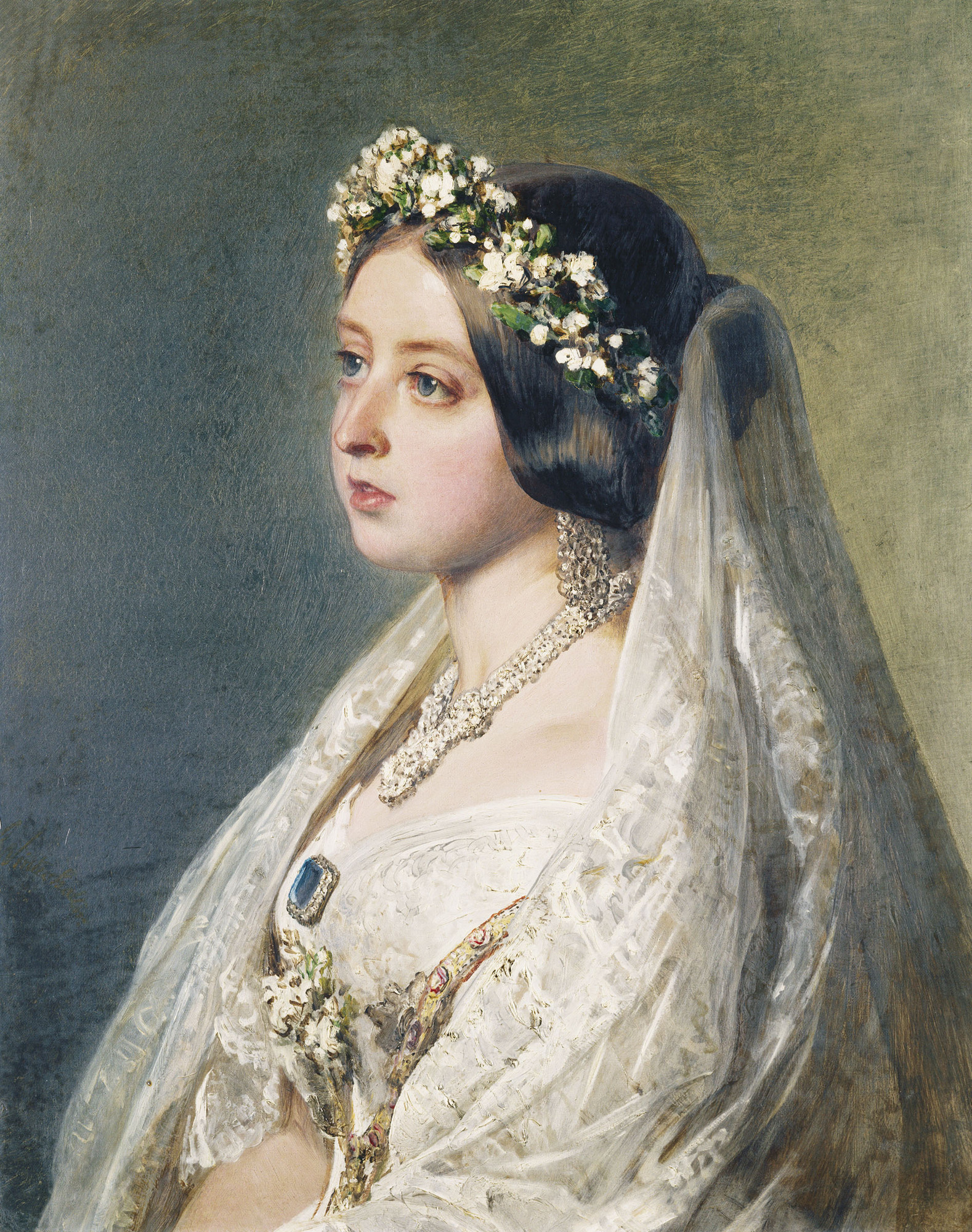
Queen Victoria in her wedding dress painted 1847
Loretta reports:

The recent marriage of the Duke and Duchess of Sussex sent me back into the archives to look at the excitement that accompanied Queen Victoria's wedding on 10 February 1840, in rotten weather.  Researching for the short story I wrote at the time, I learned, among other things, that royal wedding frenzy is nothing new.
~~~
All ranks of the people in the metropolis, and for many miles around, began to rise before the appearance of the dawn, some to prepare to take their stations in the progress of the approaching great ceremony; but the great multitude, of course, thinking that their exertions would be well repaid, if they could get only a moment's glimpse of the Queen and her husband, or even a glance at the procession going and returning. Notwithstanding the discouraging weather, the streets were crowded at an early hour with thousands, coming from every point of the compass, and making the best of their way, with emulous and unceremonious haste, to St. James's Park, as one common centre. The concourse of females was prodigious. It seemed as if every one of her Majesty's sex, from the infant in arms to the decrepit matron, now far advanced in second childhood, had made a vow not to stay at home. Women, who could not see their way without spectacles, nor walk it without crutches, were to be seen anxiously struggling for precedence at every point of the park, whence a glance at the Queen and Prince might be obtained; and, having once obtained an eligible spot, they held fast by it, heedless of the too frequent probabilities of being crushed or trodden to death. The trees, the lamp-posts, and the spikes of the railings, were contended for with as much eagerness as if the summit of every one's ambition was at the top of one or other of these elevations; and the wonder was, how many, who had climbed up to certain dangerous eminences, could ever get down in safety again. However, these adventurous folks justly thought, that that question was their own " look out," and no one's else's. About ten o'clock St. James's Park was completely filled with a vast, miscellaneous, curious multitude, not a tithe of whom, unfortunately, could see even the carriage of the Queen when it did at length pass.
The Mirror of literature, amusement, and instruction, Volume 35, 1840
Marriage of Queen Victoria

Illustrations:  Franz Xaver Winterhalter  (1805–1873) Queen Victoria, in her wedding dress and veil from 1840, painted in 1847 as an anniversary gift for her husband, Prince Albert.
Source/Photographer. Original painting owned by the Royal Collection. Source of photograph unknown.

The Marriage of Queen Victoria, 10 February 1840, painted by George Hayter 1840-1842. Royal Collection RCIN 407165, via Wikipedia.
Clicking on the image will enlarge it.  Clicking on the caption will take you to the source, where you can learn more and enlarge images as needed.


Friday, April 27, 2018

Friday Video: The Fife Tiara, A Wedding Gift for a Royal Princess in 1889

Friday, April 27, 2018

Susan reporting,

With the next British royal wedding fast approaching, the speculation grows daily as to what exactly American Meghan Markle will wear to walk down the aisle with Prince Henry of Wales. Yes, the wedding dress is the greatest mystery - but right after that comes the question of the bride's headdress. Will Meghan go for something simple like a wreathe of flowers, or will she go the full princess-to-be route with a glittering tiara?

The breathtaking tiara featured here already comes with a royal heritage. Created in the 1880s by jeweler Oscar Massin, the Fife Tiara contains approximately 200 carats of diamonds set in gold and silver. It was a wedding gift to Queen Victoria's granddaughter Princess Louise of Wales, below, daughter of Edward VII,  from her new husband, the Duke of Fife; that dukedom was a wedding gift to the groom.

Today the tiara is valued at 1.4 million pounds.  Accepted by the government in lieu of taxes, it was permanently allocated to Historic Royal Palaces for display at Kensington Palace. It can be seen there now as part of the Victoria Revealed exhibition.

If you received this post via email, you may be seeing a blank space or black box where the video should be. Click here to view the video.

Friday, January 19, 2018

Friday Video: The Wedding of Princess Elizabeth & Philip Mountbatten, 1947

Friday, January 19, 2018

Susan reporting,

This is for all of you out there who are engrossed in The Crown on Netflix. Here's a short newsreel segment with the highlights of the wedding of Princess Elizabeth and Philip Mountbatten on November 20, 1947. As grainy as this black & white footage is today, how exciting it must have been to people in the cinema in those pre-television days - and how very different from the second-by-second broadcast of the last royal wedding of the Duke and Duchess of Cambridge.

Tuesday, December 5, 2017

What Did Alexander Hamilton Wear for His Wedding to Elizabeth Schuyler in 1780?

Tuesday, December 5, 2017

Susan reporting, 

This post appeared earlier this fall on the blog that's connected to my web site, but since it was so popular there, I decided to share it here, too.

In early December 1780, Lt. Col, Alexander Hamilton finally received leave from his position as an aide-de-camp on Gen. Washington's staff, and headed north to Albany, NY to marry his fiancee Elizabeth Schuyler. It was his first leave away from the army since accepting the post in 1777. The young lieutenant colonel had performed his responsibilities so well that he'd become virtually indispensable to His Excellency, who only grudgingly granted the leave, and only for a few short weeks at that.

The wedding was small family affair, with the service taking in the parlor of The Pastures, the Schuyler family home overlooking the Hudson River. There are no surviving records of what either the bride or groom wore for the ceremony, or for the celebration that likely took place afterwards. The description of Eliza's gown that you'll find in my historical novel I, Eliza Hamilton is drawn from a suggestion for bridal dress for a fashionable winter wedding in a 1780 copy of The Lady's Magazine, the Georgian precursor of magazines like Vogue, and I also consulted with Janea Whitacre, the Mistress of the Mantua-Making Trade at Colonial Williamsburg.

In a letter that Alexander wrote to Eliza shortly before embarking for Albany, he asked if she'd prefer him to wear his uniform for their wedding, or civilian clothes. Alas, her reply is lost, so it's not known what decision she made for her groom. I'm guessing that she chose his military attire, given that it was a war-time wedding.

None of Alexander's uniforms from the Revolution are known to survive today. Uniforms from the war saw considerable hard wear, and only a handful from the entire Continental Army still exist. Among them is the uniform, above left, that was worn by another of Washington's aides-de-camp, and one of Alexander's close friends, Lt. Col. Tench Tilghman (1744-1786) of Maryland. As shown on a museum mannequin, the uniform is missing some key elements: a white linen shirt, gold officer's epaulettes, a sword and sword belt, boots, cocked hat, and the green ribbon sash worn by members of the general's staff. The portrait, above right, shows Gen. Washington himself, with the Marquis de Lafayette in the middle, and Lt. Col. Tilghman to the right, all in uniform.

Alexander's uniform at the time of the wedding was likely very similar. The miniature portrait by Charles Willson Peale of Alexander, below left, shows him in that uniform.

Now I have a totally unsubstantiated theory about this particular miniature: that Eliza may have seen it at some point during their courtship, and that perhaps Alexander even offered it to her, but that she rejected it for some reason - perhaps as not being worthy of her beloved. During the summer of 1780, he had another miniature painted at her request, showing him looking much more conventionally handsome and in civilian dress: see it here.

In any event, the epaulettes shown in the photo, lower right, did in fact belong to Alexander, and may well have been the same ones shown in the miniature portrait. Epaulettes were a relatively new feature of military dress in the 1770s, and were worn to make officers more visible to their men in battle. They were also considered to have less of the aristocratic baggage of the ribbons and sashes traditionally worn by British officers, and therefore were embraced by the Continental Army as being more democratic.

I saw Alexander's epaulettes on display this past summer at the American Revolution Museum at Yorktown, VA. Even though the gallery was in half-light to protect the artifacts (and make the photos fuzzy!), the gold bullion still glittered despite being more than two centuries old. Imagine how those golden epaulettes and rows of polished buttons must have sparkled on Alexander's coat in the sunny parlor during the wedding, and imagine, too, how wonderfully dazzled Eliza must have been by her groom. Ahh, the sartorial power of a man in uniform....

Above left: Uniform worn by Lt. Col. Tench Tilghman, c1777. 
Above right: Washington, Lafayette, and Tilghman at Yorktown, by Charles Willson Peale, 1784.          Both from the collections of the Maryland Historical Society; images from Maryland Historical Society.
Lower left: Miniature portrait of Lt. Col. Alexander Hamilton, by Charles Willson Peale,, 1777, Museum of the City of New York.
Lower right: Epaulettes Belong to Alexander Hamilton, c1777-1783, The Society of the Cincinnati. Photograph by Susan Holloway Scott.

Read more about Eliza Schuyler and Alexander Hamilton in my latest historical novel, I, Eliza Hamilton, now available everywhere.

Thursday, October 19, 2017

From the Archives: Finding Conjugal Bliss in Dr. Graham's Celestial Bed, 1781

Thursday, October 19, 2017
Susan reporting:

We TNHG are generally very good at remembering things that happened two hundred years ago, but during the last ten - not so much. Sometimes it takes a reader to jog our memories about old posts that are worthy of a return appearance. Many thanks to Alun Withey for reminding me of this post that first appeared back in 2011!

Exploiting the love-lives of the rich and famous is hardly a new pursuit. From ancient times, charlatans have offered exotic, expensive potions to increase flagging libidos and unusual regimes designed to restore the magic to chilly marriages. One of the most infamous of these is Dr. James Graham (1745-1794), a self-proclaimed physician, self-promoter, and inventor (Wikipedia luridly categorizes him as a "sexologist") who captured the imagination of English society in the 1780s – and a good deal of their money besides.

Like all good quacks, Dr. Graham had a splendid gimmick, and his was the Temple of Hymen in Shomberg House in Pall Mall, a kind of overwrought clinic for his unusual treatments. His most profitable speciality was improving conjugal sex and fertility, and he found a clamoring audience among the upper classes whose survival depended on producing healthy heirs. Many of his customers were weakened by venereal disease and general dissipation, but that didn't stop Dr. Graham from making the same outlandish guarantees that often appear today in spam folders. His celebrity clientele included politicians John Wilkes and Charles James Fox, aristocrats such as the Duchess of Devonshire and the Duke of Richmond, and courtesans like Elizabeth Armistead and Mary Robinson.

While his treatments varied from elixirs to mud baths, the centerpiece of the Temple of Hymen was the Celestial Bed. This over-sized bed (it measured nine by twelve feet) could be tilted for an optimum angle, and was supported by glass rods that could permit the bed and its occupants to become so charged with static electricity that it gave off a greenish glow. Decorative automata, a pair of live turtle doves, and lush bouquets of fresh flowers were also features of the bed. Adding to the ambiance was a mattress stuffed with a special mixture of sweet-smelling herbs and hair from the tails of the most rampant English stallions, while a special celestial pipe organ played music calculated to inspire love-making. For the next three years, until Dr. Graham's extravagance landed him in prison for debt and bankruptcy, there were plenty of couples eager for the experience.

The price of a magical night in the Celestial Bed? An astonishingly steep fifty pounds. Did it work? Perhaps – though who wanted to admit that it didn't?

In honor of Valentine's Day, 2011, the Museum of London is recreated Dr. Graham's Celestial Bed as a special adults-only exhibition. For more information about this, as well as more detailed descriptions of Dr. Graham's claims, see here – though be forewarned that this post, like the exhibition, is probably best not read at work.

Above: The Celestial Bed, with the Rosy Goddess of Health reposing thereon, unknown artist, English School, 1782, private collection.

Sunday, October 1, 2017

The Wedding Ring that Alexander Hamilton Gave to Elizabeth Schuyler, 1780

Sunday, October 1, 2017
Susan reporting,

As I've noted in previous blog posts (here and here), sometimes the most inspiring historical research isn't found in books, diaries, or letters, but in the physical objects that can offer an immediate connection to the past. I've saved the best of these from my research for my just-released historical novel I, Eliza Hamilton until now - and here it is.

Kept in an acid-free box in the Rare Book & Manuscript Library at Columbia University in New York City, and tiny in size, it's only brought out by special request, or for the even-more-rare times that it appears on display as part of an exhibition.

It's Eliza Schuyler Hamilton's wedding ring. THE wedding ring, the one that Alexander Hamilton slipped on her finger when they were married in December, 1780.

Made of gold grown burnished with time in the way that only wedding rings can be, Eliza's ring is impossibly delicate, worn thin and no longer exactly round after nearly seventy-four years on her finger. It's small, too, for Eliza was a petite woman. I wasn't permitted to try it on (nor would I have wished to: that's Eliza's ring), but when I placed my own size-5 ring beside it, mine looked large and thick by comparison.

The style is ingenious. It's called a gimmel ring (or gimmal, or puzzle ring), with two separate, twisted circles that are linked and fit together side by side to form a single band. Gimmel rings had already been popular for betrothals and weddings long before Alexander bought one for Eliza, with the earliest known examples dating from the 14th century. I made this very brief video showing the curator linking the rings together. If you look closely, you can see the little notch and peg that clicked the rings together.

The symbolism of two forming one is perfect for a marriage, and this ring was made even more special by having the names of the groom and bride - Alexander & Elizabeth (he got the ampersand) - engraved inside each ring, where they were always pressed against one another. Without the added enhancement of precious stones, this was a comparatively inexpensive ring, which was likely a consideration for the impoverished young lieutenant colonel in the middle of the American Revolution.

But I also imagine that the simplicity of the ring must have appealed to Eliza as well. There on her finger, the gold band must have been a constant comfort to her, a reminder of love and happiness through the tragedies and sorrows of her life, and through the half-century - more than fifty years! - of her widowhood.

Given that, I'm surprised that the ring was not buried with her. Yet I'm glad it wasn't. Seeing this little double-circle of gold, touching it lightly with my fingertip, was like having Eliza herself there beside me in the library. Research doesn't get any better - or more magical - than that.

Many thanks to Jennifer B. Lee, Curator, Rare Book & Manuscript Library, Columbia University, for showing me the ring along with other Hamilton memorabilia.

Above: Gold double-band wedding ring of Elizabeth Schuyler Hamilton, wife of Alexander Hamilton, maker unknown, 1780. Columbia University; gift of Furman University Library, through the suggestion and assistance of the Hamilton family descendants: Mrs. Marie Hamilton Barrett and Mrs. Elizabeth Schuyler Campbell.

Read more about Eliza Schuyler and Alexander Hamilton in my latest historical novel, I, Eliza Hamilton, now available everywhere.

Thursday, September 21, 2017

A Pair of Hand-stitched Handkerchiefs from the Wedding of Eliza Schuyler & Alexander Hamilton, 1780

Thursday, September 21, 2017
Susan reporting,

Most historical research for a novel involves words, and more words: letters, journals, diaries, and other books. But sometimes research means things: objects that were significant to my characters, and somehow survived: a tangible, magical link to the past.

Despite the popular history myths, 18thc women didn't sew the their all the clothing that their families wore. Nor did they shear the sheep and harvest the flax, process all the fibers, spin the thread, and weave the cloth; even if you lived on the edge of the wilderness, there were skilled tradespeople who took care of all that, and merchants ready to supply their wares at every price point. But while creating jackets, breeches, and gowns was left to tailors and mantua-makers, women did make the less challenging items like baby clothes, neckcloths, handkerchiefs, shirts, and shifts at home.

Sewing by hand was a useful skill, and considered a virtuously industrious one as well for women of every rank. But for many women, sewing was also a form of personal satisfaction and self-expression. The past (and the present!) is filled with women for whom sewing a neat, straight seam of perfectly even stitches or completing an intricate embroidery pattern is a matter of pride, accomplishment, and zen-like peace. Stitching for a special person could create a personal, even intimate, gift as well. Hand-made items can come with love and good wishes in every stitch.

Eliza Schuyler Hamilton (the heroine of my new historical novel, I, Eliza Hamilton) enjoyed sewing, embroidery, and knitting. I've already shared one surviving example of her needlework, this lavish embroidered mat to display the miniature of her then-fiancee, Alexander Hamilton, made during the summer and fall when they were engaged but apart. Here are a pair of handkerchiefs that, by family tradition, were also made by Eliza, and carried by her and Alexander at their wedding in December, 1780.

The larger handkerchief would have been Eliza's. Made of fine imported linen, it shows skilled cutwork over net inserts as well as precise stitching of the highest level, suitable for a special event like a wedding. (Given its size, I'm wondering if this might have been a neckerchief for wearing around the shoulders - a popular style in the 1780s - rather than a handkerchief, but since the archival description calls it a handkerchief, then so shall I.) Surviving, too, is the gentleman's handkerchief with an embroidered geometric pattern with floral accents. Again, the legend is that Eliza made the handkerchief for Alexander, a romantic gift that he must have treasured.

Today the linen on the two handkerchiefs is yellowed and so fragile that they cannot be unfolded, but the beauty and the undeniable care (and likely love) that went into each one of those long-ago stitches remains. The fact that both pieces were set aside and treasured for more than two hundred years shows how special they must have been - and even now, in their special, acid-proof archival box, they're still stored together.

Many thanks to Jennifer Lee, curator, Rare Book & Manuscript Library, Columbia University, for showing the neckerchief and the handkerchief to me.

Above: Pair of wedding handkerchiefs, c1780, Alexander Hamilton Collection, Rare Book and Manuscript Library, Columbia University. Photographs ©2017 Susan Holloway Scott.

Read more about Eliza Schuyler and Alexander Hamilton in my latest historical novel, I, Eliza Hamilton, now available everywhere.

Sunday, September 18, 2016

A Delicate Pair of Wedding Oversleeves, c1830

Sunday, September 18, 2016
Isabella reporting,

Thanks to her current series of books, Loretta is the queen of the over-the-top fashions from the 1820s-1830s (see examples in her posts here, here, and here), but she's won me over to extreme hair, huge sleeves, and bell-shaped skirts.

So when I spotted these ghostly oversleeves recently in the costume & textile study drawers at the RISDMuseum, I recognized them for what they were: delicate and rare survivors from the Romantic Era of fashion. (Although another gallery-goer standing beside me had the more normal 21stc reaction: "What the heck are those things?")

While the rest of the original dress is no longer with these oversleeves and may not even still exist, it is possible to guess what it may have looked like. Sheer oversleeves were a major fashion trend in the late 1820s-early 1830s. Always made from a sheer fabric like silk gauze or voile, they added a delicate, feminine transparency to dresses that were almost architecturally structured with pleats, wide collars, and stiff belts. Some oversleeves were embroidered with overall patterns, some were not. You can see how elegant the style could be in the portrait, right.

The oversleeves from the RISDMuseum are labeled as having been worn as part of a wedding dress. Loretta shared this fashion plate of a wedding dress, lower left, from 1828 which is probably a bit early for the RISDMuseum's sleeves (they have more volume at the top, which would make them later), but you can still get an idea of the general effect. The fortunate American bride who wore such an ensemble in the 1830s must have been on the cutting edge of bridal fashion.

What I found particularly intriguing about the RISDMuseum's oversleeves is that the label says they were created of silk that was possibly made in China for export. Then as now, China was known for its exceptionally fine silk, and for its embroidery, too. Of course there's no way now of knowing for certain, but I found myself wondering if this beautiful silk was brought to New England in a China-trade ship, chosen by a mariner for his bride-to-be waiting back home. Could that be why they were set aside and carefully saved - a very special wedding memento?

Upper left: Oversleeves from a Wedding Dress, American, c1830, RISDMuseum. Photo via RISDMuseum.
Right: Detail, "Théodore Joseph Jonet and His Two Daughters" by François-Joseph Navez, 1832, photo via Christie's.
Lower left: Bridal Costume from La Belle Assemblee, June, 1828.

Friday, June 24, 2016

Friday Video: Grace Kelly's Royal Wedding, 1956

Friday, June 24, 2016

Isabella reporting,

Since June is the month of weddings, this seemed like the perfect Friday video for the season. The wedding of Oscar-winning American actress Grace Kelly to Ranier III, Prince of Monaco, had everything that celebrity-watchers crave: Hollywood and European royalty, a beautiful bride who gave up her movie-star existence for the love of her handsome prince. The fairy-tale analogies were unavoidable, and the world couldn't get enough. Beneath the near-constant glare of media attention, the two were wed in Monaco in a civil service on April 18, 1956, and in a religious ceremony a day later on April 19.

This short newsreel feature from British Pathé captures both the glamour and the frenzy that surrounded the wedding. What struck me most about it, however, was the breathtaking beauty of Grace Kelly, both as a woman and as a bride. She's also remarkably solemn, and I hope for her sake that later that day she was as happy and joyful as a bride should be, once she and her new husband were alone together away from the cameras.

If you received this post by email and are seeing a black box or empty space where the video should be, please click here to view the video.

Monday, June 20, 2016

Staying Happily Married for a Side of Bacon

Monday, June 20, 2016
Schweninger, Happy Family
Loretta reports:

One of my favorite tomes on my shelves is The Every-Day Book; or Everlasting Calendar of Popular Amusements etc., which the prolific William Hone published in 1826, and which was reprinted for many years thereafter.

In the entry for 20 June, he brings to our attention the custom of awarding a flitch (side) of bacon to a couple able to prove marital harmony a year and a day after the wedding.

The rather saccharine Victorian era image above left, a romantic imagining of a scene from the early 1800s, certainly is a strong contrast to Gillray's before and after matrimony images.

Dunmow Custom


Image: Carl Schweninger, Happy Family, via Wikipedia.

Clicking on the image will enlarge it.  Clicking on the caption will take you to the source, where you can learn more and enlarge images as needed.

Thursday, May 12, 2016

Clandestine Marriage Attempted 1846

Thursday, May 12, 2016
The Marriage ca 1846
Loretta reports:

From the Annual Register Vol 88, Chronicle for 2 May 1846

2. A Marriage In High Life Prevented.—This morning, just as the Rev. M. D. Ffrench was about to commence the morning service at St. George's Hanover Square, a license for marriage was presented by a lady and gentleman. Upon the document being read, the reverend gentleman was much surprised to find that it authorized the performance of the ceremony for parties no less distinguished than the Lady Anna Eliza Mary Temple Nugent Brydges Chandos Grenville, daughter of Richard Plantagenet, Duke and Marquis of Buckingham and Chandos, and Gore Langton, Esq., son of Colonel Gore Langton. The late hour at which the proposed bride and bridegroom reached the church rendered it impossible for the ceremony to be performed previous to the morning service. Mr. Ffrench, in the meantime, seeing that the bride and bridegroom were not accompanied by any of their friends, and fearing that the proposed marriage was a clandestine one, sent a messenger to the Duke of Buckingham to inform him that a marriage in which he was so deeply interested was about to take place.
2nd Duke of Buckingham & Chandos
After a pause of incredulous amazement, the Duke hastened to St. George's Church. In the meantime the morning service had been completed, and the preliminaries had been duly performed in the vestry, and the parties had proceeded to the altar to have their union completed. The clergyman had just commenced, when the Duke of Buckingham arrived, and warmly expressed his decided objection to the performance of the ceremony. On the other hand, Mr. Gore Langton and the lady claimed as a matter of right that the ceremony should proceed immediately. Mr. Ffrench calmly stated that his duty did not afford any option; the parties were, it appeared, of mature age, the license was in all respects sufficient, and he was bound to perform the ceremony without further delay.
A scene of painful excitement ensued; but finally the clergyman declined to perform the ceremony, and the lady retired with her father. It was stated that the objection of the noble parents of the bride were not so much directed against the person of the bridegroom, (although much surprised at the discovery of the attachment,) as to the clandestine manner in which the union was about to take place. The parties were subsequently united, with the consent, but not in the presence of the Duke and Duchess.

Image: The Marriage, ca 1846, lith. & pub. by Sarony & Major, courtesy Library of Congress Prints and Photographs Division Washington, D.C. 20540 USA.

Richard James Lane, 2nd Duke of Buckingham and Chandos, circa 1825-1850

Clicking on the image will enlarge it.  Clicking on the caption will take you to the source, where you can learn more and enlarge images as needed.

Tuesday, February 9, 2016

Queen Victoria's Stormy Wedding Day

Tuesday, February 9, 2016
Cruikshank, Very Unpleasant Weather
Loretta reports:

This week in history—
Queen Victoria married Prince Albert of Saxe-Coburg and Gotha on 10 February 1840. I used the event, and the bad weather preceding it, as a backdrop to a short story.


“The weather during the preceding night was more boisterous than any we have experienced during the winter.  It “blew great guns from ten o’clock until sunrise when—
      The dawn was overcast, the morning lower’d,
      And heavily in clouds brought on the day,
      The great, th’important day,
on which were to be celebrated the nuptials of our maiden Sovereign and Prince Albert of Saxe Coburg.

It continued to rain almost without intermission until noon, when the weather partially cleared up and continued fine, but threatening during the remainder of the day.”— The Mirror of Literature, Amusement, and Instruction, 1840
The detailed account of the wedding begins here. And you can find my other blogs on the subject here and here. If you search “white wedding dress,” you’ll find posts explaining that Queen Victoria was not the first bride to wear white.

Image: George Cruikshank, Very Unpleasant Weather,1835, courtesy Yale Center for British Art, Paul Mellon Collection.

Clicking on the image will enlarge it.  Clicking on the caption will take you to the source, where you can learn more and enlarge images as needed.

Wednesday, December 9, 2015

Theodore Roosevelt, the Bears, & the Oaks

Wednesday, December 9, 2015

Loretta reports:

During my recent visit to the Historic Paine Estate’s Holiday Open House,

I came upon a small room filled with teddy bears. Of course I wondered what this had to do with the Paine family—or was it simply holiday décor?

A little of both, it turns out.

The name “teddy bear” derives from an incident involving Theodore Roosevelt and a bear he refused to shoot.

But what did Theodore Roosevelt have to do with the Paines?

The clue lies in this wedding invitation (recently discovered, if I remember correctly*). It’s tricky trying to take photos of objects under glass, and we had a very sunny day. But the invitation reads:

“Mrs. and Mrs. George C. Lee request the pleasure of your company at the marriage of their daughter, Wednesday, October Twenty-seventh at Twelve o’clock, Unitarian Church, Brookline.”

Mr. and Mrs. Lee’s Daughter was Alice Hathaway Lee. The Timothy Bigelow Chapter of the DAR, whose chapter house this is, did some research and learned that she was a great-great-great-granddaughter of Judge Timothy Paine. This is an invitation to her wedding to Theodore Roosevelt in 1880. Sadly, she died on Valentine’s Day 1884, two days after giving birth to the formidable Alice Lee Roosevelt.

I thought the teddy bear display was a charming way to celebrate the holiday as well as the Roosevelt-Paine connection—just one example of the discoveries and intriguing network of history related to this lovely old house.

*You can find out more here about the intriguing bits of history that turn up in the Oaks.

Please click on images to enlarge.

Wednesday, June 3, 2015

An 1836 Wedding Gown with Matching Slippers

Wednesday, June 3, 2015
Isabella reporting,

June is the month for brides, and here's an 1836 wedding gown with matching slippers to usher in the season. Both are included in the same exhibition (Cosmopolitan Consumption: New England Shoe Stories 1750-1850) that I mentioned here on Monday, and earlier here.

Sarah Eliza Smith married Mark Langdon Hill in Bath, Maine, on October 11, 1836. This was a fashionable wedding. Not only are the bride's wedding clothes made of a costly silk damask, but the bridegroom was from a prominent New England family, the great-nephew of Governor John Langdon, a Revolutionary War general, a signer of the US Constitution, and a prosperous merchant and ship-builder.

Certainly the bride was dressed for the occasion. While some 19thc. brides were choosing white for their gowns (as we've noted before, this was by no means traditional at this point, and no, Queen Victoria did not "invent" the white wedding dress), Sarah Eliza chose an elegant shade of celadon green silk damask, which has unfortunately faded to beige over the centuries.

Although the name of the dress's maker is now forgotten, she was clearly very skilled. The tiny pleats, tucks, and gathers of the sleeves and bodice were all beautifully stitched by hand, with many of the seams trimmed with matching piping as well. The dress would have originally been worn with feather-stuffed sleeve puffs to fill out the sleeves to give it the extravagant silhouette shown in this fashion plate. (Today the silk is too fragile to manipulate for any "stuffing" for display.) The full sleeves might also have made the bride appear almost as wide as she was tall; from the size of her dress, Sarah Eliza must have been tiny, probably only about 4'10" or so.

Her matching slippers have silk rosettes on the toes and leather soles, and are as insubstantial as a feather. They still follow the shape of flat, Romantic-era slippers. The thin silk cords for tying around the foot and ankle to help secure the delicate shoe to the foot still survive, too. It's easy to imagine Sarah Eliza dancing with her new bridegroom, her skirts swirling over the silk rosettes - perhaps even attempting that a daring European dance, the waltz.

Many thanks to our good friend Kimberly Alexander for assistance with this post. For more information about these shoes and many others, stayed tuned for Kimberly's upcoming book Georgian Shoe Stories From Early America (Johns Hopkins University Press, 2016.) In the meantime, please check out her blog, Silk Damask, for more fascinating fashion and textile history.

Wedding Dress and Slippers, 1836, worn at the wedding of Sarah Eliza Smith to Mark Langdon Hill. Portsmouth Historical Society.

Photographs copyright 2015 Susan Holloway Scott.

Thursday, April 30, 2015

Fashionable Survivor: A Rare Silk Damask Gown, 1777

Thursday, April 30, 2015
Isabella reporting,

This week I visited the wonderful Massachusetts Historical Society in Boston with one of our blog's good friends, Kimberly Alexander of the historic clothing blog Silk Damask. We had an appointment with Anne E. Bentley, Curator of Art & Artifacts, to see a certain pair of 1747 emerald green damask wedding shoes. We swooned over the shoes (as true Nerdy History folk do) and I wondered aloud whether the shoes had matched the bride's dress.

"They did," replied Ms. Bentley. "I know, because we have the dress, too."

Out came the long, over-sized archive box that is always a sign of marvels to come. There were three beautiful dresses inside that box, nested together in their tissue-paper cocoons: a silvery-green 1840s silk dress and matching pelerine, the emerald silk wedding dress (more about that in a future blog) worn by Rebecca Tailer for her 1747 Boston wedding to Rev. Mather Byles, and the dress shown here, long ago incorrectly identified by family tradition as having belonged to Rebecca Tailer Byles' mother. It's more likely the wedding gown of Rebecca's daughter Abigail, who married Dr. Jon Clark VI in Halifax, NS, in 1777.

And it's so beautiful.

The silk damask is light and crisp and scattered with lavishly detailed flowers between pink patterned stripes. Most likely French, the silk would have been the highest fashion at the time, and it would have been expensive, too. In the middle of the American Revolution, this silk would have been imported in a merchant ship out-racing privateers, which would have added to its cost.

The dress is an open robe à l'anglaise, lined with linen. The front of the bodice closes not with straight pins (the traditional closure for most 18thc. women's clothing), but with the very modern fastenings of hooks and eyes, middle left. The low neckline would have been filled in with a fine linen neckerchief, and there are narrow bands of pleated trim with scalloped (pinked) edges at the cuffs of the sleeves, lower right.

With its open-front skirt, the gown would have been worn over either a matching petticoat or one of a contrasting color, a look that's common in French fashion plates of the 1770s. The skirt is longer in the back, suggesting that it was worn with a false rump. Kimberly and I also suspect that the skirts were worn looped up in the back for more fullness, although we didn't have time to hunt for the tell-tale signs of stitching for a cord or buttons inside the lining.

Abigail's mantua-maker was well aware of European fashion, and skilled in executing it. She took care to work with the striped pattern of the silk, cutting the sleeves on the cross-grain so that the stripes went around the arm. The back of the gown, upper left, is particularly well-done, using the pink stripes to accentuate the tapering of the waist.

By measuring the gown, we could also tell a bit about Abigail Tailer herself. We're guessing she was about 5' 4" or so in height, and the waist of the gown was 26", with some of that an allowance for her stays and shift - roughly a modern size 6.

The gown as it is now is preserved for study, not display, so I can only offer these detail photographs of it. On a mannequin, it would probably look much like this one, lower left, from LACMA's collections. There's another similar gown from the Manchester Museum featured in Janet Arnold's Patterns of Fashion 1.

What's the most exciting thing for me about Abigail Tailer's wedding gown? Learning that Kimberly and I were the first people outside the MHS to see it in more than forty years, and probably longer than that. It came to the MHS directly from Abigail's descendants, and it hasn't been featured in any exhibitions or books. It's been waiting patiently all that time in its tissue paper to be rediscovered.

I'd say it was well worth the wait....

Many, many thanks to Anne E. Bentley and the Massachusetts Historical Society!

Above: Gown, silk, 1777. Collection, Massachusetts Historical Society. Photographs ©2015 Susan Holloway Scott. 
Lower left: Robe, silk, 1775, Collection, LACMA.

Thursday, March 19, 2015

Because Who Doesn't Love Nerdy History Newlyweds?

Thursday, March 19, 2015

Isabella reporting,

As I've mentioned before, I'm spending this week in Colonial Williamsburg. I was visiting with the mantua-makers upstairs in their shop when I was summoned downstairs to meet a pair of special visitors. This is Laura and Sam Barnett from Birmingham, Alabama, just married, and visiting Colonial Williamsburg on their honeymoon. Laura told tailor Mark Hutter that she had especially wanted to visit the Margaret Hunter shop after seeing it featured so often right here on The Two Nerdy History Girls. Much mutual excitement all around at this unexpected coincidence! As Loretta and I have said before, we're always thrilled to meet fellow Nerdy History Folk, but I think Laura and Sam were our first Nerdy History Newlyweds. We wish them all the very best, and a long, happy life together. Huzzah!

Wednesday, March 4, 2015

Advertising for a Wife in 1835

Wednesday, March 4, 2015
1835 Bridal Dress

Loretta reports:

Some time ago I posted a letter from 1810 whose author deplored at some length and with great vehemence the practice of advertising for a spouse .

Apparently, nobody paid attention because, 25 years later, they were still at it.


Advertisement from Court Journal, 12 December 1835

Bridal Dress, from May 1835 Ladies’ Cabinet of Fashion, courtesy Los Angeles Public Library, Casey Fashion Plates Collection

Clicking on the image will enlarge it.  Clicking on the caption will allow you to read at the source, where you can learn more and enlarge images as needed.

Tuesday, January 20, 2015

From the NHG Bookshelf: A Gilded-Age Guidebook for Aspiring American Beauties

Tuesday, January 20, 2015
Isabella reporting,

We seem to be in an Edwardian-Gilded Age Renaissance. The new season of Downton Abbey recently began in America, and Smithsonian has also launched its own series, Million Dollar American Princesses, with both featuring 19th c. American heiresses who went across the Atlantic to find husbands among the British aristocracy.

As the exhibition of costumes from Downton Abbey wound down its record-breaking run at Winterthur Museum (see my earlier post here), I attended an entertaining talk by Carol McD. Wallace, co-author (with Gail MacColl) of To Marry an English Lord: Tales of Wealth and Marriage, Sex and Snobbery. Originally published in 1989, To Marry has been reissued to appeal to the new surge in interest in the "buccaneers," as novelist Edith Wharton dubbed them: the American beauties who traded staggering fortunes for noble titles.

And this book is fun.  Filled with illustrations and photographs, gossip and scandal, it's the kind of book readers can as easily browse as read cover to cover, and always find considerable entertainment. There's advice on everything from the costs (vast) of running a country estate with years of deferred maintenance, to choosing the proper wardrobe (also vast) for a Season in London. The niceties of calling cards, professional beauties, court presentations, the cut direct, and Newport cottages are also discussed. All the legendary American husband-hunters are here, from Astors to Vanderbilts, to the queens of Midwest commerce, and for the modern sight-seer, there's also a handy directory of which heiresses' homes in Britain are now open to the public.

I especially enjoyed the contemporary quotes that are liberally sprinkled through the books. For example, this from Oscar Wilde: "American youths are pale and precious, or sallow and supercilious, but American girls are pretty and charming – little oases of pretty unreasonableness in a vast desert of practical common-sense."

The fabulous couturier Charles Frederick Worth was more direct: "My Transatlantic friends are always welcome; they have what I call 'the three F's': figures, francs, and faith! That is why I like dressing the Americans."

Or, in the words of a popular musical-comedy song of the day: "The almighty dollar will buy, you bet/A superior class of coronet;/That's why I've come from New York City of U.S.A."
 
Two Nerdy History Girls. Design by Pocket