Showing posts with label Queen Victoria. Show all posts

Tuesday, December 11, 2018

A Few of Loretta's Favorite Nerdy History Books

Tuesday, December 11, 2018
Globe-Wernicke, ad in American Homes & Gardens c 1905

Loretta reports:

Readers often ask which books we recommend on this, that, or the other subject. For this holiday season, it seemed like a good idea to mention some favorites. They might become gifts for the nerdy history person in your life or for yourself. Many are still in print and easily available. Some are trickier to find. While I could recommend hundreds, I winnowed it down to the following, which I often turn to for information and inspiration.

Adams, Samuel & Sarah. The Complete Servant (1825). You can read this online, or can buy your own copy. Details about not only the servant hierarchy, servants’ duties, but also the economics of maintaining household staff.

Black, A&C (publishers) Titles and Forms of Address: A Guide to Correct Use. This or Debrett’s Correct Form will help readers understand titles and forms of address they encounter in books as well as prevent writers’ committing social atrocities in their stories.

Bradfield, Nancy. Costume in Detail: Women's Dress 1730-1930. A detailed look, inside and out, of the way clothes were constructed. Extremely helpful for dressing and undressing our heroines.

Cunnington, C. Willitt. English Women’s Clothing in the Nineteenth Century and Cunnington, C. Willett and Cunnington, Phillis. The History of Underclothes (1992).  The Cunnington books, written in the early part of the 20th century, feature some outdated viewpoints. However, they still offer a wealth of examples as well as amusing and enlightening quotations from primary sources.

Gill, Gillian. We Two: Victoria and Albert: Rulers, Partners, Rivals. My favorite biography to date, and I’ve read quite a few. It reads like fiction. I originally hesitated to buy it because my sense was that Victoria lost the most fun and interesting part of herself when she wed, and that just depressed the daylights out of me. But this book offers a rather different perspective, bringing two strong personalities into sharp focus, and the compelling story starts well before she was born, with an almost operatic account of the events leading to her becoming Queen.

Grimble, Frances. The Lady's Stratagem: A Repository of 1820s Directions for the Toilet, Mantua-Making, Stay-Making, Millinery & Etiquette. Exactly as described in subtitle, it’s a marvelous compilation of information from various sources.

Inglis, John R. and Sanders, Jill. Panorama of the Thames: A Riverside View of Georgian London. A beautiful book and a labor of love that takes us on a voyage up and down the Thames during the Regency.

Rylance, Ralph. The Epicure’s Almanack. A moment in the Regency captured, as the author takes us on a detailed tour of all London’s eating establishments, and tells us what foods are in season when.
Félix Vallotton, La bibliothèque 1915 

Salisbury, Deb. Elephant’s Breath & London Smoke. A sort of OED of historical color, including dates for color names, and descriptions, it also offers advice on what colors for what complexions and occasions, among other fascinating details.

A Member of the Aristocracy. Manners and Rules of Good Society. A helpful etiquette book, as long as we remember it’s late Victorian to Edwardian (depending on the edition), when rules were more complicated and rigid than in earlier generations.

For more books we've referred to in our work and blogging, please click on the NHG library tag.

Images: Globe-Wernicke, advertisement in American Homes & Gardens c 1905;  Félix Vallotton, 1915  La bibliothèque.

Clicking on the image will enlarge it.  Clicking on a caption link will take you to the source, where you can learn more and enlarge images as needed. And, just so you know, if you order a book through one of my posts, I might get a small share of the sale.

Tuesday, May 29, 2018

The Regency's Duke of Cambridge

Tuesday, May 29, 2018
Duke of Cambridge 1806

Loretta reports:

Having recently reported on the present Duke of Sussex and the previous holder of that title, I thought it made sense to look at the man who last held Prince William’s title, Duke of Cambridge.

As in Prince Harry’s case, Prince Adolphus Frederick, the previous Duke of Cambridge (1774-1850), lived during the Regency and Victorian eras, and his life shows some parallels to Prince William’s. Prince Adolphus served in the military, was generally well-liked—including by his father, George III, who wasn’t crazy about his older sons. This royal duke, too, married a beautiful young woman, and had three children

With the death of the Princess Charlotte in 1817, he, like his other brothers, was obliged to find a wife. Of the royal dukes, Peter Pindar wrote:
Agog are all, both old and young
    Warmed with desire to be prolific
And prompt with resolution strong
    To fight in Hyman’s war terrific.
Within two weeks of his niece’s death, he sent a marriage proposal to the Princess Augusta, the Landgrave of Hesse-Cassel’s youngest daughter. She was twenty years old and  beautiful.

“This was the first of the three Royal marriages since Princess Charlotte married Prince Leopold that roused the romantic enthusiasm of the British public* ... “The Duke and Duchess had only to show themselves to be loudly cheered. The first Sunday after their arrival in England they were recognized strolling together in Hyde Park, and were at once surrounded and jostled by a large crowd, cheering and yelling ... On another occasion they were recognized in their carriage outside the famous City jewelers, Rundle and Bridge, and a great crowd came yelling round them, so that it was twenty minutes before their coachman dared move.”
Augusta, Duchess of Cambridge, 1818
Their first son, born in March 1819, was christened George, and was in line for the throne until Victoria was born, a few months later.
“And if the English public had good reason to be satisfied with the marriage, so had the Duke of Cambridge. He wrote of himself when he was first married: ‘I really believe that on the surface of the globe there does not exist so happy a Being as myself ... and Heaven grant that I may be deserving of it and not forfeit my happiness by any misconduct.’”
He became rather eccentric in later life—among other things, having gone deaf, he sat in front of the church and kept up a running, plainly audible, commentary—and was on very bad terms with Queen Victoria during her early years on the throne. But in a time of rampant anti-Semitism, he remained sympathetic to Jews. He was the only one of George III’s sons who lived within his income. “He was certainly most generous with his time, and equally generous with his money to an almost incredible number of charitable causes.”

Quotations and other information from Roger Fulford’s Royal Dukes.

*Let’s just say that the other couples were rather less attractive.
Images: E. Harding, Duke of Cambridge 1806; Sir William Beechey, Augusta, Duchess of Cambridge, 1818.

Clicking on the image will enlarge it.  Clicking on the caption will take you to the source, where you can learn more and enlarge images as needed.

Monday, May 21, 2018

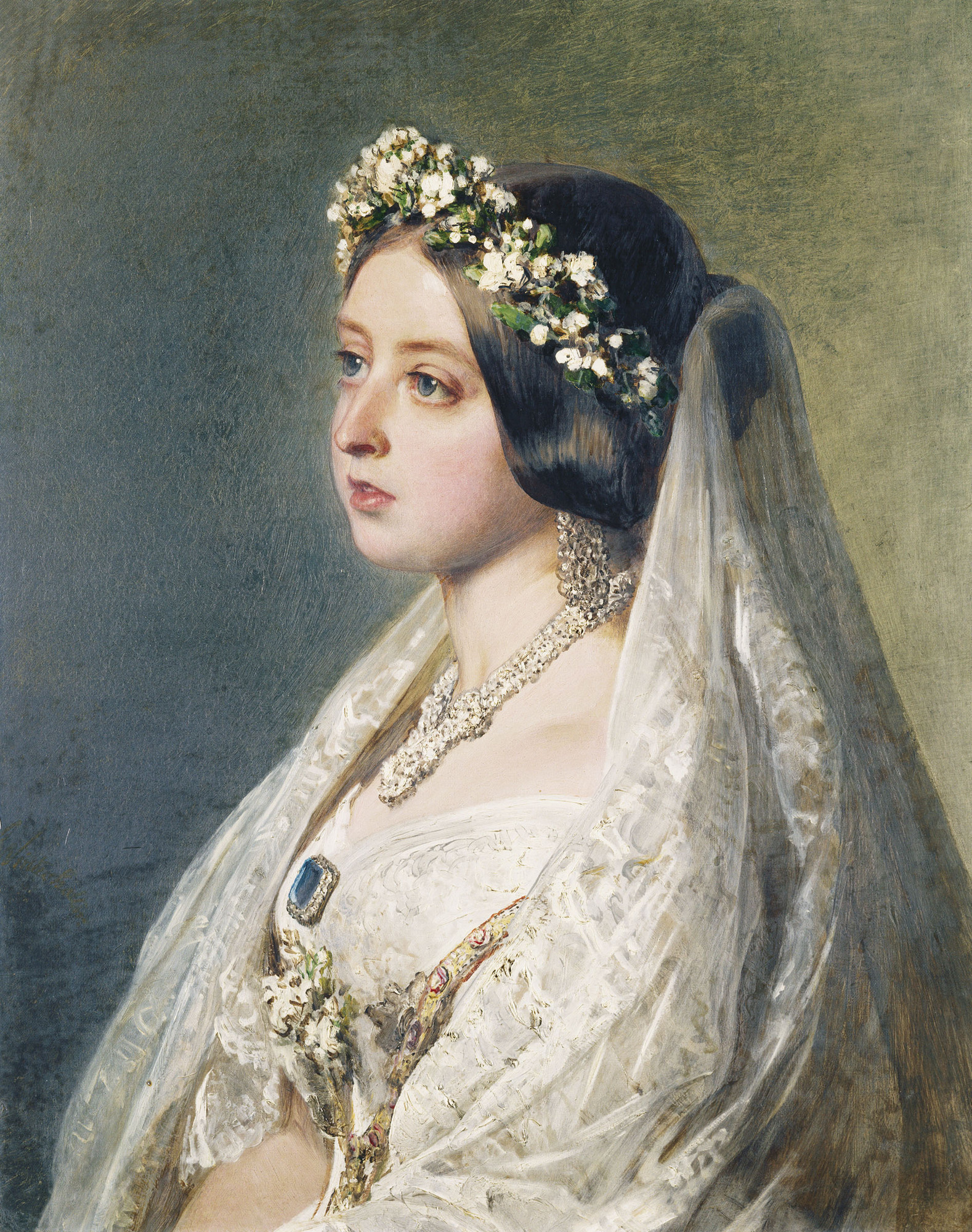
From the Archives: Queen Victoria's Wedding Drew a Crowd, Too.

Monday, May 21, 2018
Queen Victoria in her wedding dress painted 1847
Loretta reports:

The recent marriage of the Duke and Duchess of Sussex sent me back into the archives to look at the excitement that accompanied Queen Victoria's wedding on 10 February 1840, in rotten weather.  Researching for the short story I wrote at the time, I learned, among other things, that royal wedding frenzy is nothing new.
~~~
All ranks of the people in the metropolis, and for many miles around, began to rise before the appearance of the dawn, some to prepare to take their stations in the progress of the approaching great ceremony; but the great multitude, of course, thinking that their exertions would be well repaid, if they could get only a moment's glimpse of the Queen and her husband, or even a glance at the procession going and returning. Notwithstanding the discouraging weather, the streets were crowded at an early hour with thousands, coming from every point of the compass, and making the best of their way, with emulous and unceremonious haste, to St. James's Park, as one common centre. The concourse of females was prodigious. It seemed as if every one of her Majesty's sex, from the infant in arms to the decrepit matron, now far advanced in second childhood, had made a vow not to stay at home. Women, who could not see their way without spectacles, nor walk it without crutches, were to be seen anxiously struggling for precedence at every point of the park, whence a glance at the Queen and Prince might be obtained; and, having once obtained an eligible spot, they held fast by it, heedless of the too frequent probabilities of being crushed or trodden to death. The trees, the lamp-posts, and the spikes of the railings, were contended for with as much eagerness as if the summit of every one's ambition was at the top of one or other of these elevations; and the wonder was, how many, who had climbed up to certain dangerous eminences, could ever get down in safety again. However, these adventurous folks justly thought, that that question was their own " look out," and no one's else's. About ten o'clock St. James's Park was completely filled with a vast, miscellaneous, curious multitude, not a tithe of whom, unfortunately, could see even the carriage of the Queen when it did at length pass.
The Mirror of literature, amusement, and instruction, Volume 35, 1840
Marriage of Queen Victoria

Illustrations:  Franz Xaver Winterhalter  (1805–1873) Queen Victoria, in her wedding dress and veil from 1840, painted in 1847 as an anniversary gift for her husband, Prince Albert.
Source/Photographer. Original painting owned by the Royal Collection. Source of photograph unknown.

The Marriage of Queen Victoria, 10 February 1840, painted by George Hayter 1840-1842. Royal Collection RCIN 407165, via Wikipedia.
Clicking on the image will enlarge it.  Clicking on the caption will take you to the source, where you can learn more and enlarge images as needed.


Tuesday, May 1, 2018

Fashions for May 1843, Supposedly

Tuesday, May 1, 2018
Walking Dresses May 1843
Loretta reports:

I’ve referred many times to the massive amounts of stealing that went on in fashion magazines (and all other publications). As I was looking for a higher-quality image of the plate in the Magazine of the Beau Monde (at left), I stumbled on a fine example. And what makes it especially interesting is the La Mode fashion was listed for February 1843. However, since the plate from the Los Angeles Public Library online collection was detached from the original magazine, it's possible it was incorrectly dated.

If you will click here (right hand column; please scroll down), you’ll not only learn about the Louis XIII style of sleeve and other fashion trends, but you’ll come upon this  charming little note about a style of neckline:
Walking Dresses Feburary 1843

Walking Dresses 1843 Description
A general observation that may have been some time back made, by even a common observer, is the lowness of the corsage at the neck, which however it may be, or may not be, claimed to be the business of some to animadvert upon—it is our part simply to notify. This peculiarity still continues. Those who look particularly demure when travelling out of their province to criticise this fashion, and who advocate, or affect to advocate, a puritanism, in such matters, generally forget that their notions are just formed on what they happen to see, or accustomed to see for some time, in their little circle. Had they been used to see, as the common every-day wear, the style of costume worn at the ballet, and patronized by Her Majesty, and our leading nobility, such a tone of criticism would never have been ventured. In many Oriental countries the drapery of the female costume is carried over both extremities of the person, the eyes only being visible in the out door toilette. Who shall judge? The ladies themselves. What shall decide? Taste.

Magazine of the Beau Monde image: Walking & Promenade Dresses May 1843 courtesy Google Books. Fashion plate description. La Mode Image, courtesy Los Angeles Public Library, Casey Fashion Plates collection.

Clicking on the image will enlarge it.  Clicking on the caption will take you to the source, where you can learn more and enlarge images as needed.

Friday, April 27, 2018

Friday Video: The Fife Tiara, A Wedding Gift for a Royal Princess in 1889

Friday, April 27, 2018

Susan reporting,

With the next British royal wedding fast approaching, the speculation grows daily as to what exactly American Meghan Markle will wear to walk down the aisle with Prince Henry of Wales. Yes, the wedding dress is the greatest mystery - but right after that comes the question of the bride's headdress. Will Meghan go for something simple like a wreathe of flowers, or will she go the full princess-to-be route with a glittering tiara?

The breathtaking tiara featured here already comes with a royal heritage. Created in the 1880s by jeweler Oscar Massin, the Fife Tiara contains approximately 200 carats of diamonds set in gold and silver. It was a wedding gift to Queen Victoria's granddaughter Princess Louise of Wales, below, daughter of Edward VII,  from her new husband, the Duke of Fife; that dukedom was a wedding gift to the groom.

Today the tiara is valued at 1.4 million pounds.  Accepted by the government in lieu of taxes, it was permanently allocated to Historic Royal Palaces for display at Kensington Palace. It can be seen there now as part of the Victoria Revealed exhibition.

If you received this post via email, you may be seeing a blank space or black box where the video should be. Click here to view the video.

Monday, October 23, 2017

A Visit with the late Duke of Sussex

Monday, October 23, 2017
Tomb of Duke of Sussex at Kensal Green Cemetery
Loretta reports:

In my recent post about London’s Kensal Green Cemetery, I mentioned the Duke of Sussex (1773-1843). This son of George III made the place fashionable by deciding to be buried there rather than at Windsor. In life, as in death, Prince Augustus Frederick went his own way.

Though he was a big guy—six foot three and burly—he wasn't hale and hearty. Yet the asthma that plagued him also helped make him “the most consistently Liberal-minded person of the first half of the nineteenth century.” His brothers championed the Whigs in youth, but mainly in rebellion against their father. When he no longer had power over them, their politics went the other way. Not so with Prince Augustus.

Thanks to the asthma, he spent much of his early life abroad and had no military career. He matured free of the influences that shaped his brothers’ politics. Equally important, he had far more time to cultivate his mind. He became a person who supported abolition of the slave trade, Catholic emancipation, parliamentary reform, and many other progressive ideas. These views won him the hostility of, basically, the entire Establishment, including his brothers. They cost him financially, too.

On the other hand, he wasn’t unlike his brothers when it came to women. At age twenty, he fell madly in love with Lady Augusta Murray, daughter of the Earl of Dunmore, and married her, in contravention of the Royal Marriages Act, which required the monarch’s consent. King George III refused, and a decree was issued, annulling the marriage.

Nonetheless, the prince stuck with his woman...until he had to choose between getting the title Duke of Sussex—with £12,000 per annum—and her and their two children. In 1801 he chose the title and money. By 1806 he was bringing legal action to prevent her calling herself the Duchess of Sussex. (She was given a lesser title instead.) By 1809 he took the children to live with him. Still, he didn’t remarry until 1830, after she was dead. The second marriage, to Lady Cecilia Buggin, was problematic, too, until Queen Victoria recognized it in 1840 and made the lady the Duchess of Inverness.
Duke of Sussex , Knight of the Order of the Thistle

The Queen adored her uncle: “When he was dying she drove down in tears to Kensington Palace in an open carriage to inquire for him, although she was hourly expecting the birth of her third child.”

He went his own way in death, too, and it wasn't only in the choice of burial site. In keeping with his very progressive views on dissection, he gave directions in his will for his body to be opened and studied “in the interests of science.” In keeping with his ideals, his is a modest tomb. (So modest that we apparently forgot to take a picture of it.)

For the bulk of this post, and the quotations, I’m indebted to Roger Fulford’s Royal Dukes. When online sources proved unsatisfying—especially regarding the duke’s personality—I remembered this very enjoyable book.

Images: The tomb of Prince Augustus Frederick, Kensal Green Cemetery
Photo by Stephencdickson, Creative Commons license

G.E. Madeley, Prince Augustus Frederick, Duke of Sussex wearing the robes of a Knight Companion of the Order of the Thistle.

Clicking on the image will enlarge it.  Clicking on the caption will take you to the source, where you can learn more and enlarge images as needed.


Thursday, May 11, 2017

Wills and Married Women in the 1800s

Thursday, May 11, 2017
Loretta reports:

Certain of my early 1800s characters—the heroines, usually—will refer in some way to their lack of legal power. Yes, we know they couldn’t vote. But it’s hard for us to grasp just how little control they had over their lives. This excerpt from Tomlins’s Law Dictionary, 1835 edition, dealing with wills, is only one of many I could present. A glance at Caroline Norton’s situation offers several examples of the difficulties women faced.

Even Queen Victoria believed she ought to submit to her husband’s will…to a point. (For an eye-opening, beautifully written exploration of that marriage, I recommend Gillian Gill’s We Two: Victoria and Albert: Rulers, Partners, Rivals).

Married women & wills


Image: Rowlandson, “The Wedding,” from The English Dance of Death 1815

Clicking on the image will enlarge it.  Clicking on the caption will take you to the source, where you can learn more and enlarge images as needed.

Thursday, May 5, 2016

"The Opening of the Great Exhibition by Queen Victoria on 1 May 1851"

Thursday, May 5, 2016

Isabella reporting,

When newsworthy events happen today, the rest of the world is instantly informed by television and social media. Images can become part of our shared consciousness almost as soon as they occur - sometimes even while they're occurring.

Things worked a bit more slowly 165 years ago. In the spring of 1851, the most important event in London was the opening of the International Exhibition of Arts and Manufacture - more customarily (and concisely) known as the Great Exhibition - in the enormous Crystal Palace in Hyde Park. Initiated by Prince Albert, the Exhibition was an early "tech show," showcasing the best manufactured examples of imagination and ingenuity from around the world.The not-so-subtle message, however, was that the creations of Great Britain were hands-down the best in the world, and so the exhibition became as much a tribute to the British Empire as it was to international excellence. Even the Crystal Palace itself was an architectural triumph, a marvel of British engineering.

While over six million people visited the Exhibition between 1May and 11 October, 1851, there were still many more, unable to attend, who wished a glimpse at its wonders. Artists of the day were quick to capture the Crystal Palace and the various exhibits, and while they couldn't post the images on Instagram or Facebook, they swiftly did produce prints of their work that were sold around the world.

The painting shown above was made by Henry Courtenay Selous (1803-1890), and shows the opening day festivities. Of course the Royal Family (above left) is the centerpiece of the composition, but the Archbishop of Canterbury is also there, offering a benediction, as well as many of the dignitaries connected with the exhibition, right. (Except for Queen Victoria and her ladies, these are all male; other women appear to have been relegated to the viewing stands on either side of the ceremony, lower left, the curving brims of their bonnets framing their faces like scallop shells) In the foreground, the dignitaries are all carefully painted portraits, their presence documented.

For that, really, was the purpose of a commemorative painting like this: to preserve an important historical moment for posterity. The painting became an event in its own right, and was publicly exhibited for an admission fee in the year after the exhibition had closed. The large scale of the painting - it's over ten feet wide - meant that details could be studied and appreciated equally by those who had attended the opening and those who had not. In addition, prints were produced and sold commercially, making this one of the most popular and best-known images of the exhibition.

A reviewer in the Art Journal in August 1852 proclaimed: "[This painting] will form an interesting memorial of an event that for many years to come will lose little of its attractiveness in the estimation of thousands." It still does.

The Opening of the Great Exhibition by Queen Victoria on 1 May 1851, by Henry Courtney Selous, 1851-1852. Victoria & Albert Museum.

Tuesday, February 9, 2016

Queen Victoria's Stormy Wedding Day

Tuesday, February 9, 2016
Cruikshank, Very Unpleasant Weather
Loretta reports:

This week in history—
Queen Victoria married Prince Albert of Saxe-Coburg and Gotha on 10 February 1840. I used the event, and the bad weather preceding it, as a backdrop to a short story.


“The weather during the preceding night was more boisterous than any we have experienced during the winter.  It “blew great guns from ten o’clock until sunrise when—
      The dawn was overcast, the morning lower’d,
      And heavily in clouds brought on the day,
      The great, th’important day,
on which were to be celebrated the nuptials of our maiden Sovereign and Prince Albert of Saxe Coburg.

It continued to rain almost without intermission until noon, when the weather partially cleared up and continued fine, but threatening during the remainder of the day.”— The Mirror of Literature, Amusement, and Instruction, 1840
The detailed account of the wedding begins here. And you can find my other blogs on the subject here and here. If you search “white wedding dress,” you’ll find posts explaining that Queen Victoria was not the first bride to wear white.

Image: George Cruikshank, Very Unpleasant Weather,1835, courtesy Yale Center for British Art, Paul Mellon Collection.

Clicking on the image will enlarge it.  Clicking on the caption will take you to the source, where you can learn more and enlarge images as needed.

Tuesday, January 26, 2016

Mr. Curtis's Acoustic Chair

Tuesday, January 26, 2016


Curtis's Acoustic Chair
Loretta reports:

While researching another topic entirely, I came upon Mr. Curtis’s Acoustic Chair. This is another of the items that were familiar enough to people at the time to become the subject of witticisms, while being completely new to me.

“Mr. Curtis, about 1830, by the aid of several mechanics, brought out his acoustic chair, which was stated to possess such wondrous power, that His Majesty could sit in his palace, at Windsor, and hear communications from his ministers at Whitehall. Whether our present Sovereign does not require her ministers to keep at such a distance, and, therefore, has not patronized Mr. Curtis's acoustic chair, or whatever other cause may have operated, probably will never be known, but that gentleman's name does not appear to be continued in the list of Her Majesty's household.”— William Wright, A Few Minutes' Advice to Deaf Persons (1839)


Mr. William Mullinger Higgins’s Philosophy of Sound and Musical Composition (1838), whose relevant pages I show above, contains the shortest and easiest-to-understand explanation I came upon.

You can learn more of the technical details in the Mechanics’ Magazine of January 14, 1837 here.

Another illustration (of the chair at home) and explanation appeared in The Mirror of Literature, Amusement, and Instruction on 18 February 1837 here.

Clicking on the image will enlarge it.  Clicking on the caption will take you to the source, where you can learn more and enlarge images as needed.

Tuesday, July 7, 2015

The Lily Font: Christening Princess Charlotte in Royal (and Historical) Style

Tuesday, July 7, 2015
Isabella reporting,

For a holiday weekend, these last few days have had their share of excitement, from fireworks, Wimbledon, and women's World Cup Soccer. But there was also a much quieter event on Sunday afternoon that had special appeal to us who like history and tradition. Two-month-old Princess Charlotte of Cambridge was baptized at St. Mary Magdalene Church in Sandringham, surrounded by doting family, paparazzi, and a cheering crowd of royal supporters.

There has been plenty already written about how the princess cried, what her mother wore, and how her older brother had a small meltdown at the end of the day (as two-year-olds are entirely entitled to do, princely or not.) Of course the little princess made history simply by being born: thanks to recent changes in the laws of succession, she is the first British princess who cannot be displaced by any future younger brothers, and is now officially fourth in line for the throne. Considering how well Britain has done - and continues to do - under its queens, this is a fine thing indeed.

But I was fascinated by one of the lesser historical features of the christening that no cameras were permitted to capture. In fact, its very arrival in Sandringham from the Tower of London (where it is considered part of the Crown Jewels) was so shrouded in secrecy and high-level security that the man personally responsible for its care has never had his photograph taken with it, in case he might be identified and linked to the priceless treasure's whereabouts.

The Lily Font has been used for all royal baptisms since 1840. Made of silver gilt, the elaborate font features a design of water lilies (lilies in general represent purity, and water lilies are considered a symbol of new life) and harping putti (because putti are babies.) The font was ordered through the firm of E.&W.Smith, and made by Barnard & Co., at the sizable cost of £189 9s.4.d.

The font was ordered by Queen Victoria for the birth of her first child, Victoria Adelaide Mary Louisa, who was born November 21, 1840; her baptism was not until February 10, 1841, her parents' wedding anniversary. That ceremony took place at Buckingham Palace, and earned the Queen's praise: "Albert and I agreed that all had gone off beautifully and in a very dignified manner."

Dignity was important to both Victoria and Albert. The Lily Font was not the first royal silver baptismal font. An earlier one had been made for Charles II in the 1660s. Unfortunately, Charles and his queen, Catherine of Braganza, had had no children between them, but the font had been put to good use for the christenings of a number of his illegitimate children with various mistresses. Not surprisingly, this association was distasteful to Victoria, who did not want her children to use the same font as Charles's royal by-blows - no matter how many other legitimate royal children had made use of it in the 18thc.

Princess Victoria was duly baptized by the Archbishop of Canterbury, with water brought from the River Jordan, exactly as Princess Charlotte was this weekend. From the news photos, the current royal family seemed every bit as happy with the results as Victoria and Albert had been.

Still, one wag wrote in a letter to The Telegraph (London): "Does an archbishop using water from the river Jordan in the Lily Font make you more christened than any old vicar using tap water in a stone trough?" Well, no; but it certainly must have made for a beautiful and history-laden ceremony.

Above: The Lily Font, 1840, by Barnard & Co.  The Royal Collection Trust/© Her Majesty Queen Elizabeth II.

Thursday, June 11, 2015

Queen Victoria, a Polka, & 8,000 Soldiers, 1853

Thursday, June 11, 2015
Isabella reporting,

The most popular image of Queen Victoria today is the one shown in late 19th c. photographs: a short, stout, elderly woman in widow's weeds, staring grimly away from the camera.

But it was a much different queen that captivated her subjects early in her reign. Victoria was only 18 when she was crowned queen in 1837, and 21 when she married Albert of Saxe-Coburg and Gotha. She was painted, drawn, and engraved to show her to flattering advantage as a small, slender, and pretty young woman. The majority of the country would never see her in person, and in those days long before television, this image of the elegant queen was the one that was accepted and revered.

It was also an image used to sell everything from fashionable clothing to soap. The young queen's reign coincided with technological advancements in wood engraving, and color printing (chromolithography) in the 1840s that made illustrated news and culture magazines like the Illustrated London News and Harper's Weekly  both more affordable and more lavish. Gone were the days when prints were laboriously and often crudely colored by hand. Now consumers wanted color illustrations on everything, and publishers were happy to oblige.

These same middle-class consumers were also buying pianos for their parlors and sheet music to play on those pianos. There was an explosion of new social dances to learn - waltzes, polkas, and quadrilles - plus themes from popular plays and arias from the latest operas. To entice buyers, sheet music for these pieces was titled with names that would tie them to popular public figures, political events, exotic locations, and even scientific discoveries, and printed with beautiful illustrations on the covers.

The sheet music for The Camp Polka, above, combines several trends. Printed in London in 1853, the illustration shows the summer camp on Chobham Common in Surrey. The Chobham Camp was the scene of the first large-scale military maneuvers in England since the Napoleonic Wars. Patriotic fervor is usually at its highest right before a war. With the Crimean Wars looming in the future, the spectacle of 8,000 men and 1,500 horses drew crowds of spectators - including Queen Victoria and Prince Albert. Here the stylishly uniformed queen and prince, riding on spirited steeds, are shown surveying the camp in a neatly arranged show of British might and military prowess. Patriotism, royal celebrities, and horses: what better way to market a polka?

Many thanks to Andrea Cawelti, Ward Music Cataloger, Houghton Library, Harvard University, for her assistance with this post.

Above: The Camp Polka by Chas. d'Albert, sheet music for solo piano. Lithographed by John Brandard, published in London: Chappell, 1853, by M.& N. Hanhart. Harvard University Library. 

Thursday, June 4, 2015

Who Drives in Rotten Row?

Thursday, June 4, 2015
Hyde Park Corner
Loretta reports:

It’s been a while since I wrote my traditional Regency stories, and I’m not sure whether I allowed my characters to travel in a carriage in Rotten Row or realized this would be a faux pas. I’ve written about it before (here—with maps!)

“The right to drive along the Row in a carriage remained the prerogative of the reigning sovereign; as late as 1832, a map of London published by the United Kingdom Newspaper marked Rotten Row as ‘The King’s Private Road.’”
—Joyce Bellamy, Hyde Park for Horsemanship (1975)

Samuel Sidney’s Book of the Horse (1880) confirms this.
Rotten Row

As does Baron Redesdale’s Memories (1916)

Yet searching online leads to confusion. I find many books, by 19th C as well as recent authors, referring to driving in Rotten Row. Did these writers confuse Rotten Row with the carriage road running more or less parallel to it? A blog post indicates the Row was not restricted to riders until 1834, and certainly some caricatures seem to support this.Some 19th C authors describing Hyde Park say the rule was not in effect until Queen Victoria’s time, while others believe it dates to King Charles II or King William IV.

In any event, Queen Victoria was in no doubt whatsoever about her prerogative.
The Queen's Drive
Since my current books are set after 1830, I feel comfortable keeping my fictional carriages off Rotten Row.
Hyde Park after 1736-Larwood
Images: George Cruikshank, “The Arrival, or Western Entrance to Cockney Land” (first published in The English Spy 1825);  "Out of Place" from Punch, scanned from Hyde Park for Horsemanship; Hyde Park after 1735 from Larwood, The Story of the London Parks (1874).

Clicking on the image will enlarge it.  Clicking on the caption will allow you to read at the source, where you can learn more and enlarge images as needed.


Thursday, November 20, 2014

Queen Victoria proposes to Prince Albert

Thursday, November 20, 2014
Prince Albert
Loretta reports:

On 23 November 1839 Queen Victoria announced her engagement to Prince Albert of Saxe Coburg.  The story, as told in Gillian Gill’s We Two: Victoria and Albert: Rulers, Partners, Rivals is interesting, indeed, for Her Majesty was in charge.


“She imposed upon Albert a series of tests and ordeals.  The prince had to beg through family intermediaries for an invitation to come to England to see the Queen.”  The invitation was quite a cool one, apparently.  Then, “After Victoria had looked Albert over and decided that, indeed, he was the husband she was looking for, her first impulse was not to clasp her beloved in her arms but to go into delicious conclave with her prime minister over how exactly she should propose and what arrangements would have to be made for the wedding.”

England wasn’t happy about her choice.  Albert was foreign and poor.  Caricatures, insults, and mocking poetry ensued. Parliament voted him an allowance of only £30,000, though in the 17th century, Prince George of Denmark, Queen Anne’s spouse, had received £50,000.

Victoria is engaged
I’ve clipped from a lengthy memoir in the 1839 Mirror of Literature, Amusement, and Instruction, which, along with detailing his pedigree, gets in a few subtle digs about the Saxe-Coburg family’s amazing success in marrying English royals.  Leopold, King of Belgium by this time, had been “a simple major in the Austrian service” when he married Charlotte, Princess of Wales (only legitimate offspring of King George IV).

For more dish on Victoria & Albert, I highly recommend (again) We Two.

Illustration: Prince Albert, a print "after George Baxter, 1804–1867" made after 1855.  Image courtesy Yale Center for British Art, Paul Mellon Collection.

Clicking on the image will enlarge it.  Clicking on the captions will allow you to read at the source, where you can learn more and enlarge images as needed.

Sunday, October 19, 2014

From the Archives: Queen Victoria's Baby Tooth Brooch, 1847

Sunday, October 19, 2014
Isabella reporting:

Yes, it's that finish-the-infernal-manuscript time again, and so for today I'm sharing a favorite post from our archives. 

I'll freely admit that I'm as sentimental as most mothers, and that like a lot of us, I squirreled away my children's first lost baby teeth as mementos. They're tucked in my desk, inelegantly sealed in business envelopes, preserved for...something.

But then, I'm not Queen Victoria (1819-1901).

When Victoria's oldest child, the Princess Victoria, Princess Royal (1840-1901), shed her first baby tooth, it, too, was preserved, though not in a lowly envelope. The seven-year-old princess's father, Prince Albert (1819- 1861) tugged the tooth free himself in 1847, while the royal family was visiting Ardverikieby Loch Laggan, as a guest of the Duke of Abercorn. As a memento of both the enjoyable visit (Victoria was so smitten with Scotland that she soon purchased Balmoral Castle as her own retreat in the Highlands) and to commemorate the landmark event in Princess Vicky's young life, Albert had the tooth made into a special brooch, left, for Victoria. Set in gold, the tooth forms the blossom of a gold and enamel thistle, the symbolic wildflower of Scotland. A "private" piece of jewelry as opposed to royal jewels for state occasions, the small brooch had never been shared with the public until 2010, when it was included in the Victoria & Albert: Art & Love exhibition at Buckingham Palace.

It's easy to dismiss a brooch featuring a baby's tooth as one more example of slightly macabre 19th c. taste, but in some circles, such mother's jewelry is still made and worn. Check out actress Susan Sarandon's custom-made bracelet, featuring her children's assorted baby teeth as the charms.

Above: Brooch, gold, enamel, & tooth, 1847. Commissioned by Prince Albert for Queen Victoria. Photo copyright The Royal Collection.

Tuesday, May 20, 2014

Fashions for May 1854

Tuesday, May 20, 2014
View at source here
Loretta reports:

Yes, dear reader, you have read the date correctly.  After all this time of dissing Victorian fashions, I’ve decided to rethink the matter.  Partly because sticking to the first 37 years of the 19th century (pre-Victoria) has grown a little … boring.  Partly because I’ve been reading Dickens again.  Partly because I truly believe that every fashion period has certain bright points.  And partly because a great many more historical romance authors are now setting their stories in the Victorian era, and their ladies, too, deserve attention.

So I present for your consideration what’s always been one of my least favorite fashion eras—the mid-nineteenth century.  Although it’s hard to escape the “woman in a cage” or "bell-shaped female" image, I’m ready to reinterpret, and see what's pretty about the styles.  Are you?  I think we can agree that this plate is quite beautifully done, in any case.

Read at source here
The fashions, as indicated, are from Godey’s Lady’s Book, courtesy the Internet Archive. (If you decide to look up the magazine on Wikipedia, please be aware that the article contains the usual legend about Queen Victoria being the first bride to wear white, a fashion myth the 2NHG have politely disproved on numerous occasions.)

Clicking on the images will allow you to enlarge them.  Clicking on the captions will take you to the source, where you can enlarge further, for easier viewing/reading.

Sunday, January 5, 2014

Fashions for January 1827, with White Wedding Dress

Sunday, January 5, 2014
View online here

Loretta reports:

Well, how could I resist this promenade dress?  Meant for walking or driving, it makes some concession to the January weather, with the chinchilla trim and muff. Oh, and the hat!  But equally interesting, I trust, is the white wedding dress.  As we've discussed before (including here and here), white wedding dresses were not at all uncommon before Queen Victoria’s wedding in 1840.
View online here


Read online here


Read online here


Fashions from Ackermann's Repository, January 1827, from the Internet Archive, courtesy Philadelphia Museum of Art

Thursday, August 1, 2013

A Royal Baby is Born in 1840

Thursday, August 1, 2013
Victoria, Princess Royal, 1842
Loretta reports:

While, unlike the Duchess of Cambridge, Queen Victoria didn’t have the media camped outside the hospital or dogging her every move, she did not exactly have privacy, either.  If you follow the link to the rest of the account (too long to post here), you may be surprised at how public the birth of her first child was.
~~~
The Court.
The town was taken somewhat by surprise on Saturday afternoon, by the announcement that the Queen had given birth to a Princess. For although the event was expected to occur shortly, the wise in such matters had set it down for some days later. The ringing of bells, however, which spread from spire to spire, strengthened the report as it ran from mouth to mouth; and in a little while a royal salute from the Tower-guns confirmed it. In the evening, the following official announcement was published in a London Gazette Extraordinary—
     
      "Buckingham Palace, 21st November 1840.—This afternoon, at ten minutes before two, the Queen was happily delivered of a Princess. His Royal Highness Prince Albert, her Royal Highness the Dutchess* of Kent, several Lords of her Majesty's Most Honourable Privy Council, and the Ladies of her Majesty's Bedchamber, being present.
      "This great and important news was immediately made known to the town, by the firing of the Tower guns; and the Privy Council being assembled as soon as possible thereupon, at the Council-Chamber, Whitehall, it was ordered, that a form of thanksgiving for the Queen's safe delivery of a Princess be prepared by his Grace the Archbishop of Canterbury, to be used in all churches and chapels throughout England and Wales, and the town of Berwick-upon-Tweed, on Sunday the 29th of November, or the Sunday after the respective ministers shall receive the same.
      "Her Majesty and the young Princess are, God be praised, both doing well."
      The Court Circular contains the following official record of the circumstances and observances with which the event was ushered in—
     
1867
"Her Majesty was taken unwell at an early hour on Saturday morning, and the medical gentlemen were in consequence summoned to Buckingham Palace…”

      Read the full account here.
           
 *Spelling has not been corrected.
Illustrations courtesy Wikipedia:  above, Winterhalter, Portrait of Victoria, Princess Royal, 1842, below:, Winterhalter, The Princess Victoria, Princess Royal as Crown Princess of Prussia in 1867.

Thursday, June 20, 2013

Victoria Becomes Queen

Thursday, June 20, 2013
Loretta reports:

On 20 June 1837, Princess Alexandrina Victoria became Queen, and promptly dropped the “Alexandrina”—neither the first nor the last example of her independent spirit.  She had a mind of her own, and nobody, even Prince Albert, succeeded completely in crushing that powerful sense of self.

I had always felt sorry that she hadn’t a longer time to enjoy her independence before marrying Prince Albert, who was actually the “Victorian” in the sense we understand Victorian morality.  In spite of a childhood that reads like a Gothic novel or a Victorian melodrama, in spite of being ruled and jealously guarded by bullies, she had promised to be a possibly saner version of her pleasure-loving uncles (although her fashion tone-deafness would have horrified King George IV).  She was smart, well-educated, fun-loving, spirited, open-minded, and frank.

We've all heard that  Prince Albert turned her into a prude.  But that isn’t the whole story.

He never completely crushed the spirited girl, and he didn’t get his way in everything, as Gillian Gill  points out in her brilliant biography, We Two: Victoria and Albert: Rulers, Partners, Rivals.  It deals with their marriage, yes.  But it also provides one of the most moving and insightful accounts I’ve ever read of the events preceding her birth, most notably the life and death of Princess Charlotte, King George IV’s only legitimate child.

I’ve read lots of biographies, and they’re not always scintillating.  And frankly, I had given up reading about her because, well, it's too depressing. But this book reads like a novel.   I bought it some years ago, and find myself returning to it again and again.

For one thing, it gave me the impetus to celebrate today the bright beginning of her story as monarch.  On 20 June 1837, Albert was still in the future, and she was a survivor, enjoying a hard-won triumph over her ghastly childhood.  She was experiencing the first precious moments of freedom, and embarking on the role for which she’d been preparing for eighteen years.

We Two is a 2NHG Library recommendation.  No disclaimer is required because I bought it with my very own money.

 
Two Nerdy History Girls. Design by Pocket