Showing posts with label historic trades. Show all posts

Sunday, December 9, 2018

Eighteenth-Century Fashion: A Trio of Petticoats on Display at the Massachusetts Historical Society

Sunday, December 9, 2018
Susan reporting,

I've already written here about the current exhibition, Fashioning the New England Family,  at Massachusetts Historical Society in Boston, MA. Among the first pieces greeting visitors in the exhibition are a trio of petticoats, each with a different story to tell. (As always, please click on the images to enlarge them.)

Regardless of their status, all 18thc women in New England wore some form of a petticoat: a straight, full garment that covered the lower body and legs, and gathered and tied at the waist. In its most basic form, a petticoat could be made of rough linen, and worn alone like a modern skirt. At the other luxurious extreme, a petticoat could be made of silk and richly embroidered as the lower half of a costly, stylish gown. Some petticoats were also quilted, a welcome layer of warmth against a cold Massachusetts winter as well as another way to display a costly textile and decorative stitching.

The most elaborate of the petticoats on display was part of a wedding dress, detail right, worn by nineteen-year-old Elizabeth Bull at her marriage to Rev. Roger Price in Boston in 1735. The daughter of a wealthy merchant, Elizabeth had access not only to the celadon silk for the gown, but also both the leisure time to devote to designing and stitching the elaborate motifs and the budget to purchase the imported silk threads used in the embroidery.  I've featured this petticoat and the rest of the dress in three earlier posts here, here, and here, where there are many more photographs.

A brilliant yellow silk petticoat, middle left, from the 1750s was worn by Temperance Pickering (1732-1823) of Newington, NH. (The petticoat is displayed with c1780 stays, or corset, made from wool, linen, kidskin, and whalebone.) While the petticoat's maker is today unknown, the bold geometric design of the quilting remains as a testament to her skill. Beneath the yellow silk is an interlining of flax, quilted to the lining of yellow and white checked wool that make the petticoat both elegant and warm. The nearly 300-year-old silk has begun to break down, or shatter, near the waist, detail left, revealing the downy flax interlining.
The third petticoat, upper left and lower right, is a modern reproduction, commissioned by the MHS and beautifully hand-sewn and hand-quilted by our good friends from the Historic Trades program at Colonial Williamsburg: Janea Whitacre, Christina Johnson, Rebecca Starkins, and Sarah Woodyard. (For a brief video about their process, click here.) The petticoat is made of pale blue silk with wool wadding as an interlining and a linen lining.

Yet while new, this petticoat also has a New England history. Family tradition linked the original petticoat to a 17thc Massachusetts ancestor, Hannah Hudson, and was said to have been passed down through her family. The quilting design was traced from this original through a pricked paper pattern in 1896 by a descendent, Alice (Scott) Brown Knight Smith. Sadly the original silk petticoat was destroyed in the fires that followed the San Francisco earthquake of 1906. Realizing the value of the surviving pattern, Mrs. Smith had it transferred to muslin, and then gave it to the MHS. That pattern, lower right, was the one followed by the CW mantua-makers to make their stunning reproduction. (The petticoat is shown with mid-18thc stays, or corset, made of brocaded silk, linen, and leather.)

The quilting pattern and the reproduction are typical of wide quilted petticoats worn over hoops in the 1720s-1730s. However, as the exhibition's placard notes:

"Like many stories connected to family relics, Alice Smith's account of the original petticoat proved problematic as we began to examine it in detail. The purported original owner, Hannah Hudson Leverett, died between 1643 and 1646. How then can we explain the fact that, at present, the earliest documented extant petticoats with this type of quilted design in North America date from c1720-1730s, more than seven decades after Hannah's death? This is a mystery that begs to be unraveled - and so our research continues."


Regardless, the new petticoat not only recreates the one that was lost, but also proves that the tradition of 18thc fine hand stitching demonstrated in the other two original petticoats on display is still continuing today.

Many thanks to Anne Bentley and Kimberly Alexander for giving me a special tour of the exhibition, and for including me in the planning from the earliest stages. 

The book that accompanies the exhibition - generously illustrated with many full-color photographs - is being published by the University of Virginia Press. It can be pre-ordered here.

Middle right: Petticoat, detail, embroidered by Elizabeth Bull, c1731-1735, Boston Society.
Lower left: Petticoat, unknown maker, c1750s, University Museum, University of New Hampshire.
Stays, unknown maker, c1780, University Museum, University of New Hampshire
Upper left and lower right: Quilted petticoat from a pattern given by Alice (Scott Brown Knight Smith, 1953. Made in 2018 by Janea Whitacre and Christina Johnson, with Rebecca Starkins and Sarah Woodyard, Historic Trades & Skills Milliners & Mantua-makers of The Colonial Williamsburg Foundation. Courtesy of The Colonial Williamsburg Foundation.

Thursday, October 18, 2018

So Who Wore Round-Ring Pattens in the 18th Century?

Thursday, October 18, 2018
Susan reporting,

I wrote earlier this week here about the wavy-ring 18thc pattens - a kind of overshoe with a wooden sole and a metal ring intended to raise the wearer's shoes above wet or otherwise unpleasant terrain - that were being recreated and worn as part of the Historic Trades program at Colonial Williamsburg.

In the course of my discussion about the pattens with apprentice tinsmith Jenny Linn and journeywoman blacksmith Aislinn Lewis (both of whom were involved in the creation, wearing, and research of the replica pattens), we also spoke of a slightly different kind of 18thc pattens. Although the wooden sole and leather straps and laces are much the same, these pattens feature a round metal ring as a support. While the wavy-ring pattens offer plenty of surface area and almost resemble the treads of modern winter boots, the narrower base of the round-ring style would be much more precarious for both balance and walking.

This, however, may be because they weren't intended for walking. Jenny and Aislinn suggested that this type of pattens served an entirely different purpose. In 18thc prints, the round-ring style is usually shown worn by housemaids indoors, and often with a  a bucket and mop nearby.

Examples include Piety in pattens, or, Timbertoe on tiptoe, upper left, with a tall maidservant made even taller by very high round-ring pattens.  In How are you off for soap, middle right, the ring-bottom pattens are worn by a laundress, whose work would also include splashing soapy water.

The maid of all work in Roberteena Peelena, lower right, not only wears the round-ring style, but has pinned her petticoat up to avoid the wash-water. The maid in the painting A City Shower, lower left, has stepped outside with her bucket, and vigorously twirls her wet mop while poised (rather daintily) on her round-ring pattens. (A side-note: apparently rolling the mop's handle across the forearms instead of with the wrists looks like it was the accepted method of mop-twirling.)

When the round-ring style appears in prints being worn outdoors in the streets, they seem to be a way that the caricaturist is indicating that the wearer is of a lower or serving class, and a woman who is (in the cruel manner of 18thc caricatures) humorously lower class, unstylish, or down on her luck (here and here.)

From these sources, it appears that the the round-ring style was worn primarily indoors rather than out, to raise the wearer above soapy water spilled on a wet floor. They may also have served to protect a clean, wet floor from dirty shoes, rather than protecting the shoes from the water. Unfortunately there doesn't seem to be any primary source documentation in the form of letters or journals to explain this further. If anyone has come across such research, I hope you'll share it.

Many thanks to Jenny Lynn and Aislinn Lewis for their assistance with this post.

Upper left: Pattens, leather, wood, & iron rings, c1780-1800, Victoria & Albert Museum.
Upper right: Piety in pattens, or Timbertoe on tiptoe, published by M. Darly, 1773. Walpole Library, Yale University.
Middle left: Detail, How are you off for soap, published by William Elmes, 1816. Walpole Library, Yale University.
Lower right: Roberteena Peelena, the maid of all work by William Heath, 1829, British Museum.
Lower left: Detail, A City Shower by Edward Penny, 1764, Museum of London.

Tuesday, October 16, 2018

The Omnibus Comes to London

Tuesday, October 16, 2018
 Loretta reports:

Last year, during my visit to the London Transport Museum, I encountered a form of public transportation I hadn’t paid much attention to previously.

The omnibus was first introduced in Paris, and it was a Parisian coach-builder, George Shillibeer, who brought the concept to London.
“The route which Shillibeer chose for his first omnibus was from the Yorkshire Stingo at Paddington, along the New Road to the Bank. The New Road was the name by which Marylebone, Euston and Pentonville Roads were then known.

 ... On the morning of July 4, 1829, Shillibeer's two new omnibuses began to run. A large crowd assembled to witness the start, and general admiration was expressed at the smart appearance of the vehicles, which were built to carry twenty-two passengers, all inside, and were drawn by three beautiful bays, harnessed abreast. The word "Omnibus" was painted in large letters on both sides of the vehicles. The fare from the Yorkshire Stingo to the Bank was one shilling; half way, sixpence. Newspapers and magazines were provided free of charge. The conductors, too, came in for considerable notice, for it had become known that they were both the sons of British naval officers—friends of Shillibeer. These amateur conductors had resided for some years in Paris, and were, therefore, well acquainted with the duties of the position which they assumed. The idea of being the first omnibus conductors in England pleased them greatly, and prompted them to work their hardest to make Shillibeer's venture a success. They were attired in smart blue-cloth uniforms, cut like a midshipman's; they spoke French fluently, and their politeness to passengers was a pleasing contrast to the rudeness of the short-stage-coach* guards—a most ill-mannered class of men. Each omnibus made twelve journeys a day, and was generally full.”
— Henry Charles Moore, Omnibuses and Cabs 1902
Though his omnibus was a success, Shillibeer contended with fierce and often unscrupulous competition and the NIMBY inhabitants of Paddington Green—although “the threatened doom of Paddington Green did not deter the sentimental poke-bonneted young ladies, who resided in the charming suburb, from spending a considerable amount of their time in watching the omnibuses start. In the middle of the day many of them were in the habit of taking a ride to King's Cross and back, for the sole purpose of improving their French by conversing with the conductors.”

Anecdotes like this abound, including tales of theft by the paid conductors who soon replaced the gentlemen. Since space doesn’t permit me to quote at length, I recommend you read at least Chapter II of the first part for yourself.


*Short-stage coaches, which had been in existence from the mid-18th century, ran—slowly, expensively, and unpunctually—from the suburbs to the City and the West End.

Images: Photos of Loretta in omnibus at London Transport Museum, View of Exterior London Transport Museum Omnibus, and Announcement Marking the End of the Omnibus Era taken at London Transport Museum, copyright © 2018 Walter M. Henritze III.

Clicking on the image will enlarge it. Clicking on a caption link will take you to the source, where you can learn more and enlarge images as needed.

Sunday, October 14, 2018

Recreating (and Wearing) a Pair of 18thc Pattens

Sunday, October 14, 2018
Susan reporting,

Writing about the past is an ever-changing (and ever-exciting) challenge, and research is one of my absolute favorite parts of the process. I'm always eager to read or hear of new discoveries or fresh perspectives on old ideas, and I never know what may inspire a new character or plot twist.

All of which has brought me back to pattens, a kind of 18thc under-shoe raised up on a metal ring. I've already written a post about them here on the blog.

But while on a recent visit with some of my friends in the Historic Trades program in Colonial Williamsburg, I've come to realize that the subject of pattens is much more complicated.

Fragments of c1770s pattens with a wave-like base, or ring, were discovered in several archaeological digs in Williamsburg, Virginia, and inspired a project at Colonial Williamsburg to recreate them. While pattens would have been the specialized work of a professional patten-maker in 18thc England, in 21stc Colonial Williamsburg they required the skills of several different tradespeople.

Aislinn Lewis, journeywoman blacksmith, made the wavy rings and hardware that held the ring and straps to the sole, and completed the final assembly. Jay Howlett, journeyman artificer and leatherworker, made the leather straps and leather laces. Paul Zelesnikar, journeyman wheelwright, carved the wooden soles from ash. Jenny Lynn, apprentice tinsmith, has worn the finished pattens as part of CW programming. All of them contributed historical research and construction suggestions.

While the fragments were clearly worn in colonial Virginia, no documentation has yet been found to prove that pattens were being made or even sold in the colony at that time. It's probable that the pattens were imported from England, and possibly considered such mundane objects that they weren't listed for sale in newspaper advertisements.

The replica pattens are based not only on the fragments, but also on other, more complete examples that survive in other museum collections. Pattens were inexpensive, workaday footwear that likely didn't have a long life. The flat wooden soles were carved to fit beneath the wearer's shoes, and were held in place by a leather strap that tied across the instep. The metal ring raised the wearer about an inch above the muck of 18thc life, protecting her shoes.

But as Jenny Lynn actually wore the pattens, she discovered a number of things that scholars hadn't realized. First of all, walking in pattens is an acquired skill. Jenny likens it to walking in high-heeled mules. Because there's no back-strap, the wearer's weight must push forward onto the ball of the foot, or she'll walk right out of the soles. An 18thc woman who wore pattens regularly would have been familiar with how best to walk in them, but a certain amount of shuffling must have been unavoidable.

While the assumption has always been that pattens were worn on the notoriously unclean 18thc city streets, Jenny found that this kind of patten would be almost impossible to wear on cobblestone streets, where the rings would slip and tip and lead to sprained ankles and falls. They seem much better suited to the softer surfaces of a more rural life, like an unpaved path or street. Jenny found they work particularly well in mud or wet grass, though if worn by a wealthier woman than a lowly apprentice (sorry, Jenny), the pattens also probably served for making a short journey from a house to a waiting carriage.

The photos here show Jenny (in the blue petticoat) and Aislinn (in the red petticoat) holding the various components to the pattens, as well as close-ups of the soles and rings, and the pattens both on and off the foot. Perhaps my favorite photo is lower right, with the distinctive marks left by the patten-rings mingling with the modern sneaker-treads of CW visitors. The video, below, shows Jenny walking in them.

Many thanks to Jenny Lynn and Aislinn Lewis for their assistance with this post!

All photographs ©2018 by Susan Holloway Scott.

Monday, September 24, 2018

The Landau Carriage

Monday, September 24, 2018
1809 Landau
Loretta reports:

My characters get from here to there in various horse-drawn vehicles, but mainly I've posted about public transportation, like hackney cabs and coaches. Privately owned vehicles have been rather neglected, although I do offer images on my Pinterest page.

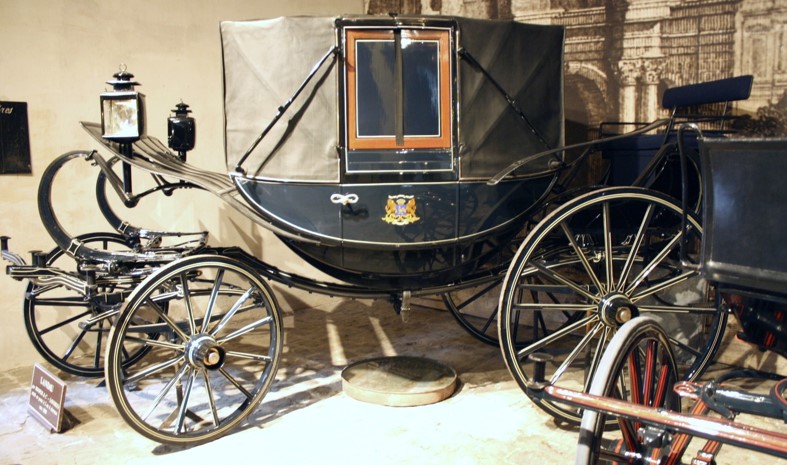
In A Duke in Shining Armor, the heroine arrives in a landau to collect her wayward duke. The landau was a coachman-driven vehicle, pulled by two to four horses. It carried four passengers, and was more luxurious than the curricles and cabriolets that dashing heroes tend to drive in our stories. The latter are more like sports cars. The former are more like luxury sedans.

Something to bear in mind: Unlike today, vehicles did not come off an assembly line. They were individually made, and the owner might have been closely involved in the design.* Consequently, not all landaus look alike. Earlier ones were often built on square lines, but not always, as the 1809 Ackermann illustration, above, shows. Some interesting aspects of the landau, as pointed out here, are the seating design, allowing the two pairs of passengers to face each other, and the two folding hoods. According to Discovering Horse-Drawn Carriages, “In the early days, the hoods were made of harness leather and fell back a mere forty-five degrees.” When these early hoods were up, the interior could be hot, stuffy, and smelly, thanks to the oil and blacking used to keep the leather nice and shiny. In later vehicles, the hoods folded back flat.
Square Landau

A much later and fancier vehicle, one of the royal family’s Ascot landaus, was the carriage the Duke and Duchess of Sussex (aka Harry & Meghan) used for their wedding.

Here’s a late Victorian landau from the Horse and Carriage Museum Château de Vaux-le-Vicomte, France. And this is one you can buy.

You can read more about landaus here at All Things Georgian.

*This is why some vehicles, like the Stanhope gig, are named after people.

Images: Patent Landau, Ackermann’s Repository, February 1809; Square Landau, NEN Gallery, Luton Culture Museum Service.

Clicking on the image will enlarge it.  Clicking on the caption will take you to the source, where you can learn more and enlarge images as needed. And just so you know, if you order an item through one of my posts, I might get a small share of the sale.

Monday, July 30, 2018

Happy 155th Birthday, Henry Ford

Monday, July 30, 2018

Loretta reports:

Today, 30 July, is automaker Henry Ford’s birthday. I’ve shown you some parts of the Fort Myers, Florida estate he shared with inventor Thomas Edison, here, here, and here.

I’ve also pointed out the way that the motorcar was quickly adopted for long-distance travel, even though the cars broke down frequently, roads could be little more than wagon tracks, and gas stations and auto mechanics were unheard of. But none of these obstacles stopped Americans from getting on the road and going—either on cross-country races or south, for warmer weather. With the advent of affordable autos came the Snowbirds—the Tin Can Tourists I posted about here and here.

All the same, I didn’t really know much about Ford beyond what little we learned (and mostly forgot) in school, back in the last century, about U.S inventors and innovators.

But I happened on this feature (please scroll down to the second article) at the Library of Congress site, which puts Ford and his world into perspective. Along with songs and recollections, it also provides an early film of an automobile parade—which was probably not the horse’s favorite experience that day.
First & ten millionth Ford 1924

Sharp-eyed readers will note the “Ford Song” by one “A. Flivver, composer.” Flivver is early 20th century slang for an automobile.

Images: Photo above left 1919 Model T at Edison-Ford estate, Photo copyright © 2018 Walter M. Henritze III.  At right,  First and ten millionth Ford (1924), courtesy Library of Congress Prints and Photographs Division Washington, D.C. 20540 USA. 
Clicking on the image will enlarge it.  Clicking on the caption will take you to the source, where you can learn more and enlarge images as needed.

Sunday, May 13, 2018

Women and the Continental Army at Valley Forge, 1777-78

Sunday, May 13, 2018

Susan reporting,

I'm fortunate to live near Valley Forge National Historical Park, which is not only the site of the 1777-78 winter encampment of the Continental Army during the American Revolution, but also a beautiful 3,500 acre park that includes a rivers, streams, forests, and tall-grass meadows.

On Saturday, I visited the park for the history, and a special program devoted to telling the stories of the approximately 400 women (along with about 10,000 soldiers and 2,000 support staff) who were part of the encampment.

Too often the role of women in connection to the 18thc army is overlooked, ignored, or reduced to mean-spirited camp-follower jokes. In reality, women were an important part of the army's day-to-day life, especially during the months-long winter encampments. Women (and children) who followed the army were paid to wash the army's laundry, sew and mend garments, cook food and bake bread, and tend the sick and wounded. The majority of these women were wives and other family members of the soldiers, who ate and slept as families with their husbands' messes. They also remained connected to the army during the summer campaign season, following at a distance from the army on foot behind the baggage wagons. These were strong women, in every sense of the word.

At the other end of the social scale, the wives of officers - including Martha Washington, the wife of the army's Commander-in-Chief George Washington - often left their homes during the war's "off season" and traveled to join their husbands at the winter encampment. Their primary role was undeniably less arduous, but also important. In addition to providing an air of genteel civility for their husbands and the other officers, these ladies helped entertain influential foreign dignitaries visiting the camp as well as members of Congress who came from Philadelphia to review the troops and conditions. In this capacity, they were often unofficial lobbyists who helped promote the army's needs and concerns. They also sewed, knitted, and mended for the soldiers - although, as officers' wives, they weren't paid for their labors.

Local women also participated in the market area near the encampment. Opened by Gen. Washington's proclamation in February 1778, the market helped supply fresh provisions to his army by permitting the inhabitants of local farms to sell their goods directly to soldiers. Strictly regulated, the market was a beneficial arrangement for both parties. Not only were the soldiers able to obtain fresh food at a fixed, fair price, but the farmers in turn were able to preserve their crops from foraging soldiers. Although small in scale - the wares of the market vendors would vary from week to week depending on what was available from farms - these local women provided fresh food to augment the soldiers' diets. The market was successful for another reason as well: any food sold to the Continental encampment was food that would not end up in the hands (and mouths) of the British army occupying nearby Philadelphia.

The program at the park showcased many of these women. There were farm women selling the first onions and cabbages of the season, laundresses washing linens, seamstresses stitching shirts, a weaver weaving on a portable tape loom, spies ready to explain secrets and codes, bakers baking bread in a hillside bake oven, and cooks cooking a sausage, onion, and apple stew over an over fire which smelled mighty tasty indeed. There was even an experienced medical woman with a fine display of lancets and scarifiers (I must have missed the leeches) who would have been happy to bleed you to relieve your foul humors.

And in one of the cabins, General Nathanael Greene's wife Catharine Littlefield Greene was charming James Lovell, the visiting Congressman from Massachusetts, with tea, tarts, and 18thc jests from a popular magazine of the time.

Hosted by the Park and their "Mom's Army" programming, Saturday's immersive event was largely the creation of two related reenactment groups: Colonel Ogden's First New Jersey Regiment, and the Continental Line (CL) Laundry and Women's Activities Club, led by organizer Samantha Vogeley.

The members of these groups were engaging and incredibly knowledgeable, and generous with that knowledge, and I can't thank them enough for putting up with all my questions. It was also an opportunity to meet in person fellow history-fans that I've known only through social media.

I can't say exactly where or when all this new 18thc knowledge will be put to use, but I can pretty much guarantee it will turn up someday in a book. How can it not, when the research was this much fun?

One final note in light of some of our recent discussions here at TNHG: Every woman participating in the event was wearing period-correct clothing, including boned stays (18thc corsets.) I'm happy to report that despite the many heavy iron kettles hoisted over fires and water-filled oak buckets lifted, no one fainted.

All photos ©2018 Susan Holloway Scott.
There are many more photographs from the event on Facebook, taken by Molly Pictures Studio. The link is here.

Tuesday, May 8, 2018

From the Archives: What the Mantua-Maker's Apprentice Wore, c. 1775

Tuesday, May 8, 2018

Susan reporting:

Since I'm currently mired deep in deadline-itis, I'm sharing another older post from 2012 featuring the clothing of 18thc. working women.

Collections of historic clothing are usually filled with the clothes of the rich and famous, which can give the misguided impression that everyone in the past wore silk and lace. Not quite; but the dress of ordinary folk is more difficult to find (and, for us writers, to imagine), because not much of it survives. Clothing was expensive, and most was worn until it was worn out. Garments were patched and mended and handed down, refashioned (see here) and recut until there was often nothing left. Even rags were useful, with a gentleman's fine linen shirt eventually ending up as bandages or rags for the paper maker.

All of which is why I especially enjoy seeing what our mantua-maker friends in the Margaret Hunter Shop, Colonial Williamsburg, are wearing to work. While they might be stitching fine silk, for the most part they're dressed as their 18th c. counterparts would have dressed. A shopkeeper's assistant or apprentice in the fashion trades was expected to dress as stylishly as possible within her means, and their clothes often reflected the latest fashions sewn in more modest fabrics. Stylish was good for trade - she was, after all, a walking advertisement for the shop - but not so stylish that she rivaled the customers by dressing above her station. (As always, please click on the photos to enlarge to see details.)

Here Sarah Woodyard is dressed as a mantua-maker's apprentice c.
1775. Her gown is a reproduction of a closed-front English gown with the skirts looped up into two puffs in the back. While this style would have been most fashionable in silk, it's here made up in block-printed cotton. The printed pattern features a meandering vine and tassel motif which would also have been copied from expensive woven silks. The single color would have made the fabric more affordable, too, but the design of the gown – carefully cut to make the most of the cloth's pattern – more than compensates.

While the gown has no costly silk ribbons or trimmings, the apprentice's fine linen cap features not only a wide silk bow, but also extravagant pleating for maximum effect. Her kerchief and apron are also fine white linen, and her white thread stockings and quilted petticoat also contributes to the impression of a neat and tidy assistant. I like the subtlety in the white-on-white textures; if you look closely, you'll see that there's a woven check in her neck kerchief, and diamond-patterned quilting in her petticoat. There's another spot of color in the heart-shaped red pincushion - an essential part of the trade - that hangs ready at her waist, and more in her red ribbon garters. Everything except the stockings was cut and stitched by hand by Sarah herself, just as any good apprentice should.

But it's her shoes that are truly eye-catching. As we've seen before, the 18th c was a glorious time for women's shoes, and these are no exception, made from red silk with yellow leather-covered heels and brass buckles. Sarah is particularly proud of these shoes, since she made them herself while working in CW's shoemakers' shop – see her carving the heels from wood here.

Many thanks to Sarah Woodyard for assistance with this post.

All photographs copyright 2012 Susan Holloway Scott.

Wednesday, May 2, 2018

From the Archives: What the Maidservant Wore, c1770

Wednesday, May 2, 2018

Susan reporting,

A reader recently left this comment on one of Loretta's posts:  "It is hard to see a woman dressed in some of the outfits of the 18thc or post-1820s doing something as normal as changing a diaper or holding a teething baby. The clothes are for women as objects and not clothes for women who did anything." 

I can't answer for the 19thc clothes (I'll leave that for Loretta), but the majority of women in the 18thc did manage to lead active, fashionable lives in the clothing of their times. True, the elaborate dresses worn for court appearances were designed for display rather than practicality, but no one today expects a woman in a $20,000 wedding dress or in haute couture for the red carpet to be tending an infant, either. But the silhouettes and styles created by the very best mantua-makers of the elite class in Georgian times would have gradually filtered down to women of lesser means, who adapted and modified and made the fashions their own. It might have been only a ribbon rosette, or petticoats looped through pocket holes to copy the look of a dress a la polonaise, but fashion was a part of everyday life.

As for the practicality of 18thc clothes: elite women in hoops, stays, and powdered hair danced all night in heeled shoes. They rode to the hunt, made perilous voyages by sea from Europe to America and India, and explored classical ruins. Women wearing stays, ruffled caps, and heels worked in nearly every one of the traditional skilled trades, as blacksmiths, printers, weavers, cooks, bakers, tinsmiths, jewelers, silversmiths, and much more. Women in stays and layers of petticoats followed their soldier-husbands to war, carrying their belongings as they marched behind the army. And while some of these women did have nursery maids (who were also usually wearing those same stays, ruffled caps, and heeled shoes) to help with child-rearing, the majority did not, and did it themselves. 

I'll climb down from my soap-box now, and introduce a post from 2012 that echoes these same themes. 

We've seen what a stylish British mantua-maker's apprentice might wear in the shop in the 1770s, what a female blacksmith or other laboring woman might wear at her work, and, what, too, a housewife might wear as she went about her day. Now Abby Cox, one of our knowledgable friends from Colonial Williamsburg, shows us what a woman in domestic service might wear. (Her clothes are modern replicas, not 18th c originals, but cut and sewn entirely by hand in true 18th c fashion.)

Uniforms for female servants were a 19th c. innovation. While Georgian-era male servants were often provided with livery, their female counterparts - whether at the top of the servant-ladder as ladies' maids or lowly maids-of-all-work - were expected to provide their own clothing from their meager wages. They were also expected to dress in a manner that was modest, fit for their station, tidy, and clean. Samuel Johnson noted that "women servants. though obliged to be at the expense of the purchasing their own clothes, have much lower wages than men servants, to whom a great proportion of that article is furnished, and when in fact our female house servants work much harder than the male."

Here Abby is wearing an untrimmed English-style gown of a woven striped cotton. The gown has inverted back pleats to shape the waist, and is worn over a plain dark linen petticoat (the under-skirt) and a white linen apron. She has looped her skirts up both to help keep them clean, and to mimic the elaborate skirts of more fashionable gowns - though the effect in the soft cotton fabric lacks the exuberance of poufs of crisp, costly silk.

She also wears white thread stockings, low-heeled buckled shoes, and a linen kerchief tucked around her shoulders. Beneath her gown, her figure is shaped by her stays (corset), which every respectable young woman would wear - see here for more about her stays. Her only indulgence is her cap, ruffled white cotton trimmed with a silk ribbon. While Abby's dress is suitable for a servant, it could be equally worn by a young woman working in a tavern or shop, or simply at home.

Like nearly all 18th c women's clothing, regardless of cost, Abby's gown is pinned closed in front (see detail, left). While men's clothing fastened with buttons and ties, women pinned their clothes together with straight pins; the points of the pins were safely buried in the multiple layers of gown and stays. Pinning was not only a neat finish, but also offered an endless, practical range of adjustments to a woman's changing body.

Photographs by Susan Holloway Scott. Many thanks to Abby Cox for being our maid servant!

Thursday, April 26, 2018

What Ordinary People Wore in the Early 1800s

Thursday, April 26, 2018
1808 Woman Churning Butter
Country Fair 1808
Loretta reports:

Given comments on my last blog, it seemed like a good time to look at resources for what working people wore. Susan and I have written about tradespeople and servants here, here, here, here, here, and elsewhere.

They are rarely the subjects of portraits, although they might be included in scenes of, say, a great estate. Also, a few employers actually had at least some of their servants’ portraits painted. Later in  the 1800s, Victorian servants appear in quite a few photographs. But for those of us who are looking at English dress before photography, there are other ways to get an understanding of what ordinary people wore.

William Henry Pyne is one of my go-to illustrators. I have two reprints of his work dealing with this subject: Picturesque Views of Rural Occupations in Early Nineteenth-Century England and Pyne's British Costumes.

Online, there’s also his Etchings of rustic figures, for the embellishment of landscape.

Rustic figures
Rustic figures
Other sources include satirical prints. Though we need to be aware of exaggerations, they generally seem to get the clothing details right. Images in Ackermann’s Microcosm of London show ordinary people as well as those of the upper orders.

In some cases, we see a distinctive uniform for a trade or profession. The watermen or firemen, for instance. Others might wear a certain type of vest. Many professions and trades required badges. Whether one’s clothes were in fashion or not would depend on one’s business. A dressmaker, for instance, would need to look up-to-date. For haymakers, it was another case entirely.

Images:
14. A woman churning butter with a cloth apron tied about her waist and a mob-cap on her head, another woman milking a cow beyond. Title page lettered "The Costume of Great Britain. Designed, Engraved , and Written by W. H. Pyne." "London: Published by William Miller, Albermarle-Street. 1808." Courtesy the British Museum
Couple at fair looking at a clown and a bell ringer, W.H. Pyne, [1808], courtesy Library of Congress Prints and Photographs Division Washington, D.C. 20540 USA
Rustic figures from Pyne, Etchings of rustic figures, for the embellishment of landscape.

Rowlandson, Thames Watermen from Miseries of London 1807I courtesy the Metropolitan Museum of Art.

Clicking on the image will enlarge it.  Clicking on the caption will take you to the source, where you can learn more and enlarge images as needed.

Monday, April 23, 2018

Fashions for Mature Women in the 1800s

Monday, April 23, 2018
Lady Anne Hamilton at age 49
Loretta reports:

A reader asked, “Do you have any fashion plates of older women?”
The answer is no. Whether it’s the 1800s or the 1900s or the 2000s, fashion is most usually displayed on younger women.

The fashions I post monthly seem to be mainly for married women. In France, for instance, unmarried young women were expected to dress with almost nunlike simplicity; and it’s my sense that young English women, while not dressing as severely as their French counterparts, generally did dress more demurely than matrons, at least through the Regency.

Still, there’s nothing matronly about the fashion prints. The images are always of young, slender women with, depending on the era, ridiculously tiny waists. I’ve yet to see older faces or plumper bodies. The fashion plates always show the idealized youthful image of the time.

Then as now, that is the way fashion is sold. A style blog focused on the over-forty woman offers an explanation that I believe is applicable to previous centuries of fashion merchandising.

Today, we do see the occasional exception. A few brands will feature 40+ models and/or fuller-figured women in their advertising. But these are rare. Rarer still are mature and/or fuller-figured models on the runways. This always seems to be the case, even though older women are buying the clothing.

To get an idea of what older women wore in earlier eras, we need to turn to portraits. It's possible that the subject isn’t necessarily wearing the latest fashion. Then as now, a woman might have stuck with a style she found comfortable and believed becoming. However, when it comes to royals and aristocrats, the portraits are generally very stylish, which makes sense: Since they could afford to buy new things all the time, and they weren't shy about showing off their wealth, they were more likely to wear the current fashion when they had their portrait painted.
Maria Amalia of Naples & Sicily about age 57

Let’s also not forget that well-off people were not buying their clothing ready-made. The fashion plate would be no more than a possible starting point. A lady would have her favorite dressmaker, who would adapt styles or create a distinctive look. Though the fashion plates featured young women, I suspect older women then would have had a better chance than we do of getting clothes that fit and flattered them. Dressmakers were far from rare, labor was cheap, and the competition for customers was fierce: It was simply good business to make the customer look great, no matter what her age or figure.

Images:
James Lonsdale, 1815 Portrait of Lady Anne Hamilton (1766–1846), lady-in-waiting to Queen Caroline1815
© Victoria and Albert Museum, London.

Louis-Édouard Rioult after Louis Hersent, Portrait of Maria Amalia of Naples and Sicily (1782-1866) about 1839
Current location Palace of Versailles 

Clicking on the image will enlarge it.  Clicking on the caption will take you to the source, where you can learn more and enlarge images as needed.


Monday, April 16, 2018

From the Archives: How Many Handsewn Stitches in an 18thc Man's Shirt?

Monday, April 16, 2018

Susan reporting,

Since Loretta's last post featured men's neckcloths, it seemed like a fine time to share this post from the archives about the shirts worn with those neckcloths.... 

In the 18thc, a man's linen shirt was perhaps the most democratic of garments. Every male wore one, from the King of England to his lowest subjects in the almshouse, and though the quality of the linen and laundering varied widely, the construction was virtually the same.

Contrary to the modern belief that the people of the past were dirty slobs (a bugaboo we NHG are always trying to banish), Georgian men were fastidious about their shirts. Men were judged by the cleanliness of their linen. From laundry records of the time, it's clear that the majority of men changed their shirts daily, and in the hot summer months, it wasn't unusual to change twice a day. This wasn't just a habit of wealthy gentlemen, either. Tradesmen, shopkeepers, and others of the "middling sort" had a good supply of shirts in their wardrobes, a dozen or so on average.

While most of these shirts were purchased from tailors, shirts were one of the few garments that women could make at home for their husbands, brothers, fathers, and sons. Eighteenth century shirts were loose-fitting, geometric garments, all precise squares and rectangles with straight seams. They weren't difficult for the average seamstress to construct - keeping in mind that everything was being sewn by hand before the invention of the sewing machine. The precision of that seamstress's stitching would make them not only more attractive, but also more long-wearing through the rough-and-tumble laundering (no gentle cycle) of the time. But how long would it take to make such a shirt? And how many stitches must be taken in the process?

When I was visiting the Margaret Hunter millinery shop in Colonial Williamsburg last month, the mantua-makers (whose seamstresses can make men's shirts just as readily as the tailors) were pondering this exact question. A chart in the July, 1782 issue of The Lady's Magazine, right, calculated the "number of stitches in a plain-shirt", perhaps to provide the amateur seamstresses among their readers with a number to impress the home-stitched shirt's wearer. The Magazine's estimated total was an impressive 20,619 stitches for a man's shirt.

The Margaret Hunter seamstresses took these calculations a step further. Working an average of 30 stitches per minute at a gauge of 10 stitches per inch, it would take approximately eleven and a half hours to stitch a shirt. Of course that doesn't take into account the time for cutting threads, finishing a thread, or threading needles, nor for cutting out the pieces to be sewn, and it also doesn't make allowances for the individual seamstress's speed. While the needles in the Margaret Hunter shop seem to fly, the ladies freely admit that they'd probably be considered slow in comparison to their 18thc counterparts who sewed from childhood.

More about 18thc shirts here and hereMany thanks to Janea Whitacre, mistress of the mantua-making trade, Colonial Williamsburg, for her assistance with this post.

Left: Shirt, maker unknown, linen, probably made in America, c1790-1820. Winterthur Museum.
Photograph © 2014 by Susan Holloway Scott.
Below: Excerpt from The Lady's Magazine, July, 1782.

Thursday, April 12, 2018

The Neckcloth Part 1

Thursday, April 12, 2018
David, Pierre Sériziat, 1795
Loretta reports:

Not very long ago, a reader who’d happened upon Susan’s post about 18th C men’s shirts, asked what an English gentleman’s stock was made of, saying, “In painting of the era it seems to be of a very light material as there are multiple folds.”

I brought the question to Mark Hutter, Master Taylor in Colonial Williamsburg’s Historic Trades Department.

The answer, as is the case so often with fashion, is, “It depends.” But he did clarify further, as well as guiding me toward several resources for my investigation. A gentleman’s choice of fabric to put around his neck would depend on the time period as well as the occasion, his bank account, and his personal taste. As Mark pointed out to a visitor, there’s no “typical.”

Because it’s a huge subject, I’m picking one era, place, and financial situation, the one in my stories: early 19th C British gentlemen of the upper classes.

According to Ian Kelley’s Beau Brummell, the dandy’s neckcloth was “a triangle of fine Irish muslin, cut diagonally from a square yard and plainly seamed.” From what I can ascertain, fine Irish muslin would have been quite expensive.
Regency style neckcloth

It gets tricky, distinguishing between cotton and linen fabrics. Undergarments like shirts, neckcloths, collars would be referred to as “linen,” though they might be made of other material. Good cotton, however, as far as I can discover, wasn’t cheap. The famous muslin dresses Regency ladies wore were made of fabric imported from India, and like their miles-long cashmere shawls, displayed their wealth.

Mark mentioned lawn and cambric, terms some of our readers might have come across in their reading. According to Harmuth’s Dictionary of Textiles, lawn is “a plain woven, very light, soft, smooth and sheer cotton or linen wash dress goods ... similar to cambric but lighter.” Irish lawn is “very fine, plain woven, bleached lawn, made of pure, hard-spun ply linen yarn.”

To answer the reader’s question, then, the neckcloths in the portraits were of quite fine material, most likely of linen or muslin. The white neckcloth* we see so often in Regency portraits would have been lightly starched to allow one to create the correct folds. Too much starch would make it too stiff. Usually. A few styles, it turns out, demanded stiffer fabric. But that’s another topic.

In the next post, we’ll take a look at the incredibly tricky business of tying these things.

*They came in other colors, as well as in silk, but we’ll deal with that later, too. Eventually.

Image: Jacques-Louis David, Portrait of Pierre Sériziat, 1795, Louvre Museum
English: A Regency style neckcloth tied in a bow on a starched Grafton collar. Attribution: CharlieHuang at English Wikipedia

Clicking on the image will enlarge it.  Clicking on the caption will take you to the source, where you can learn more and enlarge images as needed.

Sunday, March 18, 2018

An Unfinished Gown with Secrets to Share, c1785

Sunday, March 18, 2018
Susan reporting,

Historical clothing is collected, preserved, and valued for many reasons. A garment can be considered significant because it belonged to a famous person, or because it belonged to a person whom history has forgotten entirely. Another item could be treasured for the family story behind it, or could have been worn to a significant historical event. A garment can be treasured because it represents the highest level of craftsmanship and skill, or because was fashioned from rare and costly textiles.

And then there is this dress in the collection of Colonial Williamsburg. (Those of you who attended the Costume Society of America 2018 Symposium in CW last week will recognize it from the keynote discussion.) Made in America of printed cotton around 1785-1795 and purchased by CW in 2004, the dress is a popular style of the time known as a common gown. The open-front dress would have been worn over a petticoat (skirt), stays, and a false rump, and would also have had 3/4- or wrist-length sleeves. Depending on the light, the ground-color of the printed cotton appears either dark purple or brown, though chemical analysis has shown it was originally a shade with deep red overtones from a cochineal-based dye.

The reason this gown holds a special place in the CW collection, however, is not what it is, but what it isn't: it was never finished. While sufficiently assembled for fitting, the gown still has extra-wide seams allowances that would eventually be trimmed away and basting threads to hold the pleats in place and to indicate where trim would be added. Most notably, stitching holes indicate that sleeves (now lost) had once been stitched in place, and were then removed. The armholes are quite high, and it's possible that they didn't fit the intended wearer. 

Still, no one now knows why the dress was abandoned so close to completion. Yet in this state, the dress reveals a rare glimpse at the mantua-maker's working and construction methods; it's frozen in time, there at the final fitting. In addition, the unworn dress presents a glazed, printed cotton in a pristine condition. For the sake of preserving this glazed finish, it's unlikely that the dress will ever go on public display and risk light-damage to the delicate surface. See more images of the original dress plus descriptions of how the fabric was produced here on the CW e-museum website.

The dress is also unusual for another reason. Most surviving 18thc dresses tend to be small - not because all 18thc women were petite, but because in an era when remodeling and recutting clothing was common, the smaller gowns didn't offer enough fabric to make recycling feasible. This gown was intended for a tall woman - 5'10" or even taller - with a 46" bust and a 42" waist.

While the original gown is primarily a study garment in the collection, it has already inspired several copies. First, the printed cotton fabric has been commercially reproduced for sale (it can be ordered by the yard here.) An exact one-to-one copy of the dress to be used for study was created by CW's Costume Design Center, who also made another copy to be worn as a costume in the historic area.

Finally (at least for now) the mantua-makers of the Margaret Hunter shop in CW's historic trades program made a technological reproduction, recreating the dress using 18thc hand-sewing and other period-correct techniques. This version was completed based on other similar dresses from the period, and is shown right worn by Janea Whitacre, mistress of the mantua-making trade. It's stunning in person - which makes you wonder all over again why the original was never finished.

Left: Gown, maker unknown, 1785-1795, Colonial Williamsburg Foundation. Photograph courtesy of Colonial Williamsburg.
Right: Technological reproduction gown, made the Margaret Hunter shop, Colonial Williamsburg, 2018. Photograph ©2018 Susan Holloway Scott.
 
Two Nerdy History Girls. Design by Pocket