Showing posts with label paintings. Show all posts

Tuesday, August 21, 2018

Woman Reads, Wearing a Bonnet Indoors—Really?

Tuesday, August 21, 2018
Blacklock, A Quiet Read
Loretta reports:

A short time ago, this image appeared on social media, with a question about women wearing hats indoors while reading. This sort of thing leads to my putting on my deerstalker hat and sticking the pipe in my mouth—but not the needle in my arm—and sleuthing.

My collection of historical dress images includes a goodly number of early 19th century ones in which women are indoors, reading, wearing a headdress. They are usually in morning dress, and the headgear is a cap. Some caps are so elaborate, though, that at first glance they seem to be hats, like the English lace cap on the left in this image.

This fashion plate, of a promenade dress, definitely shows a hat (straw), and the woman is holding a book open. Since she’s wearing a rosary and cross,  she could be in church, and that could be a prayer book she’s holding. Or not. We often see Regency-era fashion plates of women wearing crosses with evening dress: It’s jewelry.

However, the painting in question is not from the Regency era. It comes from the late 19th/early 20th century, during a period of Regency nostalgia. In the early 1800s, Jane Austen was liked in some quarters, dismissed in others, but essentially no big deal. It wasn’t until the 1880s that she became a rock star. At this time editions of her books illustrated by the likes of Hugh Thomson and C.E. Brock begin to appear, and we start to see a Regency revival in painting. The image in question is from this Regency revival/nostalgia era, when artists like Edmund Blair Leighton, Frederick Morgan, Frédéric Soulacroix, Giovanni Boldinim and many others created their versions of the Regency (and Empire) eras.

Kennington, Lady Reading by a Window c 1900
Looking into this later time period offered a little more enlightenment. William Kay Blacklock’s painting is dated circa 1900. In the late 1800s/early 1900s, I did find a few images of women reading, indoors, wearing hats, like this one by Frederick Carl Frieseke, and this one by James Guthrie.

In conclusion, I can’t altogether explain it, but the image might be historically inaccurate only for the era it’s conveying. Or maybe not. Maybe the lady is sitting in the dentist’s office, waiting her turn. Or maybe she's waiting for her boyfriend to come and collect her for a drive in Hyde Park. Or maybe, as author Caroline Linden suggested, "She's getting ready to go out but just wants to finish one last chapter..." What do you think?


If you've seen other images with this reading-indoors-wearing-a-hat theme, please feel free to share.


My thanks to Lillian Marek for sending me on this very interesting and educational investigation!

Images: William Kay Blacklock, A Quiet Read, possibly circa 1900; Thomas Benjamin Kennington, Lady Reading by a Window; Gandalf’s Gallery via Wikipedia.

Clicking on the image will enlarge it.  Clicking on the caption will take you to the source, where you can learn more and enlarge images as needed.

Sunday, July 8, 2018

A Bold & Forthright Kiss, c1780

Sunday, July 8, 2018
Susan reporting,

Last week, I shared this unusually intimate 18thc painting on my Instagram and Facebook pages in honor of the hashtag #InternationalKissingDay. The painting has long been one of my favorites, and I've been thinking of all the other things I'd wished to say about it that didn't fit in a short caption. So here are those thoughts, along with the painting itself for those of you who didn't see it last week.

The majority of kisses in 18thc Western art of the "stolen kiss" variety (like this.) In the past, the women in stolen kiss themes were considered coy, or making la feinte resistance (a false resistance), or in mid-20thc parlance, just "playing hard to get." Today it's difficult to look at pictures like that and not think about the Me Too movement, and how often the man is shown aggressively forcing himself on a woman who'd much rather be saying no, but can't.

The artist of this watercolor is Nicolas Lavreince - also Lawreince and Lavrince - (1737-1807), a Swedish painter whose work was heavily influenced by the French rococo style of Nicolas Pater and Jean-Honore Fragonard. Most of his paintings are cheerfully gallant scenes of boudoirs and bedrooms showing pretty young women with their lovers, though he had his sleazy, queasy side, too (like this.)

All of which makes this painting the more unusual.  Here, the woman is clearly the one in control. She appears to have interrupted the gentleman at his breakfast. He's wearing an open banyan or robe de chambre over his shirt and breeches with mules on his feet - the 18thc equivalent of a robe and slippers - to show he's likely just risen from his bed. The table is set for him alone, with only one plate and cup.

The lady, however, is fully dressed for day, in a stylish gown, kerchief, cap, and stays. She appears to have just arrived, since her dark cloak is tossed over the back of the chair. She's clutching a small nosegay of flowers; has she brought that to him? There's clearly a sense of surprise, as if she's the one who's caught him in his male version of a boudoir. Here he was, quietly eating his solitary breakfast, when all of a sudden this young woman is HERE, sitting on his knee and shoving open his shirt and banyan and kissing him. It's quite the ambush - not that he objects. His hand curled around her hip to hold her steady on his thigh proves that. And if there's any doubt that this is intended to be a reversal of more customary scenes, the sketchy oval painting on the wall shows a traditional couple with the man reaching from behind the woman to kiss her and cradle her breasts.

Some art historians believe that this shows an encounter between a gentleman and a prostitute, arguing that the only possible explanation for the woman being so forthright in her desire is that she's being paid to do so. I'd rather think that, in this case, turnabout was fair play.

Le déjeuner en tête à tête by Nicolas Lawreince le Jeune, c1780, Musee Louvre.

Monday, June 18, 2018

From the Archives: Intrepid Women: Elizabeth Thompson, Lady Butler: Painter of Battles & Soldiers

Monday, June 18, 2018

Since this week is marks the commemoration of the Battle of Waterloo (the battle was fought on June 18, 1815), this painting and its celebrated artist seem like the perfect subject to share again.

Susan reporting,

Being a professional painter in Victorian England was a difficult path for a woman, but for Elizabeth Southerden Thompson (1846-1933), left, success came swiftly, and with unexpected subjects.

Born in Switzerland to wealthy English parents who believed in travel as a form of education, Elizabeth began her art training in Italy and London as a teenager, concentrating on religious subjects. While studying in Paris, she first saw the work of French painters chronicling heroic battle scenes. Inspired, her first military history painting, Missing, earned her admission to the Royal Academy in 1873.

But it was Calling the Roll after an Engagement, Crimea, or The Roll Call, right, (click on the images to enlarge) painted in 1874 when she was only 28, that made her a celebrity. Showing the haggard survivors of a battalion of Grenadiers answering the roll call after a battle, the painting was an enormous success, drawing such great crowds that a special policeman was hired to keep order. In an unprecedented move, the painting was even removed from the Academy wall and carried to Buckingham Palace so Queen Victoria could view it privately. Her Majesty was as impressed as everyone else, and bought the picture for the royal collection.

Miss Thompson next turned to Waterloo for inspiration, completing The 28th Regiment at Quatre Bras, below left, in 1875, another popular success. Her large, detailed canvases were the equivalent of big-screen extravaganzas that fed the imagination and patriotism of the British Empire, then at its pinnacle. But she also focused on the suffering of the ordinary soldier, emphasising the cost of war as well as its glory. Her battle pictures are also unusual because they most often depict the scene from the (doubtless intimidated) enemy's point of view, who are seldom shown. She was fastidious in her research, having replica uniforms made for her models. More military-themed paintings followed, and she became one of the most acclaimed artists of her time.

The public was not only fascinated by the art, but Miss Thompson herself. How was it that a young and attractive English lady could paint such vivid scenes of heroism and suffering that Crimea veterans praised their accuracy? Even the influential art critic John Ruskin was impressed by Quatre Bras - in spite of his determined preconceptions:

"I never approached a picture with more iniquitous prejudice against it than I did Miss Thompson's; partly because I have always said that no woman could paint; and, secondly, because I thought that what the public made such a fuss about must be good for nothing. But it is...the first fine Pre-Raphaelite picture of battle we have had; profoundly interesting, and showing all manner of illustrative and realistic faculty. Of course, all that need be said of it...must have been said twenty times over in the journals; and it remains only for me to make my tardy genuflexion, on the trampled corn, before this Pallas of Pall Mall."

In 1877 she married Sir William Francis Butler, and her career fell behind not only that of her husband, an officer in the British Army, but her new role as a mother. She joined her husband on his posts around the world – Egypt, Zanzibar, South Africa, as well as his home in Ireland – and bore and raised their six children. While her artistic production diminished, she still continued to paint military scenes, including the heroic Scotland Forever!above, in 1881. Regarded as her finest painting, it's also undeniably her most dramatic, depicting the start of the charge of the Royal Scots Greys at the Battle of Waterloo in 1815. (To show how cinematic this painting is - and the influence it had upon later movie-makers - see this clip of the same charge from the 1970 movie Waterloo.) She also painted and drew scenes from her travels.

But the most lasting blow to Lady Butler's career is one that many artists face. By the beginning of the twentieth century, tastes in painting had changed, and her meticulously detailed history paintings were seen as hopelessly old-fashioned in the face of new, more abstract movements like Cubism. Even more damning was the shifting perception of armies and battles after the modern horrors of World War One. The grand heroic warfare with patriotic gestures and splendid uniforms of the past no longer had a place in the public imagination, and in 1924, the last painting she submitted to the Royal Academy was rejected. She died in 1933.

In addition to her paintings, Lady Butler also wrote three books, including her autobiography. It's available to read or download for free here; her illustrations, like the one lower right, are included and are wonderful, full of excitement that matches the life she lived.

Top: Scotland Forever!, 1881, Leeds Art Gallery.
Upper right: Calling the Roll after an Engagement, Crimea, (or The Roll Call), 1874, The Royal Collection Trust.
Upper left: The 28th Regiment at Quatre Bras, 1875, National Gallery of Victoria.
Middle right: Self-Portrait by Elizabeth Southerden Thompson, Lady Butler, 1869, National Portrait Gallery.
Lower right: "Got it, Bravo!" illustration from An Autobiography, 1922.

Monday, April 23, 2018

Fashions for Mature Women in the 1800s

Monday, April 23, 2018
Lady Anne Hamilton at age 49
Loretta reports:

A reader asked, “Do you have any fashion plates of older women?”
The answer is no. Whether it’s the 1800s or the 1900s or the 2000s, fashion is most usually displayed on younger women.

The fashions I post monthly seem to be mainly for married women. In France, for instance, unmarried young women were expected to dress with almost nunlike simplicity; and it’s my sense that young English women, while not dressing as severely as their French counterparts, generally did dress more demurely than matrons, at least through the Regency.

Still, there’s nothing matronly about the fashion prints. The images are always of young, slender women with, depending on the era, ridiculously tiny waists. I’ve yet to see older faces or plumper bodies. The fashion plates always show the idealized youthful image of the time.

Then as now, that is the way fashion is sold. A style blog focused on the over-forty woman offers an explanation that I believe is applicable to previous centuries of fashion merchandising.

Today, we do see the occasional exception. A few brands will feature 40+ models and/or fuller-figured women in their advertising. But these are rare. Rarer still are mature and/or fuller-figured models on the runways. This always seems to be the case, even though older women are buying the clothing.

To get an idea of what older women wore in earlier eras, we need to turn to portraits. It's possible that the subject isn’t necessarily wearing the latest fashion. Then as now, a woman might have stuck with a style she found comfortable and believed becoming. However, when it comes to royals and aristocrats, the portraits are generally very stylish, which makes sense: Since they could afford to buy new things all the time, and they weren't shy about showing off their wealth, they were more likely to wear the current fashion when they had their portrait painted.
Maria Amalia of Naples & Sicily about age 57

Let’s also not forget that well-off people were not buying their clothing ready-made. The fashion plate would be no more than a possible starting point. A lady would have her favorite dressmaker, who would adapt styles or create a distinctive look. Though the fashion plates featured young women, I suspect older women then would have had a better chance than we do of getting clothes that fit and flattered them. Dressmakers were far from rare, labor was cheap, and the competition for customers was fierce: It was simply good business to make the customer look great, no matter what her age or figure.

Images:
James Lonsdale, 1815 Portrait of Lady Anne Hamilton (1766–1846), lady-in-waiting to Queen Caroline1815
© Victoria and Albert Museum, London.

Louis-Édouard Rioult after Louis Hersent, Portrait of Maria Amalia of Naples and Sicily (1782-1866) about 1839
Current location Palace of Versailles 

Clicking on the image will enlarge it.  Clicking on the caption will take you to the source, where you can learn more and enlarge images as needed.


Friday, March 23, 2018

Friday Video: A Moving Panorama of the Mississippi Valley

Friday, March 23, 2018
Loretta reports:

Many of the 1830s magazines I peruse include reviews of recently installed panoramas (please scroll down for the review about Niagara Falls). The moving panorama is also a large painting, but where the panorama requires the viewer to move around a room, the moving panorama is an early "moving picture." Using spools, it scrolls across a stage, creating the illusion of traveling along a scenic route.

Before photography and movies, both the still and the moving paintings offered Londoners as well as Americans views of distant locales. Since the Londoners seem to have been especially curious about the U.S. and its wildernesses, I’m sure they would have enjoyed John J. Egan’s “Panorama of the Monumental Grandeur of the Mississippi Valley”—all 348 feet of it, and a very rare survivor.


Video: John J. Egan's "Panorama of the Monumental Grandeur of the Mississippi Valley"

Credits Animation: Paul Caro Photography: Saint Louis Art Museum © 2015 The Metropolitan Museum of Art. Image is a still from the video.
Readers who receive our blog via email might see a rectangle, square, or nothing where the video ought to be. To watch the video, please click on the title to this post or the title of the video.

Sunday, June 25, 2017

What Story Is This 18thc Painting Telling?

Sunday, June 25, 2017
Susan reporting,

Earlier in the year, I posted this painting on Instagram along with close-ups of various details. The painting is so intriguing that I'm going to assemble my rambling observations here as a blog post as well - please feel free to offer your own interpretations! (And, as always, click on the images to enlarge them.)

The artist is Louis Rolland Trinquesse (c1746-1800), a Frenchman who specialized in creating titillating scenes like this that his wealthy patrons craved. With that in mind, I doubt that the title the painting has now - An Elegant Interior with Two Ladies and a Gentleman - was what it was originally called. I'm sure it went by something much more suggestive and saucy; that's just the kind of picture it is.

The gentleman is clearly a good "friend," and has been granted the intimacy of being here in the boudoir of the woman in pink while she dresses. We'll call her the mistress of the house, and I'd guess that she may be (or has been) his mistress as well. This could be an expensively appointed room in their love-nest, or it could be the house she shares with an absent husband. She's wearing a sheer white dressing robe to protect her gown as she arranges her hair and make-up - another sign of intimacy.

But while the man is doing his best to press his advantage - he's leaning into her, his foot nearly touches hers, and his hand is almost on her knee - the  mistress doesn't seem entirely pleased that he's there. She's paying more attention to repairing her somewhat mussed hair and cap than to him. Her tiny feet in seductively high-heeled mules do point towards him, but her legs are firmly crossed at the knee.

Meanwhile, the maidservant (and despite the painting's current title, she is definitely a servant from her dress) seems to be watching the other two with sly interest. She definitely Knows Things, and has probably Seen Things, too, and she'd be perfectly happy to tell them. Note how familiarly she's leaning on the back of her mistress's chair. She's probably wearing her cast-off clothing, as was a common practice among lady's maids, and her cap is nearly as impressive as the one her mistress is wearing. But the front of the maid's pinner apron seems loose, even rumpled, and without that flat, straight front that 18thc stays gave to every woman's torso. Has she left off her stays? Is her body uncorseted, and agreeable available beneath her gown? Maybe she's plotting to take her mistress's place in the man's attentions and his bed - or perhaps she already has.

Outside the window, the sun is either setting, or rising. Does it signify the beginning of an affair, or the end of it? Is the the aftermath of a nigh-long dalliance that the mistress is already regretting, or is she wrestling with her consciences, and wondering whether to give in to the man's persuasive seduction? Consider how she's holding that elaborate cap on her equally elaborate hair with one hand, while taking a pin from the pin cushion with the other (she would have used ordinary straight pins to anchor the cap to her hair.) Would she use one of those pins to jab his wrist if his hand creeps too close?

The fluttering pages of the open book in the background imply an unfinished story. It also appears as if the green drape around the mistress's looking glass on her dressing table has been pulled to cover the glass entirely. Is her conscience so unsettled that she doesn't want to confront her own reflection?

One final thing to note: the large incense burner (the peculiar item on the tripod stand in the foreground) is smoking: richly, luxuriantly, fragrantly. And where's there's smoke....

So what story do you see when you look at this painting?

Above: An Elegant Interior with Two Ladies and a Gentleman by Louise Rolland Trinquess, 1776, The Wadsworth Atheneum.

Thursday, June 22, 2017

The Wallace Collection

Thursday, June 22, 2017
Loretta reports from London:

Though I had already put the Wallace Collection on my list of must-sees, the enthusiasm of our guide on a Marylebone walking tour led us to seek it out sooner rather than later.

As we came through the entrance, I think my head snapped back, and I had an image of myself with my eyes popping out of my head like a cartoon character. I've been to quite a few stately homes and museums, but I must say that none quite matched the visual impact of this. Though no photos can fully capture the experience, these will, I hope, offer a sense of the house. I also urge you to explore the website.

Meanwhile, we have our fingers crossed that time and circumstances will allow us to go back before we have to leave London.


Thursday, April 13, 2017

Fashion vs Fashion Plates—the Wild & Crazy 1830s

Thursday, April 13, 2017
Hayter, "The Music Lesson" 1830
Loretta reports:

I know that many of the fashion plates I put up each month make readers wonder what women were thinking. In this regard, the 1830s plates seem to take the cake. Fashions in the first half of the decade were extravagant and exuberant. Gigantic sleeves ruled. Hair reached heights it hadn’t seen since the 18th century, and the styles were like mad sculptures. I love them, but then again, I have a better idea of how they really looked. Even the dresses we see in museums rarely capture the true look of these fashions: Sometimes they’re missing the sleeve puffs or corset, or the color’s faded, or they lack accessories—or a head, for that matter. If you can’t see the hair arrangement, you get only a partial sense of the look.

A good way to get a sense of these fashions is through portrait paintings. Susan has sent me a number of images that show the vast difference between fashion plates and paintings. “The Music Lesson,” by Sir George Hayter, is a fine example. The famous portrait artist, working in oil, had the tools, talent, and financial backing illustrators did not. He could give his paintings depth and texture. He could show the transparency of lace. He could create the illusion of life and three dimensions, in other words. He could bring to painterly life what magazine Illustrators could only hint at it. 
von Amerling, Countess Julie von Woyna
March 1831 Fashions

While some of the latter were extremely talented, and created quite beautiful plates (more beautiful than many of the abysmal scans we see online lead us to believe), they were not famous artists commissioned by wealthy families to spend as much time as it took to make a splendid painting. It’s all the more impressive, given the limitations, how well these illustrators managed to convey the designers’ ideas.

I do urge you to click on the painting links to get close and personal. You still mayn't love the fashions, and the hair might be an acquired taste—but at least you'll have a truer image.

Images:
Sir George Hayter, Portrait of the Hon. Charlotte Stuart (1817-1861) and the Hon. Louisa Stuart (1818-1891) aka "The Music Lesson." (original in Government Art Collection, British Embassy, Paris). Friedrich von Amerling, Countess Julie von Woyna 1832. Both images via Wikipedia.

Clicking on the image will enlarge it.  Clicking on the caption will take you to the source, where you can learn more and enlarge images as needed.

Tuesday, October 11, 2016

Sewing in a London Garden, c1800

Tuesday, October 11, 2016

Isabella reporting,

Since my last two posts have featured an 18thc sampler and another worked in 1673, it's not surprising that embroidery and sewing have been in my thoughts lately. When I came across this charming painting with women sewing in a London garden, I knew I had to share it here. As always, please click on the images to enlarge them.

The Chalon Family in London was painted around 1800 by Jacques-Laurent Agasse (1767-1849), who was known primarily as a painter of animals. Born in Switzerland, he studied art in Paris, and came to England in the late 18thc to paint the portraits of the favorite dogs and horses (though he also painted at least one giraffe) of the British aristocracy. Unfortunately, Agasse seems to have suffered the fate of many artists who have more creative talent than business acumen, and, as one historian put it, he "was born poor and died poor."

So who are the people in this painting? I'm guessing that this is the Chalon family mentioned in an 1862 edition of the Art Journal. These Chalons were French Protestants, driven by the French Revolution first to Switzerland, and then finally settling in London. The two sons of the family, Alfred and John Chalon, both in time became artists, and it seems likely they would be acquainted with Agasse, a fellow emigre from Switzerland who was also familiar with Paris.

It's an informal painting, the kind of picture that artists make as gifts for friends or for their own amusement, and small (only about 5" x 7".) Even though the specific identities of the people have been forgotten, they definitely have the look of a family at ease with one another. The women are engaged with their work, while the men talk over the wall. Though there's no documentation, I wouldn't be surprised if the man leaning over the fence was Agasse himself, bottom left.

But all that speculation aside, there's a wealth of details in the clothing of the four women. The oldest woman, upper left, sitting by herself and warily looking up at the artist, is dressed in the style of an earlier generation, in a plain gown, kerchief and ruffled cap. She's also wearing a floral-printed pinner apron, something I can't recall seeing before (Has anyone else out there seen one in a collection or in another painting?) Instead of needlework, it appears that she's peeling white turnips with a plate of peeled ones on the ground beside her, and more turnips with the leaves still attached to her left.

The four younger women are much more stylishly dressed in the high-waisted gowns and bonnets of the early 19thc. I'm particularly intrigued by the blue over-bodice or sleeveless spencer with the little ruffle at the back - don't you wish she'd turn around to show the front?

Gathered around a polished table and seated in chairs that were probably brought outdoors from an inside parlor, the women are making the most of the sunlight, workbaskets at the ready. The woman in the center is wearing eyeglasses, and I wonder if the woman to the left is also wearing them. Eyeglasses of the era didn't necessarily hook around the ears, but instead were secured with a ribbon through the bows and across the back of the head; is the black ribbon just above her nape attached to her eyeglasses?

The Chalon Family in London by Jacques-Laurent Agasse, c1800, Yale Center for British Art.

Thursday, July 28, 2016

When a Victorian Painting Isn't What It Seems

Thursday, July 28, 2016

Isabella reporting,

Some of the most popular 19thc painters were storytellers as well as artists, filling their realistic canvases with characters and symbolism that gallery-goers of the time could "read" as clearly as if the paintings were books. Poignant farewells, heroic soldiers, thwarted lovers, fallen women, scenes from history and from current events all found their place in these often-oversized, detailed paintings.

When I recently came across the painting, above, on Twitter, I was sure I understood the story it told. Even the title with its Biblical quotation seemed filled with obvious meaning: Nameless and Friendless: "The rich man's wealth is his strong city" - Proverbs X, 15. (As always, please click on the image to enlarge it.) Painted by Emily Mary Osborn in 1857, I thought it must be a poignant representation of a young widow forced to sell her belongings to survive. Her somber clothes must be a stage of mourning, and her melancholy expression hints at painful memories of happier times. Perhaps the painting that the gallery owner is appraising was even a favorite of her late husband.

And wow, was I ever wrong.

To learn the real subject of this painting, go to this page on the site of the Tate museum, who owns it. A hint: the female artist of the work drew from her own personal experiences for her subject.

But before you go over there - what do you see in this painting?

Above: Nameless and Friendless: "The rich man's wealth is his strong city" - Proverbs X, 15 by Emily Mary Osborn, 1857, The Tate.

Friday, March 25, 2016

Friday Video: The Belle Époque—A Beautiful Life Once Upon a Time

Friday, March 25, 2016
Loretta reports:

Many of us are aware that WWI was the end of an era. Life changed everywhere, and it was, among so many other things, the beginning of the end of the great aristocratic houses with their armies of servants. While the houses remained, at least for a time, the way of life was gone, as were millions of young men.

This beautiful video uses paintings to show something of what was lost and why the era has been called the Belle Époque. But let’s remember that Mark Twain called it the Gilded Age, referring to surface beauty. Like other eras, it had a dark side.

For now, though, let’s focus on the beauty of these paintings, so seamlessly brought together in a panorama.


You can see the individual paintings here.

And here you’ll find, along with the video, more pictures as well as a summary.

Readers who receive our blog via email might see a rectangle, square, or nothing where the video ought to be.  To watch the video, please click on the title to this post.

Monday, January 25, 2016

From the Archives: Big Furry Mittens from the 19thc.

Monday, January 25, 2016
Isabella reporting,

I live outside of Philadelphia, one of the areas hit hardest this weekend by the blizzard known as Winter Storm Jonas (and why do the Weather Powers That Be feel the necessity to name storms?)  As we dig out from 29" of snow plus drifts, I remembered this post, and thought about how much harder this all would have been in the 19th c., when these furry mittens were first worn.

They're made from buffalo leather and likely buffalo hide (the museum that owns them isn't quite certain about the fur/hair, but it does look the same as the popular shaggy buffalo coats and robes from the same era), and they would have qualified as serious cold-weather wear. Mittens are always warmer than gloves because the fingers are kept together. But there's a definite trade-off between warmth and dexterity, as anyone who has tried to do much of anything wearing mittens can attest.

But I'm guessing these mittens had a specific purpose. Stage, coach, and sleigh drivers were a hardy breed. The position required skill with horses, knowledge of the roads, and the necessary strength to drive and control a team of horses in all weather and on all kinds of roads. Driving in winter weather must have been especially cruel. The painting, right, shows the English Dover to London coach laboring through a snow storm, while the one, lower left, features a pair of Canadian sleighs, one having driven the other off the road.

North American drivers often wore long, gauntlet-style mittens like these for extreme weather. The extended cuffs stretched over the sleeves driver's coat, protecting his hands and forearms from driving snow and wind, while the leather palms could securely hold the reins. The mittens would have to have been removed to make any adjustments to the harnesses, but during a long, cold drive, they must have offered a welcome warmth - and probably made quite the style-statement at stage posts and inn yards.

I spotted these mittens on the The Clothing Project, a tumblr devoted to the clothing collections of the Fenimore Art Museum and the Farmers' Museum. Many unusual American pieces here, and worth checking out!

Top left: Men's Mittens, 19th c., Bison Hide & Fur, Farmers' Museum, Cooperstown, NY. Photo by The Clothing Project.
Right: London to Dover Coach, Winter, by Henry Alken, private collection.
Lower left: Run Off the Road in a Blizzard, by Cornelius Krieghoff, c 1850, Art Gallery of Ontario.

Sunday, January 10, 2016

Shame: "After the Misdeed", c1885

Sunday, January 10, 2016

Isabella reporting,

Although Loretta and I live hundreds of miles apart, we often (very often) talk on the phone, and one of our recent conversations centered on how frequently shamed and fallen women appear in 19thc art and literature.

The reasons for this are, of course, so many and varied that I can't possibly address them all successfully in a mere blog post. (The Foundling Museum  in London recently held and exhibition devoted to the myth and reality of The Fallen Woman, and the exhibition's web site still has a number of good links to explore here.) The morality of the time was behind much of it. The perceived "frailty" of women and the need for them to be protected by Good Men, husbands, fathers, and brother, also meant that women were equally susceptible to unfortunate choices, seduction, and ruin at the hands of Bad Men.

In art (if not in life), the women who became fallen were usually young and beautiful, adding a salacious edge to the tragic morality tale. Not surprisingly, the Bad Man - the rake, the bounder, the seducer - rarely merits a painting of his own.

All of which led Loretta and me to this beautifully dramatic painting. (As always, click on the image to enlarge it.) The artist is a Frenchman, Jean Béraud (1849-1935), who was a contemporary and friend of the Impressionists, and best known at the time for his scenes of Belle Epoque Paris. But he also painted his share of genre and morality pictures. His most over-the-top one is St. Mary Magdalene in the House of Simon the Pharisee, which introduces both Jesus Christ and a well-corseted and repentant Mary Magdalen into a group of wealthy 19thc Frenchmen; I particularly like the unimpressed fellow lighting his cigar to the left.

By comparison, After the Misdeed is subdued. The woman's pose, her face buried in shame against the sofa, leave no doubt that she's sinned. Nineteenth century viewers would be certain that the misdeed she'd just committed must be sexual. Her beautifully fashionable clothing could either show that she's a well-bred lady who has wandered - a pampered daughter rejecting a proper suitor for a cad, or an adulterous wife, instantly filled with regret? Or is she a demi-mondaine, a woman who sold her virtue in return for that elegant fur tippet and bustled dress? The lush red velvet sofa could also represent luxurious excess, a symbol of the woman succumbing to passion.

But Loretta and I aren't 19thc gallery-goers. Despite being Nerdy History Girls, we're firmly in the 21stc, and we couldn't resist considering less momentous possibilities for After the Misdeed. Did this distraught lady arrive at a party where the hostess wore the same dress? Did she use the wrong fork at dinner? Did she leave the parlor door open so that the family dog made a mess on that velvet sofa?

What would you guess her misdeed to be?

Above: After the Misdeed by Jean Béraud, c1885-90, National Gallery, London.

Tuesday, September 22, 2015

Tattersall's For Horses

Tuesday, September 22, 2015
Tattersall's 1834-35
Loretta reports:

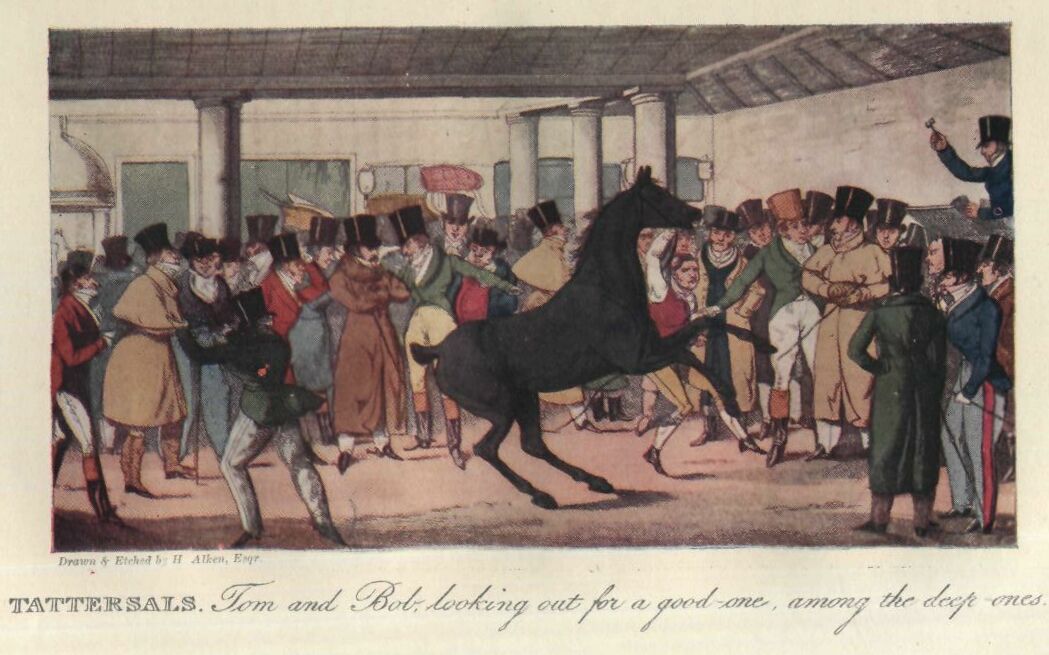
If you’ve read novels set in the 19th century, you've probably come upon mention of Tattersall's, where Lord This or That would buy a horse. Here’s a bit of its history, as seen from the mid-Victorian era.

Tattersall's history

Tattersall's history

Tattersall's from Tom & Bob


Images:
Text from John Timbs, Curiosities of London: exhibiting the most rare and remarkable objects of interest in the metropolis; with nearly sixty years personal recollections (1868)

Above left—James Pollard (1792 - 1867), Epsom Races: Settling Day at Tattersalls 1834-35, courtesy Yale Center for British Art.

Below (the image I believe the text refers to)—Henry Alken, Tattersals. Tom and Bob, looking out for a good –one, among the deep-ones, courtesy Project Gutenberg.

Clicking on the image will enlarge it.  Clicking on the caption will take you to the source, where you can learn more and enlarge images as needed.

Wednesday, August 19, 2015

Those American Goliaths [from the archives]

Wednesday, August 19, 2015
Gilbert Stuart, Dolley Madison 1804
Loretta reports:

Lieut. Francis Hall, an Englishman traveling in North America in 1816-1817, offers some fascinating observations of the young United States and its people. Dolley Madison, at left, was the president's lady at the time.
The President, or rather his lady, holds drawing-room weekly, during the sitting of Congress. He takes by the hand those who are presented to him; shaking hands being discovered in America to be more rational and manly than kissing them. For the rest, it is much as such things are every where, chatting, and tea, compliments and ices, a little music, (some scandal, I suppose, among the ladies,) and to bed. Nothing in these assemblies more attracted my notice, than the extraordinary stature of most of the western members; the room seemed filled with giants, among whom, moderately sized men crept like pigmies. I know not well, to what the difference may be attributed, but the surprising growth of the inhabitants of the Western states is matter of astonishment to those of the Eastern, and of the coast line generally. This phenomenon, which is certainly a considerable stumbling-block to the Abbé Raynal's theory, may probably be resolved into the operation of three positive causes, and one negative, namely, plentiful but simple food, a healthy climate, constant exercise in the open air, and the absence of mental irritation. In a more advanced stage of society, luxurious and sedentary habits produce in the rich that enfeeblement of vitality, which scanty food, and laborious or unwholesome occupations bring upon the poor. The only persons to be compared with these Goliahs of the West, were six Indian chiefs from Georgia, Chactaws or Chickasaws, who having come to Washington on public business, were presented at Mrs. Madison's drawing-room.

They had a still greater appearance of muscular power than the Americans; and while looking on them, I comprehended the prowess of those ancient knights, whose single might held an army in check, "and made all Troy retire."
—Lieut. Francis Hall, "Washington," from Travels in Canada, and the United States, in 1816 and 1817, courtesy Library of Congress.

Images: Gilbert Stuart, Dolley Madison 1804, courtesy Wikipedia; George Caitlin, “Three Celebrated Ball Players—Choctaw, Sioux, and Ojibbeway,” 1861, National Gallery of Art, Paul Mellon Collection [my photograph of the painting].

Clicking on the image will enlarge it.  Clicking on the caption will take you to the source, where you can learn more and enlarge images as needed.


Friday, August 14, 2015

Friday Video: A Quick Tour of Castle Howard

Friday, August 14, 2015
Isabella reporting,

When most of us decide to part with extra stuff around the house for a little extra cash, we turn to the local second-hand shop, flea market, or garage sale. But if you're the family of the Earl of Carlisle and your house is Castle Howard, you turn to Sotheby's auction house.

As we've noted before here on the blog, maintaining an enormous English country house in the 21st century is an equally enormous challenge. No matter how beautiful the house may be or how rich in history: age, deferred maintenance,  and the taxman will take their toll, requiring the noble families to turn to creative ways to make certain the houses survive. (See here for more about Ugbrooke Park, home of Lord Clifford of Chudleigh; St. Giles House, home of the Earl of Shaftsbury, and Highclere Castle (aka Downton Abbey), home of the Earl of Carnovan.)

Earlier this year, the Howard family sold nine of their family treasures at auction. No flyers on telephone poles for them - instead Sotheby's created this elegant video that offers a quick yet breathtaking tour of Castle Howard along with highlighting the pieces in the sale. Fans of the 80s version of Brideshead Revision (which was filmed at Castle Howard) will recognize the unmistakable voice of actor Jeremy Irons as the narrator.

If you'd like to read more about the Castle Howard and the famous family who has lived there, here's the post on the Sotheby's website. And if you're curious to learn the results of the sale, here's the overview, including the prices realized.
 
Two Nerdy History Girls. Design by Pocket