Showing posts with label quotations. Show all posts

Thursday, December 6, 2018

Italians Serenade London for Christmas in the 1820s

Thursday, December 6, 2018

Lazzari, Trompe l'oeil Still Life 18th C
Loretta reports:

There are a couple of interesting bits in this excerpt from Hone’s Every-Day Book. The first part reminds us that ordinary Londoners didn’t have anything like the access we do to music. If you were well off, you could go to the opera, ballet, or theater, or you would dance at Almack’s to some of the latest pieces from abroad. For ordinary people, London had its street musicians, true, as well as cheaper theatrical entertainments. Italian music by Italian musicians, however, seems to have been rather uncommon in the 1820s.

The second item I’d call to your attention is Hone’s reference, a little further on, to Londoners’ attitude toward Italian musicians a generation earlier, which this Rowlandson image illustrates. It is a far cry from the gentler and appreciative tone of Hone's report.

"Previous to Christmas 1825, a trio of foreign minstrels appeared in London, ushering in the season with melody from instruments seldom performed on in the streets. These were Genoese with their guitars.  Musicians of this order are common in Naples and all over Italy; at the carnival time they are fully employed, and at other periods are hired to assist in those serenades whereof English ladies hear nothing, unless they travel, save by the reports of those who publish accounts of their adventures. The three now spoken of took up their abode in London, at the King’s head public-house, in Leather-lane, from whence ever and anon, to wit, daily they sallied forth to ‘discourse most excellent music.’ They are represented in the engraving below, from a sketch hastily taken by a gentleman who was of a dinner party, by whom they were called into the house of a street in the suburbs.

Italian Minstrels in London,
At Christmas, 1825

Ranged in a row, with guitars slung
Before them thus, they played and sung:
Their instruments and choral voice
Bide each glad guest still more rejoice;
And each guest wished again to hear
Their wild guitars and voices clear."
Images: Sebastiano Lazzari: Trompe-l'œil Still Life, 18th century; illustrations and clipping from The Every-Day Book or Guide to the Year, William Hone, first published 1826

Clicking on the image will enlarge it.  Clicking on a caption link will take you to the source, where you can learn more and enlarge images as needed.

Tuesday, November 13, 2018

From the Archives: Harriette Wilson on Virtue

Tuesday, November 13, 2018
Loretta reports:

The Regency era courtesan Harriette Wilson belonged to the sorority called Girls Just Want To Have Fun.  Here’s her take on virtue:

~~~
There certainly was much aggravation of sin, in my projected criminal intercourse with the Marquis of Worcester.  Many women, very hard pressed par la belle nature, intrigue because they see no prospect nor hopes of getting husbands; but I, who might, as everybody told me, and were incessantly reminding me, have, at this period, smuggled myself into the Beaufort family, by merely declaring to Lord Worcester, with my finger pointed towards the North—that way leads to Harriette Wilson’s bedchamber; yet so perverse was my conscience, so hardened by what Fred Bentinck calls, my perseverance in loose morality, that I scorned the idea of taking such an advantage of the passion I had inspired, in what I believed to be a generous breast, as might, hereafter, cause unhappiness to himself, while it would embitter the peace of his parents.

Seriously I have but a very confused idea of what virtue really is, or what it would be at.  For my part, all the virtue I ever practised, or desire to learn, was such as my heart and conscience dictated.

Now the English Protestant ladies’ virtue is chastity!  There are but two classes of women among them.  She is a bad woman the moment she has committed fornication; be she generous, charitable, just , clever, domestic, affectionate, and ever ready to sacrifice her own good to serve and benefit those she loves, still her rank in society is with the lowest hired prostitute.  Each is indiscriminately avoided, and each is denominated the same—bad woman, while all are virtuous who are chaste.

…The soldier’s virtue lies in murdering as many fellow creatures as possible, at the command of any man, virtuous or vicious, who may happen to be his chief, no matter why or wherefore.

The French ladies’ virtue is, generally speaking, all comprised and summed up in one single word and article—bienséance!*

*propriety
~~~
Excerpt from The Memoirs Of Harriette Wilson, which were first published in 1825.
You can read the first two volumes from the 1909 edition online here.    And for further insight into this fascinating woman, you might want to look into The Courtesan’s Revenge: The Life of Harriette Wilson, the Woman Who Blackmailed the King.

Wednesday, October 31, 2018

The Vision of Skulls—a Little Rowlandson for Halloween

Wednesday, October 31, 2018
Rowlandson, The Vision of Skulls
Loretta reports:

Halloween seems an appropriate time for an excerpt from The English Dance of Death. In this volume, Thomas Rowlandson takes on a popular artistic subject, focusing on his countrymen, with William Combe writing a narrative based on the pictures (the method they used in the Tour of Doctor Syntax). In this excerpt from “The Vision of Skulls,” Sir Thomas describes a dream to his wife.

—The Phantom gave three heads a stroke
With his fierce Torch, and thus they spoke.
—Said one, "I was a soldier brave,
Who found in war an early grave;
But, e'er in Honour's field I died—
I slew the Hero by my side."
The Hero, by his side, exclaim'd,
—" 'Twas my right arm your prowess tam'd:
It was my sabre's well-aim'd blow,
 That laid your glittering figure low."
"Ho," cried a third, "pray cease your pother,
I saw you both kill one another."—
—Thus, though no arms, or legs had they,
 I thought they threaten'd an affray;
And seem'd, without alarm or dread,
To long to play the Loggerhead.
I thought their clamour ne'er would cease:
But the Torch wav'd, and all was peace.
It seem'd most strange the sight I saw,
That heads should speak 'gainst Nature's law,
Without a Tongue,—nor move a Jaw.
'I humbly told the Guide, that I Was of the class of Chivalry.
But that I was a Civic Knight,
Who had much rather eat than fight.
—Turn and look up, methought he said,
At the huge Sculls above your head,
Which are so thick, they might defy
The balls of any musketry.
Those which there meet your curious ken,
Belong'd to Knights and Aldermen,
Who to the Sword's heroic work
Preferr'd the feats of Knife and Fork;
And, as they grin, the Jaws between,
Their well-us'd, worn-out teeth are seen.—
But all these mortal remnants stood,
In such exact similitude,
I could not see, with all my care,
If any of my friends were there.
—I then enquir'd, if no offence,
And hop'd 'twas not impertinence,
If he might tell whose fleshless face
Was to fill up an empty space,
Which seem'd so large, that I could swear,
It was preserv'd for some Lord Mayor.
He wav'd his Torch, and lost in smoke,
'Twas thus I thought the Spectre spoke.—
—That place, Sir Simon, is your due:
And shortly will be filled by you.—
Intro to English Dance of Death
The English Dance of Death, From the Designs of Thomas Rowlandson with Metrical Illustrations, by the Author of “Doctor Syntax.” Vol 1 (1815)

Images: The Vision of Skulls
Excerpt from introduction to The English Dance of Death

Clicking on the image will enlarge it. Clicking on a caption link will take you to the source, where you can learn more and enlarge images as needed.

Thursday, October 25, 2018

Frankenstein and the Critics

Thursday, October 25, 2018
Frankenstein, annotated 2017
Loretta reports:

Mary Shelley’s reviewers had extremely different reactions to Frankenstein.

Following a plot summary, John Croker has this to say:
“Our readers will guess from this summary, what a tissue of horrible and disgusting absurdity this work presents ... The dreams of insanity are embodied in the strong and striking language of the insane, and the author, notwithstanding the rationality of his preface, often leaves us in doubt whether he is not as mad as his hero." 
Following samples of the prose style:
“... we take the liberty of assuring [the author] ... that the style which he has adopted in the present publication merely tends to defeat his own purpose, if he really had any other object in view than that of leaving the wearied reader, after a struggle between laughter and loathing, in doubt whether the head or the heart of the author be the most diseased."
Quarterly Review 18 (January [delayed until 12 June] 1818): 379-385. From the Mary Shelley Chronology and Resource Site, Scholarly Resources, Romantic Circles.

Walter Scott, however, is thrilled:
“So concludes this extraordinary tale, in which the author seems to us to disclose uncommon powers of poetic imagination. The feeling with which we perused the unexpected and fearful, yet, allowing the possibility of the event, very natural conclusion of Frankenstein's experiment, shook a little even our firm nerves ...

It is no slight merit in our eyes, that the tale, though wild in incident, is written in plain and forcible English, without exhibiting that mixture of hyperbolical Germanisms with which tales of wonder are usually told, as if it were necessary that the language should be as extravagant as the fiction. The ideas of the author are always clearly as well as forcibly expressed; and his descriptions of landscape have in them the choice requisites of truth, freshness, precision, and beauty ... 

Upon the whole, the work impresses us with a high idea of the author's original genius and happy power of expression ... If Gray's definition of Paradise, to lie on a couch, namely, and read new novels, come any thing near truth, no small praise is due to him, who, like the author of Frankenstein, has enlarged the sphere of that fascinating enjoyment."
Start of review in La Belle Assemblée
Blackwood’s Edinburgh Magazine 2 (March 1818)
His whole review is well worth reading, as are others. You can read them here at the Romantic Circles website.

If you are in New York between now and the last week of January, you might want to stop by the Morgan Library for the exhibition, “It’s Alive! Frankenstein at 200.”

Images: Cover of 2017 annotated edition of Frankenstein; Beginning of La Belle Assemblée review of Frankenstein, Vol. 17, March 1818

Clicking on the image will enlarge it.  Clicking on a caption link will take you to the source, where you can learn more and enlarge images as needed. And just so you know, if you order a book through one of my posts, I might get a small share of the sale.

Tuesday, October 16, 2018

The Omnibus Comes to London

Tuesday, October 16, 2018
 Loretta reports:

Last year, during my visit to the London Transport Museum, I encountered a form of public transportation I hadn’t paid much attention to previously.

The omnibus was first introduced in Paris, and it was a Parisian coach-builder, George Shillibeer, who brought the concept to London.
“The route which Shillibeer chose for his first omnibus was from the Yorkshire Stingo at Paddington, along the New Road to the Bank. The New Road was the name by which Marylebone, Euston and Pentonville Roads were then known.

 ... On the morning of July 4, 1829, Shillibeer's two new omnibuses began to run. A large crowd assembled to witness the start, and general admiration was expressed at the smart appearance of the vehicles, which were built to carry twenty-two passengers, all inside, and were drawn by three beautiful bays, harnessed abreast. The word "Omnibus" was painted in large letters on both sides of the vehicles. The fare from the Yorkshire Stingo to the Bank was one shilling; half way, sixpence. Newspapers and magazines were provided free of charge. The conductors, too, came in for considerable notice, for it had become known that they were both the sons of British naval officers—friends of Shillibeer. These amateur conductors had resided for some years in Paris, and were, therefore, well acquainted with the duties of the position which they assumed. The idea of being the first omnibus conductors in England pleased them greatly, and prompted them to work their hardest to make Shillibeer's venture a success. They were attired in smart blue-cloth uniforms, cut like a midshipman's; they spoke French fluently, and their politeness to passengers was a pleasing contrast to the rudeness of the short-stage-coach* guards—a most ill-mannered class of men. Each omnibus made twelve journeys a day, and was generally full.”
— Henry Charles Moore, Omnibuses and Cabs 1902
Though his omnibus was a success, Shillibeer contended with fierce and often unscrupulous competition and the NIMBY inhabitants of Paddington Green—although “the threatened doom of Paddington Green did not deter the sentimental poke-bonneted young ladies, who resided in the charming suburb, from spending a considerable amount of their time in watching the omnibuses start. In the middle of the day many of them were in the habit of taking a ride to King's Cross and back, for the sole purpose of improving their French by conversing with the conductors.”

Anecdotes like this abound, including tales of theft by the paid conductors who soon replaced the gentlemen. Since space doesn’t permit me to quote at length, I recommend you read at least Chapter II of the first part for yourself.


*Short-stage coaches, which had been in existence from the mid-18th century, ran—slowly, expensively, and unpunctually—from the suburbs to the City and the West End.

Images: Photos of Loretta in omnibus at London Transport Museum, View of Exterior London Transport Museum Omnibus, and Announcement Marking the End of the Omnibus Era taken at London Transport Museum, copyright © 2018 Walter M. Henritze III.

Clicking on the image will enlarge it. Clicking on a caption link will take you to the source, where you can learn more and enlarge images as needed.

Thursday, October 11, 2018

The Dickey, or, Abominable False Front

Thursday, October 11, 2018

August 1873 Men's Fashions
Loretta reports:

The author of this 1876 guide to men’s dress did not mince words when it came to false shirt fronts. One can only imagine what he'd have to say about, oh, man buns or low-hanging trousers.
~~~
BEAU BRUMMEL said, “A gentleman should show clean linen, and plenty of it.” The first part of this sentence is strictly true, the second less so. There is no need, having a clean shirt on, to publish the fact, or to lead the public to infer you wear it as a disguise by undue exhibition of it. “Virtue is its own reward :” so the assumption of clean underclothing generally, even if its light be kept beneath a bushel, should afford the wearer the same pleasure as if ostentatiously paraded. When I see a man placarding his chest with a wide expanse of lawn, and exhibiting an unnecessary amount of cuffs, I infer he has got on neither a clean nor white shirt. The surmise generally proves correct.

Interlined Shirt Bosoms 1912
I often see in haberdashers' shops an exaggerated collar and lapel in one, designed to cover manly bosom. The commercial name of this impious fraud is called a Dickey. This felonious impostor must be made away with. No one with any self-respect can wear a dickey. A man clad in such an unmitigated imposition is a whited sepulchre of the very blackest type. If the reader knows any so depraved even to possess one, let him persuade the wretched man to pause, ere too late, in his headlong career—to burn the spurious rag, and he can then exclaim, with regenerated heart, “Richard” (not Dickey, mind) “is himself again!”
Many say, however, when this charge is brought against them, that they suffer from neuralgia, lumbago, and tic-douloureux and ... various other ailments ... Well, what excuse is this? I do not prohibit flannel —wear an under flannel shirt—two if you like; but you must cover it with an entire white shirt, not an aliquot part of it. If hypocrisy be the homage which vice pays to virtue, then the assumption of dickey is a sneaking admission of the necessity for showing clean linen, and a discreditable way of making a sham composition with the subject.
The Gentleman's Art of Dressing with Economy. By a Lounger at the Clubs (1876)

The Lounger's disapproval did not lead to the rapid extinction of the dickey. On the contrary, it lived on into the 20th century, and it isn't dead yet.

Images: August 1873 Men’s Fashions, from the Gentleman's Magazine of Fashion, via Google Books.
Interlined Shirt Bosoms (1912), and Arrow Donchester shirt 1915, courtesy New York Public Library.

Clicking on the image will enlarge it.  Clicking on the caption will take you to the source, where you can learn more and enlarge images as needed.


Monday, August 13, 2018

The Waltz in Its Early Years

Monday, August 13, 2018


Waltzing 1821
Loretta reports:

Some comments on the kinds of physical activities ladies of the 18th and 19th century engaged in led to me to thinking about dancing, and waltzing in particular.

Early in my writing career, I became aware that the waltz had changed over the years, and the early form of the dance wasn’t quite like what we’re familiar with. Images like the ones I’ve posted here don’t look like the style of waltz we’re used to.

According to Elizabeth Aldrich’s From the Ballroom to Hell, “During the first forty years of the nineteenth century, waltzing couples turned clockwise as partners while traveling counterclockwise around the room. This constant spinning, never reversing, could and did produce a feeling of euphoria—or worse, vertigo—that could result in a loss of control.”
9 Positions of the Waltz 1816

The dance was controversial. Lord Byron disapproved. Yes, really. Others said it was unsuitable for unmarried, highly sensitive, and/or delicate women. I can tell you from my own experience, learning to waltz in a ballroom dancing class, that it is very sexy, and I understood why people disapproved. Also, though I was much younger then, I wasn’t used to ballroom dancing, and one waltz left me a little winded. Even with lots of practice, an entire evening of dancing, in the Regency and Victorian eras, must have provided vigorous exercise.

If you're curious about the precise steps for this era (though they do vary), Carlo Blassis's (trans by R. Barton), The Code of Terpischore, offers a detailed description of the waltz. I have a hard time reading these sorts of instructions, but others of you may be able to picture or re-enact it better.

I wanted to focus on this excerpt, however, which gives a sense of one difference between earlier and later forms of the waltz: “The gentleman should hold the lady by the right hand, and above the waist, or by both hands, if waltzing be difficult for her; or otherwise, it would be better for the gentleman to support the right hand of the lady by his left. The arms should be kept in a rounded position, which is the most graceful, preserving them without motion; and in this position one person should keep as far from the other as the arms will permit, so that neither may be incommoded.” This does correspond with the early 19th century images.

Here is a note from Hints on Etiquette and the Usages of Society; with a glance at Bad Habits (1836): “If a lady waltz with you, beware not to press her waist; you must only lightly touch it with the open palm of your hand, lest you leave a disagreeable impression not only on her ceinture, but on her mind.”
Cruikshank, Specimens of Waltzing 1817

For a more detailed account of the waltz—with lots of lovely images—you might want to read Paul Cooper’s post at Regency Dances.org.

Images: Waltzing 1821, courtesy Lewis Walpole Library Digital Collection; Detail from frontispiece to Thomas Wilson's Correct Method of German and French Waltzing (1816), showing nine positions of the Waltz, via Wikipedia; Specimens of Waltzing, George Cruikshank, 1817-06-04, courtesy New York Public Library.

Clicking on the image will enlarge it.  Clicking on the caption will take you to the source, where you can learn more and enlarge images as needed. FYI: If you order a book through one of my posts, I might get a small share of the sale.

Thursday, July 19, 2018

From the Archives: Dining in July 1815

Thursday, July 19, 2018
Loretta reports:

Since we had a short video about 18th and early 19th C dining last week, now seemed like  good time to bring back this post on what foods were available in July during the Regency era.
The Greengrocer

From The Epicure’s Almanack July Alimentary Calendar:
~~~
The heats of the season now impose the necessity of occasionally substituting a light vegetable diet for the more solid gratification of animal food ... Cauliflowers, artichokes, green-peas, French-beans, Windsor* and other garden beans, frequently form a conspicuous part of the family dinner, to which butcher’s meat, in moderate quantities, may be said to serve merely as an auxiliary stimulant. Ham, bacon, and tongues, as well as ducks and geese, are the most seasonable viands for this purpose ... On festive occasions venison and turtle retain their pre-eminent station at the tables of the opulent, where also the fawn ... forms an elegant dish, when roasted whole and served up with rich gravy. Veal, having now been fed on milk, in its richest state, is peculiarly fine and well flavoured; but care should be taken that it be delivered fresh to the cook, as it is more liable to suffer from the heat of the weather and from flies than any other kind of meat. Ragouts of sweetbreads, oxpalates, lambs’ bits, fat livers, and cocks’-combs, are among the light dishes introduced at superior tables; where also various preparations of curry afford a delectable repast to those who have acquired a taste for this Indian diet.
 ...
 ... a plenteous and varied dessert presents itself at this season; consisting of pines, melons, peaches, cherries, grapes, currants, gooseberries and raspberries, as well as early apples and pears. Fruit is certainly most salubrious in hot weather; but, if the opinion be well founded that it does most good when taken before dinner, the dessert ought to take place of that spurious meal called lunch, which, being usually made of animal food, too often banishes the appetite irrecoverably for the day.

~~~
*broad beans

Excerpted from The Epicure's Almanack: Eating and Drinking in Regency London (The Original 1815 Guidebook).

Image: James Pollard, The Greengrocer (ca 1819) courtesy Yale Center for British Art, Paul Mellon Collection.

Clicking on the image will enlarge it. Clicking on the caption will allow you to read at the source, where you can learn more and enlarge images as needed.

Monday, July 16, 2018

Baron de Berenger—Horse Whisperer?

Monday, July 16, 2018

Thomas Alken, A Gentleman Riding With a Groom, and Coversing
Loretta report:

Last year, during my visit to the Kensington Central Library, Dave Walker introduced me to the Baron de Berenger’s gun. Thanks to Dave's introducing me to this colorful character, I’ve spent some time with de Berenger’s Helps and Hints: How to Protect Life and Property. It surprised me in a number of ways.

At the time of my stories, animals tended to be treated brutally. I won’t go into the ugly details, but, generally speaking (of course there were many exceptions) if human life was cheap, non-human life was close to worthless, the RSPCA notwithstanding. And while life was kinder to humans of the privileged classes, they were not necessarily kinder to their animals, especially their horses. And so I was struck with de Berenger’s views on the subject:
“[A] rider should, to appearance at least, be a part of his horse; in the efforts of both these component parts there should seem as if there was but one and the same impulse,— a generous and reciprocal attention to please,—to serve, and to spare; and when that is accomplished, most horses will display as much delight in being rode, as the rider will be delighted in riding such a horse; but to accomplish this to perfection, an intimacy, nay, an affection, must be established between yourself and the generous animal; but which ... cannot be attained by the intercourse which, by far too generally, prevails between fashionable characters and their horses; these poor, willing, and faithful animals, rarely experiencing any other notice, save that of being urged on by whip and spur, to exertions but too frequently woefully distressing to a willing frame ... What has secured to the dog the reputation of being more affectionate, more intelligent, and more faithful, than the horse? Because, even the exquisite will deign to hold a familiar and encouraging intercourse, nay, conversation, with him: not so with the poor horse; except when being cleaned or fed, it stands unnoticed for many hours in dull solitude, at least as far as man is concerned. With him the cheering influence and the enjoyments of the sun are embittered by a portion of severe, because generally inconsiderate, labour; even then, and although enduring willingly, hardly ever to experience the pattings of a condescending hand as a cheap encouragement!  ... nevertheless, and aware as the horse must be that it is led forth to endure straining labour, we see him cheerfully leave the stable, ever as willing slavishly to serve his master, as to please him, in any way, which he is taught to know as agreeable to him. Only familiarize with and pet him, as much as you do the dog, and his best endeavours at least to rival canine affection, intelligence, and fidelity, will soon be placed beyond all doubt.
The entire entry, from which I’ve also included a clipping (at right), is well worth reading. I’d be especially interested in the reactions of our horse-loving/riding/driving Nerdy History persons.

Image: Henry Thomas Alken, A Gentleman Riding With a Groom, and Conversing (undated), courtesy Yale Center for British Art, Paul Mellon Collection.

Tuesday, June 12, 2018

From the Archives: They Do It Differently in France, Part One

Tuesday, June 12, 2018
Frances Trollope ca 1832
Loretta reports:

[Note: This post is from 2010, when I was researching my Dressmakers series. In light of recent discussions about the differences in the way married and unmarried women dressed, it seemed worth a return engagement.]

I had occasion to reopen my yellowed copy of Fanny Trollope’s  Paris and the Parisians recently, and was reminded what a delightful account she offers of Paris in 1835.  I suggest you read the entire Letter XXXV —which I have had to hack up mercilessly below.  It points out a very interesting cultural difference.

By this time, in England, arranged marriages were a thing of the past, but not in France.  This led to some interesting differences in social behavior.  In France, Fanny tells us, the unmarried girls are the last to get dancing partners.  It’s the married women—and many of them no spring chickens—to whom all the young gallants flock.  She discusses this oddity with an unnamed French woman of her acquaintance, who asks, "Will you then have the kindness to explain to me the difference in this respect between France and England ?"

Fanny: " The only difference between us which I mean to advocate is, that with us the amusement which throws young people together under circumstances the most likely, perhaps, to elicit expressions of gallantry and admiration from the men, and a gracious reception of them from the women, is considered as befitting the single rather than the married part of the community."

 " With us, indeed, it is exactly the reverse," replied she,—" at least as respects the young ladies. By addressing the idle, unmeaning gallantry inspired by the dance to a young girl, we should deem the cautious delicacy of restraint in which she is enshrined transgressed and broken in upon. A young girl should be given to her husband before her passions have been awakened or her imagination excited by the voice of gallantry.…When a girl is first married, her feelings, her thoughts, her imagination, are wholly occupied by her husband. Her mode of education has ensured this; and afterward it is at the choice of her husband whether he will secure and retain her young heart for himself. In no country have husbands so little reason to complain of their wives as in France ; for in no country does the manner in which they live with them depend so wholly on themselves.”

Marie J. Lafont-Porcher ca 1835
After politely debating which country has got it all wrong, the Unnamed Lady concludes:  “…as we go on exchanging fashions so amicably, who knows but we may live to see your young ladies shut up a little more, while their mothers and fathers look out for a suitable marriage for them, instead of inflicting the awkward task upon themselves?* And in return, perhaps, our young wives may lay aside their little coquetries, and become mères respectables somewhat earlier than they do now. But, in truth, they all come to it at last."

*Italics mine.

Images: Frances Trollope, by Auguste Hervieu circa 1832, courtesy National Portrait Gallery NPG 3906 via Wikipedia. François Kinson, Portrait of Marie J. Lafont-Porcher circa 1835, courtesy Groeningemuseum, via Wikipedia.

Monday, June 4, 2018

Fashions for June 1856

Monday, June 4, 2018
Dresses for June 1856
Loretta reports:

By 1856, crinolines were increasing in size, and the complaints rose accordingly.

“A drawing room now looks like a camp. You see a number of bell tents of different colors ... It now fills a brougham, overlapping at the windows, and still in the course of aggrandizement ... Certainly there is a law in fashions if one could but find it out. They have their cycles like storms, and science might calculate the periods of their recurrence. Invention or fancy there is none in fashion, nothing is new. An old thing comes in again. Thus the hoop comes round again in rather an aggravated shape of enormity. But if there is expansion in one quarter, be sure there will be contraction in another ...  Thus, while the bonnet has been dwindling away the petticoat has been expanding, engrossing, and pervading all spaces.”Littell’s Living Age.—No. 639.—23 August, 1856
The full entry is worth reading. Just bear in mind the tendency, then and now, for writers and editors (primarily men) to exaggerate and ridicule women's fashion. Photographs—something not available in the earlier part of the century—tell a slightly different story.

Foulard: “A soft, light, washing silk, twilled. Originally, in the [18]20s, of Indian manufacture; later of French. —C. Willett Cunnington, English Women's Clothing in the Nineteenth Century. “Very light and thin silk fabric, woven plain or twilled, printed in conventional style; used for summer dresses.—Louis Harmuth Dictionary of Textiles. “Light silk fabric having a distinctive soft finish and a plain or simple twill weave. It is said to come originally from the Far East. In French the word foulard signifies a silk handkerchief." —Britannica.com

Bretelles: “Strap-shaped trimming”—Cunnington.

Basquine festonné: Basquine: “The extension below the waist-line of the material forming the corsage, either cut in one with it, or applied as separate pieces.” —Cunnington. In this case, the extension is scalloped (festonné).

Taffetas d’éte: Taffeta is “a thin glossy silk of a wavy lustre.” —Cunnington. This apparently is simply a summer taffeta.
June 1856 Fashions Description

Popeline: This seems to be dressmaker Frenchification of poplin. “1. The real Irish poplin originally had fine organzine warp and a heavier woolen filling, forming cross ribs; 2. Fabrics having fine, cross ribs irrespective of the material they are made of. The better grades are dyed in the yarn; used for coats, dresses, etc. Single poplin has very fine cross ribs, the double poplin is much stouter and has prominent ribs.” Harmuth.

Bouillon: “A puffed-out applied trimming.” Cunnington.

Paille de riz: rice straw

Fashion plates from London and Paris Ladies Magazine of Fashion, June 1856.
Clicking on the image will enlarge it.  Clicking on the caption will take you to the source, where you can learn more and enlarge images as needed.

Tuesday, May 29, 2018

The Regency's Duke of Cambridge

Tuesday, May 29, 2018
Duke of Cambridge 1806

Loretta reports:

Having recently reported on the present Duke of Sussex and the previous holder of that title, I thought it made sense to look at the man who last held Prince William’s title, Duke of Cambridge.

As in Prince Harry’s case, Prince Adolphus Frederick, the previous Duke of Cambridge (1774-1850), lived during the Regency and Victorian eras, and his life shows some parallels to Prince William’s. Prince Adolphus served in the military, was generally well-liked—including by his father, George III, who wasn’t crazy about his older sons. This royal duke, too, married a beautiful young woman, and had three children

With the death of the Princess Charlotte in 1817, he, like his other brothers, was obliged to find a wife. Of the royal dukes, Peter Pindar wrote:
Agog are all, both old and young
    Warmed with desire to be prolific
And prompt with resolution strong
    To fight in Hyman’s war terrific.
Within two weeks of his niece’s death, he sent a marriage proposal to the Princess Augusta, the Landgrave of Hesse-Cassel’s youngest daughter. She was twenty years old and  beautiful.

“This was the first of the three Royal marriages since Princess Charlotte married Prince Leopold that roused the romantic enthusiasm of the British public* ... “The Duke and Duchess had only to show themselves to be loudly cheered. The first Sunday after their arrival in England they were recognized strolling together in Hyde Park, and were at once surrounded and jostled by a large crowd, cheering and yelling ... On another occasion they were recognized in their carriage outside the famous City jewelers, Rundle and Bridge, and a great crowd came yelling round them, so that it was twenty minutes before their coachman dared move.”
Augusta, Duchess of Cambridge, 1818
Their first son, born in March 1819, was christened George, and was in line for the throne until Victoria was born, a few months later.
“And if the English public had good reason to be satisfied with the marriage, so had the Duke of Cambridge. He wrote of himself when he was first married: ‘I really believe that on the surface of the globe there does not exist so happy a Being as myself ... and Heaven grant that I may be deserving of it and not forfeit my happiness by any misconduct.’”
He became rather eccentric in later life—among other things, having gone deaf, he sat in front of the church and kept up a running, plainly audible, commentary—and was on very bad terms with Queen Victoria during her early years on the throne. But in a time of rampant anti-Semitism, he remained sympathetic to Jews. He was the only one of George III’s sons who lived within his income. “He was certainly most generous with his time, and equally generous with his money to an almost incredible number of charitable causes.”

Quotations and other information from Roger Fulford’s Royal Dukes.

*Let’s just say that the other couples were rather less attractive.
Images: E. Harding, Duke of Cambridge 1806; Sir William Beechey, Augusta, Duchess of Cambridge, 1818.

Clicking on the image will enlarge it.  Clicking on the caption will take you to the source, where you can learn more and enlarge images as needed.

Monday, May 21, 2018

From the Archives: Queen Victoria's Wedding Drew a Crowd, Too.

Monday, May 21, 2018
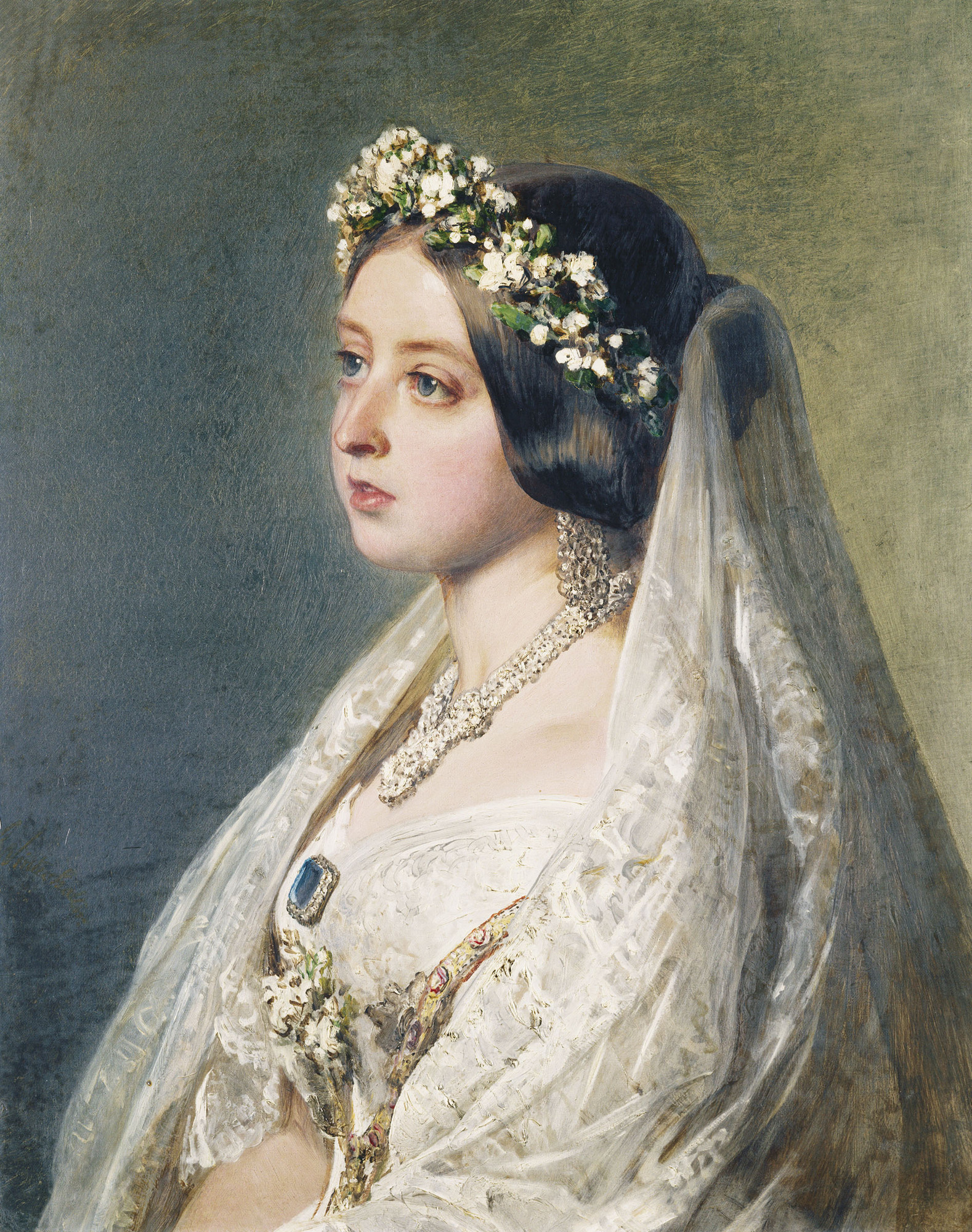
Queen Victoria in her wedding dress painted 1847
Loretta reports:

The recent marriage of the Duke and Duchess of Sussex sent me back into the archives to look at the excitement that accompanied Queen Victoria's wedding on 10 February 1840, in rotten weather.  Researching for the short story I wrote at the time, I learned, among other things, that royal wedding frenzy is nothing new.
~~~
All ranks of the people in the metropolis, and for many miles around, began to rise before the appearance of the dawn, some to prepare to take their stations in the progress of the approaching great ceremony; but the great multitude, of course, thinking that their exertions would be well repaid, if they could get only a moment's glimpse of the Queen and her husband, or even a glance at the procession going and returning. Notwithstanding the discouraging weather, the streets were crowded at an early hour with thousands, coming from every point of the compass, and making the best of their way, with emulous and unceremonious haste, to St. James's Park, as one common centre. The concourse of females was prodigious. It seemed as if every one of her Majesty's sex, from the infant in arms to the decrepit matron, now far advanced in second childhood, had made a vow not to stay at home. Women, who could not see their way without spectacles, nor walk it without crutches, were to be seen anxiously struggling for precedence at every point of the park, whence a glance at the Queen and Prince might be obtained; and, having once obtained an eligible spot, they held fast by it, heedless of the too frequent probabilities of being crushed or trodden to death. The trees, the lamp-posts, and the spikes of the railings, were contended for with as much eagerness as if the summit of every one's ambition was at the top of one or other of these elevations; and the wonder was, how many, who had climbed up to certain dangerous eminences, could ever get down in safety again. However, these adventurous folks justly thought, that that question was their own " look out," and no one's else's. About ten o'clock St. James's Park was completely filled with a vast, miscellaneous, curious multitude, not a tithe of whom, unfortunately, could see even the carriage of the Queen when it did at length pass.
The Mirror of literature, amusement, and instruction, Volume 35, 1840
Marriage of Queen Victoria

Illustrations:  Franz Xaver Winterhalter  (1805–1873) Queen Victoria, in her wedding dress and veil from 1840, painted in 1847 as an anniversary gift for her husband, Prince Albert.
Source/Photographer. Original painting owned by the Royal Collection. Source of photograph unknown.

The Marriage of Queen Victoria, 10 February 1840, painted by George Hayter 1840-1842. Royal Collection RCIN 407165, via Wikipedia.
Clicking on the image will enlarge it.  Clicking on the caption will take you to the source, where you can learn more and enlarge images as needed.


Tuesday, April 17, 2018

The Neckcloth Part 2

Tuesday, April 17, 2018
Loretta reports:

Last time, in tackling the immense subject of men’s neckwear, I focused on the material in the early 19th century neckcloth, and several readers were kind enough to explain further. The subject is daunting, and I’m taking Mark Hutter’s remark as my mantra: There is no “typical.”

For instance, stocks were old-fashioned, then they weren’t; “correct” colors and materials changed for both neckcloths and stocks, depending on the occasion and that capricious being, Fashion; and then, some people use the terms interchangeably.

What seems clear is that neckwear offered a way to express one’s individuality, especially after men’s clothing became more subdued in color and more uniform in style, thanks in great part to Beau Brummell.
Folding & tying the cravat
One important way of expressing oneself was in the way one tied that important length of fabric.
My neckcloth, of course, forms my principal care,
For by that we criterions of elegance swear,
And costs me each morning some hours of flurry,
To make it appear to be tied in a hurry.*
Cravats for travel
I don’t know the author of this verse. It appears here, there, and everywhere, referring to Beau Brummell. He didn’t write it, but everybody stole it without attribution, as often happened/happens. Still, a great deal was published anonymously or under whimsical names. One of these days I’ll pin down its first appearance. Meanwhile, let’s look at those hours of flurry.

Many readers are familiar with Cruikshank’s 1818 illustration from Neckclothitania (top left). Like many publications of the time about neckwear, it’s a combination of fact and satire.

However, it turns out that another book on neckcloths became an international bestseller. The Art of Tying the Cravat: demonstrated in sixteen lessons, including thirty-two different styles ... (the title’s longer than the book), appeared first in France, then Italy, then England, apparently by different authors. But the names seem to have been a joke: “Baron Emile de l’Empesé, Conte della Salda, and H. LeBlanc, which translate respectively as Baron Starch, Count Starched, and H. White or Starch,” as Sarah Gibbings points out in her fascinating tome, The Tie: Trends and Traditions 1990. Nonetheless, the Art of Tying the Cravat is charming. And informative. I recommend taking a look at it.
Advice to Julia excerpt

You can also find a number of Youtube videos, but none struck me as satisfactory. For a good visual, I suggest you take a look at MY Mr Knightley: Tying a Cravat, at the blog Tea in a Teacup.


Clicking on the image will enlarge it.  Clicking on the caption will take you to the source, where you can learn more and enlarge images as needed.

Tuesday, March 20, 2018

Lord Rivers Drowns in the Serpentine—Was It an Accident?

Tuesday, March 20, 2018
Lord Rivers as a boy
Loretta reports:

Georgiana, Duchess of Devonshire, was addicted to gambling. The first Lord Holland’s sons ran up enormous gambling debts. Beau Brummell fled England to escape his. A lot of that going around.

The third Baron Rivers is another example I happened on. The trail started with the following in La Belle Assemblée for March 1831:
“The first act of the Duke of Sussex, on being appointed to the Rangership of Hyde-park, has been to give directions for the placing an adequate protection against the spot where the late Lord Rivers lost his life."
This was intriguing. Who was Lord Rivers and how did he die?

Wikipedia’s short entry only tantalized, sending me to the 1 April 1831 Gentleman’s Magazine obituary.
LORD RIVERS.
Jan. 23 Drowned in the Serpentine river, aged 53, the Right Hon. Horace William Pitt, third Baron Rivers, of Sudeley Castle in Gloucestershire (1802).
 ... As Mr. Horace Beckford he was for many years a distinguished member of the haut ton; and it was only after his succeeding to the title on the death of his maternal uncle, July 20, 1828, that he took the name of Pitt ... .
“Lord Rivers was first missed on the evening of Sunday Jan. 23 ... On Tuesday the Serpentine river was dragged, and in the afternoon his Lordship's body was found at the east end, near the waterfall.”
At the inquest, his steward and a footman insisted he’d been in good spirits: He was nearsighted and must have fallen into the river by accident. The superintendent of the Humane Society's Receiving House said the footpath there was so dangerous that ten people fell into the river on a recent foggy night.
“The Jury returned this verdict: ‘Found drowned near the public path at the head of the Serpentine River, considered very dangerous for want of a rail or fence, where many persons have lately fallen in.’—The rail has been since erected by direction of the Duke of Sussex, the new Ranger of Hyde Park.

Subsequently to the inquest ..., there has been considerable discussion in the newspapers regarding the cause of the occurrence; and it has been stated, with what truth we cannot say, that when the body was taken out of the water, his Lordship's hat was secured with a handkerchief under his chin, and that his umbrella was found on the bank, both which circumstances are considered indicative that his immersion was intentional; and it is added that on the Saturday night he had lost considerable sums at a gaming-house; and that this passion for play had for some years so far possessed him, that his uncle bequeathed to him only 4000l. a year, leaving the bulk of his property, amounting to 40,000l a year, to trustees for the benefit of his son, the present Peer.”
Nigel Cox, Serpentine Waterfall
It’s important to remember that suicide, being self-murder, was a capital offense. One could be tried and hanged for the attempt, and a suicide’s property was forfeit to the Crown. Up to a certain point in the early 19th C, those who’d committed suicide were buried at midnight at a crossroads without the offices of clergy. This is why coroner’s juries tended to find the deaths accidental or, when this was impossible, the victim of unsound mind.

Image: A print of the “youthful portrait of Mr. Horace Beckford, at full length in a Vandyke costume, painted by R. Cosway, R.A. and engraved in stipple by John Conde, 1792", courtesy the Metropolitan Museum of Art

Photo of Serpentine Waterfall by Nigel Cox. Another image here.

Clicking on the image will enlarge it.  Clicking on the caption will take you to the source, where you can learn more and enlarge images as needed.

Thursday, March 15, 2018

Regency Satire: The Triumph of the Whale

Thursday, March 15, 2018
Cruikshank, The Prince of Whales 1812
Loretta reports:

On this date in 1812 the Examiner published Charles Lamb’s poem “The Triumph of the Whale,” which inspired this George Cruikshank satirical print of 1 May 1812. The image appeared in Cruikshank's satirical magazine, The Scourge.
 
The caricature and poem about the then Prince Regent (later King George IV) remind us all that mocking the great and powerful, in picture and print (and these days, in internet memes), is nothing new. Given the libel and sedition laws of the time, it’s amazing what Regency satirists got away with. And let’s not forget one of the Privileges of Peers I reported on a while back:
“3. To secure the honour of, and prevent the spreading of any scandal upon peers, or any great officer of the realm, by reports, there is an express law, called scandalum magnatum, by which any man convicted of making a scandalous report against a peer of the realm (though true) is condemned to an arbitrary fine, and to remain in custody till the same be paid.”

Scandalum magnatum notwithstanding, the faces in this caricature would have been familiar to the audience of the time, and everybody would understand the political implications. We, however, need a translation, which the Brighton Museums website provides succinctly:

“Portrayed as a whale in a ‘Sea of Politics’ George spouts the ‘Liquor of Oblivion’ on playwright and Whig supporter Richard Sheridan, and blows the ‘Dew of favour’ on Spencer Perceval the Tory Prime Minister. The prince ignores his former lover, Mrs Fitzherbert, and looks lovingly at his mistress Lady Hertford, who is shown next to her cuckold husband.”
The figures on the right—the Tories—viewed as the fat cats of the time, expect to profit further by the Regent’s decision to shun his Whig associates. The Marquess of Hertford is wearing cuckold horns. You can read a much more detailed description at the British Museum website (please click on "More" for the full description and check out the curator's comments as well). Clearly, this is pretty strong stuff, though not as strong, I think, as Lamb’s poem.

 
The 1812 blog offers a concise summary of Charles Lamb’s life and the poem. Most of the references are clear enough, although I haven't yet figured out why the muse Lamb summons is Io, one of Zeus’s many loves, who was transformed into a white heifer.

Update: As I hoped, a reader provided the following clarification—
"It's a song. 'Io' is an exclamation you find in Latin songs, and probably in Roman life as well, but spoken words don't survive. It means something like 'Hurray' or even 'Yay'.
In my country a Latin student song still survives. Its first line is 'Io vivat' which translates to 'Hurray, long live'. It dates to the days when all subjects at the universities were taught in Latin."

These pages are from The Poetical Works of Bowles, Lamb, and Hartley Coleridge Selected 1887

Image: George Cruikshank, The Prince of Whales, from the Scourge of 1 May 1812.
Clicking on the image will enlarge it.  Clicking on the caption will take you to the source, where you can learn more and enlarge images as needed.
 
Two Nerdy History Girls. Design by Pocket