Showing posts with label horses. Show all posts

Tuesday, October 16, 2018

The Omnibus Comes to London

Tuesday, October 16, 2018
 Loretta reports:

Last year, during my visit to the London Transport Museum, I encountered a form of public transportation I hadn’t paid much attention to previously.

The omnibus was first introduced in Paris, and it was a Parisian coach-builder, George Shillibeer, who brought the concept to London.
“The route which Shillibeer chose for his first omnibus was from the Yorkshire Stingo at Paddington, along the New Road to the Bank. The New Road was the name by which Marylebone, Euston and Pentonville Roads were then known.

 ... On the morning of July 4, 1829, Shillibeer's two new omnibuses began to run. A large crowd assembled to witness the start, and general admiration was expressed at the smart appearance of the vehicles, which were built to carry twenty-two passengers, all inside, and were drawn by three beautiful bays, harnessed abreast. The word "Omnibus" was painted in large letters on both sides of the vehicles. The fare from the Yorkshire Stingo to the Bank was one shilling; half way, sixpence. Newspapers and magazines were provided free of charge. The conductors, too, came in for considerable notice, for it had become known that they were both the sons of British naval officers—friends of Shillibeer. These amateur conductors had resided for some years in Paris, and were, therefore, well acquainted with the duties of the position which they assumed. The idea of being the first omnibus conductors in England pleased them greatly, and prompted them to work their hardest to make Shillibeer's venture a success. They were attired in smart blue-cloth uniforms, cut like a midshipman's; they spoke French fluently, and their politeness to passengers was a pleasing contrast to the rudeness of the short-stage-coach* guards—a most ill-mannered class of men. Each omnibus made twelve journeys a day, and was generally full.”
— Henry Charles Moore, Omnibuses and Cabs 1902
Though his omnibus was a success, Shillibeer contended with fierce and often unscrupulous competition and the NIMBY inhabitants of Paddington Green—although “the threatened doom of Paddington Green did not deter the sentimental poke-bonneted young ladies, who resided in the charming suburb, from spending a considerable amount of their time in watching the omnibuses start. In the middle of the day many of them were in the habit of taking a ride to King's Cross and back, for the sole purpose of improving their French by conversing with the conductors.”

Anecdotes like this abound, including tales of theft by the paid conductors who soon replaced the gentlemen. Since space doesn’t permit me to quote at length, I recommend you read at least Chapter II of the first part for yourself.


*Short-stage coaches, which had been in existence from the mid-18th century, ran—slowly, expensively, and unpunctually—from the suburbs to the City and the West End.

Images: Photos of Loretta in omnibus at London Transport Museum, View of Exterior London Transport Museum Omnibus, and Announcement Marking the End of the Omnibus Era taken at London Transport Museum, copyright © 2018 Walter M. Henritze III.

Clicking on the image will enlarge it. Clicking on a caption link will take you to the source, where you can learn more and enlarge images as needed.

Monday, September 24, 2018

The Landau Carriage

Monday, September 24, 2018
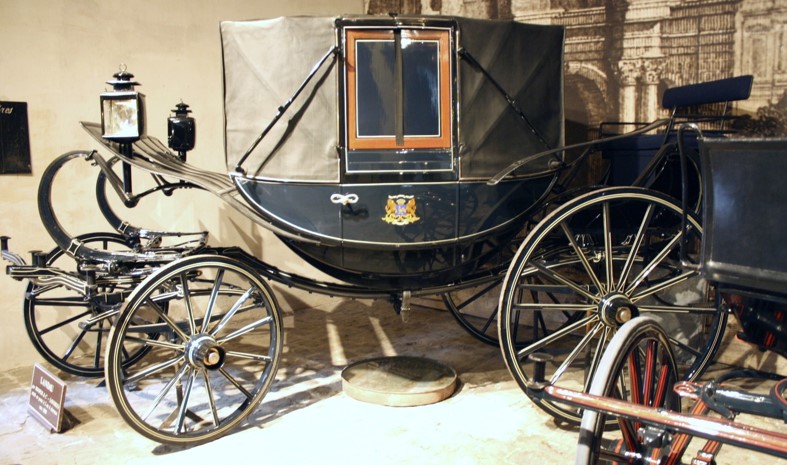
1809 Landau
Loretta reports:

My characters get from here to there in various horse-drawn vehicles, but mainly I've posted about public transportation, like hackney cabs and coaches. Privately owned vehicles have been rather neglected, although I do offer images on my Pinterest page.

In A Duke in Shining Armor, the heroine arrives in a landau to collect her wayward duke. The landau was a coachman-driven vehicle, pulled by two to four horses. It carried four passengers, and was more luxurious than the curricles and cabriolets that dashing heroes tend to drive in our stories. The latter are more like sports cars. The former are more like luxury sedans.

Something to bear in mind: Unlike today, vehicles did not come off an assembly line. They were individually made, and the owner might have been closely involved in the design.* Consequently, not all landaus look alike. Earlier ones were often built on square lines, but not always, as the 1809 Ackermann illustration, above, shows. Some interesting aspects of the landau, as pointed out here, are the seating design, allowing the two pairs of passengers to face each other, and the two folding hoods. According to Discovering Horse-Drawn Carriages, “In the early days, the hoods were made of harness leather and fell back a mere forty-five degrees.” When these early hoods were up, the interior could be hot, stuffy, and smelly, thanks to the oil and blacking used to keep the leather nice and shiny. In later vehicles, the hoods folded back flat.
Square Landau

A much later and fancier vehicle, one of the royal family’s Ascot landaus, was the carriage the Duke and Duchess of Sussex (aka Harry & Meghan) used for their wedding.

Here’s a late Victorian landau from the Horse and Carriage Museum Château de Vaux-le-Vicomte, France. And this is one you can buy.

You can read more about landaus here at All Things Georgian.

*This is why some vehicles, like the Stanhope gig, are named after people.

Images: Patent Landau, Ackermann’s Repository, February 1809; Square Landau, NEN Gallery, Luton Culture Museum Service.

Clicking on the image will enlarge it.  Clicking on the caption will take you to the source, where you can learn more and enlarge images as needed. And just so you know, if you order an item through one of my posts, I might get a small share of the sale.

Monday, July 16, 2018

Baron de Berenger—Horse Whisperer?

Monday, July 16, 2018

Thomas Alken, A Gentleman Riding With a Groom, and Coversing
Loretta report:

Last year, during my visit to the Kensington Central Library, Dave Walker introduced me to the Baron de Berenger’s gun. Thanks to Dave's introducing me to this colorful character, I’ve spent some time with de Berenger’s Helps and Hints: How to Protect Life and Property. It surprised me in a number of ways.

At the time of my stories, animals tended to be treated brutally. I won’t go into the ugly details, but, generally speaking (of course there were many exceptions) if human life was cheap, non-human life was close to worthless, the RSPCA notwithstanding. And while life was kinder to humans of the privileged classes, they were not necessarily kinder to their animals, especially their horses. And so I was struck with de Berenger’s views on the subject:
“[A] rider should, to appearance at least, be a part of his horse; in the efforts of both these component parts there should seem as if there was but one and the same impulse,— a generous and reciprocal attention to please,—to serve, and to spare; and when that is accomplished, most horses will display as much delight in being rode, as the rider will be delighted in riding such a horse; but to accomplish this to perfection, an intimacy, nay, an affection, must be established between yourself and the generous animal; but which ... cannot be attained by the intercourse which, by far too generally, prevails between fashionable characters and their horses; these poor, willing, and faithful animals, rarely experiencing any other notice, save that of being urged on by whip and spur, to exertions but too frequently woefully distressing to a willing frame ... What has secured to the dog the reputation of being more affectionate, more intelligent, and more faithful, than the horse? Because, even the exquisite will deign to hold a familiar and encouraging intercourse, nay, conversation, with him: not so with the poor horse; except when being cleaned or fed, it stands unnoticed for many hours in dull solitude, at least as far as man is concerned. With him the cheering influence and the enjoyments of the sun are embittered by a portion of severe, because generally inconsiderate, labour; even then, and although enduring willingly, hardly ever to experience the pattings of a condescending hand as a cheap encouragement!  ... nevertheless, and aware as the horse must be that it is led forth to endure straining labour, we see him cheerfully leave the stable, ever as willing slavishly to serve his master, as to please him, in any way, which he is taught to know as agreeable to him. Only familiarize with and pet him, as much as you do the dog, and his best endeavours at least to rival canine affection, intelligence, and fidelity, will soon be placed beyond all doubt.
The entire entry, from which I’ve also included a clipping (at right), is well worth reading. I’d be especially interested in the reactions of our horse-loving/riding/driving Nerdy History persons.

Image: Henry Thomas Alken, A Gentleman Riding With a Groom, and Conversing (undated), courtesy Yale Center for British Art, Paul Mellon Collection.

Monday, July 3, 2017

Green Cab Shelters

Monday, July 3, 2017
Loretta reports from London:

Some while ago, I reported on hackney coach stands and the watermen who attended them. Comments on that blog post alerted me to the green cab shelters created in the Victorian era to allow cabbies to get some refreshment and take shelter from bad weather. I put these green huts on my list of things to look out for in London.

This one is on The Kensington Road, near the Palace Gate, opposite the Albert Hall. I've seen others while riding on buses--not the ideal situation for taking photos. But, yes, they are there, and as far as I can make out, given the way roads have come and gone in London, a number remain at their 19th C locations.

You can read all about these cab shelters here at Cabbie Blog (it's pretty wonderful, and if anything will make you loyal to these true London cabbies, who spend years obtaining The Knowledge, this will). Several times on our walks through London, we saw men on scooters with maps sticking up from the handlebars: They were learning the streets, gaining The Knowledge.


Please click on images to enlarge.

Tuesday, July 26, 2016

Traveling Advice & Expenses 1828

Tuesday, July 26, 2016
Alken, Bath Coach 1820
Loretta reports:

Traveling in the early 1800s was complicated to a degree we can scarcely fathom. The Traveller's Oracle, by William Kitchiner, M.D., deals with what seems to be every last, daunting detail of the process, like what sort of servant(s) to take, what medicines to pack, how to sleep safely at an inn, and so on.

I could have picked any of dozens of excerpts, but decided matters of the horse would offer a good clue to the kinds of things one had to consider. This is from the third (1828) edition:
Travel expenses 

Travel expenses

Travel Expenses
When you wish to travel forty or fifty miles in a day expeditiously, if you have Horses of of your own—it is the most advisable plan to send them on the day before about twenty or twenty-five miles, desiring they may go not more than five miles in an hour.
If you start from home with post Horses, your own will be fresh to carry you on briskly to the termination of your Journey.
Image: Henry Alken, Bath Coach (1820) courtesy Yale Center for British Art, Paul Mellon Collection

Clicking on the image will enlarge it.  Clicking on the caption will take you to the source, where you can learn more and enlarge images as needed.

Friday, January 15, 2016

Horse-Drawn Carriages in Motion

Friday, January 15, 2016


Cabriolet
Loretta reports:

The heroine of Dukes Prefer Blondes drives her own vehicle—a cabriolet, as pictured at left— and there's quite a bit of traveling in the story, in various kinds of vehicles, including the hackney cabs and coaches I recently described
This short video offers s a chance to watch horses and carriages in action. Note that many of the vehicles are earlier than the time of my story, and some are quite modern, made specially for extreme carriage racing.


Image: John Ferneley,William Massey-Stanley Driving His Cabriolet in Hyde Park 1833, courtesy Yale Center for British Art, Paul Mellon Collection


Readers who receive our blog via email might see a rectangle, square, or nothing where the video ought to be.  To watch the video, please click on the title to this post.

Thursday, January 7, 2016

Hackney Cab vs. Hackney Coach

Thursday, January 7, 2016
Cruikshank, “The Last Cabdriver"

Loretta reports:

My characters in Dukes Prefer Blondes spend time in hackney coaches and hackney cabs. You will often find the terms used interchangeably, as though they were the same thing. However, a hackney cab was quite a different article from a hackney coach. The cab was a two-wheeled, one-horse vehicle. It held only two passengers, and seemed to be generally regarded as a mode of transportation for those who liked to live dangerously.

Leigh’s New Picture of London for 1834 briefly explains the difference here. You can read about them here in Omnibuses and Cabs, Their Origin and History, which includes excerpts from Dickens’s lively descriptions.

I’ve written a bit more about hackney coaches here, and you can read Dickens’s full version (which originally appeared in Bell’s Life in London in November 1835) here in Sketches by Boz.
1823 Hackney Cab
Clicking on the image will enlarge it.  Clicking on the caption will take you to the source, where you can learn more and enlarge images as needed.

Wednesday, October 14, 2015

The Bee Whisperer

Wednesday, October 14, 2015
Cruikshank, Bee Swarm
Loretta reports:

One of the delights of Hone’s Every-Day Book  is an entry like this one.

I was especially struck by the concluding paragraph. It’s all too easy to cite instances of animal cruelty during previous centuries. Horses, for instance, were worked to death. All the same, hundreds of years before PETA, it isn’t unusual to read expressions of concern like this—or see compassion for animals in prints.

Hogarth’s Cruelty is but one example.  Henry Alken’s print series, The High-Mettled Racer, sympathetically follows the career of a race horse to his sad end, as does Charles Dibdin’s poem of the same name.
Bee Management

Bee Management


 Image: George Cruikshank, Pic Nic party disturbed by a Swarm of Bees, 1826, courtesy of The Lewis Walpole Library, Yale University.

Clicking on the image will enlarge it.  Clicking on the caption will take you to the source, where you can learn more and enlarge images as needed.


Monday, October 12, 2015

Astley's Amphitheatre: What's Playing in October 1811

Monday, October 12, 2015
Astley's, from the Microcosm
Loretta reports:

In my third Dressmakers book, Vixen in Velvet, the hero takes the heroine to Astley’s Royal Circus. For the performance, I used descriptions from the 1830s, when Andrew Ducrow was manager, and Miss Woolford was the beloved equestrienne.

This critique below of an Astley’s performance comes from a generation earlier, when King George IV was the Prince Regent. It’s the sort of show Jane Austen might have seen.
Astley's Show 1811


You can learn more about Astley’s here at Jane Austen’s World as well as at the Victoria and Albert Museum, whose account of Astley’s covers Andrew Ducrow’s and Miss Woolford’s time as well as the interesting story of a famous equestrienne of the Victorian era.

Astley's Show 1811
As always, the blog Spitalfields Life has a larger, crisper, more beautifully colored version of the above illustration (please scroll down) from Ackermann’s Microcosm of London, originally published in 1808-10.


Clicking on the image will enlarge it.  Clicking on the caption will take you to the source, where you can learn more and enlarge images as needed.

Tuesday, September 22, 2015

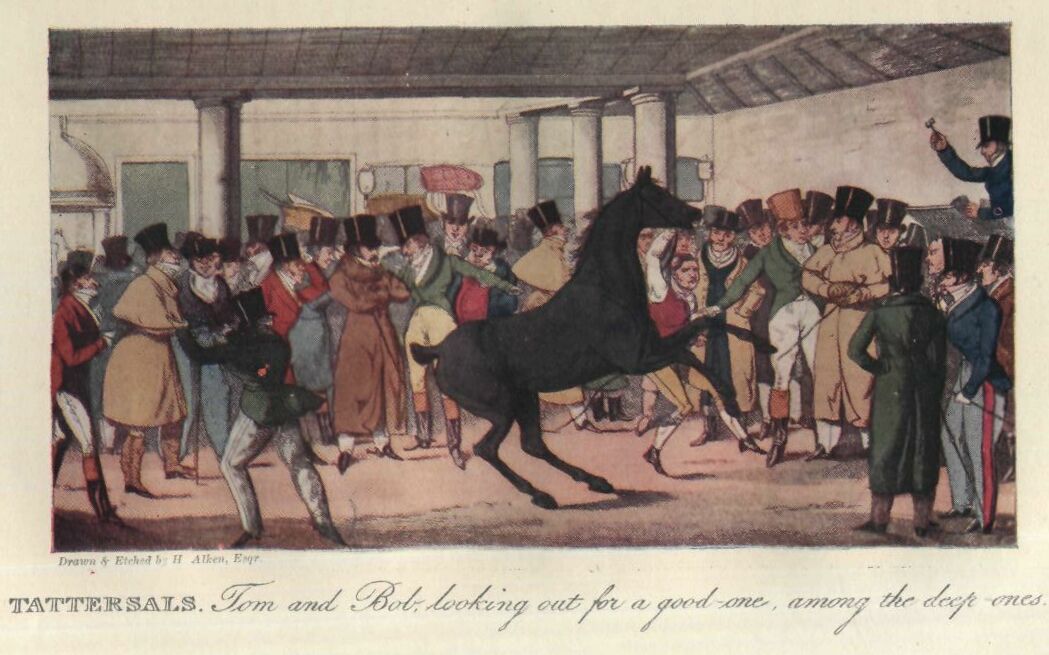
Tattersall's For Horses

Tuesday, September 22, 2015
Tattersall's 1834-35
Loretta reports:

If you’ve read novels set in the 19th century, you've probably come upon mention of Tattersall's, where Lord This or That would buy a horse. Here’s a bit of its history, as seen from the mid-Victorian era.

Tattersall's history

Tattersall's history

Tattersall's from Tom & Bob


Images:
Text from John Timbs, Curiosities of London: exhibiting the most rare and remarkable objects of interest in the metropolis; with nearly sixty years personal recollections (1868)

Above left—James Pollard (1792 - 1867), Epsom Races: Settling Day at Tattersalls 1834-35, courtesy Yale Center for British Art.

Below (the image I believe the text refers to)—Henry Alken, Tattersals. Tom and Bob, looking out for a good –one, among the deep-ones, courtesy Project Gutenberg.

Clicking on the image will enlarge it.  Clicking on the caption will take you to the source, where you can learn more and enlarge images as needed.

Thursday, June 4, 2015

Who Drives in Rotten Row?

Thursday, June 4, 2015
Hyde Park Corner
Loretta reports:

It’s been a while since I wrote my traditional Regency stories, and I’m not sure whether I allowed my characters to travel in a carriage in Rotten Row or realized this would be a faux pas. I’ve written about it before (here—with maps!)

“The right to drive along the Row in a carriage remained the prerogative of the reigning sovereign; as late as 1832, a map of London published by the United Kingdom Newspaper marked Rotten Row as ‘The King’s Private Road.’”
—Joyce Bellamy, Hyde Park for Horsemanship (1975)

Samuel Sidney’s Book of the Horse (1880) confirms this.
Rotten Row

As does Baron Redesdale’s Memories (1916)

Yet searching online leads to confusion. I find many books, by 19th C as well as recent authors, referring to driving in Rotten Row. Did these writers confuse Rotten Row with the carriage road running more or less parallel to it? A blog post indicates the Row was not restricted to riders until 1834, and certainly some caricatures seem to support this.Some 19th C authors describing Hyde Park say the rule was not in effect until Queen Victoria’s time, while others believe it dates to King Charles II or King William IV.

In any event, Queen Victoria was in no doubt whatsoever about her prerogative.
The Queen's Drive
Since my current books are set after 1830, I feel comfortable keeping my fictional carriages off Rotten Row.
Hyde Park after 1736-Larwood
Images: George Cruikshank, “The Arrival, or Western Entrance to Cockney Land” (first published in The English Spy 1825);  "Out of Place" from Punch, scanned from Hyde Park for Horsemanship; Hyde Park after 1735 from Larwood, The Story of the London Parks (1874).

Clicking on the image will enlarge it.  Clicking on the caption will allow you to read at the source, where you can learn more and enlarge images as needed.


Wednesday, January 7, 2015

The layout of a 19th C coaching inn

Wednesday, January 7, 2015
Hatchetts-The White Horse Cellar
Loretta reports:

Those of us writing books set during the coaching era often puzzle over coaching inns.  Even when we actually visit coaching inns in England, we may not feel enlightened.  We don’t see the horses or the stablemen.  The once-bustling yard is often converted to an eating area, with picnic benches and flowers.  Sometimes the interior has been redone to look more ye olde than is quite authentic.  Here’s the basic layout, courtesy H.D. Eberlein & A.E. Richardson, The English Inn Past & Present.
~~~
Custom had decreed the arrangement of an inn plan.  There was the usual courtyard with its arched or beamed entry.  There was a hall for receiving guests, a main staircase, a coffee room and a dining parlour.  Some inns could boast a special apartment for dining coach passengers only.  In addition there were smaller apartments known respectively by the names Sun, Moon, Star, Crescent or Paragon.  From 1700 to the year 1760 the arched entries were low, for until the latter date outside passengers were not encouraged.  After the accession of George the Third, when outside travelling became more general, the inside passengers were treated as belonging to an inferior order.  Not only did landlords show increased respect to the outside passengers, but a subtle compliment was paid to the coach proprietors by the landlords when alterations to the arched entries were made to their respective inns.   ...

Bull & Mouth Inn
No definite system of planning seems to have been adhered to through the centuries for inns other than to provide a yard around which were grouped sets of lodgings and a further yard for stabling and wagons ... The old inns of London consisted in the main of a block facing the street with an entry to a courtyard within, the front part of the house being reserved for sitting-rooms and eating parlours. The problem of the Georgian buildings was to provide easy ingress though an arched entry for coaches, which made their way out through a gate in the further yard.  To right or left of this entry, which varied according to circumstance, there was generally a large room where coach passengers could dine; to the left was the coach office and a passage connecting with the bar and the coffee room.  The drawing room was on the first floor.  This arrangement was generally followed in all parts of the country.
~~~
Images:  Pollard, Hatchett’s, the White Horse Cellar, Piccadilly (from which my hero and heroine set out in Scandal Wears Satin).  From Denver Art Museum collection.  T.H. Shepherd, The Old Bull & Mouth Inn, from London and Its Environs in the Nineteenth Century (1831 ed), courtesy Internet Archive.


Clicking on the image will enlarge it.  Clicking on the caption will allow you to read at the source, where you can learn more and enlarge images as needed.

Wednesday, March 19, 2014

Catching Sight: The World of the British Sporting Print

Wednesday, March 19, 2014

Bachelor's Hall: Full Cry
Loretta reports:

My recent travels took me to Richmond, VA.  Naturally, a museum being in the vicinity, I went.

In fact, I visit the Virginia Museum of Fine Arts every chance I get because (1) it houses a fine collection, with style; (2) its walls always show me something relevant to my areas of research; and (3) its permanent collection includes a breathtaking collection of Art Nouveau furnishings and jewelry, which I’ll share with you in future posts. The restaurant is genius, too, by the way.

It was my good fortune to be in town when Catching Sight: The World of the British Sporting Print was on show.  Many of the works in this exhibition of 18th and 19th century sporting prints belong to the Museum’s collection, but are too fragile to keep on permanent view.  Some were on loan, mainly from the Yale Center for British Art, which also had a tremendous benefactor in Paul Mellon. Among several knockouts—familiar prints made new because they were full size, inches from my face—were Charles Cooper Henderson’s The Olden Time and James Pollard’s Approach to Christmas and Cottagers Hospitality to Travellers.


In and Out Clever
 And then there was Henry Thomas Alken, with whom I’ve become familiar while searching for driving and riding scenes.  Along with some witty views of hunting, his work in the show included a set of six prints titled The High Mettled Racer.  They tell in pictures and verse the story of a thoroughbred, from foal to death, and have proved impossible to find online in this particular iteration, although there are lots of “after Alken” versions, not half so vibrant, to my mind. From the first verse:

He now is all nature, his limbs finely formed,
His mouth never bitted, his whole form unadorned;
 By rich colour’d silks, platted mane, and such stuff,
For a thorough breed Foal is quite handsome enough.


It’s poignant, and since I cry over Little Nell no matter what Oscar Wilde said and no matter how many times I read The Old Curiosity Shop, you can be sure I cried over the horse, right there in the gallery.

If you can get to Richmond, this is a show worth seeing.  If you can’t, the catalog will at least show you tiny versions of this glorious collection of prints.

Illustrations are courtesy the Yale Center for British Art, since the VMFA seems not to have any of their collection online.  Above left:  Francis Calcraft Turner, Bachelor's Hall:  Full Cry (1835 to 1836) courtesy Yale Center for British Art, Paul Mellon Collection.  Below right:  Henry Thomas Alken, In and Out Clever (undated), Yale Center for British Art, Yale Art Gallery Collection, Gift of Francis P. Garvan, B.A. 1897 (for Whitney Sporting Art Collection in memory of Harry Payne Whitney, B.A. 1894  


Wednesday, January 22, 2014

Early 20th Century Street Sweeping Machine

Wednesday, January 22, 2014
Loretta reports:

Following up on my last post
The World's Work, Vol 31, 1916
The search for street sweeping improvements continued, and produced some interesting approaches to the job, like this one, which uses a motorcycle.


Alert readers will note that, despite the Victorian era advances in street sweeping, the crossing sweeps were still at work through the 19th century, and men with push carts and brooms were still doing the job in 1916.


Street Sweeper & Handcart c 1896

Image at right courtesy Library of Congress Prints and Photographs Division Washington, D.C. 20540 USA
Please click on captions to view (and enlarge) at online source.

Monday, January 20, 2014

Early Victorian Street Sweeping Machine

Monday, January 20, 2014
Frith, The Crossing Sweeper, 1853
Loretta reports:

We take clean streets more or less for granted.  Litter and dog poo are nothing to what our early 19th century ancestors encountered.  Crossing sweeps pushed brooms, and pedestrians were supposed to pay for a clear path. By the late 1830s, with the filth worsening, inventors set about developing mechanical, albeit horse-driven, methods of cleaning streets.  Mr. Whitworth gets credit for the first mechanical sweeper, but by 1843, when his machines were put to work in London, other inventors (scroll down) were applying for patents for similar devices or “improvements.”

WHITWORTH'S PATENT SWEEPING MACHINE.
This machine, lately brought into operation in the town of Manchester, where it excited a considerable deal of public attention, has lately been introduced into the metropolis, and is now employed in cleaning Regent-street. It is the invention of Mr. Whitworth, of the firm of Messrs. Whitworth and Co., of Manchester, engineers, by whom it has been patented. The principle of the invention consists in employing the rotary motion of locomotive wheels, moved by horse or other power, to raise the loose soil from the surface of the ground and deposit it in a vehicle attached. The apparatus for this purpose is simple in its construction; it consists of a series of brooms (3 ft. wide) suspended from a light frame of wrought iron, hung behind a cart, the body of which is placed near the ground, for greater facility in loading. The draught is easy for two horses, and throughout the process of filling, scarcely a larger amount of force is required than would be necessary to draw the full cart an equal distance.

Two machines are advantageously worked together, one a little in advance of the other. Not only is the operation of cleansing a particular street thus effected more rapidly, but the two drivers can occasionally assist each other, and one of them (at higher wages) may exercise a supervision over both machines.
The success of the operation is no less remarkable than its novelty. Proceeding at a moderate speed through the public streets, the cart leaves behind it a well swept tract, which forms a striking contrast with the adjacent ground. Though of the full size of a common cart, it has repeatedly filled itself in the space of six minutes from the principal thoroughfares of Manchester. This fact, while it proves the efficiency of the new apparatus, proves also the necessity of a change in the present system of street cleaning.

The Civil Engineer and Architect's Journal, Volume 6, 1843

Wednesday, October 16, 2013

A Historic Carousel Still Turns

Wednesday, October 16, 2013
Loretta reports:

Yes, there was a carousel, and yes, I rode it, something I haven’t done in centuries.  This was another treat at the Heritage Museums & Gardens in Sandwich, MA, on Cape Cod. Their American Art & Carousel Gallery contains a beautiful carousel.  Though built in 1908, it includes figures made over a twenty year span, as early as the mid-1880s.  Back then, the figures didn’t move up and down.  When overhead gears were introduced, they were converted—and let me point out that they move faster than one expects.  What they all have in common is the Looff factory.  Charles I.D. Looff, the founder, built Coney Island’s first carousel.

Though the original carousel was broken up and sold, the Heritage Museums have most of it today, thanks to Hallett Tobin, who diligently hunted down the carousel animals.  Sadly, he found the original mechanism had been left to the mercy of the elements.  However, the slightly smaller antique replacement is splendidly crafted and works perfectly. 

In nearby Rhode Island, another Looff Carousel has National Historic Landmark status, as well as being designated “the State Jewel of American Folk Art.”  I’d definitely classify the carousel in Sandwich as the jewel of the Heritage Museum’s eclectic collection, and perhaps a jewel in general of American Folk Art.  Certainly the figures are beautiful examples of the artisans' care and craftsmanship—down to the horses’ metal hooves and real horse hair tails.

Among bits of information I picked up about carousels:  Most have one major figure, with fancier decorations than the others, called the “lead” horse.  The operator used this horse to count the number of times the horse went round.

Lead Horse
I also learned an interesting difference between English and American carousels.  What do you think it is?
 
Two Nerdy History Girls. Design by Pocket