Showing posts with label Georgian England. Show all posts

Tuesday, December 11, 2018

A Few of Loretta's Favorite Nerdy History Books

Tuesday, December 11, 2018
Globe-Wernicke, ad in American Homes & Gardens c 1905

Loretta reports:

Readers often ask which books we recommend on this, that, or the other subject. For this holiday season, it seemed like a good idea to mention some favorites. They might become gifts for the nerdy history person in your life or for yourself. Many are still in print and easily available. Some are trickier to find. While I could recommend hundreds, I winnowed it down to the following, which I often turn to for information and inspiration.

Adams, Samuel & Sarah. The Complete Servant (1825). You can read this online, or can buy your own copy. Details about not only the servant hierarchy, servants’ duties, but also the economics of maintaining household staff.

Black, A&C (publishers) Titles and Forms of Address: A Guide to Correct Use. This or Debrett’s Correct Form will help readers understand titles and forms of address they encounter in books as well as prevent writers’ committing social atrocities in their stories.

Bradfield, Nancy. Costume in Detail: Women's Dress 1730-1930. A detailed look, inside and out, of the way clothes were constructed. Extremely helpful for dressing and undressing our heroines.

Cunnington, C. Willitt. English Women’s Clothing in the Nineteenth Century and Cunnington, C. Willett and Cunnington, Phillis. The History of Underclothes (1992).  The Cunnington books, written in the early part of the 20th century, feature some outdated viewpoints. However, they still offer a wealth of examples as well as amusing and enlightening quotations from primary sources.

Gill, Gillian. We Two: Victoria and Albert: Rulers, Partners, Rivals. My favorite biography to date, and I’ve read quite a few. It reads like fiction. I originally hesitated to buy it because my sense was that Victoria lost the most fun and interesting part of herself when she wed, and that just depressed the daylights out of me. But this book offers a rather different perspective, bringing two strong personalities into sharp focus, and the compelling story starts well before she was born, with an almost operatic account of the events leading to her becoming Queen.

Grimble, Frances. The Lady's Stratagem: A Repository of 1820s Directions for the Toilet, Mantua-Making, Stay-Making, Millinery & Etiquette. Exactly as described in subtitle, it’s a marvelous compilation of information from various sources.

Inglis, John R. and Sanders, Jill. Panorama of the Thames: A Riverside View of Georgian London. A beautiful book and a labor of love that takes us on a voyage up and down the Thames during the Regency.

Rylance, Ralph. The Epicure’s Almanack. A moment in the Regency captured, as the author takes us on a detailed tour of all London’s eating establishments, and tells us what foods are in season when.
Félix Vallotton, La bibliothèque 1915 

Salisbury, Deb. Elephant’s Breath & London Smoke. A sort of OED of historical color, including dates for color names, and descriptions, it also offers advice on what colors for what complexions and occasions, among other fascinating details.

A Member of the Aristocracy. Manners and Rules of Good Society. A helpful etiquette book, as long as we remember it’s late Victorian to Edwardian (depending on the edition), when rules were more complicated and rigid than in earlier generations.

For more books we've referred to in our work and blogging, please click on the NHG library tag.

Images: Globe-Wernicke, advertisement in American Homes & Gardens c 1905;  Félix Vallotton, 1915  La bibliothèque.

Clicking on the image will enlarge it.  Clicking on a caption link will take you to the source, where you can learn more and enlarge images as needed. And, just so you know, if you order a book through one of my posts, I might get a small share of the sale.

Thursday, December 6, 2018

Italians Serenade London for Christmas in the 1820s

Thursday, December 6, 2018

Lazzari, Trompe l'oeil Still Life 18th C
Loretta reports:

There are a couple of interesting bits in this excerpt from Hone’s Every-Day Book. The first part reminds us that ordinary Londoners didn’t have anything like the access we do to music. If you were well off, you could go to the opera, ballet, or theater, or you would dance at Almack’s to some of the latest pieces from abroad. For ordinary people, London had its street musicians, true, as well as cheaper theatrical entertainments. Italian music by Italian musicians, however, seems to have been rather uncommon in the 1820s.

The second item I’d call to your attention is Hone’s reference, a little further on, to Londoners’ attitude toward Italian musicians a generation earlier, which this Rowlandson image illustrates. It is a far cry from the gentler and appreciative tone of Hone's report.

"Previous to Christmas 1825, a trio of foreign minstrels appeared in London, ushering in the season with melody from instruments seldom performed on in the streets. These were Genoese with their guitars.  Musicians of this order are common in Naples and all over Italy; at the carnival time they are fully employed, and at other periods are hired to assist in those serenades whereof English ladies hear nothing, unless they travel, save by the reports of those who publish accounts of their adventures. The three now spoken of took up their abode in London, at the King’s head public-house, in Leather-lane, from whence ever and anon, to wit, daily they sallied forth to ‘discourse most excellent music.’ They are represented in the engraving below, from a sketch hastily taken by a gentleman who was of a dinner party, by whom they were called into the house of a street in the suburbs.

Italian Minstrels in London,
At Christmas, 1825

Ranged in a row, with guitars slung
Before them thus, they played and sung:
Their instruments and choral voice
Bide each glad guest still more rejoice;
And each guest wished again to hear
Their wild guitars and voices clear."
Images: Sebastiano Lazzari: Trompe-l'œil Still Life, 18th century; illustrations and clipping from The Every-Day Book or Guide to the Year, William Hone, first published 1826

Clicking on the image will enlarge it.  Clicking on a caption link will take you to the source, where you can learn more and enlarge images as needed.

Tuesday, November 13, 2018

From the Archives: Harriette Wilson on Virtue

Tuesday, November 13, 2018
Loretta reports:

The Regency era courtesan Harriette Wilson belonged to the sorority called Girls Just Want To Have Fun.  Here’s her take on virtue:

~~~
There certainly was much aggravation of sin, in my projected criminal intercourse with the Marquis of Worcester.  Many women, very hard pressed par la belle nature, intrigue because they see no prospect nor hopes of getting husbands; but I, who might, as everybody told me, and were incessantly reminding me, have, at this period, smuggled myself into the Beaufort family, by merely declaring to Lord Worcester, with my finger pointed towards the North—that way leads to Harriette Wilson’s bedchamber; yet so perverse was my conscience, so hardened by what Fred Bentinck calls, my perseverance in loose morality, that I scorned the idea of taking such an advantage of the passion I had inspired, in what I believed to be a generous breast, as might, hereafter, cause unhappiness to himself, while it would embitter the peace of his parents.

Seriously I have but a very confused idea of what virtue really is, or what it would be at.  For my part, all the virtue I ever practised, or desire to learn, was such as my heart and conscience dictated.

Now the English Protestant ladies’ virtue is chastity!  There are but two classes of women among them.  She is a bad woman the moment she has committed fornication; be she generous, charitable, just , clever, domestic, affectionate, and ever ready to sacrifice her own good to serve and benefit those she loves, still her rank in society is with the lowest hired prostitute.  Each is indiscriminately avoided, and each is denominated the same—bad woman, while all are virtuous who are chaste.

…The soldier’s virtue lies in murdering as many fellow creatures as possible, at the command of any man, virtuous or vicious, who may happen to be his chief, no matter why or wherefore.

The French ladies’ virtue is, generally speaking, all comprised and summed up in one single word and article—bienséance!*

*propriety
~~~
Excerpt from The Memoirs Of Harriette Wilson, which were first published in 1825.
You can read the first two volumes from the 1909 edition online here.    And for further insight into this fascinating woman, you might want to look into The Courtesan’s Revenge: The Life of Harriette Wilson, the Woman Who Blackmailed the King.

Wednesday, October 31, 2018

The Vision of Skulls—a Little Rowlandson for Halloween

Wednesday, October 31, 2018
Rowlandson, The Vision of Skulls
Loretta reports:

Halloween seems an appropriate time for an excerpt from The English Dance of Death. In this volume, Thomas Rowlandson takes on a popular artistic subject, focusing on his countrymen, with William Combe writing a narrative based on the pictures (the method they used in the Tour of Doctor Syntax). In this excerpt from “The Vision of Skulls,” Sir Thomas describes a dream to his wife.

—The Phantom gave three heads a stroke
With his fierce Torch, and thus they spoke.
—Said one, "I was a soldier brave,
Who found in war an early grave;
But, e'er in Honour's field I died—
I slew the Hero by my side."
The Hero, by his side, exclaim'd,
—" 'Twas my right arm your prowess tam'd:
It was my sabre's well-aim'd blow,
 That laid your glittering figure low."
"Ho," cried a third, "pray cease your pother,
I saw you both kill one another."—
—Thus, though no arms, or legs had they,
 I thought they threaten'd an affray;
And seem'd, without alarm or dread,
To long to play the Loggerhead.
I thought their clamour ne'er would cease:
But the Torch wav'd, and all was peace.
It seem'd most strange the sight I saw,
That heads should speak 'gainst Nature's law,
Without a Tongue,—nor move a Jaw.
'I humbly told the Guide, that I Was of the class of Chivalry.
But that I was a Civic Knight,
Who had much rather eat than fight.
—Turn and look up, methought he said,
At the huge Sculls above your head,
Which are so thick, they might defy
The balls of any musketry.
Those which there meet your curious ken,
Belong'd to Knights and Aldermen,
Who to the Sword's heroic work
Preferr'd the feats of Knife and Fork;
And, as they grin, the Jaws between,
Their well-us'd, worn-out teeth are seen.—
But all these mortal remnants stood,
In such exact similitude,
I could not see, with all my care,
If any of my friends were there.
—I then enquir'd, if no offence,
And hop'd 'twas not impertinence,
If he might tell whose fleshless face
Was to fill up an empty space,
Which seem'd so large, that I could swear,
It was preserv'd for some Lord Mayor.
He wav'd his Torch, and lost in smoke,
'Twas thus I thought the Spectre spoke.—
—That place, Sir Simon, is your due:
And shortly will be filled by you.—
Intro to English Dance of Death
The English Dance of Death, From the Designs of Thomas Rowlandson with Metrical Illustrations, by the Author of “Doctor Syntax.” Vol 1 (1815)

Images: The Vision of Skulls
Excerpt from introduction to The English Dance of Death

Clicking on the image will enlarge it. Clicking on a caption link will take you to the source, where you can learn more and enlarge images as needed.

Thursday, October 25, 2018

Frankenstein and the Critics

Thursday, October 25, 2018
Frankenstein, annotated 2017
Loretta reports:

Mary Shelley’s reviewers had extremely different reactions to Frankenstein.

Following a plot summary, John Croker has this to say:
“Our readers will guess from this summary, what a tissue of horrible and disgusting absurdity this work presents ... The dreams of insanity are embodied in the strong and striking language of the insane, and the author, notwithstanding the rationality of his preface, often leaves us in doubt whether he is not as mad as his hero." 
Following samples of the prose style:
“... we take the liberty of assuring [the author] ... that the style which he has adopted in the present publication merely tends to defeat his own purpose, if he really had any other object in view than that of leaving the wearied reader, after a struggle between laughter and loathing, in doubt whether the head or the heart of the author be the most diseased."
Quarterly Review 18 (January [delayed until 12 June] 1818): 379-385. From the Mary Shelley Chronology and Resource Site, Scholarly Resources, Romantic Circles.

Walter Scott, however, is thrilled:
“So concludes this extraordinary tale, in which the author seems to us to disclose uncommon powers of poetic imagination. The feeling with which we perused the unexpected and fearful, yet, allowing the possibility of the event, very natural conclusion of Frankenstein's experiment, shook a little even our firm nerves ...

It is no slight merit in our eyes, that the tale, though wild in incident, is written in plain and forcible English, without exhibiting that mixture of hyperbolical Germanisms with which tales of wonder are usually told, as if it were necessary that the language should be as extravagant as the fiction. The ideas of the author are always clearly as well as forcibly expressed; and his descriptions of landscape have in them the choice requisites of truth, freshness, precision, and beauty ... 

Upon the whole, the work impresses us with a high idea of the author's original genius and happy power of expression ... If Gray's definition of Paradise, to lie on a couch, namely, and read new novels, come any thing near truth, no small praise is due to him, who, like the author of Frankenstein, has enlarged the sphere of that fascinating enjoyment."
Start of review in La Belle Assemblée
Blackwood’s Edinburgh Magazine 2 (March 1818)
His whole review is well worth reading, as are others. You can read them here at the Romantic Circles website.

If you are in New York between now and the last week of January, you might want to stop by the Morgan Library for the exhibition, “It’s Alive! Frankenstein at 200.”

Images: Cover of 2017 annotated edition of Frankenstein; Beginning of La Belle Assemblée review of Frankenstein, Vol. 17, March 1818

Clicking on the image will enlarge it.  Clicking on a caption link will take you to the source, where you can learn more and enlarge images as needed. And just so you know, if you order a book through one of my posts, I might get a small share of the sale.

Monday, September 24, 2018

The Landau Carriage

Monday, September 24, 2018
1809 Landau
Loretta reports:

My characters get from here to there in various horse-drawn vehicles, but mainly I've posted about public transportation, like hackney cabs and coaches. Privately owned vehicles have been rather neglected, although I do offer images on my Pinterest page.

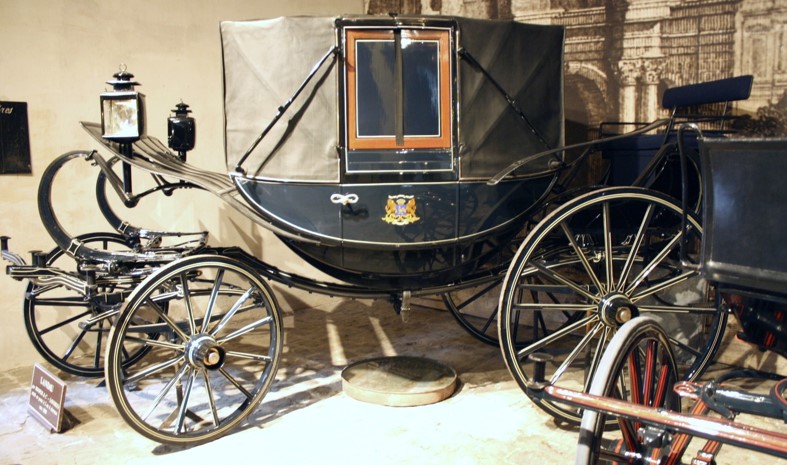
In A Duke in Shining Armor, the heroine arrives in a landau to collect her wayward duke. The landau was a coachman-driven vehicle, pulled by two to four horses. It carried four passengers, and was more luxurious than the curricles and cabriolets that dashing heroes tend to drive in our stories. The latter are more like sports cars. The former are more like luxury sedans.

Something to bear in mind: Unlike today, vehicles did not come off an assembly line. They were individually made, and the owner might have been closely involved in the design.* Consequently, not all landaus look alike. Earlier ones were often built on square lines, but not always, as the 1809 Ackermann illustration, above, shows. Some interesting aspects of the landau, as pointed out here, are the seating design, allowing the two pairs of passengers to face each other, and the two folding hoods. According to Discovering Horse-Drawn Carriages, “In the early days, the hoods were made of harness leather and fell back a mere forty-five degrees.” When these early hoods were up, the interior could be hot, stuffy, and smelly, thanks to the oil and blacking used to keep the leather nice and shiny. In later vehicles, the hoods folded back flat.
Square Landau

A much later and fancier vehicle, one of the royal family’s Ascot landaus, was the carriage the Duke and Duchess of Sussex (aka Harry & Meghan) used for their wedding.

Here’s a late Victorian landau from the Horse and Carriage Museum Château de Vaux-le-Vicomte, France. And this is one you can buy.

You can read more about landaus here at All Things Georgian.

*This is why some vehicles, like the Stanhope gig, are named after people.

Images: Patent Landau, Ackermann’s Repository, February 1809; Square Landau, NEN Gallery, Luton Culture Museum Service.

Clicking on the image will enlarge it.  Clicking on the caption will take you to the source, where you can learn more and enlarge images as needed. And just so you know, if you order an item through one of my posts, I might get a small share of the sale.

Friday, September 21, 2018

Friday Video: Recreating Madame Récamier's Coiffure

Friday, September 21, 2018

Chinard, Mme Récamier
Loretta reports:

I have mentioned Madame Récamier before, mainly in connection with furniture (here and here). She is quite well known among Regency/Napoleonic era aficionados, both for her portraits and her salon.

The Gérard and David portraits of her will be familiar to many. However, being mainly interested in the chaise longue, I hadn’t really noticed the marble bust by Joseph Chirard, until I came upon Janet Stephens’s video. Ms Stephens has posted several YouTube videos explaining Greek and Roman hair styles, which in turn help us get a better sense of the powerful influence of Greek and Roman statuary on this period of fashion in Europe and America.


Image: Bust of Juliette Récamier by Joseph Chinard, in "Musée des Beaux-arts" of Lyon (France), photo by Philippe Alès, Creative Commons license.
Please click on images to enlarge.
Readers who receive our blog via email might see a rectangle, square, or nothing where the video ought to be. To watch the video, please click on the title to this post (which will take you to our blog) or the video title (which will take you to YouTube).

Thursday, September 13, 2018

Goodwin's Court, London: A Little Time Travel

Thursday, September 13, 2018
Loretta reports:

I’ve just been reading a history of Kensington and Chelsea and shaking my head over the numbers of old buildings that have disappeared. So have streets. While my imagination is strong, trying to get a strong visual sense of an area is sometimes very difficult. The world in which my characters lived is long gone. In London one can certainly find pre-Victorian houses as well as venerable public buildings (St. Paul’s doesn’t seem likely to go anywhere) but they’re surrounded and often overwhelmed by, primarily, late Victorian to 20th & 21st-century architecture. Streets have to accommodate automobiles—zillions of them—and they are not traveling at horse-and-carriage speed.

Standing inside Apsley House, with tour guide Kristine Hughes Patrone, I had to really work to get a sense of what the Duke of Wellington saw from his window. For instance, Hyde Park isn’t the same; neither is Hyde Park Corner; and the Marble Arch is not where it used to be. However, the once-controversial statue of Achilles (which I’ve used more than once in my books) is right where it’s supposed to be. So one starts with the existent and mentally paints in the rest. It works, but oh, wouldn't I like to travel invisibly in a bubble, and actually be there.

Sometimes one can come close, though. One day, following a reader’s suggestion, I made my way to Goodwin’s Court in Covent Garden.

Here was a little slice of my characters’ London: the kinds of shop fronts they might have gazed into, and the gas lights that would have illuminated (not very well) the place at night.

Though it’s one small court in London, it’s easily the kind of space I can imagine, say, a lot of troublemakers bursting out from, or a pair of friends stepping in to, in order have a conversation at a time when the streets would have been extremely noisy. There are other quiet little corners that don’t seem to have changed very much from the early 1800s. A step off the beaten track sometimes does seem like a step through a portal into the past. Goodwin’s Court is one of the better examples

You can see more images and read more about Goodwin’s Court here and here.

All photos copyright © 2018 Walter M. Henritze III
Please click on images to enlarge.

Tuesday, August 21, 2018

Woman Reads, Wearing a Bonnet Indoors—Really?

Tuesday, August 21, 2018
Blacklock, A Quiet Read
Loretta reports:

A short time ago, this image appeared on social media, with a question about women wearing hats indoors while reading. This sort of thing leads to my putting on my deerstalker hat and sticking the pipe in my mouth—but not the needle in my arm—and sleuthing.

My collection of historical dress images includes a goodly number of early 19th century ones in which women are indoors, reading, wearing a headdress. They are usually in morning dress, and the headgear is a cap. Some caps are so elaborate, though, that at first glance they seem to be hats, like the English lace cap on the left in this image.

This fashion plate, of a promenade dress, definitely shows a hat (straw), and the woman is holding a book open. Since she’s wearing a rosary and cross,  she could be in church, and that could be a prayer book she’s holding. Or not. We often see Regency-era fashion plates of women wearing crosses with evening dress: It’s jewelry.

However, the painting in question is not from the Regency era. It comes from the late 19th/early 20th century, during a period of Regency nostalgia. In the early 1800s, Jane Austen was liked in some quarters, dismissed in others, but essentially no big deal. It wasn’t until the 1880s that she became a rock star. At this time editions of her books illustrated by the likes of Hugh Thomson and C.E. Brock begin to appear, and we start to see a Regency revival in painting. The image in question is from this Regency revival/nostalgia era, when artists like Edmund Blair Leighton, Frederick Morgan, Frédéric Soulacroix, Giovanni Boldinim and many others created their versions of the Regency (and Empire) eras.

Kennington, Lady Reading by a Window c 1900
Looking into this later time period offered a little more enlightenment. William Kay Blacklock’s painting is dated circa 1900. In the late 1800s/early 1900s, I did find a few images of women reading, indoors, wearing hats, like this one by Frederick Carl Frieseke, and this one by James Guthrie.

In conclusion, I can’t altogether explain it, but the image might be historically inaccurate only for the era it’s conveying. Or maybe not. Maybe the lady is sitting in the dentist’s office, waiting her turn. Or maybe she's waiting for her boyfriend to come and collect her for a drive in Hyde Park. Or maybe, as author Caroline Linden suggested, "She's getting ready to go out but just wants to finish one last chapter..." What do you think?


If you've seen other images with this reading-indoors-wearing-a-hat theme, please feel free to share.


My thanks to Lillian Marek for sending me on this very interesting and educational investigation!

Images: William Kay Blacklock, A Quiet Read, possibly circa 1900; Thomas Benjamin Kennington, Lady Reading by a Window; Gandalf’s Gallery via Wikipedia.

Clicking on the image will enlarge it.  Clicking on the caption will take you to the source, where you can learn more and enlarge images as needed.

Monday, August 13, 2018

The Waltz in Its Early Years

Monday, August 13, 2018


Waltzing 1821
Loretta reports:

Some comments on the kinds of physical activities ladies of the 18th and 19th century engaged in led to me to thinking about dancing, and waltzing in particular.

Early in my writing career, I became aware that the waltz had changed over the years, and the early form of the dance wasn’t quite like what we’re familiar with. Images like the ones I’ve posted here don’t look like the style of waltz we’re used to.

According to Elizabeth Aldrich’s From the Ballroom to Hell, “During the first forty years of the nineteenth century, waltzing couples turned clockwise as partners while traveling counterclockwise around the room. This constant spinning, never reversing, could and did produce a feeling of euphoria—or worse, vertigo—that could result in a loss of control.”
9 Positions of the Waltz 1816

The dance was controversial. Lord Byron disapproved. Yes, really. Others said it was unsuitable for unmarried, highly sensitive, and/or delicate women. I can tell you from my own experience, learning to waltz in a ballroom dancing class, that it is very sexy, and I understood why people disapproved. Also, though I was much younger then, I wasn’t used to ballroom dancing, and one waltz left me a little winded. Even with lots of practice, an entire evening of dancing, in the Regency and Victorian eras, must have provided vigorous exercise.

If you're curious about the precise steps for this era (though they do vary), Carlo Blassis's (trans by R. Barton), The Code of Terpischore, offers a detailed description of the waltz. I have a hard time reading these sorts of instructions, but others of you may be able to picture or re-enact it better.

I wanted to focus on this excerpt, however, which gives a sense of one difference between earlier and later forms of the waltz: “The gentleman should hold the lady by the right hand, and above the waist, or by both hands, if waltzing be difficult for her; or otherwise, it would be better for the gentleman to support the right hand of the lady by his left. The arms should be kept in a rounded position, which is the most graceful, preserving them without motion; and in this position one person should keep as far from the other as the arms will permit, so that neither may be incommoded.” This does correspond with the early 19th century images.

Here is a note from Hints on Etiquette and the Usages of Society; with a glance at Bad Habits (1836): “If a lady waltz with you, beware not to press her waist; you must only lightly touch it with the open palm of your hand, lest you leave a disagreeable impression not only on her ceinture, but on her mind.”
Cruikshank, Specimens of Waltzing 1817

For a more detailed account of the waltz—with lots of lovely images—you might want to read Paul Cooper’s post at Regency Dances.org.

Images: Waltzing 1821, courtesy Lewis Walpole Library Digital Collection; Detail from frontispiece to Thomas Wilson's Correct Method of German and French Waltzing (1816), showing nine positions of the Waltz, via Wikipedia; Specimens of Waltzing, George Cruikshank, 1817-06-04, courtesy New York Public Library.

Clicking on the image will enlarge it.  Clicking on the caption will take you to the source, where you can learn more and enlarge images as needed. FYI: If you order a book through one of my posts, I might get a small share of the sale.

Friday, August 3, 2018

Friday Video: Dressing an 18thc English Gentleman

Friday, August 3, 2018

Susan reporting,

Here's another wonderful fashion history video from the Lady Lever Art Gallery and National Museums of Liverpool, and a companion to this video demonstrating how an 18thc elite woman dressed for her day.

This jaded gentleman is not so much dressing, as being dressed, languidly presenting himself to his valet. Personally, I want to share this video with every copy editor who has queried the word "fall" in relation to 18thc breeches. One picture (or video!) is worth a thousand words.

Thanks to costume historian Pauline Loven and director Nick Loven of Crow's Eye Productions for sharing their latest video with us.

If you received this video via email, you may be seeing an empty space or black box where the video should be. Please click here to view the video.

Tuesday, July 24, 2018

A Wife Mourned

Tuesday, July 24, 2018
Loretta reports:

During last summer’s trip to London, we visited many of the sites used or intended to be used in my new Difficult Dukes series. On one amazing day, which began at Wimbledon, we explored the environs of Putney Bridge aka Fulham Bridge, whose predecessor is a sort of secondary character in this series.  It's believed to be the only bridge in England with a church at each end. We visited both. All Saints Church in Fulham is where we landed towards the end of the day.
“Putney Bridge cost upwards of £23,000; it is not only a disgrace to the neighbourhood, considered as an object of use and necessity, but is most dangerous to boats upon the river: the Ferry (which is still used) is mentioned in Doomsday-Book, as yielding an annual toll of 20s.—in 1729 its produce was four-hundred pounds. Immediately opposite to Putney stands Fulham, a mean town, noticeable only from its possessing a Palace of the Bishops of London, and a Church, in which are some monuments of eminent men.”
—Arthur Freeling, Picturesque Excursions; containing views at and near places of popular resort; with descriptions of each locality, 1842 (black & white image is from this book)

The church, which receives only this passing reference—after the slap at the town—is quite lovely, inside and out, and as the day was fading, we had the special treat of hearing choir practice.

There were, as there always are, poignant messages on the stones of the churchyard. But this one struck us as both touching and  ... odd.

Depending on your screen, you might find it a little hard to read. Transcription below:
“Sacred to the Memory of ISABELLA MURR
of this Parish
who departed this Lifethe 29th of November 1829
in the 52nd Year of her Age.

Ye who possess the highest charms of life:
A tender friend - a kind indulgent wife:
Oh, learn their worth! In her beneath this stone
These pleasing attributes together shone.
Was not true happiness with them combin’d?
Ask the spoil’d being she has left behind.                                               
                                    HE’S GONE TOO.
You can learn more about the bridge and see a number of images at the London Borough of Hammersmith & Fulham Library Service’s blog here and here.

Photographs copyright © 2018 Walter M. Henritze III
Please click on images to enlarge.

Thursday, July 19, 2018

From the Archives: Dining in July 1815

Thursday, July 19, 2018
Loretta reports:

Since we had a short video about 18th and early 19th C dining last week, now seemed like  good time to bring back this post on what foods were available in July during the Regency era.
The Greengrocer

From The Epicure’s Almanack July Alimentary Calendar:
~~~
The heats of the season now impose the necessity of occasionally substituting a light vegetable diet for the more solid gratification of animal food ... Cauliflowers, artichokes, green-peas, French-beans, Windsor* and other garden beans, frequently form a conspicuous part of the family dinner, to which butcher’s meat, in moderate quantities, may be said to serve merely as an auxiliary stimulant. Ham, bacon, and tongues, as well as ducks and geese, are the most seasonable viands for this purpose ... On festive occasions venison and turtle retain their pre-eminent station at the tables of the opulent, where also the fawn ... forms an elegant dish, when roasted whole and served up with rich gravy. Veal, having now been fed on milk, in its richest state, is peculiarly fine and well flavoured; but care should be taken that it be delivered fresh to the cook, as it is more liable to suffer from the heat of the weather and from flies than any other kind of meat. Ragouts of sweetbreads, oxpalates, lambs’ bits, fat livers, and cocks’-combs, are among the light dishes introduced at superior tables; where also various preparations of curry afford a delectable repast to those who have acquired a taste for this Indian diet.
 ...
 ... a plenteous and varied dessert presents itself at this season; consisting of pines, melons, peaches, cherries, grapes, currants, gooseberries and raspberries, as well as early apples and pears. Fruit is certainly most salubrious in hot weather; but, if the opinion be well founded that it does most good when taken before dinner, the dessert ought to take place of that spurious meal called lunch, which, being usually made of animal food, too often banishes the appetite irrecoverably for the day.

~~~
*broad beans

Excerpted from The Epicure's Almanack: Eating and Drinking in Regency London (The Original 1815 Guidebook).

Image: James Pollard, The Greengrocer (ca 1819) courtesy Yale Center for British Art, Paul Mellon Collection.

Clicking on the image will enlarge it. Clicking on the caption will allow you to read at the source, where you can learn more and enlarge images as needed.

Monday, July 16, 2018

Baron de Berenger—Horse Whisperer?

Monday, July 16, 2018

Thomas Alken, A Gentleman Riding With a Groom, and Coversing
Loretta report:

Last year, during my visit to the Kensington Central Library, Dave Walker introduced me to the Baron de Berenger’s gun. Thanks to Dave's introducing me to this colorful character, I’ve spent some time with de Berenger’s Helps and Hints: How to Protect Life and Property. It surprised me in a number of ways.

At the time of my stories, animals tended to be treated brutally. I won’t go into the ugly details, but, generally speaking (of course there were many exceptions) if human life was cheap, non-human life was close to worthless, the RSPCA notwithstanding. And while life was kinder to humans of the privileged classes, they were not necessarily kinder to their animals, especially their horses. And so I was struck with de Berenger’s views on the subject:
“[A] rider should, to appearance at least, be a part of his horse; in the efforts of both these component parts there should seem as if there was but one and the same impulse,— a generous and reciprocal attention to please,—to serve, and to spare; and when that is accomplished, most horses will display as much delight in being rode, as the rider will be delighted in riding such a horse; but to accomplish this to perfection, an intimacy, nay, an affection, must be established between yourself and the generous animal; but which ... cannot be attained by the intercourse which, by far too generally, prevails between fashionable characters and their horses; these poor, willing, and faithful animals, rarely experiencing any other notice, save that of being urged on by whip and spur, to exertions but too frequently woefully distressing to a willing frame ... What has secured to the dog the reputation of being more affectionate, more intelligent, and more faithful, than the horse? Because, even the exquisite will deign to hold a familiar and encouraging intercourse, nay, conversation, with him: not so with the poor horse; except when being cleaned or fed, it stands unnoticed for many hours in dull solitude, at least as far as man is concerned. With him the cheering influence and the enjoyments of the sun are embittered by a portion of severe, because generally inconsiderate, labour; even then, and although enduring willingly, hardly ever to experience the pattings of a condescending hand as a cheap encouragement!  ... nevertheless, and aware as the horse must be that it is led forth to endure straining labour, we see him cheerfully leave the stable, ever as willing slavishly to serve his master, as to please him, in any way, which he is taught to know as agreeable to him. Only familiarize with and pet him, as much as you do the dog, and his best endeavours at least to rival canine affection, intelligence, and fidelity, will soon be placed beyond all doubt.
The entire entry, from which I’ve also included a clipping (at right), is well worth reading. I’d be especially interested in the reactions of our horse-loving/riding/driving Nerdy History persons.

Image: Henry Thomas Alken, A Gentleman Riding With a Groom, and Conversing (undated), courtesy Yale Center for British Art, Paul Mellon Collection.

Friday, July 13, 2018

Friday Video: 18th Century Dining

Friday, July 13, 2018
Loretta reports:

As I’ve pointed out in a previous blog post, the dinner table of the late 1700s and early 1800s looked very different from our own, with a large number of dishes, both sweet and savory, presented at the same time.

This video gives a nice, three-dimensional view of what was on the table, as well as short explanations of the dishes. Also, I think you'll enjoy curator Ivan Day’s dry wit.

If the macaroni and cheese surprises you (as it did some commenters), you might want to check out Susan’s blog post on the subject.  Also, as she explains in this blog post, the governor of Virginia would have been eating in the same fashion as his aristocratic counterparts in London.

YouTube Video: English Taste: The Art of Dining in 18th Century England with curator Ivan Day
Image is a still from the video.
Readers who receive our blog via email might see a rectangle, square, or nothing where the video ought to be. To watch the video, please click on the title to this post (which will take you to our blog) or the video title (which will take you to YouTube).

Thursday, June 7, 2018

Newgate Prison and the Old Old Bailey

Thursday, June 7, 2018

Loretta reports:

In June 2017, I sat in two different visitors’ galleries, in two different courtrooms of the Old Bailey,  the Central Criminal Court of England and Wales, and watched the proceedings. This is not the same Old Bailey I wrote about in Dukes Prefer Blondes, though I noticed similarities in the way the courtroom was laid out, which will be useful the next time I bring criminals into my fiction.

Part of the present building stands where Newgate Prison once did, on the street named Old Bailey. Not many traces of the old building remain. There's a door in the Museum of London, and other bits in the U.S. Since the previous building wasn’t demolished until 1902, though, quite a few photographs are available, along with the Regency-era images by George Shepherd, Thomas Rowlandson, and the like. It took a bit of puzzling to determine from pictures, descriptions, and maps, which was the prison and which was the courtroom, but that might just be my brain malfunction. If you’re looking at an old map, the latter appears as “Session House,” and it ought to be perfectly clear to normal people.

I knew a gloomy walkway connected them. I’d read descriptions, which helped me visualize scenes in the book. But at the time I was writing the story, I couldn’t find images of this passageway. Recently, though, my trusty tome, The Queen’s London, provided the image you see below.

In case one doesn't already feel sufficiently low-spirited at the prospect of being hanged, the passageway will do the trick. It’s the English version of the Bridge of Sighs—that last walk from freedom, possibly from life. Please do read the cheery description under the photo.

You can read the description that accompanies the Ackermann plate (above left) here. Note that this image was done from the other end of Old Bailey, with the Sessions House in front.

Black & white photographs are from my copy of The Queen's London.


Please click on images to enlarge.


Tuesday, May 29, 2018

The Regency's Duke of Cambridge

Tuesday, May 29, 2018
Duke of Cambridge 1806

Loretta reports:

Having recently reported on the present Duke of Sussex and the previous holder of that title, I thought it made sense to look at the man who last held Prince William’s title, Duke of Cambridge.

As in Prince Harry’s case, Prince Adolphus Frederick, the previous Duke of Cambridge (1774-1850), lived during the Regency and Victorian eras, and his life shows some parallels to Prince William’s. Prince Adolphus served in the military, was generally well-liked—including by his father, George III, who wasn’t crazy about his older sons. This royal duke, too, married a beautiful young woman, and had three children

With the death of the Princess Charlotte in 1817, he, like his other brothers, was obliged to find a wife. Of the royal dukes, Peter Pindar wrote:
Agog are all, both old and young
    Warmed with desire to be prolific
And prompt with resolution strong
    To fight in Hyman’s war terrific.
Within two weeks of his niece’s death, he sent a marriage proposal to the Princess Augusta, the Landgrave of Hesse-Cassel’s youngest daughter. She was twenty years old and  beautiful.

“This was the first of the three Royal marriages since Princess Charlotte married Prince Leopold that roused the romantic enthusiasm of the British public* ... “The Duke and Duchess had only to show themselves to be loudly cheered. The first Sunday after their arrival in England they were recognized strolling together in Hyde Park, and were at once surrounded and jostled by a large crowd, cheering and yelling ... On another occasion they were recognized in their carriage outside the famous City jewelers, Rundle and Bridge, and a great crowd came yelling round them, so that it was twenty minutes before their coachman dared move.”
Augusta, Duchess of Cambridge, 1818
Their first son, born in March 1819, was christened George, and was in line for the throne until Victoria was born, a few months later.
“And if the English public had good reason to be satisfied with the marriage, so had the Duke of Cambridge. He wrote of himself when he was first married: ‘I really believe that on the surface of the globe there does not exist so happy a Being as myself ... and Heaven grant that I may be deserving of it and not forfeit my happiness by any misconduct.’”
He became rather eccentric in later life—among other things, having gone deaf, he sat in front of the church and kept up a running, plainly audible, commentary—and was on very bad terms with Queen Victoria during her early years on the throne. But in a time of rampant anti-Semitism, he remained sympathetic to Jews. He was the only one of George III’s sons who lived within his income. “He was certainly most generous with his time, and equally generous with his money to an almost incredible number of charitable causes.”

Quotations and other information from Roger Fulford’s Royal Dukes.

*Let’s just say that the other couples were rather less attractive.
Images: E. Harding, Duke of Cambridge 1806; Sir William Beechey, Augusta, Duchess of Cambridge, 1818.

Clicking on the image will enlarge it.  Clicking on the caption will take you to the source, where you can learn more and enlarge images as needed.

Thursday, May 24, 2018

The Duke of Sussex, Then and Now

Thursday, May 24, 2018

Prince Augustus Frederick, Duke of Sussex
Loretta reports:

As everybody who follows royal doings now knows, the Queen has made Prince Harry the Duke of Sussex. This may puzzle some people who watched the video I posted not long ago, The Last of the Dukes. There we were told that we could not look forward to any new dukes.

However, a royal duke is a different article. He’s a member of the royal family who happens to be a prince, upon whom the sovereign has bestowed the title—as the Queen did in the cases of her sons as well as her grandsons. For further details, such as how long the title remains royal and where these royal dukes stand in precedence, I recommend this Wikipedia article. It offers a fairly easy-to-understand and, I think, fascinatingly nerdy account.

As a nerdy history girl, what I found interesting, was this particular choice of title. The last Duke of Sussex was a gentleman I wrote about last October, where I quoted a description of him as “the most consistently Liberal-minded person of the first half of the nineteenth century.” You can read more about him here at the Georgian Era blog.
Prince Harry, Duke of Sussex

Of course I have no idea why the Queen chose the Sussex title for Prince Charles’s second son. However, in light of the choice of bride; the wedding celebration, including the clergy and guests; and the causes the gentleman has espoused, I like to think of it as a nod to her progressive ancestor as well as to the new duke and the future we hope for him (excluding the problematic relationships with women, of course).

Images: Prince Augustus Frederick, Duke of Sussex, by Guy Head, National Portrait Gallery NPG 648.

Prince Harry, Duke of Sussex, speaks during the opening ceremonies of the 2017 Invictus Games (edited), Creative Commons License, Author DoD News.

Clicking on the image will enlarge it.  Clicking on the caption will take you to the source, where you can learn more and enlarge images as needed.
 
Two Nerdy History Girls. Design by Pocket