Thursday, March 2, 2017

Fashions for March 1822

Thursday, March 2, 2017
Walking Dress February 1822
Loretta reports:

With last month’s fashion plates, I mentioned the style change that began after Waterloo. Dresses became more structured, less drapery-like.

One of the things we start seeing is a stiffening of the hem, using wadding, flounces, etc. These two dresses demonstrate the change. If you compare the opera dress of 1813 and the evening dress of 1822, the difference is clear.

I would remind readers, though, that the dresses themselves were not as stiff and geometric-looking in real life as in the fashion plates.  Susan offered us a good example back in December.
Evening Dress February 1822

Here are some  examples of 1820-25 dresses from the Metropolitan Museum of Art:
A wedding dress

A morning dress

An evening dress

1822 Dress description


Clicking on the image will enlarge it.  Clicking on the caption will take you to the source, where you can learn more and enlarge images as needed.

Tuesday, February 28, 2017

Victorians Lose Their Luggage

Tuesday, February 28, 2017
Frith, The Railway Station 1866

Loretta reports:

Last time, I talked about penmanship. Today, I offer a look at letter-writing, another lost art. I was, as any nerdy history person would imagine, thrilled to find the Correct Guide to Letter Writing (4th ed, 1889), which covers letters for virtually all occasions, including a marriage proposal From a Widower with grown-up Daughters to a Young Lady (and acceptance and rejection letters for same);  a letter From a Young Man to his  Guardian, asking for an increased Allowance; one from From a Butler to his Master, giving Notice; and one From a Lady, promising to sing at an Afternoon Tea.
Lost Luggage Letters

The two letters displayed here, complaining about lost luggage, show that this phenomenon didn't begin with airline luggage.  I’ll bet anything there are Egyptian hieroglyphs and Roman tablets complaining about lost luggage. Some of those pictures carved on cave walls probably express some Neolithic ancient ancestor’s dismay about his misplaced mastodon skin.
Llangollen Station
Images
Llangollen station on the w:Llangollen Railway, a heritage line in north Wales. Photographed from the town bridge over the River Dee (Afon Ddyfrdwy), by Chris Mckenna, 2005, courtesy Wikipedia.

William Powell Frith, The Railway Station. Engraving by Francis Holl (after Frith) 1866, courtesy Wikipedia.
Clicking on the image will enlarge it.  Clicking on the caption will take you to the source, where you can learn more and enlarge images as needed.


Sunday, February 26, 2017

Is This a Forgotten Portrait of Angelica Schuyler Church?

Sunday, February 26, 2017
Susan reporting,

Anyone familiar with the musical Hamilton already knows the name Angelica Schulyer Church (1756-1814). In fact, in most Hamil-fan circles, she's called just Angelica, the Schuyler sister who's famously never satisfied.

Anyone alive in late 18thc London and Paris would have recognized her name, too, for she was certainly the best-known American woman in the fast set of English society. Born into a wealthy Dutch-American family in Albany, NY, she eloped with John Church, a slightly shady Englishman who made his fortune selling arms during the American Revolution. After the war, John took Angelica and their children back to England, where he became a landed gentleman and a member of parliament. Angelica combined  her wit, beauty, and vivacious character with her husband's money to make her drawing room one of THE places to see and be seen in Georgian London.

Angelica was admired by gentlemen as diverse as Benjamin Franklin, the Prince of Wales, the Marquis de Lafayette, Whig party leader Charles James Fox and playwright Richard Brinsely Sheridan. She was a patron of artists Benjamin West, John Trumbull, and Maria Cosway. She may (or may not) have had an affair with Thomas Jefferson, and she may (or may not) have had one with her brother-in-law Alexander Hamilton, too.

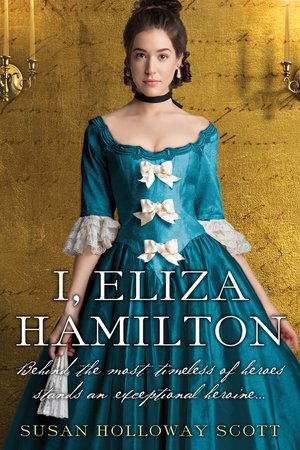
To me, she's the older sister of Eliza Schuyler Hamilton, the heroine of my new historical novel, I, Eliza Hamilton (to be published by Kensington Books in September, 2017.) I've been wallowing deep in my research of the Schuyler and Hamilton families for a good long time now. Characters become very real to me (especially the ones who were real people - I know, weird writer problems) to the point that I half-expect to run into them at the local grocery.

So imagine my surprise when the lovely face, above left, turned up in my Instagram feed this morning. Posted by the account of the Philip Mould Gallery in London, this portrait is by the well-known Georgian miniature painter Samuel Shelley (1750-1808). Shelley was famous for painting society beauties of the day, and this one - identified only as a portrait of a lady - is a gorgeous example of his work.

I'm also convinced it's a forgotten portrait of Angelica Schuyler Church.

There are only two other portraits of Angelica known today. One is a portrait of her with her son and servant by the American artist John Trumbull, detail, right, and the other a print after a painting by English artist Richard Cosway, lower left. To my eye, the Trumbull and Shelley portraits show the same woman. It's an uncommon face for an 18thc beauty: a long nose (which also turns up in portraits of her father), a small mouth, the dark, slightly close-set eyes. The Shelley miniature also seems to capture both the flirtatious charm and intelligence that Angelica's contemporaries all mention.

From the clothes and hair style, I'd guess that this portrait was painted in the 1780s, the time when Angelica was living in London. The art world in London at the time was a small one; another portraitist, Maria Cosway, was one of Angelica's closest friends, and it's easy to imagine Maria introducing Samuel Shelley to Angelica as a possible patron.

I've written to Emma Rutherford, the consultant specializing in miniatures for Philip Mould with my thoughts. UPDATE: Here's the reply from Ms. Rutherford: "Portrait miniatures do not often survive with the same provenance as oil portraits – their size meant that they could not be physically attached to labels and papers - and they were often not properly listed in inventories etc. I have also checked the RA listings and Shelley does not note exhibiting a portrait of Angelica. There are no other papers or sitters lists which survive relating to his output. With the lack of documentary evidence and provenance we would be unable to say that this is definitively a portrait of Angelica. On the other hand, the facial similarity (including eye colour) is so strong that I would like to amend our cataloguing to say that this is ‘possibly’ a portrait of her."

Above left: Portrait of a Lady by Samuel Shelley, image via Philip Mould Gallery.
Right: Portrait of Mrs. John Barker Church (Angelica Schuyler), Son Philip, and Servant by John Trumbull, c1785, private collection
Lower left: Print after a painting of Mrs. Church by Richard Cosway, c1790

Read more about Eliza Schuyler and Alexander Hamilton in my latest historical novel, I, Eliza Hamilton, now available everywhere.

Saturday, February 25, 2017

Breakfast Links: Week of February 20, 2017

Saturday, February 25, 2017
Breakfast Links are served - our weekly round-up of fav links to other web sites, articles, blogs, and images via Twitter.
• Library hand, the fastidiously neat penmanship style made for library card catalogues.
• And so to bed: 18thc night attire.
• Born in 1790, President John Tyler still has two grandsons alive today.
• "I always made an awkward bow": the final letter of poet John Keats.
• The ghost ships of San Francisco: dozens of wrecked ships lie beneath the city streets.
• Image: Anne Boleyn handed this miniature book of psalms, which contains a portrait of Henry VIII, to one of her maids of honor on the scaffold in 1536.
• Caught out, or why expense fiddling is not a modern phenomenon.
• Pennygown: the ruined chapel and medieval effigies of a Hebridean burial ground.
• Help transcribe Word War One love letters.
• Image: Photo of sixteen-year-old future author Agatha Christie on a visit to Paris in 1906.
• Discovering Citoyen Coiffier, an 18thc artists' supplier in Paris.
• What about the fathers? Men and childbirth in 19thc Ulster.
• Walt Whitman's brain, Napoleon's penis, and other famous body parts plundered from the grave.
• Those glorious wedding gowns of the 1980s, often inspired by Princess Diana.
• Who were "the servants"? Piecing together the lives of two 18thc enslaved men owned by the Schuyler family of Albany, NY.
• Image: The absolutely essential Oxford comma.
• This little street in Manhattan holds a story of two murders - and money.
• Mystery over 14thc male Black Death victims found buried together hand in hand.
• Nylon, the fiber that changed America, turns eighty.
• The lowdown on pantaloons: what Regency men wore on their legs.
• An abandoned hobbit castle built for sheep?
• Image: Just for fun: Best. Footnote. Ever.
Hungry for more? Follow us on Twitter @2nerdyhistgirls for fresh updates daily.
Above: At Breakfast by Laurits Andersen Ring. Private collection

Friday, February 24, 2017

The Art of Penmanship

Friday, February 24, 2017
Alfred Stevens, The Letter

Loretta reports:

Periodically, an inquiry pops up on social media about whether or not children ought to be taught cursive handwriting. Some say it’s no longer necessary. Others worry that our letters and journals will become the equivalent of Egyptian hieroglyphs, which were a complete mystery for about 1400 years. We’re still not positive about how to pronounce the ancient Egyptian words, since the hieroglyphs don’t bother with vowels.

But the Is Cursive Really Necessary? contingent maintain that there will always be experts who can translate our funny little marks on paper, just as there are experts today who can translate the numerous scripts of centuries past, like this letter written in English Chancery Hand.
Who Can Learn to Write
The Picturesque

In other words, our diaries and such will make perfect sense to a small group of nerdy history writing scholars in the centuries ahead.

For now, though, a great many of us are still writing and reading cursive. Some of us ancient ones remember being taught the “Palmer Method” in elementary school. While reading Ann Trubeck’s The History and Uncertain Future of Handwriting, I learned that the Palmer method was a simplification of a very beautiful style that was popular from about 1850 to the 1920s, and used for one of the most famous logos on earth, Coca-Cola®.

It’s called Spencerian script, and it was developed by Platt Rogers Spencer, who thought that our writing should be inspired by the forms in nature. The forms of his letters truly are beautiful. The words are easy to read. But it’s no easy feat to get good at it. If you’re interested, though, you can read the New Spencerian Compendium of Penmanship here at Internet Archive or in this PDF.
Ladies' Hand
Images: Alfred Stevens, The Letter, courtesy Wikipedia.
Handwriting advice and samples from the New Spencerian Compendium, courtesy Internet Archive.

Clicking on the image will enlarge it.  Clicking on the caption will take you to the source, where you can learn more and enlarge images as needed.
 
Two Nerdy History Girls. Design by Pocket