Friday, September 6, 2013

Casual Friday: Late Victorian Travel Films

Friday, September 6, 2013
Courtesy Library of Congress
Loretta reports:

Some early travel films, set to rather sad music.  Yes, as some of the YouTube comments point out, everyone in these films is dead.  However, those people were very much alive when they were being filmed.  So you might wish to choose your own music to accompany it—and have fun, as I did, trying to guess the locales.  I was delightfully surprised to see early film footage of a locale featured in Mr. Impossible.


Thursday, September 5, 2013

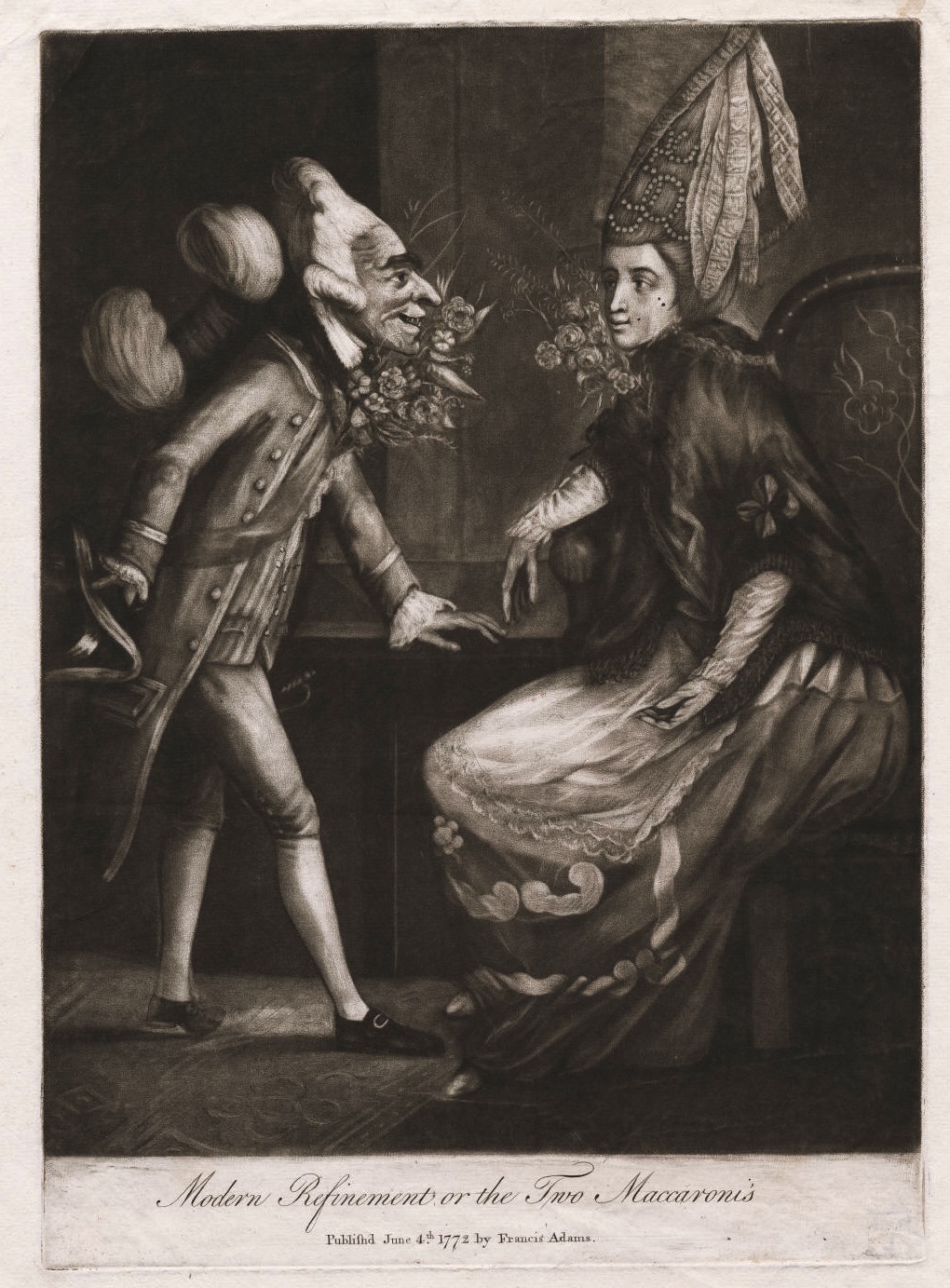
"Curls Frizzed Out with Laborious Nicety", 1747

Thursday, September 5, 2013
Isabella reporting,

Whenever I write books set in the 17th-18th c., the question of wigs always makes my editors very nervous. If I were to be true to the times, all my noble-born characters would be wearing hair other than their own. Apparently, however, this is too horrifying a concept for modern readers to accept, so I have to be very discreet whenever mentioning wigs or other false hair. No matter that nearly every modern Hollywood celebrity sports a full head of glued-on extensions....but I digress.

Still, while wig-wearing was very popular in Georgian London, it wasn't above being ridiculed as a fashionable frivolity, and there are scores of caricatures such as this and this poking fun at the style. The following passage begins with a brief history of wig-wearing, but soon lapses in scornful criticism. It's from a description of the peruke (wig) maker's trade from The London Tradesman, written by Robert Campbell in 1747. He might have had the exaggerated pair, above, in mind.

Our Forefathers were contented with their own Hair, and never dreamed of thatching their Skulls with false-curls. It is a foreign Invention, but of what Country I cannot learn, and appeared among us at the Restoration...It was originally but rude and simple, but kept a nearer Resemblance to Nature than it does at present; the Fashion was to wear Wigs nearly resembling the natural Colour of our Hair, and shaped in such manner as to make the artificial Locks appear like a natural Production; but in Process of Time full-bottomed Wiggs became the Mode; and the Heads of our Beaus and Men of Fashion were loaded with Hair...and the Natural Colour was laid aside for Silver Locks. The Bobb, the Pig-tail, Tuppe, Ramilie, and a Number of Shapes, are now become the Mode. Sometimes the Beaus appear plaistered all over with Powder and Pomatum, and their Curls frizzled out with laborious Nicety; at other Times the Powder Puff is laid aside, and they affect to dress in Wanton Ringlets. Originally Wiggs were confined to the Male Part of the Species, but of late, that usurping Sex the Ladies, are grown ashamed of the Natural Production of their own Heads, and lay Snares for our Hearts in artificial...TĂȘtes de Mouton [sheep's heads]. The Black, the Brown, the Fair and Carroty, appear now all in one Livery; and you can no more judge of your Mistress's natural Complexion by the Colour of her Hair, than by that of her Ribbons. The whole Species of our Modern Beaus and Belles appear in a perpetual Masquerade, and seem contending with one another who shall deviate most from Nature, and the ancient Simplicity of their Forefathers.

Above: Modern Refinement, or, The Two Macaronis, published 1772 by Francis Adams. Lewis Walpole Library, Yale University.

Wednesday, September 4, 2013

Fashions for September 1815

Wednesday, September 4, 2013
Loretta reports:

You may find the description of the dinner dress confusing.  I’ve always associated the color primrose with yellow, and my research seems to agree, although the Smithsonian’s botany page offers a variety whose petals are “rose-purple to white, rarely cream-yellow, or rarely orange-red.”

The dress in the plate is not yellow, and might have been intended to be purple, though I suspect not.  I decided the artist in charge of coloring the plate misunderstood.  If those of you who’ve made a closer study of 19th century women’s magazines can solve the mystery, all of us nerdy history persons will be fascinated and grateful.


Read online here


From Ackermann's Repository, September 1815

Tuesday, September 3, 2013

A New England Meeting House with an Anglican Steeple, 1775

Tuesday, September 3, 2013
Isabella reporting,

The most important things that any group of immigrants or refugees brings with them to their new homes aren't tucked inside trunks or suitcases, but inside their heads: the memories of old lives and places, as well as beliefs, talents, and skills. The handsome building, left, is the First Baptist Meeting House in Providence, RI, and when I recently visited Providence (to see the dandies), I was struck again by how the old church is a perfect testament to the talents, skills, and beliefs of the 18th c. colonists who built it in 1774-1775.

Roger Williams (c1603-1683) not only founded the church, but also what would become the state of Rhode Island. A Cambridge-educated theologian, Williams fled Stuart Britain in the 1630s to find freedom to practice his religious beliefs. Unfortunately, the Puritans of Massachusetts Bay proved no more tolerant of his tenets than England had been, and again he fled, this time to create a colony of his own, drawing his followers together into the first congregation of Baptists in the New World in 1636. (Read here for an excellent brief history of Williams and the First Baptist Church.) Unlike other colonies with established, official churches, Williams wanted his colony to remain "a shelter for persons distressed of conscience" where all faiths were free to worship; in 1658, Rhode Island also became the home of the second-oldest Jewish congregation in America.

By the 1770s, the small Baptist congregation had grown dramatically, and required a new home. Despite the political unrest in the American colonies, the congregation looked back to the great churches of London for the inspiration for the new meeting house, churches designed by Christopher Wren and James Gibbslike St Clement Danes in Westminster, right. It didn't matter that these London churches were Anglican, the same Anglican Church that Roger Williams had rejected. It was the imposing dignity and solemnity of the churches that the Rhode Islanders wished to copy. They did, too, combining the best of Georgian church architecture combined with a traditional New England clapboard meeting house.

But there was more "borrowing" in the actual construction. The new meeting house was to be the largest building in New England at the time, 80 x 80 feet, and able to seat 1200 people - approximately one-third of Providence's population in 1770. Finding a sufficient number of skilled housewrights and other tradesmen for the job should have slowed the building. But the British had closed Boston's harbor as punishment for the 1773 Boston Tea Party, putting scores of shipbuilders and carpenters out of
work. Desperate for work, these men made their way to Providence, and with them, the new meeting house was able to be dedicated in 1775. The towering 185-foot steeple - the first on a Baptist meeting house - was erected in just three and a half days.

Their work has stood the test of time - and numerous hurricanes! - over the centuries, and the meeting house is as beautiful a building now, as a National Historic Landmark nestled into the side of College Hill, as it must have been in 1775. While it is still in use for worship, with the congregation celebrating its 375th anniversary this  year, and for Brown University's commencement ceremony each spring, there are guided tours open to the public.

So many historic sites commemorate wars and battles; it's good to see one that honors both freedom and tolerance as well as the phenomenal handwork of those long-forgotten craftsmen.

Above: First Baptist Meeting House, Providence, RI. Photo copyright Susan Holloway Scott.
Below: St. Clement Danes Church, Strand. Published by William Clark, print made by Thomas Hingham, Britain, 1817.

Monday, September 2, 2013

Thicker and Longer Hair in 1807

Monday, September 2, 2013
December 1806
Loretta reports:

In the early 19th century, as today, ladies might choose from a great many beauty products, including a surprising number of hair products.  The following competing claims, Russian vs. Italian miracle hair growth products, come from La Belle AssemblĂ©e, Volume 3, Supplement, Advertisements for September 1807.


Image in upper left corner is a detail from an 1806 fashion plate, courtesy Los Angeles County Museum of Art.
 
Two Nerdy History Girls. Design by Pocket