Saturday, March 4, 2017

Breakfast Links: Week of February 27, 2017

Saturday, March 4, 2017
Breakfast Links are served - our weekly round-up of fav links to other web sites, articles, blogs, and images via Twitter.
• A five-minute guide to Callot Soeurs Couture.
• House of cards: the politics of calling card etiquette in 19thc Washington.
• Katherine Johnson of NASA: she was a computer when computers wore skirts.
• What digital does: Queen Charlotte online.
• Image: A dog who knows how to steal the show.
• Marie Antoinette's daily schedule.
• Welcoming in the month: all kinds of march.
• The weaker sex? Violence and the suffragette movement.
• Was Elizabeth Jeffries really a cold-blooded killer of a victim of domestic abuse?
• A guide to commuting in Regency England.
• Image: Entrance from Mile End of Whitechapel Turnpike by Thomas Rowlandson, 1798.
• Zoom in on Paul Revere's eye-witness drawing of the Boston Massacre, the only eye-witness drawing.
• Who was Benjamin Tallmadge and what was the Culper Spy Ring during the Revolutionary War?
• It's Shrove Tuesday, so ploughmen should be cooking the cockerel they won from the farmer on Plough Monday.
• James Hatfield, the mysterious would-be assassin of George III.
• Thomas Jefferson and the case of the missing letters.
• The now-lost Riding Club was formed in 19thc. New York City so that the wives and daughters of millionaires could ride in fashion - just not be members.
• Pancake recipe from the reign of Queen Elizabeth I in a 16thc cookbook.
• What a story! Robert Smalls, former slave and Civil War hero.
• Jane Crothers, witness to the Boston Massacre.
• Just for fun: Image: Whoa, there, Mrs. Morse. I'm not a Michelin chef.
Hungry for more? Follow us on Twitter @2nerdyhistgirls for fresh updates daily.
Above: At Breakfast by Laurits Andersen Ring. Private collection

Friday, March 3, 2017

Friday Video from the Archives: Leaving Work, c1895

Friday, March 3, 2017


Susan reporting,

After posting the early film clip from 1896 of a snowball fight, the creation of the pioneering French film-maker Louis Lumière (1864-1948), I looked for more of his work to share here.

This short silent clip is known as Workers Leaving the Lumière Factory in Lyon (La Sortie des Usines Lumière à Lyon), and it's exactly that. Using natural daylight, Lumière set his camera across the street from the exit of his family's factory at closing time and recorded the workers – mostly women, though there are a few men in top hats – leaving for the day, plus a single large, inquisitive dog. Lumière filmed the same scene three times, on three different days, which accounts for the varying light as well as other differences like the carriages that come through the gate.

While I love seeing the clothes worn by everyday working women (plus the hats!), this film is famous for another reason. It was one of ten short films shown together to an audience on December 28, 1895 at the Salon Indien du Grand Cafe on the Boulevard des Capucines in Paris, making this the first public screening of films with an admission fee charged. Each film ran about 50 seconds, shown through a hand-cranked projector. And, as the old saying goes, the rest is history.

Thursday, March 2, 2017

Fashions for March 1822

Thursday, March 2, 2017
Walking Dress February 1822
Loretta reports:

With last month’s fashion plates, I mentioned the style change that began after Waterloo. Dresses became more structured, less drapery-like.

One of the things we start seeing is a stiffening of the hem, using wadding, flounces, etc. These two dresses demonstrate the change. If you compare the opera dress of 1813 and the evening dress of 1822, the difference is clear.

I would remind readers, though, that the dresses themselves were not as stiff and geometric-looking in real life as in the fashion plates.  Susan offered us a good example back in December.
Evening Dress February 1822

Here are some  examples of 1820-25 dresses from the Metropolitan Museum of Art:
A wedding dress

A morning dress

An evening dress

1822 Dress description


Clicking on the image will enlarge it.  Clicking on the caption will take you to the source, where you can learn more and enlarge images as needed.

Tuesday, February 28, 2017

Victorians Lose Their Luggage

Tuesday, February 28, 2017
Frith, The Railway Station 1866

Loretta reports:

Last time, I talked about penmanship. Today, I offer a look at letter-writing, another lost art. I was, as any nerdy history person would imagine, thrilled to find the Correct Guide to Letter Writing (4th ed, 1889), which covers letters for virtually all occasions, including a marriage proposal From a Widower with grown-up Daughters to a Young Lady (and acceptance and rejection letters for same);  a letter From a Young Man to his  Guardian, asking for an increased Allowance; one from From a Butler to his Master, giving Notice; and one From a Lady, promising to sing at an Afternoon Tea.
Lost Luggage Letters

The two letters displayed here, complaining about lost luggage, show that this phenomenon didn't begin with airline luggage.  I’ll bet anything there are Egyptian hieroglyphs and Roman tablets complaining about lost luggage. Some of those pictures carved on cave walls probably express some Neolithic ancient ancestor’s dismay about his misplaced mastodon skin.
Llangollen Station
Images
Llangollen station on the w:Llangollen Railway, a heritage line in north Wales. Photographed from the town bridge over the River Dee (Afon Ddyfrdwy), by Chris Mckenna, 2005, courtesy Wikipedia.

William Powell Frith, The Railway Station. Engraving by Francis Holl (after Frith) 1866, courtesy Wikipedia.
Clicking on the image will enlarge it.  Clicking on the caption will take you to the source, where you can learn more and enlarge images as needed.


Sunday, February 26, 2017

Is This a Forgotten Portrait of Angelica Schuyler Church?

Sunday, February 26, 2017
Susan reporting,

Anyone familiar with the musical Hamilton already knows the name Angelica Schulyer Church (1756-1814). In fact, in most Hamil-fan circles, she's called just Angelica, the Schuyler sister who's famously never satisfied.

Anyone alive in late 18thc London and Paris would have recognized her name, too, for she was certainly the best-known American woman in the fast set of English society. Born into a wealthy Dutch-American family in Albany, NY, she eloped with John Church, a slightly shady Englishman who made his fortune selling arms during the American Revolution. After the war, John took Angelica and their children back to England, where he became a landed gentleman and a member of parliament. Angelica combined  her wit, beauty, and vivacious character with her husband's money to make her drawing room one of THE places to see and be seen in Georgian London.

Angelica was admired by gentlemen as diverse as Benjamin Franklin, the Prince of Wales, the Marquis de Lafayette, Whig party leader Charles James Fox and playwright Richard Brinsely Sheridan. She was a patron of artists Benjamin West, John Trumbull, and Maria Cosway. She may (or may not) have had an affair with Thomas Jefferson, and she may (or may not) have had one with her brother-in-law Alexander Hamilton, too.

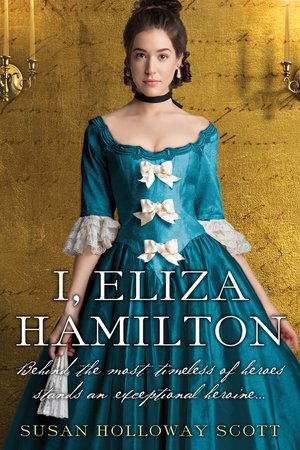
To me, she's the older sister of Eliza Schuyler Hamilton, the heroine of my new historical novel, I, Eliza Hamilton (to be published by Kensington Books in September, 2017.) I've been wallowing deep in my research of the Schuyler and Hamilton families for a good long time now. Characters become very real to me (especially the ones who were real people - I know, weird writer problems) to the point that I half-expect to run into them at the local grocery.

So imagine my surprise when the lovely face, above left, turned up in my Instagram feed this morning. Posted by the account of the Philip Mould Gallery in London, this portrait is by the well-known Georgian miniature painter Samuel Shelley (1750-1808). Shelley was famous for painting society beauties of the day, and this one - identified only as a portrait of a lady - is a gorgeous example of his work.

I'm also convinced it's a forgotten portrait of Angelica Schuyler Church.

There are only two other portraits of Angelica known today. One is a portrait of her with her son and servant by the American artist John Trumbull, detail, right, and the other a print after a painting by English artist Richard Cosway, lower left. To my eye, the Trumbull and Shelley portraits show the same woman. It's an uncommon face for an 18thc beauty: a long nose (which also turns up in portraits of her father), a small mouth, the dark, slightly close-set eyes. The Shelley miniature also seems to capture both the flirtatious charm and intelligence that Angelica's contemporaries all mention.

From the clothes and hair style, I'd guess that this portrait was painted in the 1780s, the time when Angelica was living in London. The art world in London at the time was a small one; another portraitist, Maria Cosway, was one of Angelica's closest friends, and it's easy to imagine Maria introducing Samuel Shelley to Angelica as a possible patron.

I've written to Emma Rutherford, the consultant specializing in miniatures for Philip Mould with my thoughts. UPDATE: Here's the reply from Ms. Rutherford: "Portrait miniatures do not often survive with the same provenance as oil portraits – their size meant that they could not be physically attached to labels and papers - and they were often not properly listed in inventories etc. I have also checked the RA listings and Shelley does not note exhibiting a portrait of Angelica. There are no other papers or sitters lists which survive relating to his output. With the lack of documentary evidence and provenance we would be unable to say that this is definitively a portrait of Angelica. On the other hand, the facial similarity (including eye colour) is so strong that I would like to amend our cataloguing to say that this is ‘possibly’ a portrait of her."

Above left: Portrait of a Lady by Samuel Shelley, image via Philip Mould Gallery.
Right: Portrait of Mrs. John Barker Church (Angelica Schuyler), Son Philip, and Servant by John Trumbull, c1785, private collection
Lower left: Print after a painting of Mrs. Church by Richard Cosway, c1790

Read more about Eliza Schuyler and Alexander Hamilton in my latest historical novel, I, Eliza Hamilton, now available everywhere.
 
Two Nerdy History Girls. Design by Pocket