Whenever I write books set in the 17th-18th c., the question of wigs always makes my editors very nervous. If I were to be true to the times, all my noble-born characters would be wearing hair other than their own. Apparently, however, this is too horrifying a concept for modern readers to accept, so I have to be very discreet whenever mentioning wigs or other false hair. No matter that nearly every modern Hollywood celebrity sports a full head of glued-on extensions....but I digress.
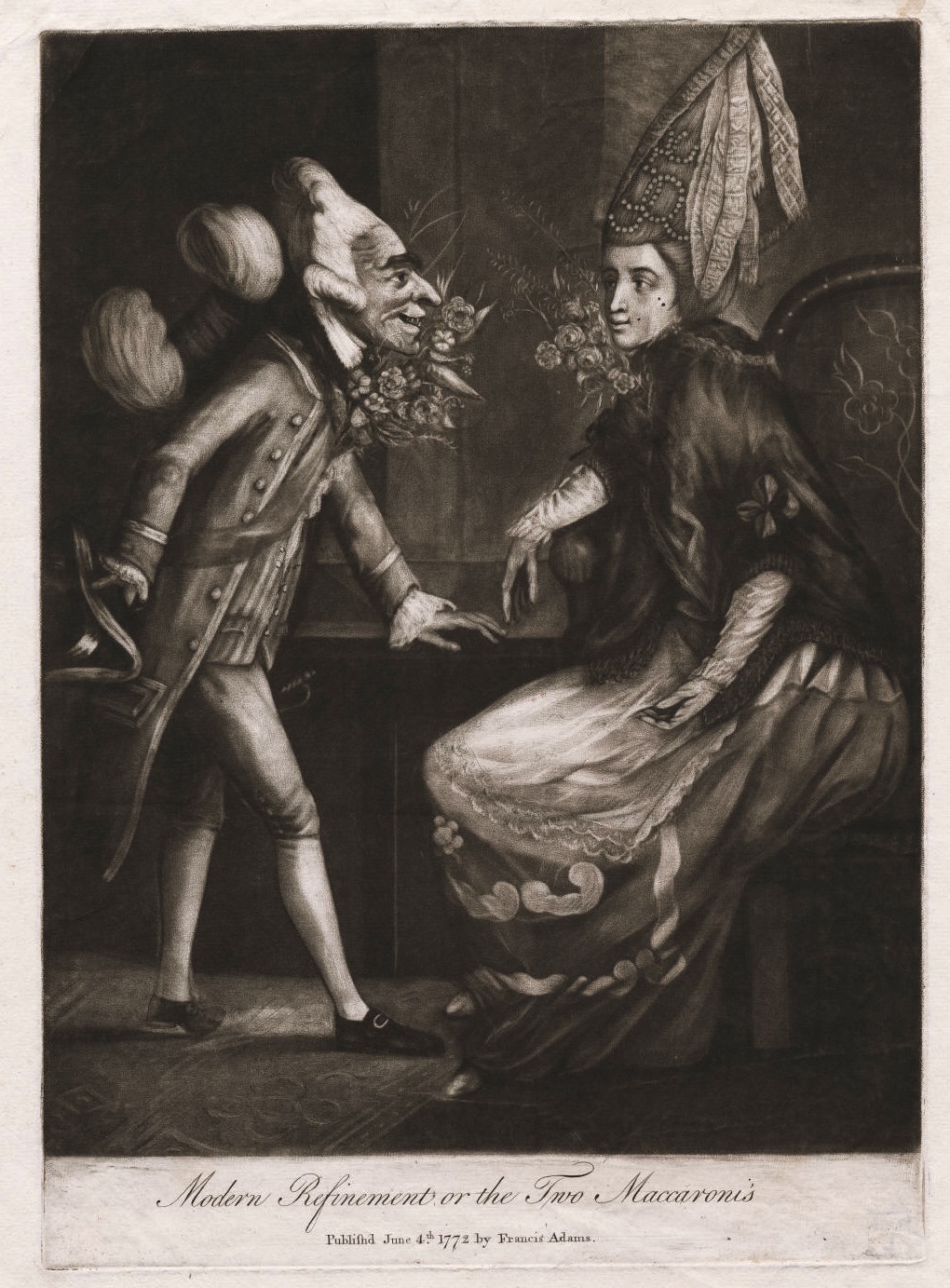
Still, while wig-wearing was very popular in Georgian London, it wasn't above being ridiculed as a fashionable frivolity, and there are scores of caricatures such as this and this poking fun at the style. The following passage begins with a brief history of wig-wearing, but soon lapses in scornful criticism. It's from a description of the peruke (wig) maker's trade from The London Tradesman, written by Robert Campbell in 1747. He might have had the exaggerated pair, above, in mind.
Our Forefathers were contented with their own Hair, and never dreamed of thatching their Skulls with false-curls. It is a foreign Invention, but of what Country I cannot learn, and appeared among us at the Restoration...It was originally but rude and simple, but kept a nearer Resemblance to Nature than it does at present; the Fashion was to wear Wigs nearly resembling the natural Colour of our Hair, and shaped in such manner as to make the artificial Locks appear like a natural Production; but in Process of Time full-bottomed Wiggs became the Mode; and the Heads of our Beaus and Men of Fashion were loaded with Hair...and the Natural Colour was laid aside for Silver Locks. The Bobb, the Pig-tail, Tuppe, Ramilie, and a Number of Shapes, are now become the Mode. Sometimes the Beaus appear plaistered all over with Powder and Pomatum, and their Curls frizzled out with laborious Nicety; at other Times the Powder Puff is laid aside, and they affect to dress in Wanton Ringlets. Originally Wiggs were confined to the Male Part of the Species, but of late, that usurping Sex the Ladies, are grown ashamed of the Natural Production of their own Heads, and lay Snares for our Hearts in artificial...Têtes de Mouton [sheep's heads]. The Black, the Brown, the Fair and Carroty, appear now all in one Livery; and you can no more judge of your Mistress's natural Complexion by the Colour of her Hair, than by that of her Ribbons. The whole Species of our Modern Beaus and Belles appear in a perpetual Masquerade, and seem contending with one another who shall deviate most from Nature, and the ancient Simplicity of their Forefathers.
Above: Modern Refinement, or, The Two Macaronis, published 1772 by Francis Adams. Lewis Walpole Library, Yale University.


 One of us --