Sunday, February 13, 2011

Breakfast Links: Week of February 7, 2011

Sunday, February 13, 2011
Happy Sunday! Here's this week's serving of the freshest Breakfast Links, a selection of noteworthy tidbits gathered from other blogs, web sites, news stories, and other curiosities that we've discovered wandering around the Twitterverse:
• We've gone all hearts-and-flowers looking at the beautiful vintage Valentine’s Day cards from the  collection of the Beamish Museum: http://bit.ly/h9zQtc
 • What's inside an 1885 bustle (and we never would have guessed it looked like this!) http://bit.ly/fsOHgO
 • Royal marriage rules: The laws that bind William and Kate’s romance date to the 1772 Royal Marriages Act:  http://bit.ly/gXrq9F
 • How to Farce a Cabbage, 18th c style. You do have one in the cellar, yes? http://bit.ly/h7uyN9
 • Take a virtual tour of No. 10 Downing Street: http://bit.ly/Xoztt
 • Young Charles Dickens, in honor of his 199th birthday this week: http://bit.ly/dRHqVD
 • Art world agog as private hoard of an unlikely collector comes to light: http://ind.pn/i0LNKw
 • Revamped website for Viscount Fairfax's 18th c Georgian townhouse in York. Great photos show daily life as well as interiors : http://bit.ly/eKcVTB
 • Irish Traditional Music Archive, complete with 78 rpm crackle: http://bit.ly/hQVLcV
 • Tour Handel's House via a slideshow – and yes, Jimi Hendrix's there too: http://bit.ly/e2ITVp (click on 'Show Info' for a commentary)
 • Wonderful stylish sketch of Marie Antoinette c1785 (& an excellent fashion/art blog): http://bit.ly/fR4f9X
 • Amazing ladies in amazing hats, 1859-1927: RT@Visual_History From French Artist Paul Cesar Helleu: http://bit.ly/erJPqg
• Astonishing transformation of 17th c Spitalfields, London, worker's house: http://bit.ly/hyNxaI
• This year's Oscar-worthy film costumes on display in LA, from The King’s Speech to Alice in Wonderland: http://bit.ly/gCNPrf
• Talk about Anglo-American history! This week in 1964,The Beatles debut on Ed Sullivan show: http://t.co/zJ5VnpA via @youtube
• A niche subject I admit, but for anyone interested: “A world of sallats:17th Century salads”: http://bit.ly/hgRxAH
• Hugh Thomson, the 19th c. illustrator of Jane Austen's six novels: http://t.co/q1Q
• London Lives 1690-1800, Searchable database of Londoners: http://www.londonlives.org/index.jsp
• For Gilded Age Millionaires, c. 1900: a nice "little" summer place in Maine w/ 35 rooms & battling footmen: http://bit.ly/epVRxr
• The favorite color for Georgian gardens: “invisible green”: http://bit.ly/dmvhcU

Saturday, February 12, 2011

Update: Eco-Fashion Exhibition Now On-line

Saturday, February 12, 2011
Susan reporting:

Last summer I wrote about a fascinating fashion exhibition that I'd seen at the Museum at the Fashion Institute of Technology in NYC. Eco-Fashion: Going Green not only featured a selection of clothes from the 18th c. to the present, but also posed many thoughtful questions about style-driven consumerism, the use and re-purposing of textiles, and the ever-increasing mark fashion has left on the environment.

Unfortunately, as is often the case when delicate fabrics are on display, cameras were forbidden in the galleries, and I wasn't able to include pictures with the blog. Now, however, FIT has put a detailed version of the exhibition on-line. Check it out here. It's a great resource that will make you think not only about fashion in an historical context, but also about what you'll be purchasing for your own wardrobe this spring.

Left: Two-piece day dress, green silk faille & chenille (dyed with arsenic-based green dyes) , c. 1865, USA, Museum purchase, FIT collection. Photograph courtesy FIT.

Friday, February 11, 2011

Florence Nightingale in Cairo

Friday, February 11, 2011
Loretta reports:


The Egyptians have a long history of despotic rulers—a situation 19th century Europeans deplored in nearly every journal and travel account I read while researching Mr. Impossible. Florence Nightingale grieves for the oppressed Egyptians, too, but the following passage is more typical of her vibrant writing in this fascinating book—a surprise when I stumbled on it.  As with Queen Victoria, one tends to see Florence Nightingale as an institution.  But here she is as a young woman of twenty-nine, discovering an exotic world.
~~~
No one ever talks about the beauty of Cairo, ever gives you the least idea of this surpassing city.  I thought it was a place to buy stores at and pass through on one’s way to India instead of being the rose of cities, the garden of the desert, the pearl of Moorish architecture, the fairest, really the fairest, place of earth below.  It reminds me always of Sirius I can’t tell why, except that Sirius has the silveriest light in heaven above, and Cairo has the same radiant look on earth below . . . Oh, could I but describe those Moorish streets, in red and white stripes of marble, the latticed balconies, with little octagonal shrines, also latticed, sticking out of them, for the ladies to look straight down through; the innumerable mosques and minarets; the arcades in the insides of houses you peep into ,the first stories meeting almost overhead, and yet the air with nothing but fragrance on it, in these narrowest of narrow wynds!...

We strode down again into the city, swarming with life . . . you cannot imagine how you will get through the streets; you expect to run over every child, and to be run over by every camel, who, gigantic animals! Loom round every sharp corner just as you are coming to it, and are the tallest creatures I ever saw: there does not appear standing room for a fly.  You address your ass in the tenderest terms, and in the purest Arabic; you adjure him by all the names of friendship to stop: but he understands no Arabic except his drivers, and on he goes, full trot, while you are making hairbreadth ‘scapes at every corner, yet receiving hardly a knock.
~~~
Florence Nightingale, Letters from Egypt: A Journey on the Nile, 1849-50.

Illustrations:  David Roberts, Bazaar of the Coppersmiths
 Florence Nightingale about 1845

Courtesy wikimedia.

Thursday, February 10, 2011

Alexander Hamilton Seeks a Wife: 1779

Thursday, February 10, 2011
Susan reporting:

No matter the time period, finding the perfect spouse seems to have been a constant challenge for men and women alike. Matchmaking today may have become one more internet transaction, but in the past, most people turned to friends and family to help them find a suitable mate. And in the past, just as today, the laundry-list of requirements in a potential spouse that the hopeful bride or groom sought must have sorely tried the patience of a good many friends.

Alexander Hamilton (1757-1804), left, was one of early America's Founding Fathers, and is most remembered today as the first U.S. Secretary of the Treasury. But in April, 1779, he was an ambitious young lieutenant colonel serving in the Continental Army as an aide to General George Washington, and one of the ways he hoped to rise in the world was to make a favorable marriage. In a letter to his good friend and fellow officer John Laurens, he enlisted Laurens' assistance in finding just the right lady:

"Such a wife as I want will, I know, be difficult to be found, but if you succeed, it will be the stronger proof of your zeal and dexterity. Take her description – She must be young, handsome (I lay most stress upon a good shape) sensible (a little learning will do), well bred (but she must have an aversion to the word ton) chaste and tender (I am an enthusiast in my notions of fidelity and fondness) of some good nature, a great deal of generosity (she must neither love money nor scolding, for I dislike equally a termagant and an economist). In politics, I am indifferent what side she may be of; I think I have arguments that will easily convert her to mine. As to religion a moderate stock will satisfy me. She must believe in God and hate a saint. But as to fortune, the larger stock of that the better. You know my temper and circumstances and will therefore pay special attention to this article in the treaty. Though I run no risk of going to Purgatory for my avarice; yet as  money is an essential ingredient to happiness in this world – as I have not much of my own and as I am very little calculated to get more either by my address or industry; it must needs be, that my wife, if I get one, bring at least a sufficiency to administer to her own extravagancies."

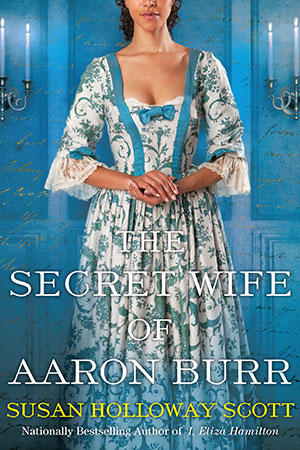
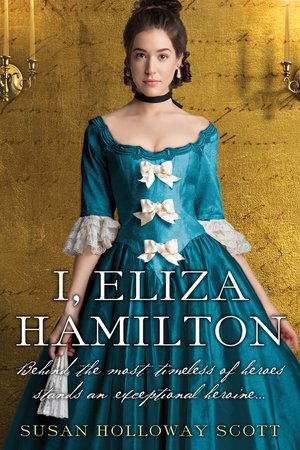
Amazingly, Hamilton soon did find himself a wife who met nearly all of these stipulations. Elizabeth Schuyler (1757-1854), right, was the daughter of General Philip Schuyler, and a member of one of the wealthiest and most influential families in New York. Hamilton wed her in December, 1780, in her family's mansion. The marriage produced eight children and survived Hamilton's various scandals and a very public infidelity, and for the duration of Elizabeth's long life (she outlived her husband – killed in the famous duel with Aaron Burr – by fifty years), she defended Hamilton and refused to believe the gossip about him, no matter how true it might have been.

So perhaps despite the mercenary beginning, Alexander Hamilton really did get lucky and wed the girl of his dreams....

Wednesday, February 9, 2011

Queen Victoria's Wedding Cake

Wednesday, February 9, 2011

Loretta reports:

When Queen Victoria got married on 10 February 1840, she was not, as many believe, the first bride to wear a white wedding dress—though it was a new look for royals, who’d previously inclined toward silver.  Still, she did start a fashion for BIG royal weddings.  Previously, these had been relatively quiet, private affairs.  But then, hers was a big deal—the first wedding of a reigning queen since Queen Mary in 1554.

The wedding cake was a big deal, too. 

“If taste of design only equal what appears to be intended for the actual dimensions, it will beat any bride-cake ever seen.”*

~~~
  5. THE ROYAL WEDDING CAKE. —A select few have been gratified with a sight of the royal wedding cake at the apartments of the confectionary in St. James's palace, but it is described as consisting of the most exquisite compounds of all the rich things with which the most expensive cakes can be composed, mingled and mixed together into delightful harmony by the most elaborate science of the confectioner. This royal cake weighs nearly 300 lb. weight. It is three yards in circumference, and about fourteen inches in depth or thickness. It is covered with sugar of the purest white; on the top is seen the figure of Britannia in the act of blessing the illustrious bride and bridegroom, who are dressed somewhat incongruously in the costume of ancient Rome. These figures are not quite a foot in height; at the feet of his serene highness is the effigy of a dog, said to denote fidelity; and at the feet of the queen is a pair of turtle doves, denoting the felicities of the marriage state. A cupid is writing in a volume expanded on his knees the date of the day of the marriage, and various other cupids are sporting and enjoying themselves as such interesting little individuals generally do. These little figures are well modelled. On the top of the cake are numerous bouquets of white flowers tied with true lovers' knots of white satin riband, intended for presents to the guests at the nuptial breakfast. This elegant emblem of the felicities of marriage will be placed on the breakfast table of the queen at Buckingham palace at the breakfast which is to succeed the ceremonies in the chapel royal.
—1840 Annual Register.

*The Mirror of literature, amusement, and instruction, Volume 35, 1840.
 
Two Nerdy History Girls. Design by Pocket