Sunday, November 12, 2017

From the 2NHG Library: "The American Duchess Guide to 18th Century Dressmaking"

Sunday, November 12, 2017
Susan reporting,

With the holidays approaching, books are always on the top of the 2NHG lists for both giving and receiving. Here's one that will appeal to many of our readers who love historic clothing, the 18th century, and recreating period clothing for re-enacting and interpreting. It would also be welcomed by anyone who enjoys reading about the Georgian era, and wonders exactly how stays and hoops and pockets all fit together on a woman's body.

The book is The American Duchess Guide to 18th Century Dressmaking: How to Hand Sew Georgian Gowns and Wear Them with Style by Lauren Stowell and Abby Cox (Page Street Publishing) and it's a wonderful introduction to recreating and wearing 18thc fashions, exactly as that over-long title says. For those of you unfamiliar with the American Duchess brand: it's a company founded by co-author Lauren Stowell and devoted to creating replicas of historic footwear for modern feet. Their products have appeared in film, television, and on Broadway (from Outlander to Hamilton), and walked everywhere from red carpets to battlefield re-enactments. This is the first American Duchess book, and perfectly designed to serve the market that wears their shoes.

Hundreds of color photographs cover not only every step of cutting, sewing, and construction representative women's garments, but also demonstrate how to wear and style the clothes accurately. Instructions are included for undergarments and accessories, too. Although the book assumes the reader may possess zero background in 18thc costuming, there is also plenty here to interest those with more experience, with glossaries of fashion terms, explanations of 18thc sewing and fabric, and troubleshooting advice.

I'm guessing that much of the expertise in this book comes from co-author Abby Cox, who earned a M.Litt in Decorative Arts and Design History from the University of Glasgow. Abby's name (and face) will be familiar to long-time readers of this blog from her years as an apprentice mantua-maker at Colonial Williamsburg, where she cheerfully both shared her knowledge and posed for my camera for numerous blog posts. As a member of CW's historic trades program, Abby learned 18thc sewing techniques from Mistress of the Trade Janea Whitacre, and that training and practice shows in every page of this book. While The American Duchess Guide isn't a Colonial Williamsburg publication, it does reflect the high standards set by Janea and the other mantua-makers of the Margaret Hunter Shop. Even the most accuracy-focused readers and sewers will be pleased by the detailed instructions and photographs. If you're like me, you'll soon be eager to try your hand at a gracefully elegant Italian Gown in flowered chintz.

All in all, an informative and entertaining look at a particularly lovely period of women's dress (I know, I'm biased.) You can purchase it here on Amazon.

Full disclosure: I received a pre-publication copy of this book for review. 

Saturday, November 11, 2017

Breakfast Links: Week of November 6, 2017

Saturday, November 11, 2017
Breakfast Links are served - our weekly round-up of fav links to other web sites, articles, blogs, and images via Twitter.
• "Huge and black-bearded and ferocious": Byron's manservant Tita Falcieri.
• Why are these 1940s clothes so happy?
• Ten interesting facts about Napoleon's family.
• Dressing the graves for All-Saints Day in New Orleans, 1845.
• Salem's 1692 anti-woman witch hunt.
• John and Abigail Adams, the first President and First Lady to live in the (unfinished) White House.
Image: Royal Garden Party guests, 1935.
• A cricket on Ascension Day keeps bad luck away.
• When the wild beast of Gevaudan terrorized France.
Image: The portable darkroom used by Roger Fenton, a pioneer of war photography, during the Crimea War, 1855.
• The Queen was amused: Queen Victoria's Halloween celebrations at Balmoral Castle.
Home in a can: when trailers offered a compact version of the American Dream.
• Many fortune-telling games of the past were designed for girls and young women to see their romantic futures.
• A forgotten/lost manuscript by poet John Donne is rediscovered.
Jolly Jane Toppan, the killer nurse obsessed with death.
Image: Marie-Antoinette's initials are engraved in this repoussed music stand.
William Dawes tells a good story (and it even seems it's true, too.)
• The enduring allure of Baba Yaga, an ancient swamp witch who loved to eat people.
Image: The message on this c1900 trade card is just...strange.
Hungry for more? Follow us on Twitter @2nerdyhistgirls for fresh updates daily.
Above: At Breakfast by Laurits Andersen Ring. Private collection

Friday, November 10, 2017

Friday Video: Flights of Fashion, 1946

Friday, November 10, 2017

Susan reporting,

Here's another wonderful short newsreel fashion-film from British Pathe. In the days before television, these were shown in movie houses along with a feature film, and were intended to entertain a wide audience. Considering the date - 1946 - I imagine this kind of stylish frivolity was far beyond the means of most English women, but the cheerful commentary, outlandish hats, and in-flight fashion show must have been a welcome diversion at the time. And how modern many of the clothes look today!

If you receive this post via email, you may be seeing a blank space or a black box where the video should be. Please click here to view the video.

Thursday, November 9, 2017

Remembering Lieutenant Davitt

Thursday, November 9, 2017
1st Lt William F. Davitt
Loretta reports;

On Saturday we’ll be commemorating the 99th anniversary of the end of World War I. At 11 AM on 11 November 1918, an Armistice was in effect, ending the Great War with Germany.

Initially, the annual commemoration was called Armistice Day. Sadly, that armistice didn’t mark an end to all wars, and after WWII, the name, in the U.S., changed to Veterans Day, to recognize all war veterans. Elsewhere, the name of the holiday is different, but the theme of remembrance remains.

Our local newspaper called my attention to one of the last men to be killed in action in WWI—minutes before the 11AM ceasefire.  First Lt. William F. Davitt, the Chaplain of the 125th Infantry, was a graduate of Worcester’s Holy Cross College. An extraordinarily brave man, he earned a Distinguished Service Medal, a Croix de Guerre with palm, and a Silver Star Citation.

As I’ve mentioned in a previous post, Worcester has squares, with memorial markers, dedicated to its veterans.* Lt. Davitt’s is one I pass nearly every day during my walk. I didn’t know his story, though, until I saw this newspaper article, and recognized the name—because, yes, I often pause at these memorial markers and re-read the inscriptions, as a kind of remembrance.

There’s more about him at this website of the VFW post named in his honor.

His foot locker is here.

And there’s a detailed picture of the last months of battle as well as his particular story at the 32nd “Red Arrow Veteran” Association site (please scroll down to “FINIS LA GUERRE!”). If you take the time to find and read it, you'll understand how he earned those medals.

*At one point you could find photographs of all the memorial squares at this website, but the links do not seem to be working. You can see two examples on the home page, though.

Photograph: 1st Lt. William F. Davitt, photo credit: State Library of Massachusetts
Photograph: Davitt Square memorial plaque is by me.


Tuesday, November 7, 2017

Research Books Before Post-Its: Hamilton's Manicules

Tuesday, November 7, 2017
Susan reporting,

One of my rituals after I finish writing a research-heavy manuscript is the removal of the Post-Its. I write surrounded by stacks of research books on the floor, each book bristling with multi-color flags to mark inspiring and important passages, facts, and images. Peeling off all those Post-Its means they've done their job, and it's time for the books to return to their shelves.

Post-Its are perfect for me, because I've never been able to bring myself to write in books. I like my pages clean, my spines intact. Even as a college student, I was horrified to see other people's textbooks striped with neon-yellow highlighter. In my generally cluttered world, unmarked books are one of my few attempts at order.

It's also a habit that would have marked me as clueless in an 18thc personal library. First of all, of course, I would have been the wrong gender to possess an extensive collection of books. Even the most well-read of 18thc American women - such as Abigail Adams, or Mercy Otis Warren - relied on libraries owned by husbands, fathers, and brothers. Studies, libraries, and offices were the male domains where books were kept in private homes, intellectual retreats that women entered by invitation (or to clean.)

Books were expensive, a sign not only of the prosperity necessary for such a purchase, but also proof that the gentleman possessed the luxury of sufficient leisure time for reading. Living in a country far removed from the great universities of Europe, books provided an intellectual connection to great minds of the past and the 18thc present, linking Americans with the Age of Enlightenment. Books were read and reread extensively, considered and referred to and used to settle disputes and discussions. Books were the primary source of knowledge and authority, and prized as such by their owners. They were symbols of continuing self-education, as well as of literacy.

All the American Founders possessed personal libraries of varying sizes. Many of these men were trained as lawyers, and their libraries were filled with the legal books required by their practices, but also filled with ideas that also helped shape the most important documents in American history. Benjamin Franklin's library alone had over three thousand volumes. Thomas Jefferson's library was the largest in the country; after the Library of Congress was burned by the British during the War of 1812, Congress purchased most of Jefferson's personal library as a replacement - nearly 6,500 books.

To men like Jefferson and Franklin, reading and studying a book included annotating it. Whether making comments or asking questions in the margins, underlining important ideas, or even "editing" by physically cutting a page, they viewed these notations as a way of personalizing the book and tailoring it to be more useful for their individual needs.

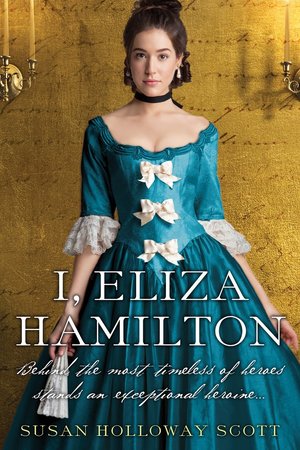
As can be imagined for a successful lawyer and statesman, Alexander Hamilton, too, possessed an extensive library. (Yes, I know, I've managed to include another Hamilton reference - but since he's the husband of my heroine in I, ELIZA HAMILTON, I've looked at far more examples of his books and handwriting lately than of Jefferson's or Franklin's.) Although the Revolution had interrupted Hamilton's studies at King's College - he was granted an honorary degree later in life - he was a voracious reader on topics that ranged from medicine to history, agriculture to military science, and famously prepared himself for the bar in a matter of months.

And as can also be imagined for someone who was so opinionated, Hamilton freely wrote in his books, and his law books in particular were often marked to highlight a precedence or argument useful to a particular case. One of these - a copy of the 1738 The Rights of War and Peace by Hugo Grotius - has recently been shared online by a private collector; thanks to his generosity, you can view it here, as well as learn why Hamilton's annotated copy is considered an important volume to legal historians.

Hamilton not only wrote his name in the book, right, but he underlined, labeled passages alphabetically, and corrected printers' misspellings and translations. One of his favorite ways to call attention to a salient point was with a manicule, a decorative notation in use since the 12thc. Manicules are tiny hand-drawn hands, pointing into the text, and are as varied in style as the writers who made them. Some have exaggerated index fingers for emphatic pointing, and others have elaborate lace cuffs around the hand.

Hamilton devised his version of the manicule as a single calligraphic line, a pointing hand that often ends in an elegant curl, above left. He was, however, a bit breezy about anatomy; some of his manicules have only four fingers (much like Mickey Mouse), or even just the thumb and forefinger, lower left, with only a hint at the other digits. Still, they're distinctive, and variations appear throughout his books, and in drafts of his own work, too. Manicules are also elegantly utilitarian, because they do catch your eye, and make you look at what they're marking.

Hmm. Perhaps with a little practice, they might even replace my Post-Its.

Many thanks to Robert Pattelli for sharing this book from his personal collection, and for his assistance with this post.
 
Two Nerdy History Girls. Design by Pocket