Perfect timing for the Christmas holidays - our friends at Crow's Eye Productions have just released this splendid video in their "Getting Dressed" series. The maidservant's clothes are wonderfully presented, and the candle-lit atmosphere of a winter's night in Victorian England is gorgeous. Plus there's a guest appearance by a very special celebrity....
Many thanks to Pauline and Nick Loven for sharing these videos with us all this year!
If you received this post via email, you may be seeing an empty space or black box where the video should be. Please click here to see the video.
We’ve been doing quite a few “getting dressed” videos, yet I don’t hesitate to offer one more because, well, historical clothing. And then, too, it’s Lucy Worsley!
Readers who receive our blog via email might see a rectangle, square, or nothing where the video ought to be. To watch the video, please click on the title to this post (which will take you to our blog) or the video title (which will take you to YouTube).
Diamonds may be forever, but the jewelry that enhances them seldom is. Precious stones can be recut and reset, and precious metals reformed into new settings and pieces. Royal jewels are among the most transitory of all, especially those belonging to a doomed royal family in the midst of a revolution.
Queen Marie Antoinette of France was famous for her jewels, and it can be argued that her love for diamonds helped lead to her tragic downfall. This week, a few of her pieces (along with other jewels belonging to the Bourbon Parma family) came up for auction through Sotheby's. As can be imagined, the interest in jewels with such a history was considerable, and this video features the rarest of the pieces in the auction, and beautiful things they are, too.
Pre-auction sales estimates often tend to be low, but I imagine even Sotheby's was stunned by the final sales figures. The small enamel and seed-pearl pocket watch engraved with the queen's monogram and featured in the video was estimated to sell for around $8,000-9,000; it sold for $248,203. The triple-strand pearl necklace with the diamond clasp had an estimate of around $198,000-297,000; it sold for $2,278,499.
But the real star was the large pearl pendant on a diamond bow, right. The pre-sale estimate was around $1,000,000-2,000,000. The final price? A staggering $36,165,090.
See here for photos and a listing of all the pieces in the auction.
If you receive this post via email, you may see a blank space or black box where the video should be. Please click here to view the video.
Another wonderful video from our friends at CrowsEyeProductions - and this one also tells the story of how author Mary Shelley came to write her legendary novel Frankenstein. Many people believe that women's clothing of the early 19thc was breezy and uncomplicated. In comparison to the more structured clothing of the 18thc, perhaps it was; but as this video showed, there were still a good many layers involved, and a lady's maid continued to be useful.
Many thanks to Pauline Loven for sharing the latest in the "Getting Dressed" series with us.
If you receive this post via email, you may be seeing a black box or empty space where the video should be. Please click here to see the video.
Due to some technical difficulties - looking at you, Comcast - our Friday Video is appearing for Saturday instead this week.
Here's another short video from our friends at CrowsEye Productions. Active during both the First and Second World Wars, the Women's Land Army was a British civilian organization created to fill agriculture jobs with women workers and therefore free more men for military service. While this video does show the kind of uniforms worn by the women in the 1940s, it also gives a glimpse of their lives as country laborers - a life that was likely new to many of the women who were from cities. Don't miss the hand-knitted sweaters and socks, plus some wonderful vintage tractors.
Many thanks to costumer, historian, and producer Pauline Loven for continuing the share these videos with us. From our stats, it's clear you enjoy them as much as we do!
If you received this video via email, you may be seeing an empty space or black box where the video should be. Click here to view the video.
When it comes to 19th and early 20th century fashion, as our readers are aware, it’s not all that easy to get a sense of what clothes looked like on real people. Fashion plates offer a simplistic idea of color but tend to be anatomically inaccurate (if not downright bizarre) and flat. Paintings show us color, texture, accessories, and so on, but they tend to be idealized, a sort of Photoshop version of the real person. Photography, once it gets going in the Victorian era, offers a degree of realism (they did doctor photos), but in black and white. Museums show us the actual clothing, but on mannequins often lacking accessories (and very often, underwear).
This video, featuring colorized Victorian and Edwardian photos, helps us get a real sense of real women in a range of clothing. Some of you will recognize at least a few of the women.
Readers who receive our blog via email might see a rectangle, square, or nothing where the video ought to be. To watch the video, please click on the title to this post (which will take you to our blog) or the video title (which will take you to YouTube).
Our friends at Crow's Eye Productions have ventured into the 20thc for this video. Featured in this video are the nurses who served in the Voluntary Aid Detachment (VAD) run by the British Red Cross Society during World War One. The VAD was a voluntary unit of civilians who provided nursing care to British military personnel; the majority of the volunteers were women and girls from the middle and upper classes who wished to contribute to the war effort. While most of these volunteers (over 60,000 by 1918) lacked the medical training of professional nurses, by the war's end many had proven that they were not mere "society ladies." They served bravely and competently not only in auxiliary hospitals at home and in the field, but as ambulance drivers and cooks as well.
The accomplishments of the VAD are especially impressive in light of their uniforms - no easy-care scrubs here! This video shows the staggering amount of clothing that these women were expected to wear as they performed their duties. In time the war would mark a dramatic shift in the role of modern women and how they dressed, but these uniforms clearly belong more to the Edwardian era than to the 1920s flappers.
An additional note: the video was filmed on location at Stanhope Hall, Horncastle, the site of a former VAD Hospital.
Many thanks to producer and costumer Pauline Loven for sharing this video with us!
If you receive this post via email, you may be seeing an empty space or black box where the video should be. Please click here to view the video.
In the course of researching some 19th century self-defense materials, I learned that, even before Victorian times, women could learn self-defense techniques. It wasn’t easy, and it wasn’t exactly respectable, but it could be done. However, by the Edwardian era, women are beginning to get formal instruction in martial arts, like ju jitsu (you can learn a great deal more about this at the Bartitsu Society website).
Some women, trained in these arts, provided protection for suffragists.
This film is a bit later—1933—but the moves employ the same principles.
Readers who receive our blog via email might see a rectangle, square, or nothing where the video ought to be. To watch the video, please click on the title to this post (which will take you to our blog) or the video title (which will take you to YouTube).
I have mentioned Madame Récamier before, mainly in connection with furniture (here and here). She is quite well known among Regency/Napoleonic era aficionados, both for her portraits and her salon.
The Gérard and David portraits of her will be familiar to many. However, being mainly interested in the chaise longue, I hadn’t really noticed the marble bust by Joseph Chirard, until I came upon Janet Stephens’s video. Ms Stephens has posted several YouTube videos explaining Greek and Roman hair styles, which in turn help us get a better sense of the powerful influence of Greek and Roman statuary on this period of fashion in Europe and America.
Image: Bust of Juliette Récamier by Joseph Chinard, in "Musée des Beaux-arts" of Lyon (France), photo by Philippe Alès, Creative Commons license. Please click on images to enlarge. Readers who receive our blog via email might see a rectangle, square, or nothing where the video ought to be. To watch the video, please click on the title to this post (which will take you to our blog) or the video title (which will take you to YouTube).
Here's the latest lovely fashion history video from our friends at Crow's Eye Productions. The layers and layers of clothing worn by an elite Dutch woman in the 17thc served not only to display her family's wealth, but also kept her warm in a damp, unheated house. I found myself thinking of the Dutch immigrants in New Amsterdam (later to become New York City) at the same time, and how welcome those layers must have been in the New World, too.
There's also a wonderful surprise ending to this video that delighted the nerdy-history-girl-art-historian in me. Wait for it!
Many thanks to costume historian Pauline Loven and director Nick Loven of Crow's Eye Productions for sharing their work with us.
If you received this video via email, you may be seeing an empty space or black box where the video should be. Please click here to view the video.
Here's a wonderfully peaceful way to ease into the weekend: harpist Nancy Hurrell plays a short selection on an 18thc French pedal harp in the collection of Museum of Fine Arts, Boston. Made in Paris around 1785 by master luthier and harp-maker Godefroi Holtzman, the harp, right, is an exquisitely beautiful instrument, a work of art even if it didn't make such lovely music. For more information about the harp, please see the museum's page here.
Romance from Sonata in B-flat major (op.13, no. 1), 1775-90, by Jean-Baptiste Krumpholtz, performed by Nancy Hurrell.
If you received this post via email, you may be seeing an empty space or black box where the video should be. Click here to view the video.
Many readers express dismay at the clothing of the post-Regency 19th century, and how restrictive it seems. There's an assumption that women couldn't do much while wearing corsets and layer upon layer of undergarments. Dress historians and re-enactors, however, have shown us otherwise. For example, some years ago I attended a talk by Astrida Schaeffer, during which she showed photos of Victorian women (whose clothing made it clear they were wearing corsets—not to mention all the other layers) performing various outdoor activities.
My post the other day about bustles drew more of the dismayed comments on social media, e.g., women couldn't do any work in these clothes. And so, naturally, I hunted for evidence that women did not spend all their time lying on sofas in a swoon. I think this video, of a lady skating while wearing a corset and a bustle and the elaborate dress of what seems to be the 1880s, offers a good demonstration. Gina White's even wearing Victorian-era roller skates, which apparently aren't easy to maneuver.
Readers who receive our blog via email might see a rectangle, square, or nothing where the video ought to be. To watch the video, please click on the title to this post (which will take you to our blog) or the video title (which will take you to YouTube).
Here's another wonderful fashion history video from the Lady Lever Art Gallery and National Museums of Liverpool, and a companion to this video demonstrating how an 18thc elite woman dressed for her day.
This jaded gentleman is not so much dressing, as being dressed, languidly presenting himself to his valet. Personally, I want to share this video with every copy editor who has queried the word "fall" in relation to 18thc breeches. One picture (or video!) is worth a thousand words.
Thanks to costume historian Pauline Loven and director Nick Loven of Crow's Eye Productions for sharing their latest video with us.
If you received this video via email, you may be seeing an empty space or black box where the video should be. Please click here to view the video.
Back in January, I alerted you to Emily Wilson's new translation of Homer's Odyssey, the first in English by a woman. Since then I’ve been reading it in installments, puzzling over the hero especially, and what drives him, as well as the culture in which the story lives.
This video offers some interesting insights as well as laughs. However, since it’s part of the Thug Notes series, be warned that the language is not delicate.
Readers who receive our blog via email might see a rectangle, square, or nothing where the video ought to be. To watch the video, please click on the title to this post (which will take you to our blog) or the video title (which will take you to YouTube).
Image at top left is a still from the video.
Here's another short video from our friends at Crow's Eye Productions, featuring two young rural women from 18thc Britain and how they dress for their day as harvest workers. I have to admit that they don't seem to be working particularly hard, but then they'll be working from dawn to dusk, so maybe they're pacing themselves.
Thanks to producer/costume designer Pauline Loven for sharing with us!
If you received this post via email, you may be seeing an empty space or a black box where the video should be. Click here to view the video.
As I’ve pointed out in a previous blog post, the dinner table of the late 1700s and early 1800s looked very different from our own, with a large number of dishes, both sweet and savory, presented at the same time.
This video gives a nice, three-dimensional view of what was on the table, as well as short explanations of the dishes. Also, I think you'll enjoy curator Ivan Day’s dry wit.
If the macaroni and cheese surprises you (as it did some commenters), you might want to check out Susan’s blog post on the subject. Also, as she explains in this blog post, the governor of Virginia would have been eating in the same fashion as his aristocratic counterparts in London.
YouTube Video: English Taste: The Art of Dining in 18th Century England with curator Ivan Day Image is a still from the video. Readers who receive our blog via email might see a rectangle, square, or nothing where the video ought to be. To watch the video, please click on the title to this post (which will take you to our blog) or the video title (which will take you to YouTube).
"Provenance" is an important word among museum curators, and refers to the history of an artifact or artwork. Sometimes the provenance is detailed and indisputable, a sure trail from one owner to another. More often, however, facts become a bit hazy, particularly with historical garments. Family traditions and wishful thinking often contribute to create breathless stories about how "this dress was worn by my great-great-great-grandmother when she danced with the Marquis de Lafayette", and are often taken with a big grain of salt by curators.
The uniform jacket featured in this video had a tradition of having been worn by Sir Thomas Noel Harris, Brigade-Major, at the Battle of Waterloo. He danced at the Duchess of Richmond's ball before being called to join his regiment, and then fought unscathed until the last day of the battle. A musket ball - or perhaps two? - pierced both his arm and his side, severely wounding him. He lay among the dead and dying on the battlefield overnight, until he was discovered by a searching family member and taken to a dressing station. There his arm was amputated, but he did survive and recover, and continue to serve in the army.
But was this really Sir Thomas's jacket, and was it in fact worn by him at Waterloo? This video shows the different scientific tests used by the Cranfield Forensic Institute to answer that question. It's a fascinating mix of CSI-style forensic examination plus the known history of the jacket, the wearer, and the battle.
If you received this post via email, you may be seeing only a black box or empty space where the video should be. Please click here to view the video.
My husband, who also is a Nerdy History Person (although suffering from a less virulent form of the disease), sent me this article: How Wilma Rudolph Became the World’s Fastest Woman. Not being a Sports Person, I had only recognized her name—something to do with Olympics? That’s as far as it went. Then I read her story, and kept on looking for more and more. She survived and conquered ordeals that would have crushed many of us—well, me, definitely. How about polio and poverty, to start with?
Readers who receive our blog via email might see a rectangle, square, or nothing where the video ought to be. To watch the video, please click on the title to this post (which will take you to our blog) or the video title (which will take you to YouTube).
I've shared the wonderful costume videos by Crow's Eye Productions before ( Dressing an 18thc Lady, Dressing an 18thc Lady: The Busk, and Dressing an 18thc Lady: Pockets.) Here's their latest, featuring two 14thc woman - a lady, and a servant - dressing for the day. I was struck by how fluid and unstructured these clothes were, and surprisingly modern, too, in their limited color palette.
These videos are the work of Pauline Loven, costume historian, costumer, and heritage film producer, and director Nick Loven. They've recently set up a Patreon page if you'd like to support future videos in the series.
If you receive this post via email, you may be seeing an empty space or a black box where the video should be. Click here to view the video.
One of us -- Loretta Chase -- writes historical romance. One of us -- Susan Holloway Scott -- writes historical novels,and as Isabella Bradford, wrote historical romances, too.
There’s a big difference in how we use history. But we’re equally nuts about it. To us, the everyday details of life in the past are things to talk about, ponder, make fun of -- much in the way normal people talk about their favorite reality show.
We talk about who’s wearing what and who’s sleeping with whom. We try to sort out rumor or myth from fact. We thought there must be at least three other people out there who think history’s fascinating and fun, too. This blog is for them.
Susan's Latest
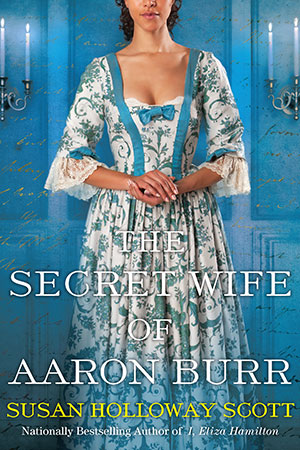
Available Now The Secret Wife of Aaron Burr Amazon | B&N


 Loretta reports:


 Loretta reports:
 One of us -- Loretta Chase -- writes historical romance. One of us -- Susan Holloway Scott -- writes historical novels,and as Isabella Bradford, wrote historical romances, too.


