Showing posts with label I. Show all posts

Tuesday, March 14, 2017

A Little House that Survived a Major Battle, 1777

Tuesday, March 14, 2017
Susan reporting,

One of the best parts about writing I, Eliza Hamilton is that I've been able to visit so many of the places that were familiar to my characters. Alexander and Eliza Hamilton lived most of their lives in New York and Pennsylvania, with some months spent also in New Jersey during the war. As a young man, Alexander served as an officer in the Continental Army, and was the senior aide-de-camp of Commander-in-Chief General George Washington. For obvious reasons, Eliza wasn't there on the front lines with Alexander, and since this is her book, not his, I've only now been playing catch-up and visiting "his" battlefields.

This past weekend, I braved the cold to traipse across the Brandywine Battlefield, located in Chadds Ford, PA. The Battle of Brandywine was fought on September 11, 1777. It was the largest battle of the Revolution, involving the most troops (over 30,000 men between the two armies), and the longest battle as well, with fighting that ranged over 11 hours in ninety-degree heat. It was not a good day for the Continental Army. Not only were they soundly defeated with significant casualties, but their retreat also permitted the British Army to capture Philadelphia (then the country's capital) virtually unopposed. And yes, twenty-year-old Alexander Hamilton was one of those soldiers in the retreat.

There is, of course, few signs of the battle left today. Housing developments and highways close in around what remains of the battlefield, a fraction of the long-gone open space of 1777. The word "battlefield" itself has always struck me as something of a misnomer, sounding as it does like some carefully designated and set-aside place for war. The Battle of Brandywine took place across farms and around homes, river fords, and meeting houses, and as wars always do, changed forever the lives of those caught in the middle of it.

The house of farmer Gideon Gilpin (shown here) still stands, and it is open to visitors as part of the Brandywine Battlefield historic site. Gilpin was a prosperous wheat and dairy farmer whose family had been among the first English settlers of the region. He lived with his wife and six young children in the two-story, four-room stone house shown here (the ell with the porch is a later addition.) Like most of his neighbors, he was a Friend, or Quaker. Quakers believed that war and conflict went against God's wishes, and refused to choose sides or fight during the Revolution.

It was a difficult and unpopular stand to take, especially when the war spilled over onto Gilpin's land. Standing inside the little stone house, I tried to imagine what that September day must have been like for the Gilpin family, who remained inside their house while the battle raged nearby. With shutters closed, the thick stone walls protected them to a certain extent, but considering how seasoned soldiers spoke afterwards of the terrible fighting and steady gunfire from the artillery on both sides, it must have been a horrifying ordeal.

Imagine trying to comfort your small children when you're terrified yourself. Imagine hearing the sounds of war, without knowing exactly what was happening. Imagine wondering if the next round of cannon fire will be near enough to shatter the wall of your home.

The Gilpins and their house survived, but the aftermath of the battle may have been even more difficult for Gideon. His crops - so close to harvest - fields, and trees were destroyed. Worse yet, the British had taken not only the bacon, hay, and wheat he had in storage, but all his livestock: milch cows, sheep, swine, and his yoke of oxen, the 18thc farmer's equivalent to a tractor and a truck. His farm was in ruins, and he was left with no way to feed or support his family. It was enough for Gideon Gilpin. Soon after, he chose to side with the Continental cause - and was read out (or expelled) from his Quaker community for doing so.

I think there could be another book here....

One more quick Nerdy History fact: that enormous sycamore tree in the background of the bottom photo is certified by the National Arborist Association and the International Society of Arboriculture to have been standing at least since 1787, the year the American Constitution was signed. Most likely it, too, is another survivor of the battle.

The Brandywine Battlefield historic site includes not only the Gilpin House, but the Benjamin Ring House, which served as Washington's headquarters. They've just reopened for the season; their website is here. Special thanks to Andrew M. Outten, director of education and museum services, for his first-rate tour of the Gilpin House.

All photos ©2017 by Susan Holloway Scott.

Sunday, March 5, 2017

Abigail Adams Disapproves of French Fashion, 1800

Sunday, March 5, 2017
 Susan reporting,

I'm sure it's no surprise to anyone who regularly reads this blog that one of the things I enjoy about writing books set in the past is the clothes. My next book, I, Eliza Hamilton, covers about thirty years, from 1777 to 1804, and what a period for clothes!

As a wealthy young woman and then the wife of a prominent lawyer and statesman (who wasn't above being something of a male peacock himself), my heroine Eliza's wardrobe follows the fashions of the day, from dresses worn over whalebone-stiffened stays and hoops with powdered hair to the airy high-waisted dresses of the early 19thc. It must have been quite an evolution, but it was one that she embraced. As her even-more-fashionable sister Angelica Schuyler Church wrote as the closing of a letter in 1794: "Adieu my dear Sister yours with all my heart. Remember that your waist must be short, your petticoats long, your headdress moderately high, and altogether a la Grec...."  Words to live by, indeed.

But not all American women (or statesmen's wives) were so eager to follow the latest trends. In 1800, Abigail Smith Adams was the First Lady, her husband John serving the final year of his term as president in the then-capitol of Philadelphia. Ladies there were quick to follow the latest fashions from Paris, but Abigail was having none of it. She had recently read an article (probably something of a sermon) by a lay preacher  who "thinks there are some Ladies in this city, who stand in need of admonition, and I fully agree with him." Does she ever: here's more of her commentary in a letter written to her sister Mary Smith Cranch:

"The Stile of Dress...is really an outrage upon all decency. I will describe it as it has appeared even at the drawing Room - a Sattin petticoat of certainly not more than three breadths gored at the top, nothing beneath but a chimise over this thin coat, of muslin...made so strait before as perfectly to show the whole form, the arms naked almost to the shoulder and without stays or Bodice...and the "rich Luxurience of naturs Charms" without a handkerchief fully displayed...when this Lady has been led up to make her curtzey, which she does most gracefully it is true, every Eye in the Room has been fixed upon her and you might litterally see through her....[Most of the other ladies also] wear their Cloaths too scant upon the body, and too full upon the Bosom for my fancy, not content with the Show which nature bestows, they borrow from art, and litterally look like Nursing Mothers....The Lady described & her Sister, being fine women and in the first Rank, are leaders of the fashion, but they Show more of the [word illegible] than the decent Matron or the modest woman."

In fairness to Abigail, there's probably more going on here than fashion alone. This era marked the beginning of the two-party system in American politics. Her husband John was a Federalist; the opposing party, led by Thomas Jefferson, was the Democratic-Republican Party. One of the issues dividing the two parties was the French Revolution. The Federalists abhorred the violence, chaos, and breakdown of traditional government of the Terror, while the Democratic-Republicans believed the Jacobins were simply following the precedent of the American Revolution, and the bloodshed of the guillotine was unfortunate but necessary. At the time, America was also engaged in an undeclared naval war with France, the aptly-named Quasi-War.

The unstructured, classically inspired fashions from Paris might be the latest style, but to Abigail they likely were also the clothes of the Jacobins and the French Revolution. This was a political fashion statement that she'd no wish to approve, let alone wear herself.

It's also difficult to know exactly how far the American ladies were willing to follow the French. The English fashion plate for April 1800, right, seems modest enough, and so does the portrait, lower left, of Mrs. Harrison Gray Otis (Sally Foster), whose husband was a Federalist congressman. But then there's this portrait, upper left, of a now-unknown French woman dressed in the most extreme (and extremely revealing) version of the style.

Above left: Detail, Portrait of a Young Woman in White by Circle of Jacques-Louis David, c1798, National Gallery of Art.
Right: Full Dress for April, 1800, anonymous fashion plate.
Lower left: Detail, Mrs. Harrison Gray Otis (Sally Foster) by Gilbert Stuart, c1805, Reynolda House Museum of Art.

Read more about Eliza Schuyler and Alexander Hamilton in my latest historical novel, I, Eliza Hamilton, now available everywhere.

Sunday, February 26, 2017

Is This a Forgotten Portrait of Angelica Schuyler Church?

Sunday, February 26, 2017
Susan reporting,

Anyone familiar with the musical Hamilton already knows the name Angelica Schulyer Church (1756-1814). In fact, in most Hamil-fan circles, she's called just Angelica, the Schuyler sister who's famously never satisfied.

Anyone alive in late 18thc London and Paris would have recognized her name, too, for she was certainly the best-known American woman in the fast set of English society. Born into a wealthy Dutch-American family in Albany, NY, she eloped with John Church, a slightly shady Englishman who made his fortune selling arms during the American Revolution. After the war, John took Angelica and their children back to England, where he became a landed gentleman and a member of parliament. Angelica combined  her wit, beauty, and vivacious character with her husband's money to make her drawing room one of THE places to see and be seen in Georgian London.

Angelica was admired by gentlemen as diverse as Benjamin Franklin, the Prince of Wales, the Marquis de Lafayette, Whig party leader Charles James Fox and playwright Richard Brinsely Sheridan. She was a patron of artists Benjamin West, John Trumbull, and Maria Cosway. She may (or may not) have had an affair with Thomas Jefferson, and she may (or may not) have had one with her brother-in-law Alexander Hamilton, too.

To me, she's the older sister of Eliza Schuyler Hamilton, the heroine of my new historical novel, I, Eliza Hamilton (to be published by Kensington Books in September, 2017.) I've been wallowing deep in my research of the Schuyler and Hamilton families for a good long time now. Characters become very real to me (especially the ones who were real people - I know, weird writer problems) to the point that I half-expect to run into them at the local grocery.

So imagine my surprise when the lovely face, above left, turned up in my Instagram feed this morning. Posted by the account of the Philip Mould Gallery in London, this portrait is by the well-known Georgian miniature painter Samuel Shelley (1750-1808). Shelley was famous for painting society beauties of the day, and this one - identified only as a portrait of a lady - is a gorgeous example of his work.

I'm also convinced it's a forgotten portrait of Angelica Schuyler Church.

There are only two other portraits of Angelica known today. One is a portrait of her with her son and servant by the American artist John Trumbull, detail, right, and the other a print after a painting by English artist Richard Cosway, lower left. To my eye, the Trumbull and Shelley portraits show the same woman. It's an uncommon face for an 18thc beauty: a long nose (which also turns up in portraits of her father), a small mouth, the dark, slightly close-set eyes. The Shelley miniature also seems to capture both the flirtatious charm and intelligence that Angelica's contemporaries all mention.

From the clothes and hair style, I'd guess that this portrait was painted in the 1780s, the time when Angelica was living in London. The art world in London at the time was a small one; another portraitist, Maria Cosway, was one of Angelica's closest friends, and it's easy to imagine Maria introducing Samuel Shelley to Angelica as a possible patron.

I've written to Emma Rutherford, the consultant specializing in miniatures for Philip Mould with my thoughts. UPDATE: Here's the reply from Ms. Rutherford: "Portrait miniatures do not often survive with the same provenance as oil portraits – their size meant that they could not be physically attached to labels and papers - and they were often not properly listed in inventories etc. I have also checked the RA listings and Shelley does not note exhibiting a portrait of Angelica. There are no other papers or sitters lists which survive relating to his output. With the lack of documentary evidence and provenance we would be unable to say that this is definitively a portrait of Angelica. On the other hand, the facial similarity (including eye colour) is so strong that I would like to amend our cataloguing to say that this is ‘possibly’ a portrait of her."

Above left: Portrait of a Lady by Samuel Shelley, image via Philip Mould Gallery.
Right: Portrait of Mrs. John Barker Church (Angelica Schuyler), Son Philip, and Servant by John Trumbull, c1785, private collection
Lower left: Print after a painting of Mrs. Church by Richard Cosway, c1790

Read more about Eliza Schuyler and Alexander Hamilton in my latest historical novel, I, Eliza Hamilton, now available everywhere.

Sunday, February 12, 2017

We're Back - and New Books Are Coming

Sunday, February 12, 2017
Susan reporting,

Finally, Loretta and I are back! After furious writing, holidays, groundhogs, and a couple of snowstorms, we can now report there WILL be new books from both of us this fall (as well as new blog posts in the meantime.)

First off: I've returned to writing historical fiction. I've also returned to being Susan Holloway Scott, while Isabella Bradford, my historical romance name, has gone on hiatus; it's all part of having multiple pseudonyms, and being a Gemini, too.

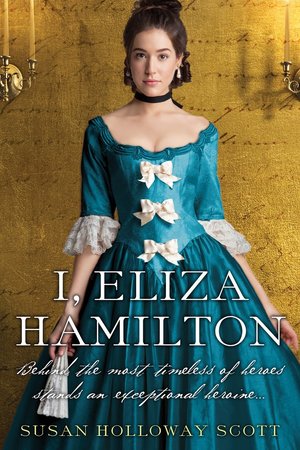
Secondly: My new novel is I, ELIZA HAMILTON, coming in September from Kensington Books. (It's available for pre-order now in both paperback and ebook, through those links over to the right.)

Elizabeth Schuyler Hamilton (1757-1854) was the wife of Alexander Hamilton (c1755-1804), a Revolutionary War hero, statesman, politician, and abolitionist, the first Secretary of the Treasury, a signer and promoter of the Constitution, the founder of the American financial system, and, perhaps most famously for posterity, the only Founding Father killed in a duel.

You might also have heard that he inspired a certain Broadway musical that carries his name.

Like so many women of the past, Eliza's story has been overshadowed by her brilliant husband. She didn't help her place in posterity by destroying most of her own letters and virtually eliminating her voice. As a result, she's too often been dismissed by (male) historians, who variously describe her as shy and reclusive, a homebody, a saint.

But the real Eliza's still there: in the letters of others who knew her, in diaries, in portraits, in memoirs, and most of all, in the achingly beautiful love letters her husband wrote to her over the years of their courtship and marriage. She was a mother, daughter, sister, and wife. She was intelligent and resourceful and strong, a woman who lived in the thick of some of the most turbulent and exciting times in American history. Her marriage was filled with love, passion, regard, and devotion, but also marred by public scandal and unimaginable tragedies that broke her heart, but not her spirit. I'm honored to tell her story.

Over the next months, I'll be sharing more here on the blog about Eliza and her life and times, as well as discoveries from my research junkets. You can also read a bit more about the book here in a recent post on Bustle.com.
 
Two Nerdy History Girls. Design by Pocket