Showing posts with label prints. Show all posts

Tuesday, November 6, 2018

Election Day

Tuesday, November 6, 2018
No blog post today, except this one-word message for our American readers.

You know what to do, right?

Vote, published by the Milwaukee County League of Women Voters, early 20thc, Collection of the Wisconsin Historical Society.

Thursday, October 11, 2018

The Dickey, or, Abominable False Front

Thursday, October 11, 2018

August 1873 Men's Fashions
Loretta reports:

The author of this 1876 guide to men’s dress did not mince words when it came to false shirt fronts. One can only imagine what he'd have to say about, oh, man buns or low-hanging trousers.
~~~
BEAU BRUMMEL said, “A gentleman should show clean linen, and plenty of it.” The first part of this sentence is strictly true, the second less so. There is no need, having a clean shirt on, to publish the fact, or to lead the public to infer you wear it as a disguise by undue exhibition of it. “Virtue is its own reward :” so the assumption of clean underclothing generally, even if its light be kept beneath a bushel, should afford the wearer the same pleasure as if ostentatiously paraded. When I see a man placarding his chest with a wide expanse of lawn, and exhibiting an unnecessary amount of cuffs, I infer he has got on neither a clean nor white shirt. The surmise generally proves correct.

Interlined Shirt Bosoms 1912
I often see in haberdashers' shops an exaggerated collar and lapel in one, designed to cover manly bosom. The commercial name of this impious fraud is called a Dickey. This felonious impostor must be made away with. No one with any self-respect can wear a dickey. A man clad in such an unmitigated imposition is a whited sepulchre of the very blackest type. If the reader knows any so depraved even to possess one, let him persuade the wretched man to pause, ere too late, in his headlong career—to burn the spurious rag, and he can then exclaim, with regenerated heart, “Richard” (not Dickey, mind) “is himself again!”
Many say, however, when this charge is brought against them, that they suffer from neuralgia, lumbago, and tic-douloureux and ... various other ailments ... Well, what excuse is this? I do not prohibit flannel —wear an under flannel shirt—two if you like; but you must cover it with an entire white shirt, not an aliquot part of it. If hypocrisy be the homage which vice pays to virtue, then the assumption of dickey is a sneaking admission of the necessity for showing clean linen, and a discreditable way of making a sham composition with the subject.
The Gentleman's Art of Dressing with Economy. By a Lounger at the Clubs (1876)

The Lounger's disapproval did not lead to the rapid extinction of the dickey. On the contrary, it lived on into the 20th century, and it isn't dead yet.

Images: August 1873 Men’s Fashions, from the Gentleman's Magazine of Fashion, via Google Books.
Interlined Shirt Bosoms (1912), and Arrow Donchester shirt 1915, courtesy New York Public Library.

Clicking on the image will enlarge it.  Clicking on the caption will take you to the source, where you can learn more and enlarge images as needed.


Thursday, April 26, 2018

What Ordinary People Wore in the Early 1800s

Thursday, April 26, 2018
1808 Woman Churning Butter
Country Fair 1808
Loretta reports:

Given comments on my last blog, it seemed like a good time to look at resources for what working people wore. Susan and I have written about tradespeople and servants here, here, here, here, here, and elsewhere.

They are rarely the subjects of portraits, although they might be included in scenes of, say, a great estate. Also, a few employers actually had at least some of their servants’ portraits painted. Later in  the 1800s, Victorian servants appear in quite a few photographs. But for those of us who are looking at English dress before photography, there are other ways to get an understanding of what ordinary people wore.

William Henry Pyne is one of my go-to illustrators. I have two reprints of his work dealing with this subject: Picturesque Views of Rural Occupations in Early Nineteenth-Century England and Pyne's British Costumes.

Online, there’s also his Etchings of rustic figures, for the embellishment of landscape.

Rustic figures
Rustic figures
Other sources include satirical prints. Though we need to be aware of exaggerations, they generally seem to get the clothing details right. Images in Ackermann’s Microcosm of London show ordinary people as well as those of the upper orders.

In some cases, we see a distinctive uniform for a trade or profession. The watermen or firemen, for instance. Others might wear a certain type of vest. Many professions and trades required badges. Whether one’s clothes were in fashion or not would depend on one’s business. A dressmaker, for instance, would need to look up-to-date. For haymakers, it was another case entirely.

Images:
14. A woman churning butter with a cloth apron tied about her waist and a mob-cap on her head, another woman milking a cow beyond. Title page lettered "The Costume of Great Britain. Designed, Engraved , and Written by W. H. Pyne." "London: Published by William Miller, Albermarle-Street. 1808." Courtesy the British Museum
Couple at fair looking at a clown and a bell ringer, W.H. Pyne, [1808], courtesy Library of Congress Prints and Photographs Division Washington, D.C. 20540 USA
Rustic figures from Pyne, Etchings of rustic figures, for the embellishment of landscape.

Rowlandson, Thames Watermen from Miseries of London 1807I courtesy the Metropolitan Museum of Art.

Clicking on the image will enlarge it.  Clicking on the caption will take you to the source, where you can learn more and enlarge images as needed.

Tuesday, March 20, 2018

Lord Rivers Drowns in the Serpentine—Was It an Accident?

Tuesday, March 20, 2018
Lord Rivers as a boy
Loretta reports:

Georgiana, Duchess of Devonshire, was addicted to gambling. The first Lord Holland’s sons ran up enormous gambling debts. Beau Brummell fled England to escape his. A lot of that going around.

The third Baron Rivers is another example I happened on. The trail started with the following in La Belle Assemblée for March 1831:
“The first act of the Duke of Sussex, on being appointed to the Rangership of Hyde-park, has been to give directions for the placing an adequate protection against the spot where the late Lord Rivers lost his life."
This was intriguing. Who was Lord Rivers and how did he die?

Wikipedia’s short entry only tantalized, sending me to the 1 April 1831 Gentleman’s Magazine obituary.
LORD RIVERS.
Jan. 23 Drowned in the Serpentine river, aged 53, the Right Hon. Horace William Pitt, third Baron Rivers, of Sudeley Castle in Gloucestershire (1802).
 ... As Mr. Horace Beckford he was for many years a distinguished member of the haut ton; and it was only after his succeeding to the title on the death of his maternal uncle, July 20, 1828, that he took the name of Pitt ... .
“Lord Rivers was first missed on the evening of Sunday Jan. 23 ... On Tuesday the Serpentine river was dragged, and in the afternoon his Lordship's body was found at the east end, near the waterfall.”
At the inquest, his steward and a footman insisted he’d been in good spirits: He was nearsighted and must have fallen into the river by accident. The superintendent of the Humane Society's Receiving House said the footpath there was so dangerous that ten people fell into the river on a recent foggy night.
“The Jury returned this verdict: ‘Found drowned near the public path at the head of the Serpentine River, considered very dangerous for want of a rail or fence, where many persons have lately fallen in.’—The rail has been since erected by direction of the Duke of Sussex, the new Ranger of Hyde Park.

Subsequently to the inquest ..., there has been considerable discussion in the newspapers regarding the cause of the occurrence; and it has been stated, with what truth we cannot say, that when the body was taken out of the water, his Lordship's hat was secured with a handkerchief under his chin, and that his umbrella was found on the bank, both which circumstances are considered indicative that his immersion was intentional; and it is added that on the Saturday night he had lost considerable sums at a gaming-house; and that this passion for play had for some years so far possessed him, that his uncle bequeathed to him only 4000l. a year, leaving the bulk of his property, amounting to 40,000l a year, to trustees for the benefit of his son, the present Peer.”
Nigel Cox, Serpentine Waterfall
It’s important to remember that suicide, being self-murder, was a capital offense. One could be tried and hanged for the attempt, and a suicide’s property was forfeit to the Crown. Up to a certain point in the early 19th C, those who’d committed suicide were buried at midnight at a crossroads without the offices of clergy. This is why coroner’s juries tended to find the deaths accidental or, when this was impossible, the victim of unsound mind.

Image: A print of the “youthful portrait of Mr. Horace Beckford, at full length in a Vandyke costume, painted by R. Cosway, R.A. and engraved in stipple by John Conde, 1792", courtesy the Metropolitan Museum of Art

Photo of Serpentine Waterfall by Nigel Cox. Another image here.

Clicking on the image will enlarge it.  Clicking on the caption will take you to the source, where you can learn more and enlarge images as needed.

Thursday, March 15, 2018

Regency Satire: The Triumph of the Whale

Thursday, March 15, 2018
Cruikshank, The Prince of Whales 1812
Loretta reports:

On this date in 1812 the Examiner published Charles Lamb’s poem “The Triumph of the Whale,” which inspired this George Cruikshank satirical print of 1 May 1812. The image appeared in Cruikshank's satirical magazine, The Scourge.
 
The caricature and poem about the then Prince Regent (later King George IV) remind us all that mocking the great and powerful, in picture and print (and these days, in internet memes), is nothing new. Given the libel and sedition laws of the time, it’s amazing what Regency satirists got away with. And let’s not forget one of the Privileges of Peers I reported on a while back:
“3. To secure the honour of, and prevent the spreading of any scandal upon peers, or any great officer of the realm, by reports, there is an express law, called scandalum magnatum, by which any man convicted of making a scandalous report against a peer of the realm (though true) is condemned to an arbitrary fine, and to remain in custody till the same be paid.”

Scandalum magnatum notwithstanding, the faces in this caricature would have been familiar to the audience of the time, and everybody would understand the political implications. We, however, need a translation, which the Brighton Museums website provides succinctly:

“Portrayed as a whale in a ‘Sea of Politics’ George spouts the ‘Liquor of Oblivion’ on playwright and Whig supporter Richard Sheridan, and blows the ‘Dew of favour’ on Spencer Perceval the Tory Prime Minister. The prince ignores his former lover, Mrs Fitzherbert, and looks lovingly at his mistress Lady Hertford, who is shown next to her cuckold husband.”
The figures on the right—the Tories—viewed as the fat cats of the time, expect to profit further by the Regent’s decision to shun his Whig associates. The Marquess of Hertford is wearing cuckold horns. You can read a much more detailed description at the British Museum website (please click on "More" for the full description and check out the curator's comments as well). Clearly, this is pretty strong stuff, though not as strong, I think, as Lamb’s poem.

 
The 1812 blog offers a concise summary of Charles Lamb’s life and the poem. Most of the references are clear enough, although I haven't yet figured out why the muse Lamb summons is Io, one of Zeus’s many loves, who was transformed into a white heifer.

Update: As I hoped, a reader provided the following clarification—
"It's a song. 'Io' is an exclamation you find in Latin songs, and probably in Roman life as well, but spoken words don't survive. It means something like 'Hurray' or even 'Yay'.
In my country a Latin student song still survives. Its first line is 'Io vivat' which translates to 'Hurray, long live'. It dates to the days when all subjects at the universities were taught in Latin."

These pages are from The Poetical Works of Bowles, Lamb, and Hartley Coleridge Selected 1887

Image: George Cruikshank, The Prince of Whales, from the Scourge of 1 May 1812.
Clicking on the image will enlarge it.  Clicking on the caption will take you to the source, where you can learn more and enlarge images as needed.

Monday, March 12, 2018

Elegant Bookcase for a Fashionable Regency Library

Monday, March 12, 2018
Library Bookcase March 1812
Loretta reports:

I set quite a few scenes in libraries, mainly because, by the time of my stories, they had become a family gathering place. Furthermore, in many great houses, these were large, comfortable rooms, often fitted out less formally than say, the drawing room. The one I used in A Duke in Shining Armor is a good example.

While bookcases, complete with writing desk, might appear in various rooms, this one seems to need quite a large room. And even if the library already has miles of bookshelves, those of us who love books can always use storage space for more.

I was particularly struck by the tambour circular cupboards, because (a) while horizontal tambour is fairly common, the circular vertical style is much less so, and (b) one of my own favorite pieces of furniture is a mid-20th century dressing table that has this feature.

Bookcase description

Images from Ackermann's Repository for March 1812, courtesy Philadelphia Museum of Art, via Internet Archive.

Clicking on the image will enlarge it.  Clicking on the caption will take you to the source, where you can learn more and enlarge images as needed.


Thursday, December 14, 2017

From the Archives: Mistletoe Madness, 1796

Thursday, December 14, 2017
Susan reporting:

In modern holiday celebrations, mistletoe has become something of a kitsch-y joke, the inevitable prop for I Saw Mommy Kissing Santa Claus humor.

But in the 1790s, when the print, left, was published, mistletoe still had an aura of wickedness, even danger. The ancient Druidic traditions linking mistletoe and fertility had not been forgotten, and kissing beneath the mistletoe was thought to lead to promiscuity, or even - shudder! - marriage.

Certainly the four merry young  couples in this print appear to be enjoying themselves. Some scholarly descriptions refer to this as a dance scene, and perhaps it does show nothing more than a particularly rollicking country dance.

Still, I can't help but think that at any moment some stern-faced, indignant elder is going to appear in the doorway and demand to know what exactly is going on down here. I'm guessing the artist thought that, too, from the caption he added to the bottom: "Whilst Romp loving Miss is haul'd about/With gallantry robust." (The attribution to Milton is incorrect; the line is from a poem by the 18th c. Scottish poet James Thomson.) In any event, there's no doubt that these are romp-loving misses being haul'd about by their robust gallants. No wonder Christmas mistletoe was so popular!

Above: The mistletoe, or, Christmas gambols, by Edward Penny, 1796, London. Lewis Walpole Library, Yale University.

Tuesday, August 22, 2017

Turnpike Gates Demolished

Tuesday, August 22, 2017
Turnpike Gates
Loretta reports:

Some while ago, I reported my surprise at learning the Hyde Park Corner Tollgate was taken down as early as 1825. It was one of numerous traffic-slowing structures on the London roads, like Temple Bar (but more of that anon).

During my visit to the London Transport Museum, some clippings from the Illustrated London News gave me another little surprise: Hyde Park Corner Toll-gate might have gone away in the 1820s, but the majority of turnpike gates stayed in place for a long time afterward, in spite of decades of complaints, until the 1860s.

DEMOLITION OF LONDON TURNPIKE GATES.
This week has witnessed the abolition of turnpike toll obstructions upon fifty miles of road in and about London on the Middlesex side of the Thames. It was many years ago that the agitation for their removal commenced, and the Illustrated London News then took the lead in advocating this important matter of social and economical reform. We have therefore thought it worth while to engrave Sketches of some of the tollgates which have been so familiar to every Londoner's eye. and which, having partly disappeared in the last few weeks, are henceforward to be utterly demolished. The City-road gate and the Islington gate, which were situated amidst a dense population, with the gates of Kensington and Notting-hill, which barred free communication with the western suburbs and villages beyond, have been selected for these Illustrations. Under the “Metropolis Turnpike. Road Act Amendment" (which takes effect from the 1st of July), twenty-five toll-gates and fifty-six side bars are done away with. At Fulham. including Walham-green and Earl's Court, all the gates and side bans are removed; also at Kensington, Hammersmith, Notting-hill, Harrow-road, Kilburn, and Camden Town, the latter comprising the King's-road gate, High-street, Chalk Farm, and the Brecknock gate, as well as the gate in the road at Kentish Town. Further removals take place at Holloway, Islington, Ball’s Pond, Kingsland-road, Cambridge-heath, Hackney, Twickenham, and Teddington.  All the gates and side bars of the city-road are included. We congratulate the whole metropolis upon the abatement of this nuisance, and hope soon to record its total extirpation on the Surrey as well as the Middlesex side of the river.
—The Illustrated London News, 2 July 1864
Clicking on the image will enlarge it.  Clicking on the caption will take you to the source, where you can learn more and enlarge images as needed.


Tuesday, June 13, 2017

Treasures of the Kensington Central Library

Tuesday, June 13, 2017

Loretta reports from London:

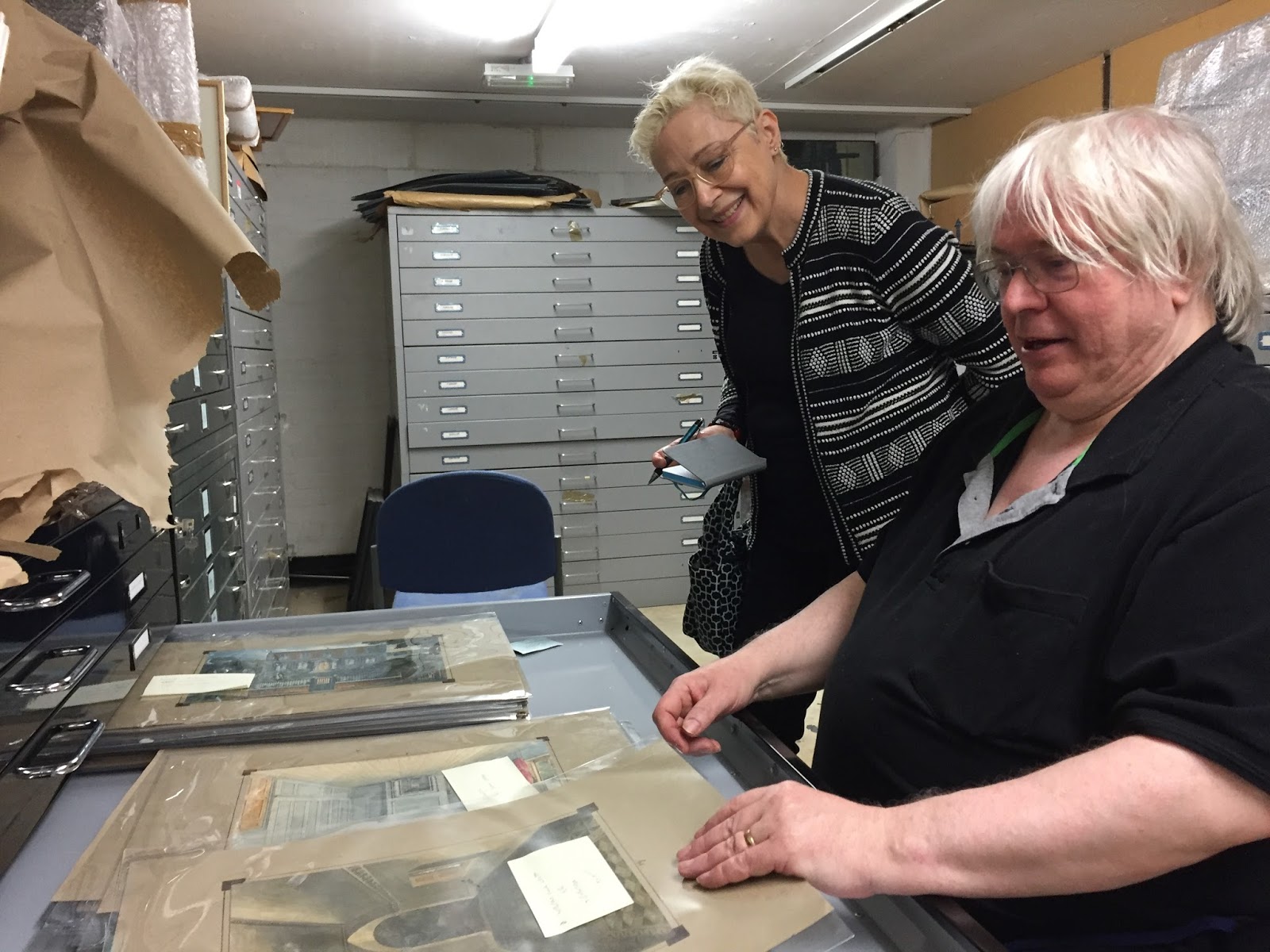
The archives of the Kensington Central Library contains, among numerous other materials, an immense collection of art.  Dave Walker, archivist + librarian, showed us dozens and dozens of prints, drawings, and paintings. I called Hold on a few, so we could photograph them.

Regency aficionados will recognize the Temple of Concord, which stood in the Green Park for a time. The 1814 Annual Register describes the festivities the Prince Regent put on to celebrate "Peace restored under the Regency"--which morphed into a celebration of  the centenary of the Hanoverian dynasty.  Apparently, the fireworks display at the Temple of Concord was spectacular. Also, unfortunately, it appears that the Temple exploded at some point.  Fortunately, we have this and a number of other images as a reminder of how wonderfully fanciful and colorful the Regency could be.


Sunday, June 11, 2017

"The Lady's Disaster": Fashion Gone Bad, c1746

Sunday, June 11, 2017

Susan reporting,

Yes, I love 18thc fashion, but I also have a fascination for the those wardrobe malfunctions that could only occur in the Georgian era - towering hairstyles so extreme that bystanders duck in terror, cork rumps that serve as life preservers for ladies that topple into the Thames, and hoops that flip up at inopportune moments. Of course many of these are more social satire than actual occurrences, since then, as now, fashion has always been a favorite target for exaggeration and ridicule - but who can resist those wickedly pointed 18thc prints and cartoons?

It was, then, with great delight that I saw this print posted recently on Twitter by historian Greg Roberts. Called The Lady's Disaster, it claims to depict an actual wardrobe malfunction in a London street c1746. According to the caption, the scene was:

"Drawn from the Fact. Occasion'd by a Lady carelessly tossing her Hoop too high, in going to shun a little Chimney sweeper's Boy who fell down just at her Feet in an artful surprise, at ye enormous sight."

"Artful surprise", indeed. (See the detail, right.)

Yet the print is more a commentary on the foibles of fashion and the ladies who follow them than on the artful boy. Eighteenth-century hoops were designed to support and extend a woman's skirts to an extreme width; imagine them something like a wire lampshade or even a Hula Hoop, tied around the wearer's waist with tapes. Unlike crinolines a century later, the 18thc hoops didn't have additional supports like ruffled petticoats under the hoop, and beneath her wide-spreading skirts (which to complicate things further were in fact called petticoats) than a knee-length shift.

Hoops were ridiculed for their impractical folly and cursed from pulpits as the Devil's vanity. Mantua-makers (dressmakers) loved them, because they required so much costly fabric to cover and thereby resulted in a bigger sale. Women liked how hoops made their waists look small by comparison, and provided a graceful gait likened to floating clouds and rippling waves.  A woman couldn't help but make a grand entrance when her skirts were as wide as she herself was tall.

The woman in this print, however, saw her grand gesture of flicking her skirt away from a lowly chimney-swift backfire when her extra-large hoops - and her petticoats - flipped upward. Bystanders laugh, tradesmen smirk, and other women (probably prostitutes from their own revealing dress) lean from windows to get a better view of her mortification. Even a mongrel dog offers his own commentary by lifting a leg against another woman's hoop skirt.

The non-PC caption not only describes the woman's "wide Machine" (her hoops) and chastises her for wearing it, but also attempts to put her hoops in a historical context by mentioning the farthingales worn by Elizabethan women in the late 16thc.

"If Fame say true in former Days,
The Fardingale was no disgrace;
But what a sight is here reveal'd!
Such as our Mothers ne'er beheld.
A Nymph in an unguarded hour,
(Alas! who can be too secure)
Dire fate has destin'd to be seen,
Entangled in her wide Machine.
While Carmen, Clowns, and Gentle folks
With satisfaction pass their Jokes.
Some view th' enamel'd scene on high
And some at bottom fix their Eye.
Mark well the Boy with smutty Face,
And wish themselves were in his place.
Whose black distorted features show, 
There's something - to be seen below.
And awful grinning at her Foot
Cries sweep! sweep! Madam for your Soot....
In moderate bounds had Celia dres't,
She'd ne'er become a publick Jest."

Yet the more things change, the more they stay the same. How many modern paparazzi pray for the moment when some starlet  - "gone commando" for the sake of a clean line in her designer gown - slides from her limousine and reveals a bit too much on the red carpet?

Above: The Lady's Disaster, artist and publisher unknown, London 1746, Lewis Walpole Library, Yale University.

Monday, April 24, 2017

Portland Place in 1815

Monday, April 24, 2017

Portland Place 1815
Portland Place description
Loretta reports:

Not until I read this entry about Portland Place did I know there was such a building as Foley House, or the rules that once existed about building in the vicinity. Not surprising. So many great London houses have disappeared, some with virtually no trace. However, I did manage to find an old engraving online (please scroll down), from Old and New London, one of my oft-consulted Victorian guidebooks to London’s history (complete, apparently, with various Victorian myths).

Portland Place is still an impressive street, though you will see more than a couple of carriage rattling around on it these days. And the road is paved, yes.


Portland Place description  


Images from Ackermann's Repository for April 1815, courtesy Philadelphia Museum of Art, via Internet Archive.

Clicking on the image will enlarge it.  Clicking on the caption will take you to the source, where you can learn more and enlarge images as needed.

Thursday, March 30, 2017

From the Archives: Frothy, Fashionable Caps, c.1780

Thursday, March 30, 2017

Susan reporting,

Since I'm in Colonial Williamsburg this week, it seemed like a good time to revisit this popular post from 2015. Then,  the mantua-makers had just finished two complicated sewing projects, and their form of relaxing was to replicate several silk gauze caps of the late 1770s-early 1780s.

Caps had been part of an Englishwoman's day-time wardrobe for many generations before this. Ostensibly to cover the head and hair for modesty's sake, they were worn by nearly all women of every age and rank. For working women, linen caps kept hair tidy and out of the way, and offered extra protection around open fires. For the more fashionable, caps could also provided a base for the wide-brimmed hats worn out-of-doors.

By the last quarter of the 18th c., however, caps had evolved into notable fashion statements on their own. Trimmed with ribbons, bows, and ruffles and enhanced with fine stitching and embroidery, caps inflated into frothy confections to match the towering hairstyles ("heads") of the time.

These stylish caps were made of the finest silk gauze, a translucent fabric with a crisp hand much like modern organza. The narrow rolled hems, pleats, and tiny stitches were a test of skill for the mantua-makers, as Nicole Rudolph, above left, demonstrates. The original caps were so airy and insubstantial that few survive in collections today. (Our CW manuta-makers report that even after a single careful laundering, the caps
begin to wilt, and after two, they're pretty much done.)

But longevity wasn't the caps' point. They were a trend-driven fashion, with new variations appearing frequently in the London shops. They could be further personalized with different bows, as the back view of the example, lower left, demonstrates (though it could use some equally fashionable big hair beneath it for proper height.) Compared to a new gown, caps were also inexpensive, and an easy way to update an older wardrobe.

Looking at the satirical prints of the time, right, it's easy to assume that the size and foolishness of the caps was exaggerated (along with everything else) by the artists. They weren't. Former apprentice Abby Cox models one of the caps copied by the shop from a print, lower right, and there's no denying its exuberant charm. Yes, the cap is extreme, and more than a little foolish to modern eyes, but to an 18th c. lady - and more importantly, to an 18th c. gentleman - there were few things more unabashedly flirtatious than a pretty young woman in a sweet ruffled cap.

Above left: Photo copyright 2015 Susan Holloway Scott.
RightDetail, Deceitful Kisses, or The Pretty Plunderers, from an original by John Collet, printed by Carrington Bowles, 1781. Collection of the British Museum.
Lower right: Photographs copyright 2015 the Margaret Hunter Shop.

Thursday, March 9, 2017

From the Archives: Stealing Kisses Inside Hats, 1810

Thursday, March 9, 2017

Susan reports:

When we last saw the fashionable young Parisians of Le Supreme Bon Ton, they were swimming together with a vigorous freedom that seemed astonishing for 1810. Now the ladies and gentlemen are back on shore and dressed in their fashionable best, which, for the ladies, includes the new style of deep-brimmed hats. While the hats shown were doubtless exaggerated by this artist, the name given to the wearers ("the invisible ones") does imply that the wearer's face was well-hidden. Undaunted, the gentlemen seem determined to pursue the ladies inside their brims, and make the most of the privacy the hats provided – with clearly mixed results.

But while at first glance this print seems to be satirizing the fashionable headgear of the ladies, I believe the gentlemen, too, must be feeling the artist's sharpened barbs. Consider these amorous swains. Exactly how long must their necks be, that they'll be able to reach their ladies' lips for a kiss? And what misfortune has happened to their breeches? Over and over we read about the provocatively close-fitting breeches favored by young gentleman in this time period, and yet the ones these poor fellows are wearing are...not. 'Nuff said.

Except, of course, what's satirical sauce for the goose is sauce for the gander, even in the land of the Bon Ton.

Above: Les invisibles en Tete-a-Tete, from the series Le Supreme Bon Ton, No. 16; artist unknown; published by Martinet, Paris, c. 1810-1815

Sunday, October 30, 2016

Finding Relief in the Lady's Garden at Vauxhall, 1788

Sunday, October 30, 2016

Isabella reporting,

As interesting as all life in the past is to us now, it's the common aspects that our readers seem to find most interesting. Forget riding in a coach or dancing in hoops. Where and how did our heroines answer nature's call before indoor plumbing? This explains why a six-year-old blog post on the necessary bourdaloue remains one of our all-time most popular - and why this 18thc satirical print will probably be both amusing and informative. As always, please click on the image to enlarge it.

The pleasure gardens at Vauxhall were among the most popular entertainment spots in Georgian London. Several generations of Londoners of every rank put on their finery (and the occasional mask) and came to stroll, dance, dine, and flirt beneath the legendary lights. With its tree-shaded paths, Chinese-inspired pavilions, popular music, and statues and paintings by famous artists, there was much to amuse - and plenty of places to find mischief, too.

But even Vauxhall's glamorous settings had a baser side.  It had to, after all that drinking and dining. Or as Christopher Smart observed in a popular journal:

   "In sweet Vaux-hall I love to stray:
    But wish it were completely gay:
    In splendid Scenes we drink and eat:
    In sordid Huts – evacuate."*

Apparently many visitors of both sexes didn't bother to seek out the "sordid Huts", but chose to take advantage of the shadowy paths and bushes to relieve themselves. For ladies who were a fraction more fastidious, there was also the "Lady's Garden", shown in this 1788 print.

Apparently being reserved for the use of ladies didn't mean the facilities had much in the way of amenities or privacy. Along two walls is a bench forming a communal latrine, with four women in various stages of relief and distress, their fashionable skirts gathered up around them. Keep in mind that there would have been no "flushing" mechanism beneath the women, and imagine what the smell must have been by the end of a busy evening.

The towering plumes on the women's hats and in their powdered hairstyles come dangerously close to the open flames of the candles in wall sconces behind them, offering one more hazard. Discarded on the floor are a nosegay, an unmatched glove, and an advertisement sheet - which probably would have been used in place of modern toilet paper - for Dr. Leak's pills, a popular quack venereal remedy and a sly jab at the sexual assignations that often occurred at Vauxhall.

To the right sits one woman ostentatiously retying her garter, perhaps a potential customer for Dr. Leake, while another is freshening her makeup at a looking glass. This tall woman, detail right, is believed to be Lady Sarah Archer, an aristocratic widow famous for her independence, her love of gambling, and her interest in politics and outdoor sports (she drove her own phaeton and rode to the hounds.) In the eyes of misogynistic 18thc caricaturists, however, her greatest sin was being over forty with a fondness for makeup and fashion. She is always cruelly drawn with florid cheeks and an exaggerated hooked nose to accentuate her supposedly unfeminine appearance - and what better way to mock her further than to show her painting her face in a communal outhouse?

* From the wonderful Vauxhall Gardens: A History by David Coke & Alan Borg. See Loretta's post about this book here.

Above: The inside of the lady's garden at Vauxhall Drawing attributed to Henry Kingsbury; published S.W. Fores, 1788. The British Museum.

Thursday, October 13, 2016

Views on Tobacco in 1832

Thursday, October 13, 2016
Cigars, by H. Heath (1827)
Loretta reports:

From the time Sir Walter Raleigh brought it to England, tobacco had its detractors as well as proponents.

Henry James Meller's Nicotiana (1832), whose full title is almost as long as one of its chapters, is very much a pro-tobacco document. However, it’s also an interesting historical one. I chose one from hundreds of possible excerpts, mainly because this isn’t the only 1800s book I've found recommending tobacco as a preservative for teeth.
Tobacco for teeth
More tobacco treatment


If you start on page 83,
you can learn about the many ailments it was alleged to cure, including lung ailments.


Cigars, by H Heath 1827, courtesy Wellcome Images via Wikipedia.

Clicking on the image will enlarge it.  Clicking on the caption will take you to the source, where you can learn more and enlarge images as needed.

Thursday, September 29, 2016

Newgate Prison and Its Inmates in September 1819

Thursday, September 29, 2016
Newgate Prison—west view
Loretta reports:

My recent book, Dukes Prefer Blondes, features a barrister (trial lawyer) who’s familiar with Newgate Prison and the Old Bailey. As I researched the book, I was already aware that, during the Regency era (some years before my story) England had an extremely high number of capital offenses. According to Albion’s Fatal Tree, “The most recent account suggests that the number of capital statutes grew from about 50 to over 200 between the years 1688 and 1820.”*

As a consequence, we tend to believe that people were being hanged by the droves. What I learned was, people were hanged, yes, including children, but more often, mercy was sought and granted, and the sentence changed to transportation or prison. This may explain the rather shocking nil in the category “Convicts under sentence of death.” You will notice that, even though more men than women were convicted of crimes, more women were sentenced to transportation. At the moment, I can’t explain that one.

*Figures based on Sir Leon Radzinowicz, A History of English Criminal Law and its Administration from 1750.
Newgate Statistics 1819


Monday, August 1, 2016

Opening the New London Bridge, August 1831

Monday, August 1, 2016
London Bridge 1 August 1831

Loretta reports:

Usually, I start the month with fashion plates, but today’s the 185th anniversary of the opening of the “new” London Bridge. So we'll look at that instead, in pictures and text, since it isn't in London anymore.

The bridge, as many are aware, has had several incarnations.

On this day in 1831, King William IV officially opened, with great pomp and ceremony, the version that’s since moved—more or less—to Arizona.
You can read a short summary of its life hereand a lengthy account in the Gentleman’s Magazine starting here.

London Bridge ca 1890-1900
You may not feel up to an early 19th century detailed report on the bridge’s history and construction, along with a blow-by-blow description of the opening ceremony. These lengthy accounts are tough on modern readers. But this sort of thing was what readers wanted, in the days before photography, let alone television. If the whole article is too much for you, you might still want to take a look at the very nice bird’s eye view engraving here.

Image above left: The New London Bridge as it appeared on Monday August 1st, 1831, at the Ceremony of opening by their Majesties, courtesy Library of Congress Prints and Photographs Division Washington, D.C. 20540 USA.

Below right: London Bridge ca 1890-1900, courtesy Library of Congress Prints and Photographs Division Washington, D.C.

Clicking on the image will enlarge it.  Clicking on the caption will take you to the source, where you can learn more and enlarge images as needed.

Tuesday, July 26, 2016

Traveling Advice & Expenses 1828

Tuesday, July 26, 2016
Alken, Bath Coach 1820
Loretta reports:

Traveling in the early 1800s was complicated to a degree we can scarcely fathom. The Traveller's Oracle, by William Kitchiner, M.D., deals with what seems to be every last, daunting detail of the process, like what sort of servant(s) to take, what medicines to pack, how to sleep safely at an inn, and so on.

I could have picked any of dozens of excerpts, but decided matters of the horse would offer a good clue to the kinds of things one had to consider. This is from the third (1828) edition:
Travel expenses 

Travel expenses

Travel Expenses
When you wish to travel forty or fifty miles in a day expeditiously, if you have Horses of of your own—it is the most advisable plan to send them on the day before about twenty or twenty-five miles, desiring they may go not more than five miles in an hour.
If you start from home with post Horses, your own will be fresh to carry you on briskly to the termination of your Journey.
Image: Henry Alken, Bath Coach (1820) courtesy Yale Center for British Art, Paul Mellon Collection

Clicking on the image will enlarge it.  Clicking on the caption will take you to the source, where you can learn more and enlarge images as needed.

Monday, July 18, 2016

Proper Dress for Gentlemen in 1838

Monday, July 18, 2016
Men's Fashion Paris 1838
Loretta reports:

I tried to cut this excerpt down to my preferred short post size. Unfortunately, unlike so much 19th century prose, this is fairly concise, as well as being enlightening on several points.
However ugly you may be, rest assured that there is some style of dress which will make you passable ...
If you have weak eyes, you should wear spectacles. If the defect be great, your glasses should be coloured. In such cases emulate the sky rather than the sea: green spectacles are an abomination—blue ones are respectable, and even distinguĂ©.
Almost every defect of face may be concealed by a judicious use and arrangement of hair. Take care, however, that your hair be not of one colour and your whiskers of another. If you wear a wig, let it be large enough to cover the whole of your red or white hair.
The style of dress for the street is of little consequence, so that it be in good taste. Very light-coloured coats are to be avoided, as well as any thing in strong contrast with the other parts of your dress. The effect of a frock coat is to conceal the height. If, therefore, you are beneath the ordinary stature, or much above it, you should affect frock coats on all occasions that etiquette permits.
In the dining-room, and the drawing-room, dress coats must be adopted, and of late boots are permitted; but shoes and silk stockings are in better taste.
Abroad, in public assemblies, in the church or the theatre, as well as in walking the street, you should always wear gloves. The greatest care should be taken that they fit well, and that they are scrupulously unsullied.
Before going to a ball or party it is not sufficient that you consult your mirror twenty times. You must be personally inspected by your servant or a friend. From want of this precaution, I once saw a gentleman enter a ball-room, attired with scrupulous elegance, but with one of his suspenders curling in graceful festoons about his feet. His glass could not show what was behind.
When we speak of excellence in dress we do not mean richness of clothing, nor manifested elaboration. Profusion of ornaments, rings, chains, &c. &c. are in bad taste. Faultless propriety, perfect harmony, and a refined simplicity,—these are the charms which always fascinate.
It is as great a sin to be finical in dress as to be negligent. A gentleman will always be well and tastefully dressed—choosing a sort of middle course between the extremes: avoiding foppery on the one hand, and carelessness on the other.
Upon this subject the ladies are the only infallible oracles. Apart from the perfection to which they must of necessity arrive, from devoting their entire existence to such considerations, they seem to be endued with an inexpressible tact, a sort of sixth sense, which reveals intuitively the proper distinctions. That your dress is approved by a man is nothing;—you cannot enjoy the high satisfaction of being perfectly comme il faut, until your performance has received the seal of a woman's approbation.
Paris fashion June 1838
Etiquette for Gentlemen, with hints on the art of conversation, 1838

Images from Journal des Dames & des Modes, Costumes Parisiens, 1838. (Not a lot of men's 1830s fashion in any English publication I could find online.)

Clicking on the image will enlarge it.  Clicking on the caption will take you to the source, where you can learn more and enlarge images as needed.


Tuesday, July 12, 2016

Gothic Library for July 1813

Tuesday, July 12, 2016
Gothic Library July 1813
Loretta reports:

I tend to set many scenes in libraries, for all kinds of reasons. Libraries in great houses can be cozy or vast. By the Regency, and certainly by the time of my stories, people are spending more time in them, reading, looking at maps, drawing, writing letters, or simply using it as a family den—“a room of usual resort” as the description puts it. In my searches online, I’ve found libraries of all shapes and sizes. They might contain a greater variety of furniture than other rooms. And then, I like the idea of surrounding my characters with books.
Library description
This gothic-looking library is a follow up to the previous month’s architectural feature You can read the “observations contained in the Repository of last month” here.

The image, not as interesting, I think, as July’s, is here.

Library description cont'd


Clicking on the image will enlarge it.  Clicking on the caption will take you to the source, where you can learn more and enlarge images as needed.

 
Two Nerdy History Girls. Design by Pocket