Showing posts with label words of wisdom. Show all posts

Wednesday, September 19, 2018

"Moral Poison": The Evils of Reading Novels, 1864

Wednesday, September 19, 2018
Susan reporting,

Loretta and I have written so many posts for this blog over the years - nearly a decade's worth! - that we've forgotten a good many of them. Fortunately, our readers haven't. This one surfaced yesterday on Twitter (thank you, Lucy Paquette), and I thought it deserved another appearance here as I wallow through deadline-itis.

In an earlier post, I shared an 18thc warning against women reading romances. By 1860, those who worried about everyone else's reading habits had expanded their concerns, including all novels read not only by women, but by men as well. Apparently novels were dangerous.

The warnings below come from a religious tract published in New York in 1864. A Pastor's Jottings; or, Striking Scenes during a Ministry of Thirty-Five Years was printed anonymously because, as the prefatory note explains, the author "could thus write with more freedom." That same note assures us that "the statements of this volume are all literally true."

Among the many things (this book is nearly 350 pages long) that distress this unknown pastor, novels - that "moral poison" - are right there at the top of the list: "The minds of novel readers are intoxicated, their rest is broken, their health shattered, and their prospect of usefulness blighted."

But he doesn't want us simply to take his word for it. Apparently even novels by Charles Dickens are suspect, and he quotes the famous educator Dr. Thomas Arnold of Rugby School fame to prove it:

Childishness in boys even of good ability seems to be a growing fault; and I do not know what to ascribe it, except to the great number of exciting books of amusement, like Pickwick, Nickleby, Bentley's Magazine, etc...that leave [a boy] totally palled, not only for his regular work, but for literature of all sorts.

Nor are women exempt from the terrible influences of novel-reading. In fact (remember, this is all LITERALLY TRUE), according to the pastor, women suffer even more:

Listen to the evidence given by a physician in Massachusetts: 'I have seen a young lady with her table loaded with volumes of fictitious trash, poring day after day and night after night over highly wrought scenes and skillfully portrayed pictures of romance, until her cheeks grew pale, her eyes became wild and restless, and her mind wandered and was lost – the light of intelligence passed behind a cloud, and her soul was forever benighted. She was insane, incurably insane from reading novels.'

But insanity is only the beginning:

Not very long since, a double suicide was committed...by a young married couple from Ohio, who were clearly proved to be led to ruin and death by these most pernicious books....Police officers too in London and some of our own large cities, have given mournful evidence of the results of some of these novels when dramatized and performed on the stage, as leading to burglaries and murder.

Suicide, madness, burglaries, and murder! As an unrepentant novelist, I clearly have much to answer for. While for obvious reasons, I don't want you to see the error of your ways, but if you'd like to read more of the Unnamed Pastor's edifying work, here's the link to his book, available to read for free via Google Books.

Thanks to Clive Thompson, who shared quotes from A Pastor's Jottings on Twitter.

Above: The Pink Domino; print made by William Henry Mote after Frank Stone, c1833-1835. The British Museum.

Friday, October 16, 2015

Friday Video: Top 10 Duels in History

Friday, October 16, 2015
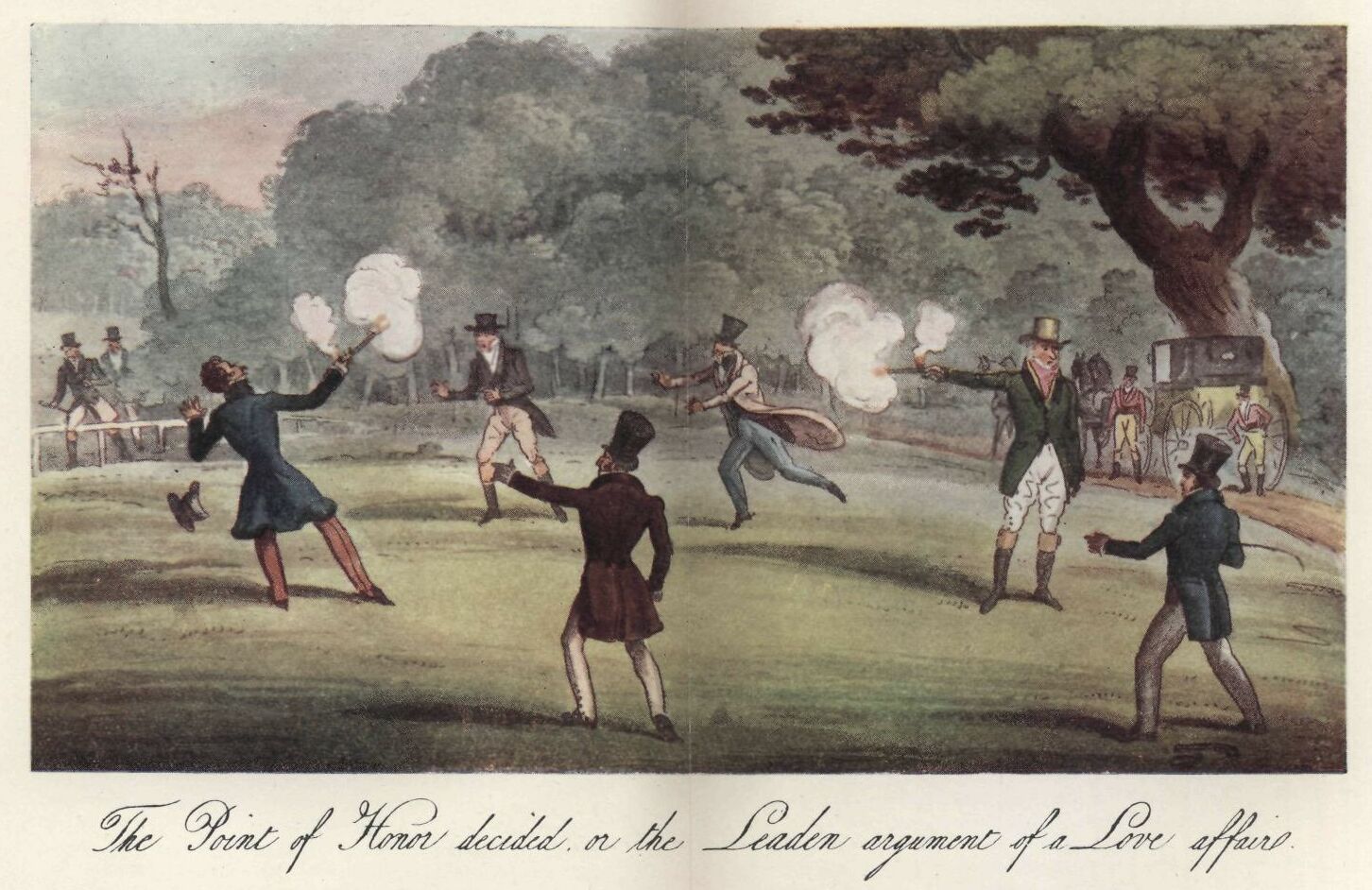
Cruikshank, Duel
Loretta reports:

In Gentlemen’s Blood, author Barbara Holland says,

“There was much to like about the duel. It was a regulated way for one man to prevail over another when he felt the need to do so, and an improvement over the informal ambush, or sending out henchmen to break the enemy’s skull by night on the highway.”

In Samuel Johnson’s opinion dueling was “more justifiable than war in which thousands go forth without any personal quarrel.”

Our readers will hold varying opinions on the subject. Please feel free to explore the topic in the comments—that, or duels you’d have put in your Top 10 list, or maybe other movies with excellent dueling scenes?


Image: Cruikshank, The Point of Honor decided, or the Leaden argument of a Love affaire, from The English Spy, 1825

For [many] more of our blog posts on the subject, just type in “duel” in the search box.

Readers who receive our blog via email might see a rectangle, square, or nothing where the video ought to be.  To watch the video, please click on the title to this post.

Clicking on the image will enlarge it.  Clicking on the caption will take you to the source, where you can learn more and enlarge images as needed.


Thursday, July 30, 2015

True Love According to Helen Rowland

Thursday, July 30, 2015
La Câline
Loretta reports:

Helen Rowland (1875-1950)was called “America’s Bernard Shaw.” Unfortunately, not an awful lot is known about her, and I’ve turned up exactly two pictures (one only last night—to feature in a future post).

It’s been a while since I’ve posted any of her wit and wisdom.* This one, on love, is rather sweet, for her.

*Blog posts here, here, and here.
True Love

Page images from Helen Rowland, A Guide to Men: Being Encore Reflections of a Bachelor Girl (1922).

Illustration: "La Câline," from Gazette du bon ton (1922) [edited], courtesy Internet Archive.

Clicking on the image will enlarge it.  Clicking on the caption will take you to the source, where you can learn more and enlarge images as needed.


True Love

Tuesday, April 21, 2015

From the Archives: The fine art of walking city streets in the 19th century

Tuesday, April 21, 2015
Louise-Léopold Boilly, Passer Payez, c. 1803
Loretta reports:

The art of negotiating city streets in bad weather, modeled on the Parisian method.
 ~~~
You must pay attention to your manner of walking, for fear of throwing mud around you, and spattering yourself as well as those who accompany you, or who walk behind you. Any person, particularly a lady, who walks in this improper manner, whatever her education may be in other respects, will always appear awkward and clumsy.

Every one knows that the Parisian ladies are celebrated for their skill in walking: we see them in white stockings and thin shoes, passing through long, dirty, and blocked up streets, gliding by careless persons, and by vehicles crossing each other in every direction, and yet return home after a walk of several hours, without soiling their clothes in the least.

To arrive at this astonishing result, which causes the wonder and vexation of provincial visitors on their first coming to Paris, we must be careful to put the foot on the middle of the paving stones, and never on the edges, for, in that case, one inevitably slips into the interstice between one pavement and another: we must begin by supporting the toe, before we do the heel; and even when the mud is quite deep, we must put down the heel but seldom. When the street becomes less muddy, we can compensate ourselves for this fatigue, which, however, in the end, leaves us hardly sensible.

This manner of walking is strictly necessary when you offer your arm to any one. When tripping over the pavement, (as the saying is) a lady should gracefully raise her dress a little above her ancle. With the right hand she should hold together the folds of her gown, and draw them towards the right side. To raise the dress on both sides, and with both hands, is vulgar. This ungraceful practice can be tolerated only for a moment, when the mud is very deep.
—Elisabeth Celnart, The gentleman and lady's book of politeness and propriety of deportment: dedicated to the youth of both sexes, 1833  

Illustration: Louis Leopold Boilly, Passer-payez (ca 1803), courtesy Wikimedia Commons.  

Clicking on the image will enlarge it.  Clicking on the caption will allow you to read at the source, where you can learn more and enlarge images as needed.lease click on caption for more info.

Tuesday, April 9, 2013

Appomattox and Beyond

Tuesday, April 9, 2013
Loretta reports:

On this day in 1865, at Appomattox Court House, General Robert E. Lee surrendered the Army of Northern Virginia to Ulysses S. Grant, general-in-chief of all United States forces.  The surrender didn’t end the Civil War.  It took several more months, and the death of President Lincoln, before the fighting ended completely, after 600,000 men had been killed.

A Virginia Girl in the Civil War, 1861-1865 is told from the point of view of a wife of a Confederate soldier, but this excerpt, which I found initially via the Library of Congress, struck me as particularly poignant.  And universal.

The author has been waiting for several days, with increasing panic, for her husband to return from the war.
~~~

Do you know how it is to feel in your sleep that some one is looking at you? This is the sort of sensation that aroused me the next morning, and I opened my eyes in the early dawn to find my husband standing by the bed with clasped hands looking down at me.

Ah, we were happy—we were happy! Ragged, defeated, broken, we but had each other and that was enough.
...
We are prosperous now, our heads are nearly white; little grandchildren cluster about us and listen with interest to grandpapa's and grandmamma's tales of the days when they "fought and bled and died together." They can't understand how such nice people as the Yankees and ourselves ever could have fought each other. "It doesn't seem reasonable," says Nellie the third, who is engaged to a gentleman from Boston, where we sent her to cultivate her musical talents, but where she applied herself to other matters, 'it doesn't seem reasonable, grandmamma, when you could just as easily have settled it all comfortably without any fighting. How glad I am I wasn't living then! How thankful I am that 'Old Glory' floats alike over North and South, now!'

And so am I, my darling, so am I!

~~~
—A Virginia Girl in the Civil War, 1861-1865: Being a Record of the Actual Experiences of the Wife of a Confederate Officer.

Photographs courtesy Library of Congress Prints and Photographs Division Washington, D.C. 20540 USA.

Above:  Unidentified young soldier in Union uniform with musket, bayonet, and knapsack.

Below: Unidentified soldier in Confederate uniform

Thursday, March 28, 2013

"Remember the Ladies," writes Abigail Adams

Thursday, March 28, 2013
Loretta reports:


It was about this time of year, when New England was showing faint signs of spring, that Abigail Adams wrote to her husband, John Adams, a long letter that included the following words. I post the excerpt without comment, leaving commentary to you.
 
Braintree, 31 March, 1776….

I long to hear that you have declared an independency. And, by the way, in the new code of laws which I suppose it will be necessary for you to make, I desire you would remember the ladies and be more generous and favorable to them than your ancestors. Do not put such unlimited power into the hands of the husbands. Remember, all men would be tyrants if they could. If particular care and attention is not paid to the ladies, we are determined to foment a rebellion, and will not hold ourselves bound by any laws in which we have no voice or representation.

That your sex are naturally tyrannical is a truth so thoroughly established as to admit of no dispute; but such of you as wish to be happy willingly give up the harsh title of master for the more tender and endearing one of friend. Why, then, not put it out of the power of the vicious and the lawless to use us with cruelty and indignity with impunity? Men of sense in all ages abhor those customs which treat us only as the vassals of your sex; regard us then as beings placed by Providence under your protection, and in imitation of the Supreme Being make use of that power only for our happiness.

—Familiar Letters of John Adams and His Wife Abigail Adams, During the Revolution: With a Memoir of Mrs. Adams, edited by Charles Francis Adams, 1875.

You can see the letter online at the Massachusetts Historical Society site.
Small image here.  Large image here.

You can also read here about her pearl necklace.

Wednesday, August 22, 2012

Helen Rowland On Kissing

Wednesday, August 22, 2012
Loretta reports:

I thought it was time for more (previous posts here and here) of Helen Rowland’s wit and wisdom.  This is from my favorite of her books available online, The Sayings of Mrs. Solomon: being the confessions of the seven hundredth wife as revealed to Helen Rowland, 1913.


Please click on pictures to enlarge.

Monday, April 16, 2012

Fashionable furniture for April 1814

Monday, April 16, 2012
Loretta reports:

From the April 1814 issue of Ackermann’s Repository, remarks on the value of the arts accompany the illustration of a table and chair inspired by the man who gave the Regency its name.
~~~
Plate 23. —FASHIONABLE FURNITURE.
We know that a people become enlightened by the cultivation of the arts, and that they become great in the progress of that cultivation. That a just knowledge of the useful and a correct taste for the ornamental go hand in hand with this general improvement, the dullest observer may be satisfied by looking around him. We now acknowledge, that it is alone the pencil of the artist which can trace the universal hieroglyphic; understood alike by all, his enthusiasm communicates itself to all alike, and prepares the mind for cultivation. A national improvement is thus produced by the arts, and the arts are supported in their respectability by the calls which the improving public taste makes for their assistance ; they are inseparable in their progress, and mutually depend on each other for support. In the construction of the domestic furniture of our dwellings we see and feel the benefit of all this. To the credit of our higher classes who encourage, and of our manufacturing artists who produce, we now universally quit the overcharged magnificence of former ages, and seek the purer models of simplicity and tasteful ornament in every article of daily call.

The table and chair which are the subject of the present engraving, are peculiarly of the description of improvement of which we are speaking. They exhibit a judicious combination of elegance and usefulness, do great credit to the artists who designed and executed them, and highly merit the patronage afforded them. They are from the ware-rooms of Messrs. Morgan and Sanders, of Catherine-street, Strand. They take the name of Carlton-House Table and Chair, as we presume, from having been first made for the august personage whose correct taste has so classically embellished that beautiful palace.
—The Repository of arts, literature, commerce, manufactures, fashions and politics,1814

Thursday, March 22, 2012

Wearing the right shoes & stockings in 1811

Thursday, March 22, 2012
Loretta reports:

~~~
Be the foot eminently handsome, or the reverse, it alike requires to be arrayed soberly...On brilliant assembly nights, or court drawing-rooms, the spangled or diamond-decorated slipper has a magnificent and appropriate effect. But for the raiment of the leg, we totally disapprove, at all times, of the much ornamented stocking.
 
The open-wove clock and instep, instead of displaying fine proportion, confuse the contour; and may produce an impression of gaiety; but exclude that of beauty, whose rays always strike singly. But if the clock be a coloured or a gold one, as I have sometimes seen, how glaring is the exhibition! how coarse the association of ideas it produces in the fancy! Instead of a woman of refined manners and polished habits, your imagination reverts to the gross and repelling females of Portsmouth-point, or Plymouth-dock; or at least to the hired opera-dancer, whose business it is to make her foot and ancle the principal object which characterizes her charms, and attracts the coup d'œil of the whole assembly.
 
If I may give my fair friends a hint on this delicate subject, it would be that the finest rounded ancles are most effectually shown by wearing a silk stocking without any clock. The eye then slides easily over the unbroken line, and takes in all its beauties. But when the ancle is rather large, or square, then a pretty unobtrusive net clock, of the same colour as the stocking, will be a useful division, and induce the beholder to believe the perfect symmetry of the parts. A very thick leg cannot be disguised or amended ; and in this case I can only recommend absolute neatness in the dressing of the limb, and petticoats so long that there is hardly a chance of its ever being seen.
 
One cause of thick ancles in young women is want of exercise, and abiding much in overheated rooms. Standing too long has often the same effect, by subjecting the limb to an unnatural load, and therefore to swelling. The only preventive or cure for this malady is a strict attention to health You might as well expect to see a rose-bush spring, bud, and bloom, in a closely-pent oven, as anticipate fine proportions and complexion from a long continuance of the exotic fashions of these days.  —The Mirror of the Graces, 1811

Illustration from An analysis of country dancing, 1811, courtesy Library of Congress American Memory, Washington, D.C. 20540 USA.

Wednesday, August 3, 2011

A Bride with Wedding Night Jitters, c. 1750

Wednesday, August 3, 2011
Susan reporting:

Doubtless fueled by pictures of primly dressed cardboard Thanksgiving Pilgrims, many modern Americans believe that their forefathers & mothers were chaste and modest, too busy creating a new country to give way to impure thoughts, let alone actions.

Not so. The years directly before the American Revolution showed a record number of premarital pregnancies and babies born soon after marriages - records that in some cases weren't equaled until the 1960s. Despite the warnings of the colonial church, sex was not only practiced outside of marriage, but freely discussed and joked about, too. This bawdy story comes from the diary of John Adams, and while it might have been embellished a bit for the audience, it shows that even in supposedly straight-laced New England, a good jest with double-entendres was considered an excellent way "to raise the spirits" - and it also seems that the new Mistress Bicknal enjoyed herself, too.

"Last Thursday Night, at Cranach's Wedding, Dr. Tufts, in the Room where the Gentlemen were, said We used to have on these Occasions, some good Matrimonial stories, to raise our spirits. The story of B. Bicknal's Wife is a very clever one. She said, when she was married she was very anxious, she feared, she trembled, she could not go to Bed. But she recollected she had put her Hand to the Plow and could not look back, so she mustered her Spirits, committed her soul to God, and her Body to B. Bicknal and into Bed she leaped and in the Morning she was amazed, she could not think for her Life what it was that had scared her so."

Many thanks to John Bell for reminding us of this passage - and please check out his excellent Boston 1775, a blog devoted to history, analysis, and unabashed gossip about the start of the American Revolution in Massachusetts.

Above: Detail from Illustration for 'Wedding Proposals', print by Daniel Nikolaus Chodowiecki (1726-1801), 1780, Gift of Mr. & Mrs. Stanley Talpis, Los Angeles County Museum of Art.

Wednesday, December 15, 2010

"The pleasures of the world are deceitful," 1728

Wednesday, December 15, 2010
Susan reporting:

As we saw yesterday with Regency courtesan Harriette Wilson, cheerfully, willfully bad girls are not a modern invention. Alexander Pope famously (if cynically) noted in 1735:

Men, some to Business, some to Pleasure take,
But every Woman is, at heart, a Rake:
Men, some to Quiet, some to public Strife,
But every Lady would be Queen for life.

Clearly this was enough to worry careful 18th c. parents of daughters. Then, as now, publishers happily answered the call, and London booksellers offered a wealth of cautionary guides for ladies. Sobriety, modesty, decorum, piety, and other traditional virtues are all preached on their pages, if not necessarily heeded by their readers. (Yes, Harriette, we mean you.)

Among the most popular of these conduct books was the 1728 Advice of a Mother to her Daughter by the Marquise de Lambert (1647-1733), which was translated into English and published in many editions throughout the century, an early self-help bestseller. Still, one suspects that more girls were breathlessly devouring the romantic trials and attempted seductions of Pamela and Clarissa (two more Georgian bestsellers by Samuel Richardson), than these somber words from the marquise:

The pleasures of the world are deceitful; they promise more than they perform; the quest of them is full of anxiety: their enjoyment is far from yielding any true satisfaction, and their loss is attended with vexation....Honours and riches have no charms that are lasting for any length of time...Pleasures when they grow familiar, lose their relish. Before you have tasted them, you may do without them; whereas enjoyment makes that necessary to you, which was once superfluous, and you are worse at your ease than you were before...and when you lose them, they leave you nothing but emptiness and want.

If you're feeling in need of more edification, Advice continues to be available in many different versions. Here it's included in a compilation of conduct manuals: The Young Lady's Pocket Library, or Parental Monitor, reprinted from a 1790 edition, and here, as a Google book of an 1800 edition.

Above: Mr. B. snatches Pamela's letter to her parents and reads it, illustration from Pamela, or, Virtue Rewarded by Samuel Richardson, 1742.

Tuesday, September 21, 2010

How to Breed a Spoiled Young Gentleman: 1678

Tuesday, September 21, 2010
Susan reporting:

No matter what the century, there always seems to be a market for books of child-rearing advice. The author of one such 17th c. book, J. Galliard, offered his credentials in the forward as a "gentleman, who hath been a Tutor Abroad to several of the Nobility and Gentry." The lengthy title of his book –  The Compleat Gentleman; or, Directions for the Education of Youth as to their Breeding at Home and Travelling Abroad, in Two Treatises – promised exact directions on how to raise a perfect little gentlemen. This book was published in London in 1678, in the merry old days of Charles II and his Restoration court, and considering all the hard-living, hard-drinking libertine mischief that his courtiers were enjoying, worried parents were probably eager for a bit of common sense regarding their own unformed scions.

While Mr. Galliard's advice is more than three hundred years old and the language a bit convoluted, his words remain apt – both for the child, and the parents who spoil him in the name of "fondness."

"I do not deny how decent it is that Children of men of quality should be brought up in a handsomer way than those of common people: but I speak against the fondness which some have for them, which is so far from deserving to be called care, that I more properly name it want of care.


Let the inconveniences of this manner of Breeding be observed. These young Gentlemen. when they come somewhat to know themselves, will eat no coarse meat, but only the most delicate they can find for money. They scorn to wear cloathes except that they be very rich; they will think it is below them to walk, but if they go out, it must be in a Coach;...and if there be no servant to give them a glass of Wine, they will rather be choked than take it themselves. Sometimes the weather is not good for them to walk out, therefore they will sit at home, and Dice or Card away many a pound, or in a Tavern, and drink away their health till the Gout, or Gravel comes upon them, or a Pleurisie, an Apoplexy, or some other sudden Disease carries them to their Grave....What manner of men...who for years were kept as soft and warm as if they had been in their Mothers womb; who would not so much as suffer workmen in the Town for fear their sleep would have been interrupted with the noise made...who made in bed most of their Exercises, and their most serious Discourses at Table, and...look for excesses in every thing. Now I would fain know: what good can be expected from such a Breeding?"


Above: The Children of Charles I of England by Anthony Van Dyck, 1637

Wednesday, July 14, 2010

A man in love

Wednesday, July 14, 2010
Loretta reports:

I came upon this sweet little passage in The Lady’s Stratagem.*  It’s taken from The Young Woman's Companion; or, Female Instructor, a book that remained in print for most of the 19th century.  If the Stratagem isn’t in your budget right now, you can read more about Love & Courtship as well as receive Advice Previous to Matrimony here.
~~~~~
LOVE AND COURTSHIP,
The following are the most genuine effects of an honourable passion among men, and the most difficult to counterfeit. A young man of delicacy often betrays his passion by his too great anxiety to conceal it, especially if he have little hopes of success. True love renders a man not only respectful but timid, in his behaviour to the woman he loves. To conceal the awe which he feels, he may sometimes affect pleasantry, but it sits awkwardly on him, and he quickly relapses into seriousness. He magnifies all her real perfections in his imagination, and is either blind to her failings, or converts them into beauties.

His heart and his character will be improved in every respect by his attachment. His manners will become more gentle, and his conversation more agreeable; but diffidence and embarrassment will always make him appear to disadvantage in the company of the object of his affections.

When you observe these marks in a young man's behaviour, you must reflect seriously what you are to do. If his attachment be agreeable to you, if you feel a partiality for him, you would do well not to discover to him, at first, the full extent of your love. Your receiving his addresses shews your preference, which is all at that time he is entitled to know. If he have delicacy, he will ask for no stronger proof of your affection, for your sake; if he have sense, he will not ask it, for his own.

If you see evident proofs of a young man's attachment, and are determined to shut your heart against him; as you ever hope to be used with generosity by the person who shall engage your heart, treat him honourably and humanely. Do not suffer him to linger in a state of miserable suspense, but be anxious to let him know your sentiments concerning him.
~~~~~
*For more, see yesterday's blog

Illustrations courtesy  Library of Congress Prints and Photographs Division Washington, D.C. 20540 USA
Above left:  A Receipt for Courtship

Below right:  The Dutch Apollo!

Saturday, June 19, 2010

Words of Wisdom: Mr. Ben. Alexander, 1659

Saturday, June 19, 2010

Susan reports: 

There's nothing better for summing up a situation than a good maxim, aphorism, or saying.

These were taken from a slender forty-page booklet called The Last Advice of Mr. Ben. Alexander (late Minister of West-Markham, in the County of Nottingham) To His Children. Printed in London 1659, The Last Advice includes not only suggestions regarding religion and prayer, but also "General and Particular Advice", from which these quotes are drawn. Considering that in the following year of 1660, Charles II would be restored to the throne, a father's caution against the "snufle of lust" was probably a wise thing indeed.

ut not your sickle into another man's corn, least you cut your fingers....


• Take heed of wantonnesse, in word or deed, for the snufle of lust goeth out with the stinke of loathing....


• Burthen not yourselfe with uselesse notions, nobody will carry about with him that key, that will unlock no Treasure....


• Write not the faults of Great Persons in a Letter, least it be intercepted, and you sent out of the World before your time....


• Have a care you meddle not with women's quarrells, for women's brawles are men's thralls....


• Ride not hastily through a Town, men do think that either the horse, or your braines, are none of the best....


• Leave your bed, when first sleep hath left you, tis very ill for your eyes to read lying, and worse for the mind, to be a cage of uncleane thoughts....


Initial letter, above, by Wenceslas Hollar, (1607-1677)
Thanks to Dainty Ballerina at the blog Fragments for introducing us to Mr. Alexander!
 
Two Nerdy History Girls. Design by Pocket