Showing posts with label libraries. Show all posts

Monday, March 12, 2018

Elegant Bookcase for a Fashionable Regency Library

Monday, March 12, 2018
Library Bookcase March 1812
Loretta reports:

I set quite a few scenes in libraries, mainly because, by the time of my stories, they had become a family gathering place. Furthermore, in many great houses, these were large, comfortable rooms, often fitted out less formally than say, the drawing room. The one I used in A Duke in Shining Armor is a good example.

While bookcases, complete with writing desk, might appear in various rooms, this one seems to need quite a large room. And even if the library already has miles of bookshelves, those of us who love books can always use storage space for more.

I was particularly struck by the tambour circular cupboards, because (a) while horizontal tambour is fairly common, the circular vertical style is much less so, and (b) one of my own favorite pieces of furniture is a mid-20th century dressing table that has this feature.

Bookcase description

Images from Ackermann's Repository for March 1812, courtesy Philadelphia Museum of Art, via Internet Archive.

Clicking on the image will enlarge it.  Clicking on the caption will take you to the source, where you can learn more and enlarge images as needed.


Tuesday, June 13, 2017

Treasures of the Kensington Central Library

Tuesday, June 13, 2017

Loretta reports from London:

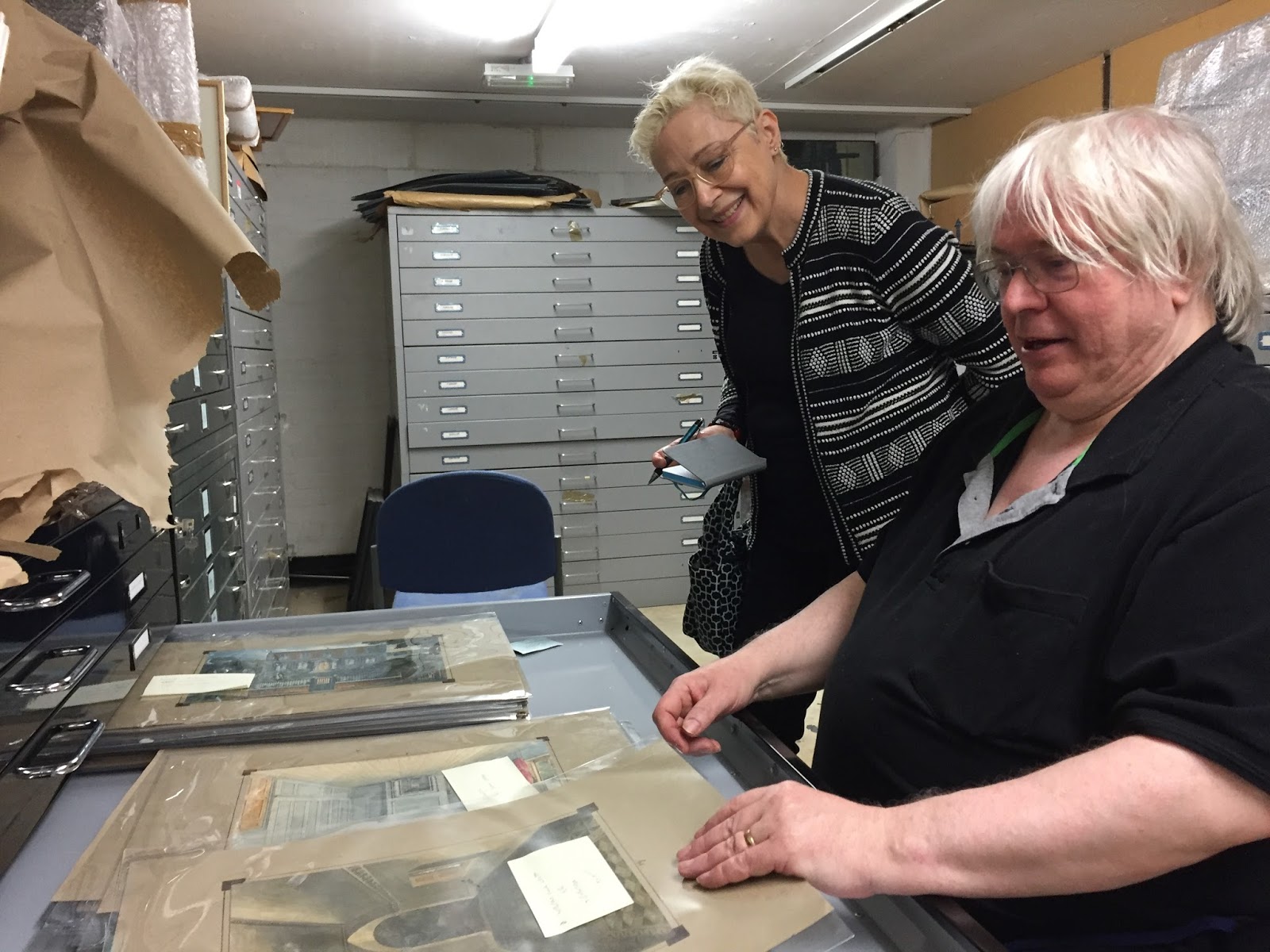
The archives of the Kensington Central Library contains, among numerous other materials, an immense collection of art.  Dave Walker, archivist + librarian, showed us dozens and dozens of prints, drawings, and paintings. I called Hold on a few, so we could photograph them.

Regency aficionados will recognize the Temple of Concord, which stood in the Green Park for a time. The 1814 Annual Register describes the festivities the Prince Regent put on to celebrate "Peace restored under the Regency"--which morphed into a celebration of  the centenary of the Hanoverian dynasty.  Apparently, the fireworks display at the Temple of Concord was spectacular. Also, unfortunately, it appears that the Temple exploded at some point.  Fortunately, we have this and a number of other images as a reminder of how wonderfully fanciful and colorful the Regency could be.


Tuesday, January 10, 2017

Fashions for January 1801

Tuesday, January 10, 2017


Morning Dress 1801
Loretta reports:
We’ll kick off the 2017 monthly fashion plates by returning to the beginning of the 19th century—and incidentally get a lesson in differences in digitization technology. The first plates and the description are from a Google scan of the New York Public Library’s copy of The Lady’s Monthly Museum for January 1801. They look like the work of an inept artist, don’t they?

Afternoon Dress 1801
Now let's look at the last image, which came from the Los Angeles County Museum of Art’s online collection. This is the same “Afternoon Dress” fashion plate as above, but what a difference! (Unfortunately, I haven’t been able to find a high quality counterpart to the Morning Dress plate.)

Afternoon Dress
Many libraries have fine images like this of fashion plates. The trouble is, in most cases—as I’ve complained repeatedly—all we have is the plate. The rest of the magazine, including the description, is who knows where.


Let's hope that the magazines Google digitized in the early days haven't been destroyed, and will one day be re-scanned using improved technology.

Images, from The Lady’s Monthly Museum Vol 6 Jan-June 1801 courtesy Hathi Trust. Second Afternoon Dress image courtesy Los Angeles County Museum of Art.


Clicking on the image will enlarge it.  Clicking on the caption will take you to the source, where you can learn more and enlarge images as needed.

Tuesday, September 20, 2016

Andrew Carnegie & His Libraries

Tuesday, September 20, 2016
Punch cartoon
Loretta reports:

Andrew Carnegie was one of those rich guys who ended up giving away something close to 90% of his money. This would still leave a large chunk of change, because he was extremely rich, one of the richest Americans of all time.

One of his methods for unloading his money was building libraries. A lot of libraries. I knew nothing about Carnegie libraries until my husband, after one of his photographic expeditions in Worcester, MA, told me the city had three of them. This entry in the The Hitchhiker’s Guide to the Galaxy; Earth edition, explains what they were and the conditions Carnegie required the town to meet.
Greendale Branch
If you scroll down this page of the Worcester Public Library site, you can read the vital statistics about our three Carnegie-funded branches.
Greendale Branch detail
Mr & Mrs Carnegie attended the cornerstone layings of all three libraries, as described here. I loved that, having come unprepared for a cold, raw, Worcester day, Mr. Carnegie stopped at a store to get rubbers. Here’s more about that day, complete with illustrations and links. It’s well worth reading, for a glimpse into the past, and some idealism we could use today.
South Worcester Branch
The Greendale Branch, now renamed, is still a library.
The Quinsigamond Branch is now part of a school.
The South Worcester Branch has been converted to private residences.
South Worcester Branch detail
Is there a Carnegie Library in your town? Look around. You might be surprised, as I was.


Tuesday, July 12, 2016

Gothic Library for July 1813

Tuesday, July 12, 2016
Gothic Library July 1813
Loretta reports:

I tend to set many scenes in libraries, for all kinds of reasons. Libraries in great houses can be cozy or vast. By the Regency, and certainly by the time of my stories, people are spending more time in them, reading, looking at maps, drawing, writing letters, or simply using it as a family den—“a room of usual resort” as the description puts it. In my searches online, I’ve found libraries of all shapes and sizes. They might contain a greater variety of furniture than other rooms. And then, I like the idea of surrounding my characters with books.
Library description
This gothic-looking library is a follow up to the previous month’s architectural feature You can read the “observations contained in the Repository of last month” here.

The image, not as interesting, I think, as July’s, is here.

Library description cont'd


Clicking on the image will enlarge it.  Clicking on the caption will take you to the source, where you can learn more and enlarge images as needed.

Thursday, February 18, 2016

Pitt's Cabinet Globe Writing-Table of 1810

Thursday, February 18, 2016
Cabinet Globe Writing-Table
Loretta reports:

Looking into catalogs of early 19th century furniture, I’m always struck by the number of multi-purpose items. We’ve shown some of these articles in previous posts. (Here,  herehere, and here are some examples.)

For me, Pitt’s Cabinet Globe Writing-Table epitomizes this “high degree of ingenuity ... displayed by British artists,” as well as the “elegance and usefulness” so highly prized in the time before Form Follows Function and Less Is More.

Sometimes I wonder whether less is simply less.

Cabinet Globe description

Description continued
Clicking on the image will enlarge it.  Clicking on the caption will take you to the source, where you can learn more and enlarge images as needed.

Thursday, April 2, 2015

A Brilliant Starry Messenger, 1783

Thursday, April 2, 2015

Isabella reporting,

The night sky is unfamiliar territory to most modern Westerners. A sky filled with stars and planets that was once so familiar for telling time and location is today lost in the brightness of electric lights. Rare celestial events like comets, meteors, and fireballs are relegated to a passing notice on the Weather Channel (or worse, in a song by Pitbull.)

But to our ancestors, the sight of an unexpected ball of fire shooting across the heavens was a strange and unsettling thing, a divine portent of a coming war or the downfall of a king. Starry Messengers: Signs and Science from the Skies is the name of a wonderful exhibition currently on display at Harvard University's Houghton Library, and features examples of how early modern scientists, artists, and writers tried to explain and understand the stars and skies above. The exhibition runs through May 2, and is free and open to the public; click here for more information, and also watch the excellent short video here.

I was particularly fascinated by the story that accompanied these two images on the exhibition caption:

"On the evening of August 18, 1783, a fireball streaked across the British night sky, breaking up in the atmosphere and vanishing over the course of a minute. The summer heat meant there were a number of observers outside at the right moment. Remarkably, a gathering on the terrace of Windsor Palace included both the physicist Tiberious Cavallo and the artist Thomas Sandby, each of whom recorded the event in his own way; Cavallo in the pages of the premier scientific journal of the time, and Sandby in a beautifully atmospheric painting of the event, turned into a hand-colored etching by his brother Paul."

The illustration, right, that accompanied Cavallo's scholarly account in Philosophical Transactions of the Royal Society in 1784 no doubt explained the stages of the fireball's self-destruction to his learned readers. However, the Sandby painting, above, (click on the image to enlarge it) captures the magic of the event, showing a group of party-goers turned celestial observers gazing up into the sky from the terrace. Unlike some of the earlier illustrations in the exhibition that show people recoiling in fear from comets, these individuals are calmly regarding the fireball with true Age of Reason solemnity.

I like that Sandby included two well-dressed women in the group, and that they are watching solemnly, too, without any signs of female hysterics or fear. What did they make of the sight, I wonder? They certainly weren't going to report their reaction to the Royal Society; women were not admitted as Fellows to that august group until 1945. Did they rush to tell their friends and family and mantua-maker the next day? Did they write letters describing what they'd witnessed? Did they rely on the men around them for explanation(that one fellow pointing his hand was probably a know-it-all), or were they sufficiently educated themselves to understand what they were seeing?

Alas, no one knows. But don't be surprised if a heroine in one of my next books happens to be walking on the terrace of Windsor Palace on a warm August night....

Many thanks to John Overholt and Andrea Cawelti for their assistance with this post, and for my tour of Houghton Library; I am still in a blissful Nerdy History Girl daze.

Above: To Sir Joseph Bankes, President of the Royal Society, London, this plate, from motives of respect and esteem, is inscrib'd. London: P. Sandby, 1783.
Right: Royal Society (Great Britain), Philosophical transactions, 1784.
Both from the Houghton Library, Harvard University. Images via Houghton Library.

Thursday, October 17, 2013

A Stylish Paper Shopping Bag, c. 1850

Thursday, October 17, 2013
Isabella reporting,

While stores and shops have been around since ancient times, it wasn't until the late 18th c. that "shopping" became a verb, an activity that began to acquire as much importance as the object being purchased.

The Industrial Revolution created not only many more items available for purchase, but also a middle class full of customers with money to spend. Advances in printing technology also led to more imaginative ways for shopkeepers to advertise their wares. By the middle of the 19th c., savvy merchants were beginning to offer paper bags printed with their shop's names and addresses, a kind of walking advertisement that's still popular with today's shoppers in the local mall.

The early printed paper bag, left, from the 1850s is a rare survivor. The pleated-bottom bag must have carried home some sort of tasty treat: it came from a combined cook, confectioner, and caterer in Stamford, Lincolnshire, UK, who also promised "full-licensed dining and refreshment rooms."

But the illustration on the bag adds much more. A group of elegantly dressed ladies and gentlemen (plus a few equally well-dressed children) are shown playing croquet on the lawn of Burghley House, a grand Elizabethan country house built by Sir William Cecil, later Lord Burghley, and later the ancestral seat of his descendant, the Marquess of Exeter. The other side of the bag is printed with the romantic poem The Lord of Burghley, by Alfred, Lord Tennyson, to further reinforce the connection.

Decorating a humble paper bag with an image of a nobleman's home might simply have been civic pride, for Burghley House is the most spectacular landmark near Stamford. But it might also be an early example of "aspirational" marketing, implying that the sweets inside the bag will magically confer on the customer a bit of the elegant life shown on the outside.

This bag is from the Kislak Center for Special Collections, Rare Books and Manuscripts at the University of Pennsylvania Libraries, and is included in their current exhibition of recent acquisitions (through December 13, 2013). Their blog post highlights some of the other fascinating items included in the exhibition, from a 1926 Tent Revival Banner to a 15th c. genealogical chronicle that's 37 feet long, and traces the Kings of England all the way back to Adam and Eve.

Many thanks to Mitch Fraas, Bollinger Fellow at the University of Pennsylvania Libraries, for his assistance with this post.

Above: Paper Bag: J.T.Holmes, (Late Dawson) Cook, Confectioners, & Public Caterer, Full-Licensed Dining & Refreshment Rooms, 7, St. Mary's Street, Stamford. Birmingham: Martin Billing, Son and Co., Printers, c. 1850s. Rare Book & Manuscript Library, University of Pennsylvania.

Wednesday, June 15, 2011

The Big Bad City Tempts Young Men, 1849

Wednesday, June 15, 2011
Susan reporting:

Just as the country has traditionally represented a pure and wholesome life, cities everywhere are most often depicted harboring sin and wickedness on every street corner. As the focus of the 19th c. American economy shifted away from farms to factories, young men became increasingly eager to leave rural homes for the proverbial bright lights of the big city. Cautionary tracts were quick to appear, doubtless far more popular with worried parents than ambitious youth. The warning below comes from The Temptations of City Life: A Voice to Young Men Seeking a Home and Fortune, in Large Towns and Cities (New York, 1849):

"On almost every corner, some saloon brilliantly lighted, opens its attractive portals. It is furnished on a scale of the richest luxury, with splendid mirror, costly divans, easy lounges, and tables covered with late journals and pictorial works. Paintings of great artistic merit, arranged on the walls, and exhibiting the nude and seductive forms of female beauty, appeal to the ardent passions of youth; and corresponding music in sweetest strains steals upon his senses. Often, to add to the attractions of these places, varying entertainments, of the buffoon, danseuse, and the ballad-singer, are furnished. Captivated by such scenes, unsuspecting youth repeats his visits, finds other similar resorts, and finally is in the habit of being abroad every night, and is found at his boarding-house only for his meals and late lodgings. He visits all the distinguished saloons, refectories, bowling-alleys, theatres, gambling-hells, and other abodes of affiliated infamy."

As we've written here before, old diaries and journals are finding their voices (and readers) thanks to the new social media. I discovered the above excerpt on the blog of the American Antiquarian SocietyWorcester, MA; the Society is currently publishing a 19th c. daily diary in their collection in its own blog. Clerk and the City: A Young Man's Search for Love & Culture on the Streets of Philadelphia features an annotated entry each day from Nathan Beekley, a young clerk in 1849. Nathan seems to find the big bad city a quite sociable place, since his entries often include "the pleasure of seeing" various young ladies, and he seems much more interested in them than his job. Fun reading for us history nerds! You can also follow Nathan on Twitter, @TheIronClerk.

Above: Unknown Young Woman Lacing Her Corset, c. 1890

Tuesday, January 18, 2011

Fashionable library table for January 1814

Tuesday, January 18, 2011
Loretta reports:

Since they're usually rich and upper class, my characters tend to live in large houses.  I plant my dukes in a fictional version of Norfolk House or Northumberland House—buildings that occupied large chunks of London real estate.  In the country, their domiciles are the fictional counterparts of Derbyshire’s Chatsworth or Hardwick Hall.  If your library measures, say, 30 X 50 feet, with built-in shelves, you don’t have to worry all that much about where to put the books.  Nor do you fret about fitting in a set of the latest mode in furniture for reading or writing or staring into the fire thinking shallow or deep thoughts, according to your inclinations.

But a great many people, including celebrities like Beau Brummell and Lord Byron, lived in lodgings. For them and others living in smaller quarters, furniture designers exercised their ingenuity.

Above is s a piece of fashionable furniture from January 1814.
~~~
The chaste and elegant library table represented in the annexed engraving, is of a convenient form and moderate size, and is suited to an apartment of small dimensions:  at the same time it exhibits that breadth of parts and greatness of design, which characterize most articles of modern furniture, and give a dignity heretofore unknown.  The recess beneath renders it also extremely commodious for a writing table, which was not the case with the library tables formerly constructed.  The chair is designed with equal attention to elegance and convenience, and made to correspond.  They may both be formed of mahogany, with rings and ornaments of bronze; the shelves of the table will divide, so as to admit either a row of folios and octavos, or two rows of quartos.
~~~

Excerpt from Rudolph Ackermann’s Repository of arts, literature, commerce, manufactures, fashions and politics, for January 1814, Vol. XI, 1814.

Monday, June 14, 2010

Jane Austen Crosses Out!

Monday, June 14, 2010
Susan reporting:

Yes, Loretta and I are both writers, but we don't like to write about writing. While we're here, we'd rather be Nerdy and Historically Inclined, and besides, the actual act of writing a book is not terribly thrilling for bystanders.

Except, of course, when the book-writing is being done by Jane Austen (1775-1817).

I've already mentioned here (and here) how more and more rare books and manuscripts are being made available on line. Not only does this wonderful trend free these works from the confines of rare book rooms for a much wider audience, but it also helps safely preserve the originals for posterity.

Certainly this is the case with Jane Austen's Fiction Manuscripts, a three-year funded project of the University of Oxford and King's College London. Here is the formal explanation of the project, in polysyllabic scholar-ese, but the gist is wonderfully simple: to create a digital resource that offers all of Jane's handwritten manuscripts on line, page by page, with transcriptions beside them.

I can't begin to explain how much I love this. As a reader, it's fascinating to see how a familiar story evolves, how sentences and characters were changed by the author. But as a writer,  it's empowering as well, this astonishing chance to peek over Jane's own shoulder as she sits at her desk. Consider this page, the beginning of Chapter Ten of Persuasion, my favorite JA book. Cross-outs and insertions, scribbles and abbreviations and over-writing: all proof that those wonderfully perfect words didn't spring fully-formed and complete, but were wrestled with considerable thought and effort into final submission.

And yes, Jane, seeing that effort only makes me admire you more....:)

Many thanks to Michael Robinson for suggesting this link.

Sunday, April 18, 2010

Lost Lady Writers Found

Sunday, April 18, 2010
Susan reports:
There's much talk of e-books in publishing these days, and of how the format will affect writers. But for long-forgotten writers,  e-books and books on-line offer a literal life-line to modern readers, and their only chance to be rescued from dusty obscurity.

Women writers of the past are among the most neglected. While everyone knows Jane Austen, there were many others who were dismissed as "scribblers" in their time, and ignored by ours. Fortunately, there are libraries determined to change this. One of the more noteworthy is the Chawton House Library, whose mission is to promote the study and research of early English women writers. (It's a splendid coincidence that the beautiful Chawton House was also the home of Jane Austen's brother.)

The library's collections focus on writers from 1600-1830, and slowly but surely, they are putting more and more of these collection on line. How about dipping into The Princess of Cleves (1777) by the extravagantly named Marie-Madeleine Ploche de la Verne La Fayette? Or Paris Lions and London Tigers (1825) by Harriette Wilson, better known for her less literary endeavors?

Of course I had to check out the irresistibly titled Romance Readers and Romance Writers: a Satirical Novel (1810).  The author, Sarah Green, is long neglected, but unjustly, as the opening paragraph shows:

"It is very strange," said Uncle Ralph, with evident impatience and vexation, as he threw down on the table with great force a romance of the last century, "that a writer must use so many words, only to tell us, that a woman got up and sat down again! No, they must inform us in high-flown-poetic language, that she rose from her mossy couch, and then thoughtfully reseated herself, and resumed her pensive posture! and then, if the wind happened to blow her thin clothes about, and made her ribbons flutter and fly, we must be entertained through half a page with her silk scarf floating in the wind and the rude zephyr discomposing her light and nymph-like attire!"

Personally, I'm hoping for the on-line version of another of Mrs. Green's novels: Scotch Novel Reading; or, Modern Quackery; a Novel Really Founded on Facts (1824).

Above: Mrs. Richard Bennett Lloyd by Sir Joshua Reynolds, c. 1775. Mrs. Lloyd elegantly carving her husband's name into the bark of the tree makes for a beautiful painting, if not for a very accurate one of a lady writing (though I doubt even Sir Joshua could make great art of a current lady-writer, hunkered down over her laptop.) But we'll let it stand in for Ms. Green, for whom, alas, I could find no portrait.
Digression alert: Mrs. Lloyd's picture, however, does turn up in the work of another, more famous women writer. In The House of Mirth by Edith Wharton, heroine Lily Bart scandalously chooses to recreate the painting as a tableau vivant at a late 19th c. house party: "Deuced bold thing, to show herself in that get-up." 
 
Two Nerdy History Girls. Design by Pocket