Saturday, March 31, 2012

Breakfast Links Week of March 26, 2012

Saturday, March 31, 2012
Served up fresh for your browsing delight: our favorite links of the week to other blogs, web sites, pictures, and articles, collected from around the Twitterverse.
• Brief history of royal barges, including Eleanor of Provence's being pelted with stones from London Bridge in 1263.
• The onager, a fabulous beast, and symbol of the devil, who brays 12 times on the spring equinox.
• Artist at the window: 18th c French painter Marie Victoire Lemoine.
• Who was Casanova - history's greatest lover, a cad, or a misunderstood intellectual?
• Breathtaking pink silk satin evening gown by Liberty c 1910 - esp. like the open sleeves & tassels.
• An "angel in a top hat" or "a great meddler"? Henry Bergh (1813-1888) inspiring founder of ASCPA.
• Few artists are as sharply cruel as caricaturist James Gillray: his 1807 take on Lady Hamilton, "greatly enlarged."
• The original "Mad Men" office building 1957.
• Rare archival photographs of everyday life on board the Titanic by fortunate passenger who disembarked early.
• Who killed Alexander the Great? New theories about his death.
• Grim way of punishing outspoken women in the 16th-17th c: the scold's bridle.
• The education of an 18th c squire: John Wilkes (1725-1797.)
• The donkey born in a First World War trench that became a mascot for British troops.
Caroline, Byron, and Annabella, in the same house on the same "fatal day."
• So cool! Virtual tour of Victorian chemist shop at Hitchin Museum.
• Garden history: 19th c White House gardens and grounds.
• A view of London: Tottenham Court Road, 1812.
Self-Murder: The Sad Case of Mary Hunt (1767-1792.)
• An unusual Italian Renaissance mansion on NYC's Upper East Side survives relatively unchanged.
Fannie Farmer & Cooking: fantastic list/links of historical cooking & recipe sources.
Automaton: The Turk-The Grandmaster Hoax.
• "The wisdom of Solomon"and a stone pyramid, in the yard of a Hawksmoor church in London.
• Elegant black lace mitts from 1830s, not 1980s.

Friday, March 30, 2012

Friday Video: Buster Keaton in the ring

Friday, March 30, 2012
Loretta reports:

I've incorporated early 19th C gentlemen's fondness for fisticuffs in several of my books.  For an idea of what boxing was really like back then, take a look at Georgian Boxing at Horrible Histories.


Fortunately for the squeamish, we don't have actual Regency era fisticuffs recorded on film—but here's Buster Keaton, my favorite silent film actor and comic genius, demonstrating his brilliance in the ring.


Cruikshank illustration from Pierce Egan's Life in London, 1821

Thursday, March 29, 2012

Are These Marie-Antoinette's Shoes?

Thursday, March 29, 2012
Susan reporting:

Some things from the past are valued for their intrinsic worth (a diamond ring, set in gold) while others become valued for what they represent (the original Declaration of Independence) or who created them (any painting by Rembrandt.)

These 18th c mules, left, don't fall into any of those categories. They're faded and worn, they're not remarkable in design from many other surviving 18th c women's shoes, and their maker is long since forgotten. But because they were said to have been worn by the French Queen Marie-Antoinette, they recently were sold at auction in Toulon, France for a staggering 43,225 euros, or $54,800 - far exceeding the pre-sale estimates of 3000-5000 euros.

The provenance (history) of the shoes is unsubstantiated, and even the auction organizers admit that the pair only "may" have been worn by the queen. The main evidence seems to be that they're the same size (about a modern 36.5) that Marie-Antoinette is known to have worn. They're also reputed to have been worn to the Fete de la Federation on July 14, 1790, marking the first anniversary of the storming of the Bastille. While the first Fete was supposed to be celebrating the establishment of a constitutional monarchy in France, in time it came to be called Bastille Day, a holiday with very different connotations that supporting any sort of monarchy.

Even if none of this is true, there's an undeniable poignancy to the idea of these white silk shoes with their much-faded tricolor pleated ribbons being worn by Marie-Antoinette. None who attended that long-ago celebration could have imagined the horror of the coming years in France, or the significance that the tricolor ribbon would acquire. As symbols go, these shoes have it all: white silk mules with high heels perfectly exemplify the "let-them-eat-cake" decadent luxury of the ancien-regime, while the tricolor ribbon adds that innocent yet tragic foreshadowing. Just like the questionable legend that these shoes belonged to Anne Boleyn, another doomed queen, it's the story that gave this pair their value - all $54,800 worth.

Wednesday, March 28, 2012

A Sunday Visit to Hyde Park in 1835

Wednesday, March 28, 2012
Loretta reports:

Following is an excerpt from Sketches from Real Life, published in The Court Magazine in January 1835.  The entire piece is interesting reading, & you might have fun guessing which people the initials & dashes & asterisks refer to.
~~~
We will enter Hyde Park by the gateway of the beautiful screen we have just glanced at . . .It is Sunday ; and we are accompanied on our entrance by streams of well dressed pedestrians, throngs of well mounted cavaliers, and strings of well appointed equipages, all tending to the same point of popular attraction, — the northern portion of that irregular shaped Ring which it is now our business to describe, with all its extraneous chasing, and all those temporary adjuncts which it wears so profusely on this its weekly jour-de-fĂȘte.

On first passing through the Screen which separates Hyde Park from the point of junction between the western extreme of Piccadilly on the one hand, and the great western road on the other, we find ourselves in an angular area, of irregular shape, and branching off, on the left, into two long and spacious carriage roads, running parallel with each other to an extent that (in our misty metropolitan atmosphere) the eye can scarcely take in. To-day these two roads are enlivened at intervals, "few and far between," the one on the left by various unpretending equipages, rolling steadily along in both directions, as if willing to avoid the vulgar noise, bustle, and dust of the public road on the one hand, and the aristocratic gaiety and splendour of the crowded Ring on the other. . .
 
The other still broader and more stately road,* running parallel with that just referred to, finds its spacious solitude enlivened by a few quietly disposed equestrians alone: for carriages are interdicted there, save those of royalty itself, and of one favoured exception, His Grace the High Falconer of England . . . Certain it is, his Duchess does not fail frequently to avail herself of this imaginary approximation to royalty. Nor can we blame her for so doing. To pay a hundred thousand a year for a turnpike ticket entitling one to travel the eight furlongs of "royal road," between Kensington and London, and then not to use the privilege, were a superfluous piece of magnificence. The Court Magazine and Belle Assemblée, 1835

*Rotten Row

Illustrations:  
1833-Smollinger-Hyde Park section of "Improved map of London for 1833, from Actual Survey. Engraved by W. Schmollinger, 27 Goswell Terrace." (with my notes)

Rotten Row and Hyde Park Corner, London, England, between ca. 1890 and ca. 1900, courtesy Library of Congress Prints and Photographs Division Washington, D.C. 20540 USA

Tuesday, March 27, 2012

More Fashions for the Gentleman: 1700 vs. 1800

Tuesday, March 27, 2012
Susan reporting:

Loretta's post yesterday about poufy pants set me to thinking of other masculine fashion foolishness. Modern men are often let off the hook regarding fashions, as if they're somehow above that particular frivolity - or, others would argue, far beneath it. But in the past men had no qualms about playing the peacock and following fashion, even to its most extreme.

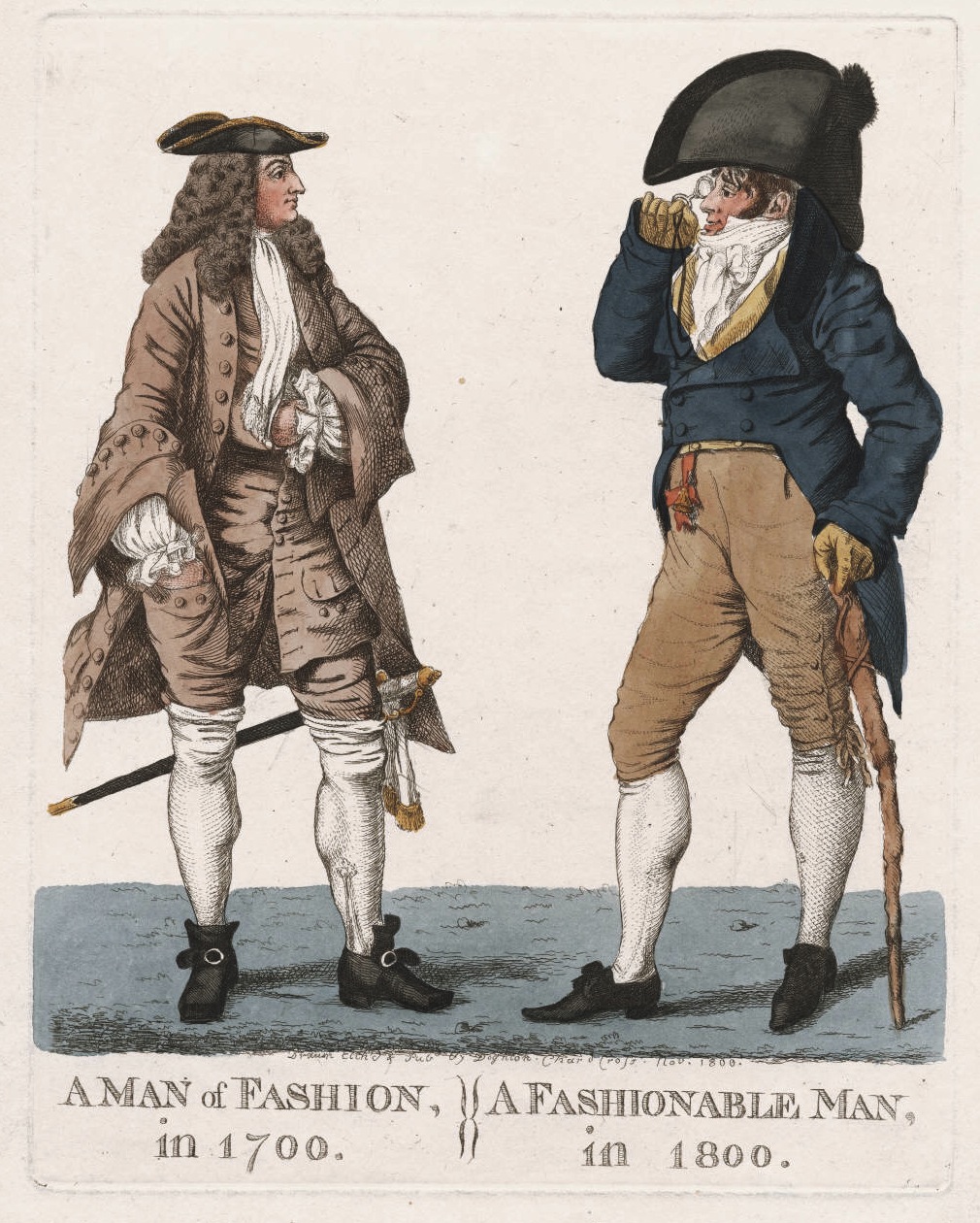
This print, left, is one of my favorites. (Click on the image to enlarge.) A century separates these two stylish English gentleman, a hundred years of evolving styles. Yet unlike most caricatures of male fashion (like our old friends Son Tom and the Young Macaroni), the attire of these two gentlemen isn't really exaggerated for their times. Judging by portraits of their respective contemporaries, both of these men could have walked down a London street without anyone turning to gawk – except perhaps at their handsomeness.

In addition to their clothes, I also like the men's different affectations. The difference between clothes and fashion often lies in the accessories, and what the wearer chooses to reveal of himself along with his taste. The earlier gentleman displays his studied nonchalance by tucking one hand in his open waistcoat and the other in his pocket. His wig is a virile mane, his stockings are purposefully slouchy, and he wears his sword – always ready to defend his honor  – hung impractically low (reminding me of how low certain rock stars will likewise sling their guitars.)

The later gentleman has traded a sword for a romantically rustic walking stick. Instead of the earlier nonchalance, this fellow is scrupulously tailored, his stockings and breeches snug-fitting and his neck cloth tied just so. At his waist are dangling seals with antique cameos, demonstrating his (possible) knowledge of antiquity. He wears his own hair instead of a wig, though the over sized cocked hat cancels that out. With his quizzing glass at the ready, he's prepared to examine the world instead of challenging it with a sword.

One more thing to note: in light of last week's post about wearing the proper socks, both gentlemen are wearing stockings with clocks – the decorative designs running vertically over their ankles.

Left: A man of fashion in 1700: A fashionable man in 1800, drawn, etched & published by Dighton, Charg. Cross, London, 1800. Copyright Lewis Walpole Library, Yale University.
 
Two Nerdy History Girls. Design by Pocket