Showing posts with label transportation. Show all posts

Tuesday, October 16, 2018

The Omnibus Comes to London

Tuesday, October 16, 2018
 Loretta reports:

Last year, during my visit to the London Transport Museum, I encountered a form of public transportation I hadn’t paid much attention to previously.

The omnibus was first introduced in Paris, and it was a Parisian coach-builder, George Shillibeer, who brought the concept to London.
“The route which Shillibeer chose for his first omnibus was from the Yorkshire Stingo at Paddington, along the New Road to the Bank. The New Road was the name by which Marylebone, Euston and Pentonville Roads were then known.

 ... On the morning of July 4, 1829, Shillibeer's two new omnibuses began to run. A large crowd assembled to witness the start, and general admiration was expressed at the smart appearance of the vehicles, which were built to carry twenty-two passengers, all inside, and were drawn by three beautiful bays, harnessed abreast. The word "Omnibus" was painted in large letters on both sides of the vehicles. The fare from the Yorkshire Stingo to the Bank was one shilling; half way, sixpence. Newspapers and magazines were provided free of charge. The conductors, too, came in for considerable notice, for it had become known that they were both the sons of British naval officers—friends of Shillibeer. These amateur conductors had resided for some years in Paris, and were, therefore, well acquainted with the duties of the position which they assumed. The idea of being the first omnibus conductors in England pleased them greatly, and prompted them to work their hardest to make Shillibeer's venture a success. They were attired in smart blue-cloth uniforms, cut like a midshipman's; they spoke French fluently, and their politeness to passengers was a pleasing contrast to the rudeness of the short-stage-coach* guards—a most ill-mannered class of men. Each omnibus made twelve journeys a day, and was generally full.”
— Henry Charles Moore, Omnibuses and Cabs 1902
Though his omnibus was a success, Shillibeer contended with fierce and often unscrupulous competition and the NIMBY inhabitants of Paddington Green—although “the threatened doom of Paddington Green did not deter the sentimental poke-bonneted young ladies, who resided in the charming suburb, from spending a considerable amount of their time in watching the omnibuses start. In the middle of the day many of them were in the habit of taking a ride to King's Cross and back, for the sole purpose of improving their French by conversing with the conductors.”

Anecdotes like this abound, including tales of theft by the paid conductors who soon replaced the gentlemen. Since space doesn’t permit me to quote at length, I recommend you read at least Chapter II of the first part for yourself.


*Short-stage coaches, which had been in existence from the mid-18th century, ran—slowly, expensively, and unpunctually—from the suburbs to the City and the West End.

Images: Photos of Loretta in omnibus at London Transport Museum, View of Exterior London Transport Museum Omnibus, and Announcement Marking the End of the Omnibus Era taken at London Transport Museum, copyright © 2018 Walter M. Henritze III.

Clicking on the image will enlarge it. Clicking on a caption link will take you to the source, where you can learn more and enlarge images as needed.

Monday, September 24, 2018

The Landau Carriage

Monday, September 24, 2018
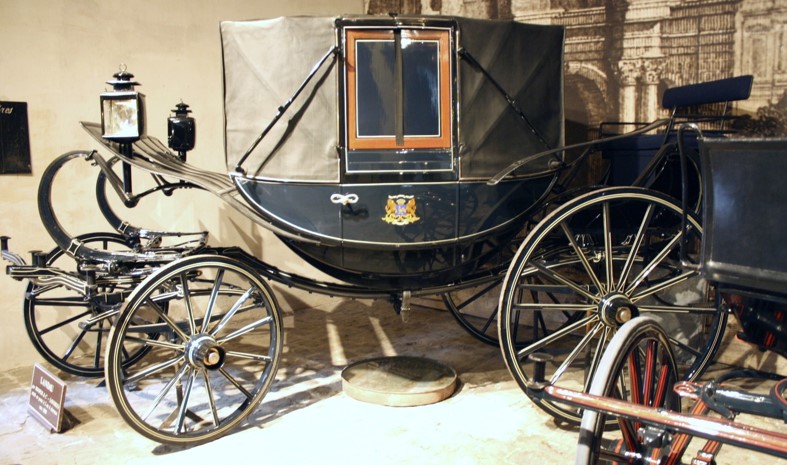
1809 Landau
Loretta reports:

My characters get from here to there in various horse-drawn vehicles, but mainly I've posted about public transportation, like hackney cabs and coaches. Privately owned vehicles have been rather neglected, although I do offer images on my Pinterest page.

In A Duke in Shining Armor, the heroine arrives in a landau to collect her wayward duke. The landau was a coachman-driven vehicle, pulled by two to four horses. It carried four passengers, and was more luxurious than the curricles and cabriolets that dashing heroes tend to drive in our stories. The latter are more like sports cars. The former are more like luxury sedans.

Something to bear in mind: Unlike today, vehicles did not come off an assembly line. They were individually made, and the owner might have been closely involved in the design.* Consequently, not all landaus look alike. Earlier ones were often built on square lines, but not always, as the 1809 Ackermann illustration, above, shows. Some interesting aspects of the landau, as pointed out here, are the seating design, allowing the two pairs of passengers to face each other, and the two folding hoods. According to Discovering Horse-Drawn Carriages, “In the early days, the hoods were made of harness leather and fell back a mere forty-five degrees.” When these early hoods were up, the interior could be hot, stuffy, and smelly, thanks to the oil and blacking used to keep the leather nice and shiny. In later vehicles, the hoods folded back flat.
Square Landau

A much later and fancier vehicle, one of the royal family’s Ascot landaus, was the carriage the Duke and Duchess of Sussex (aka Harry & Meghan) used for their wedding.

Here’s a late Victorian landau from the Horse and Carriage Museum Château de Vaux-le-Vicomte, France. And this is one you can buy.

You can read more about landaus here at All Things Georgian.

*This is why some vehicles, like the Stanhope gig, are named after people.

Images: Patent Landau, Ackermann’s Repository, February 1809; Square Landau, NEN Gallery, Luton Culture Museum Service.

Clicking on the image will enlarge it.  Clicking on the caption will take you to the source, where you can learn more and enlarge images as needed. And just so you know, if you order an item through one of my posts, I might get a small share of the sale.

Monday, July 30, 2018

Happy 155th Birthday, Henry Ford

Monday, July 30, 2018

Loretta reports:

Today, 30 July, is automaker Henry Ford’s birthday. I’ve shown you some parts of the Fort Myers, Florida estate he shared with inventor Thomas Edison, here, here, and here.

I’ve also pointed out the way that the motorcar was quickly adopted for long-distance travel, even though the cars broke down frequently, roads could be little more than wagon tracks, and gas stations and auto mechanics were unheard of. But none of these obstacles stopped Americans from getting on the road and going—either on cross-country races or south, for warmer weather. With the advent of affordable autos came the Snowbirds—the Tin Can Tourists I posted about here and here.

All the same, I didn’t really know much about Ford beyond what little we learned (and mostly forgot) in school, back in the last century, about U.S inventors and innovators.

But I happened on this feature (please scroll down to the second article) at the Library of Congress site, which puts Ford and his world into perspective. Along with songs and recollections, it also provides an early film of an automobile parade—which was probably not the horse’s favorite experience that day.
First & ten millionth Ford 1924

Sharp-eyed readers will note the “Ford Song” by one “A. Flivver, composer.” Flivver is early 20th century slang for an automobile.

Images: Photo above left 1919 Model T at Edison-Ford estate, Photo copyright © 2018 Walter M. Henritze III.  At right,  First and ten millionth Ford (1924), courtesy Library of Congress Prints and Photographs Division Washington, D.C. 20540 USA. 
Clicking on the image will enlarge it.  Clicking on the caption will take you to the source, where you can learn more and enlarge images as needed.

Thursday, February 15, 2018

Thames Watermen & Their Wherries

Thursday, February 15, 2018
Thames Waterman—circa 1825
Loretta reports:

By 1833, the time of A Duke in Shining Armor, it would have been simple enough for my hero and heroine to get on a steamboat to continue upriver from Battersea Bridge. I decided to put them on a wherry instead. The chances of mishap on either vessel were good: Steamboats exploded, and wherries overturned or lost passengers overboard. And of course, I’m always looking for ways to make my characters’ lives difficult.

The wherries, about which I knew next to nothing, however, were aesthetically pleasing, and turned out to have a long history, while the watermen had a distinctive character.
“As may easily be imagined, they formed very much of a caste by themselves… They were a rough, saucy, and independent lot, if we may judge from allusions to them which occur in the novels, comedies, farces, and popular songs of the last century.”Old and New London Vol 3
Thames Wherries, Richmond 1829
As to their vessels:
Thames Wherries.—Of all wherries in the world, none are so beautifully modelled or so light and graceful as the "trim-built wherries" of the Thames. They are constructed upon the most scientific and approved lines; the numerous boatbuilders daily endeavouring to outvie each other. These boats are truly a pattern for all nations, and are the especial admiration of foreigners, particularly the smaller craft, adapted for a party of five or six. They have a beautiful sharp bow, with graceful proportions, carrying the beam well aft, or gradually flaring from the bows, and finishing with a neat tapering stern: a chair rail, for a support to the back, is prettily arranged round the stern-sheets, where the company sit.  —H.C. Folkard, Esq., The Sailing Boat 1863 3rd ed
Rowlandson, Thames Watermen 1807
Though I found images of wherries with a top covering, like the one described in the book, only recently did I come upon the term for these boats: “By a 'tilt' boat of course is meant a boat with a covering." —Old and New London Vol 3. Or, as the OED describes it: "tilt-boat n. [SE tilt-boat,] ‘a large rowing boat having a tilt or awning, formerly used on the Thames, esp. as a passenger boat between London and Gravesend."

Clicking on the image will enlarge it.  Clicking on the caption will take you to the source, where you can learn more and enlarge images as needed.

Monday, December 4, 2017

The Invalid Chair in A Duke in Shining Armor

Monday, December 4, 2017
Mechanical Chair
Loretta reports:

The basics of this post appeared a few years ago, as Merlin's Mechanical Chair. Clearly, the ingenious device stuck in my mind, because it ended up playing an important role in A Duke in Shining Armor.

The trick was figuring out how the thing worked. In the first place, early 19th century prose can be very hard to follow. It tends to be much less direct than our way of writing. In the second place, my brain is easily confused by physics and mechanics. Doubtless it took me a lot longer to learn how to drive this chair than it did the Duke of Ripley, in my book. I will leave it to you to read the instructions and make what sense of them you can.

Meanwhile, let us consider for a moment the commentary that follows the instructions. "Amusement"? Oh, yes, I figured that one out pretty quickly. But the suggestions for running the chair by means of a "very small and portable steam-engine" remind me of the way some people used to imagine us flying around on individual rocket-propelled devices in The Future. Having a 19th C steam engine powering my chair does not strike me as a safer prospect.

And then there's the idea of finding a way "to enable it to carry a small cannon, which should be, both for itself and its operators, completely unassailable by the enemy, as well as, by the singular rapidity of its evolutions, terribly and unusually destructive." Is your hair standing on end? Mine sure is. But let us remember that Great Britain was at war with Napoleon in 1811, and things weren't going so well. At home, people carried on with their lives, but that didn't mean they weren't aware of what was happening on the Continent, or didn't take seriously the possibility of invasion. As it turned out, Napoleon continued to be a danger until June 1815.

By the time of my story (1833), however, that's all in the distant past, and the chair is perfoming its dual functions of serving those with limited mobility as well as providing amusement.
Mechanical chair described


Mechanical chair described


Clicking on the image will enlarge it.  Clicking on the captions will allow you to read at the source, where you can learn more and enlarge images as needed.

Tuesday, August 22, 2017

Turnpike Gates Demolished

Tuesday, August 22, 2017
Turnpike Gates
Loretta reports:

Some while ago, I reported my surprise at learning the Hyde Park Corner Tollgate was taken down as early as 1825. It was one of numerous traffic-slowing structures on the London roads, like Temple Bar (but more of that anon).

During my visit to the London Transport Museum, some clippings from the Illustrated London News gave me another little surprise: Hyde Park Corner Toll-gate might have gone away in the 1820s, but the majority of turnpike gates stayed in place for a long time afterward, in spite of decades of complaints, until the 1860s.

DEMOLITION OF LONDON TURNPIKE GATES.
This week has witnessed the abolition of turnpike toll obstructions upon fifty miles of road in and about London on the Middlesex side of the Thames. It was many years ago that the agitation for their removal commenced, and the Illustrated London News then took the lead in advocating this important matter of social and economical reform. We have therefore thought it worth while to engrave Sketches of some of the tollgates which have been so familiar to every Londoner's eye. and which, having partly disappeared in the last few weeks, are henceforward to be utterly demolished. The City-road gate and the Islington gate, which were situated amidst a dense population, with the gates of Kensington and Notting-hill, which barred free communication with the western suburbs and villages beyond, have been selected for these Illustrations. Under the “Metropolis Turnpike. Road Act Amendment" (which takes effect from the 1st of July), twenty-five toll-gates and fifty-six side bars are done away with. At Fulham. including Walham-green and Earl's Court, all the gates and side bans are removed; also at Kensington, Hammersmith, Notting-hill, Harrow-road, Kilburn, and Camden Town, the latter comprising the King's-road gate, High-street, Chalk Farm, and the Brecknock gate, as well as the gate in the road at Kentish Town. Further removals take place at Holloway, Islington, Ball’s Pond, Kingsland-road, Cambridge-heath, Hackney, Twickenham, and Teddington.  All the gates and side bars of the city-road are included. We congratulate the whole metropolis upon the abatement of this nuisance, and hope soon to record its total extirpation on the Surrey as well as the Middlesex side of the river.
—The Illustrated London News, 2 July 1864
Clicking on the image will enlarge it.  Clicking on the caption will take you to the source, where you can learn more and enlarge images as needed.


Thursday, August 17, 2017

The Coffin Cab at the London Transport Museum

Thursday, August 17, 2017
Loretta reports:

Even though they belong to the privileged classes, characters in my books often make use of public transportation, mainly for anonymity. I’ve put them in hackney coaches and hackney cabs (and, in the new book, A Duke in Shining Armor, in a wherry).

For Dukes Prefer Blondes, I researched cabs and coaches obsessively—and blogged about them, too, here and here—but my interest has by no means palled. So of course I was excited and delighted to find this model of an 1820 hackney cab at the London Transport Museum.

I think the model helps give a sense, as illustrations may not, of just how small it was. This one in particular would not have fit two people, and the information page on the museum's website says it had space for only one passenger. Certainly, it corresponds to the Cruikshank illustration, the first one shown in this blog post.

But Omnibuses and Cabs: Their Origin and History tells us the hackney cabriolets introduced in 1823 “had accommodation for two passengers.” Since my current books are set in the 1830s, I go with the roomier model, the one appearing in the second illustration in last year’s blog post.
Hackney cab

Still, the London Transport Museum’s earlier model does give the 3D view, and readers familiar with Dukes Prefer Blondes will, I hope, have a clearer idea what the real thing was like. For instance, we can see the apron that protected passengers from kicked-up dust and stormy weather. What the model doesn’t show are the curtains. Omnibuses and Cabs tells us, “The fore part of the hood could be lowered as required, and there was a curtain which could be drawn across to shield the rider from wind and rain.” The curtain isn’t visible in the London Transport Museum model.  Either it was a later development, too, or it’s lost in the blackness of the interior. I couldn’t be sure, then or now: It’s not easy to see into a black box, through a glass case, let alone take photographs of it.

Photograph copyright © 2017 Walter M. Henritze III

Image below: detail from James Pollard, Hatchetts, the White Horse Cellar, Piccadilly
courtesy Denver Art Museum via Wikipedia

Clicking on the image will enlarge it.  Clicking on the caption will take you to the source, where you can learn more and enlarge images as needed.

Friday, July 7, 2017

Friday Video: New York City in 1911

Friday, July 7, 2017
Susan reporting,

Because of copyright & ownership issues that prohibit embedding, you'll have to click here to watch today's video, but it's well worth it. This is another of the wonderful travelogues produced in the early twentieth century. This one was made by a team of cameramen with the Swedish company Svenska Biograteatern, who traveled around the world making films. Now in the collection of New York's Museum of Modern Art, the museum's description of the eight-minute travelogue is worth repeating:

"Opening and closing with shots of the Statue of Liberty, the film also includes New York Harbor; Battery Park and the John Ericsson statue; the elevated railways at Bowery and Worth Streets; Broadway sights like Grace Church and Mark Cross; the Flatiron Building on Fifth Avenue; and Madison Avenue. Produced only three years before the outbreak of World War One, the everyday life of the city recorded here - street traffic, people going about their business - has a casual, almost pastoral quality....Take note of the surprising and remarkably timeless expression of boredom exhibited by a young girl filmed as she was chauffeured down Fifth Avenue in the front seat of a convertible limousine."

My favorite parts include the hats on every man (summer straw boaters, derbies, and everything in between) and woman (stupendous creations, with drifts of ribbons, flowers, and veils.) I also liked how, when the ferries dock, the vehicles that disembark are all drawn by horses. But I was most surprised by how little the cityscape has changed in the last century. Except for dodging trucks and taxis instead of horse-drawn wagons, in many ways walking the sidewalks of New York is still much the same experience it apparently always has been.

Monday, July 3, 2017

Green Cab Shelters

Monday, July 3, 2017
Loretta reports from London:

Some while ago, I reported on hackney coach stands and the watermen who attended them. Comments on that blog post alerted me to the green cab shelters created in the Victorian era to allow cabbies to get some refreshment and take shelter from bad weather. I put these green huts on my list of things to look out for in London.

This one is on The Kensington Road, near the Palace Gate, opposite the Albert Hall. I've seen others while riding on buses--not the ideal situation for taking photos. But, yes, they are there, and as far as I can make out, given the way roads have come and gone in London, a number remain at their 19th C locations.

You can read all about these cab shelters here at Cabbie Blog (it's pretty wonderful, and if anything will make you loyal to these true London cabbies, who spend years obtaining The Knowledge, this will). Several times on our walks through London, we saw men on scooters with maps sticking up from the handlebars: They were learning the streets, gaining The Knowledge.


Please click on images to enlarge.
 
Two Nerdy History Girls. Design by Pocket