|
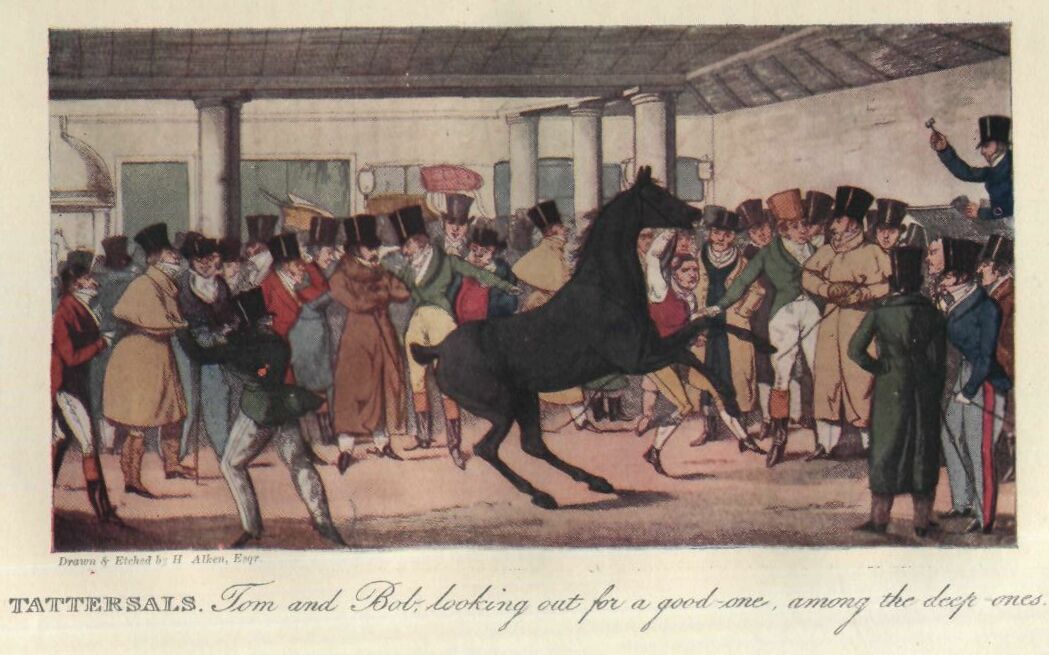
| Thomas Alken, A Gentleman Riding With a Groom, and Coversing |
Last year, during my visit to the Kensington Central Library, Dave Walker introduced me to the Baron de Berenger’s gun. Thanks to Dave's introducing me to this colorful character, I’ve spent some time with de Berenger’s Helps and Hints: How to Protect Life and Property. It surprised me in a number of ways.
At the time of my stories, animals tended to be treated brutally. I won’t go into the ugly details, but, generally speaking (of course there were many exceptions) if human life was cheap, non-human life was close to worthless, the RSPCA notwithstanding. And while life was kinder to humans of the privileged classes, they were not necessarily kinder to their animals, especially their horses. And so I was struck with de Berenger’s views on the subject:
“[A] rider should, to appearance at least, be a part of his horse; in the efforts of both these component parts there should seem as if there was but one and the same impulse,— a generous and reciprocal attention to please,—to serve, and to spare; and when that is accomplished, most horses will display as much delight in being rode, as the rider will be delighted in riding such a horse; but to accomplish this to perfection, an intimacy, nay, an affection, must be established between yourself and the generous animal; but which ... cannot be attained by the intercourse which, by far too generally, prevails between fashionable characters and their horses; these poor, willing, and faithful animals, rarely experiencing any other notice, save that of being urged on by whip and spur, to exertions but too frequently woefully distressing to a willing frame ... What has secured to the dog the reputation of being more affectionate, more intelligent, and more faithful, than the horse? Because, even the exquisite will deign to hold a familiar and encouraging intercourse, nay, conversation, with him: not so with the poor horse; except when being cleaned or fed, it stands unnoticed for many hours in dull solitude, at least as far as man is concerned. With him the cheering influence and the enjoyments of the sun are embittered by a portion of severe, because generally inconsiderate, labour; even then, and although enduring willingly, hardly ever to experience the pattings of a condescending hand as a cheap encouragement! ... nevertheless, and aware as the horse must be that it is led forth to endure straining labour, we see him cheerfully leave the stable, ever as willing slavishly to serve his master, as to please him, in any way, which he is taught to know as agreeable to him. Only familiarize with and pet him, as much as you do the dog, and his best endeavours at least to rival canine affection, intelligence, and fidelity, will soon be placed beyond all doubt.
 The entire entry, from which I’ve also included a clipping (at right), is well worth reading. I’d be especially interested in the reactions of our horse-loving/riding/driving Nerdy History persons.
Image: Henry Thomas Alken, A Gentleman Riding With a Groom, and Conversing (undated), courtesy Yale Center for British Art, Paul Mellon Collection.


 One of us --