Showing posts with label Brandywine. Show all posts

Tuesday, September 11, 2018

A Silk Vest Honoring the Marquis de Lafayette, c1824

Tuesday, September 11, 2018
Susan reporting,

Yesterday marked the 241st anniversary of the Battle of Brandywine, a pivotal confrontation in the American Revolution between General George Washington and his Continental Army and General Sir William Howe, commander of the British troops. I've written posts about the battle several times before (here and here. Aside from Brandywine's significance as the largest land battle of the Revolution, it also marked the debut in the war of a young volunteer from France.

An aristocratic idealist with a military background, Marie-Joseph Paul Yves Roch Gilbert du Motier, Marquis de Lafayette (1757-1834) was only nineteen when he met General Washington in August 1777. Already commissioned by the American Congress as a major general, Lafayette was not at first given troops to command, but instead became a member of Washington's staff. At Brandywine, he saw his first experience in the field; he was shot in the leg, yet still was cited by Washington for his "bravery and military ardor." Lafayette went on to play a key role in the war, not only as an officer and close friend to Washington, but also as a diplomat who helped secure the French ships and soldiers that ultimately tipped the scales for an American victory. He was celebrated as one of the most popular heroes of the Revolution, and remains so to this day. (How many of you began singing Guns and Ships in your head at the mere mention of his name?)

Lafayette is included in a wonderful small exhibition currently on display (through July 9, 2019) at the Smithsonian's National Museum of American History in Washington, DC. Through a well-chosen selection of paintings, maps, and artifacts, The American Revolution: A World War explains how the Revolution was only part of a global shift in the balance of power, war, and conquest that marked the 18thc world. As a Frenchman fighting the British with the American forces and Spanish allies, Lafayette is prominently featured.

But it's not only his wartime exploits that are highlighted. Lafayette's triumphant return to America in 1824 is also included. To quote from the exhibition:

"In 1824, the Marquis de Lafayette returned to the United States at the invitation of President James Monroe. Over fourteen months, he visited all twenty-four states....[President Monroe's invitation came as America] approached the 50th anniversary of its independence. He hoped the general's iconic presence would help rekindle the nation's "revolutionary spirit" and commitment to unity, which seemed to be slipping away. The trip was a smashing success, but it did not moderate the divisive 1824 presidential contest between John Quincy Adams and Andrew Jackson."

Americans celebrated Lafayette's visit with all kinds of souvenirs. Much like modern Americans wear t-shirts printed with the names and faces of their heroes, Lafayette's portrait was emblazoned on ribbons, dresses, and gloves, as well as the vest shown here:

"Hosting the Marquis de Lafayette at a New York banquet, Revolutionary War veteran Matthew Clarkson wore this vest covered with the general's image. During his sojourn, Lafayette attended hundreds of banquets, balls, and celebrations."

Though the Marquis was far too well-bred to record his thoughts about his host, I wonder what it must have been like to sit through a banquet across from a man wearing your face and name all over his chest....

Above left and detail right: Vest worn at banquet for Marquis de Lafayette, 1824-1836, National Museum of American History. Photos ©2018 Susan Holloway Scott.
Lower right: Le marquis de La Fayette en capitaine du régiment de Noailles by Louis Léopold Boilly, 1788, Musée national du château de Versailles. Image ©RMN-Grand Palais/Art Resource NY.

Wednesday, September 13, 2017

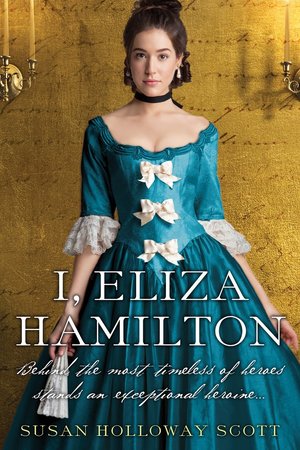
Shameless Self-Promotion: The First Booksigning for I, ELIZA HAMILTON Is Saturday, September 16

Wednesday, September 13, 2017

Susan reporting,

Writing a book seems to take forever, and the production - the edits, and rewrites, and galleys, and approving this and that and more - seems to take even longer. And then, suddenly, it's publication day, and your darling is thrust out into the world.

OK, that's melodramatic, but at last it's that time for I, ELIZA HAMILTON, which will be available everywhere on September 26. If you'll be in the Philadelphia area this weekend, however, you'll be able to get your copy early at a very special booksigning at Sandy Hollow Heritage Park, Birmingham Township, PA.

What makes this booksigning special is that it will be part of Brandywine2017, a weekend-long re-enactment and celebration to mark the 240th anniversary of the Battle of Brandywine. (See my earlier blog posts about the battle here and here.) Fought on September 11, 1777, Brandywine was the largest land battle of the American Revolution, with approximately 26,000 combatants. George Washington commanded the Continental Army, and General William Howe led the British. The names of those on the field included many who would become well known in American history: the Marquis de Lafayette, generals Nathaniel Greene, Anthony Wayne, and Henry Knox, future President James Monroe, and future Supreme Court Chief Justice John Marshall.

Oh, and there was also another young officer at the battle, serving as one of General Washington's aides-de-camp, who would one day become the first Secretary of the Treasury: Lt. Col. Alexander Hamilton. Can you understand now why I wanted this to be my first booksigning for I, ELIZA HAMILTON?

Nearly a thousand uniformed Revolutionary War re-enactors will gather from around the country to recreate the battle, fighting on the same fields and farmland as the original battle more than two centuries ago. There will infantry, cavalry, and dragoons, artillery demonstrations and military music.

Before and after the "battles" (the British will win on Saturday, but the Americans will triumph on Sunday), visitors will be able to tour the encampments and meet the re-enactors, and step inside the handsewn replica of Washington's campaign headquarters tent. There will also be 18thc-style wares offered for sale by dozens of vendors and sutlers, as well as other authors, offering fiction, non-fiction, and children's books, all with a Revolutionary War connection.

Perhaps best of all, the event is free, with plenty of free parking. Check out the the Brandywine2017 website for all the details, including directions.

I'll be signing I, ELIZA HAMILTON on Saturday, September 16, from 11:00 am-1:00 pm, in the author tent near the entrance. Hope to see you there - please introduce yourself!

Tuesday, July 4, 2017

"Taking Sides with... the Rebel Congress & the Rebel Army" in 1777

Tuesday, July 4, 2017
Susan reporting,

For most American teenagers today, Independence Day and the Revolution it led to aren't things to be given much thought during summer vacation from school (unless they're Hamilfans, and then they're rapping the Revolution along with the HamiltonAn American Musical soundtrack.)

But for sixteen-year-old Samuel Ring, a young Quaker living near Chadds Ford, PA in 1777, the Revolution was unavoidable. He witnessed the Battle of Brandywine first-hand, and watched the British destroy his home afterwards. His family had dared to side with the Continental Army, and had been branded as traitors. (I've written before about the Ring family, here in this post.)

The following excerpt comes from recollections that were written by Samuel's son, also named Samuel, in 1859. The letters remain with his descendants, and a copy is now in the collection of the Brandywine Battlefield Park; to the best of their knowledge, these recollections haven't been published. Although written over 80 years after the battle, the details (like eating the peaches in his family's orchard, as well as the betrayal by their neighbors) are exactly what a teenager would remember.

On the morning of September 11,1777, Samuel's father and older brother had gone to serve Washington as guides to the area, while his mother and the younger children had fled their home to avoid the coming battle, first attempting to leave by carriage, and then escaping by foot over the fields. Too young to be with the army, yet too old to be with his mother, Samuel remained near the family's house.

"[Samuel] said that he left in a hurry in the morning, on some errand, with only shirt and pantaloons on, thinking nothing of what was coming, and before his return, the road was completely blocked [by soldiers]. There was no chance of approaching very near the house, so he made for the higher ground where he could view the contending armies, out of harm's way.

"He was in a peach tree with some others, eating peaches, when the Americans gave way; he never heard such a noise, it appeared as if all the fiends of the infernal regions were let loose. He quit eating, his heart seemed to sink, he knew that the enemies of his country had triumphed.

"[His] family was scattered and part did not know where the others were. All he had was on his back, and that was almost nothing; his home was in the hands of the enemy, and liable to be laid in ashes, which, indeed, a good part soon was.

"The British occupied the ground for three days and nights....When the British retired and [Samuel] returned home, desolation was complete. He thought of changing his clothes, but a glance at the house made him think it doubtful whether there were any left there for him.

"He went upstairs to his chest - it was open, the lid broken off, and not a vestige of anything in it, and indeed not an article of clothing of any sort remained about the house. The beds [mattresses] had been ripped open, the feathers strewed over the yard (they had had about a dozen good beds) and not a sign of either beds or bedsteads [remained]. The latter had been used for fuel...and not a rail was left – all burned. Not a fowl, sheep, or hog was left on the place...the yard and fields torn up by the horse and baggage wagons and common carriages. [The British] had used a part of the house as a stable. Desolation reigned, and the work of the destroyer complete.

"[Samuel's son later] asked him if that was the way the neighborhood had been served generally, and he said it was quite different with some, their property was respected and a guard put over it, and the smallest thing left unharmed.

"[Samuel's son] asked the cause of this (being quite small and [knowing] little of such things, and [Samuel had answered] that his father favored the side of the colonies in every way, so far as his religion would permit, and many thought he went farther in his politics than he ought in taking sides with what was called the Rebel Congress and Rebel Army, and the fact of Gen. Washington having his headquarters for the time being at our house when he came to view the battlefield - and there is no doubt that had he been victorious he would have taken up his headquarters there again; all this the British general knew. There were scores in the neighborhood ready to carry news, and this was the cause of the destruction of [his father's] property. Whilst others were protected, he was pointed out as a rebel and his property given over to the enemy for destruction...."

Although the Ring farm was looted and vandalized and the contents of the house destroyed, the stone house itself survived. A restoration of the house is today part of Brandywine Battlefield Park, and is open to the public. See here for more information. A major reenactment of the battle to mark its 240th anniversary will take place this fall; see here for more information.

Many thanks to Andrew Outten for his assistance with this post.

Above: "The Nation Makers" by Howard Pyle, c1902, Brandywine River Museum of Art.
 
Two Nerdy History Girls. Design by Pocket