Showing posts with label Massachusetts Historical Society. Show all posts

Wednesday, November 28, 2018

A Sparkling Length of 18thc Gold Lace from the Massachusetts Historical Society

Wednesday, November 28, 2018
Susan reporting,

Earlier this month I visited the latest exhibition at one of my favorite places for research and inspiration, the Massachusetts Historical Society in Boston, MA. Called Fashioning the New England Family, it's a truly breathtaking exhibition, featuring clothing, accessories, textiles, and embroidery worn and made by New Englanders.

The majority of the pieces are drawn from the MHS collections, and many have never before or only rarely been seen by the public. There's so much here: Abigail Adams's copper-colored silk gown (on loan from the Adams Historical Park); Thomas Hancock's walking stick crowned by a clenched ivory fist; Governor John Leverett's 17thc buff coat worn to fight under Oliver Cromwell in the English Civil War; Rachael Hartwell's light-as-air 1890s wedding dress. The history of the wearers is woven into each piece, and the presentation is thoughtful and beautifully displayed. The exhibition is free to the public, and runs through April 6, 2019. See here for more information.

I'll be featuring highlights from the exhibition in upcoming blog posts, and I'm starting with one of the smaller items. It's also among the most stunning. Some time during the mid-18thc, this length (unfolded, it measures 283 cm x 5 cm) of gold wire bobbin lace was made in Europe. Whether bought by an individual there or imported to the American colonies to be sold in a shop here, the lace was purchased and carefully wrapped in blue paper with the price written in iron gall ink. For whatever reason, the lace was never used, but instead put away in its original paper wrapping.

Metallic lace was a costly and luxurious trim, designed to sparkle in 18thc candlelit rooms. It could be used to adorn a woman's gown or a man's waistcoat, or even the cap of a special baby. (I immediately thought of the similar gold bobbin lace that was incorporated in this mat embroidered c1780 by Elizabeth Schuyler Hamilton.) Metallic lace was usually a blend of gold and silver or other metals, and over time and wear often tarnished and lost its shine.

But this particular length of lace remains as bright as new, the intricate woven gold glowing against the blue paper.  When the lace was given to the MHS, it was accompanied by a handwritten note from Susan Holmes Upham (1804-1877): "Gold lace given me with other old-fashioned things by my mother." It must indeed have been an old-fashioned curiosity by the mid-19thc. Today it's a sparkling link through the centuries to the shop of the now-forgotten milliner or mantua-maker who made the sale, tallied the price, and wrapped the lace, and the (I hope!) satisfied customer who carried the new purchase home.

Many thanks to Anne Bentley and Kimberly Alexander for giving me a special tour of the exhibition, and for including me in the planning from the earliest stages. 

The book that accompanies the exhibition - generously illustrated with many full-color photographs - is being published by the University of Virginia Press. It can be pre-ordered here.

Gold Wire Bobbin Lace, mid-18thc, European. Massachusetts Historical Society. 
Photographs courtesy of Massachusetts Historical Society.

Sunday, February 18, 2018

Those Now-Famous Strands of George Washington's Hair: The Backstory

Sunday, February 18, 2018

Susan reporting,

If you're reading this blog, you're most likely a history nerd, and proud of it, too. It also likely means that somewhere you've read this week's favorite history story in the mainstream media: how a few strands of George Washington's hair were discovered tucked inside a 200-year-old almanac in the rare book library of Union College. Partly because it's almost Washington's birthday, and partly because it IS an interesting discovery, the story has been everywhere, including the Washington Post, The New York Times, USAToday, Newsweek, Newsday, US News & World Report, and the Smithsonian's SmartNews, NPR, and network and cable outlets as well. Last time I checked, it had appeared in over 200 outlets.

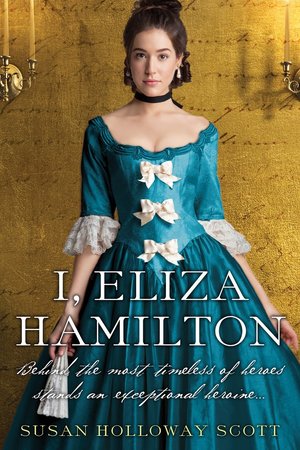
In many versions of these stories, I'm quoted (along with professors of history and hair-experts), describing how hair was a common memento among friends and family in the past.  Which, of course, it was - but there's much more to the story than most journalists have space to tell. I don't have those constraints, and besides, I love all the nerdy-history details. There are even connections to Elizabeth Schuyler Hamilton, the heroine of my historical novel, I, Eliza Hamilton.

The almanac (shown above) - and the hair - were discovered during an inventory of the archival collections of Schaffer Library, Union College. Bound in red leather, Gaines Universal Register or American and British Kalendar for the year 1793 was a popular volume for gentlemen of the time, and contained useful, everyday knowledge such as population estimates for American cities and comparisons of various coins and monies. The almanac is inscribed "Philip Schuyler's a present from his friend Mr. Philip Ten Eycke New York April 20, 1793."

The first thought was that the almanac belonged to Gen. Philip Schuyler (1733-1804), a close friend of Gen. Washington who served under him during the American Revolution. Philip Schuyler was later active in Federalist politics and government as a U.S. senator from Albany, as well as one of the founders of Union College. He was also the father of Elizabeth Schuyler Hamilton (1757-1854), and father-in-law to Alexander Hamilton.

Tucked inside the almanac were several pages of handwritten notes and a business letter, which make the owner more likely General Schuyler's son, Philip Jeremiah Schuyler (1768-1835). Also inside the almanac was a slender yellowed envelope, upper right, with this written on one side: "Washington's hair, L.L.S. & (crossed out) GBS from James A. Hamilton given him by his mother, Aug.10, 1871." Inside the envelope were a few white hairs, tied together with a thread, left. Who were all these people, and could their identities help prove that the hair really had come from Washington?

A Google search by Phillip Wajda, Union's director of media and public relations brought him to my blog post about historic hair in the collection of the Massachusetts Historical Society. (See the strands of Washington's hair, held together with red wax, that belong to MHS, lower right.) The handwriting accompanying that hair does appear to the be same as is on the envelope, belonging to James Alexander Hamilton (1788-1878.) James was the fourth child of Elizabeth and Alexander Hamilton, and, like his mother, was very aware of both his father's legacy and his family's place in American history.

Locks and strands of hair were often exchanged, especially as tokens of a deceased loved one. While it's impossible to be absolutely certain without DNA testing, the hair's provenance makes a strong case for it having come from Washington. The Hamiltons were close to the Washingtons, and it's likely that Martha shared George's hair with Elizabeth after George's death, if not before. It therefore makes sense that James passed along the hair given to him by his mother, Eliza, as he wrote on the envelope.

He gave the hair to family members who would have appreciated it, too. Thanks to the assistance of Jessie Serfilippi, an interpreter at the Schuyler Mansion in Albany, we determined that the initials refer to James's granddaughters, Louisa Lee Schuyler (1837-1926) and Georgina Schuyler (1841-1924.) The sisters continued the family interest in history through historic preservation - an idea growing in the late 19thc-early 20thc with a renewed appreciation for the country's early history. Together the sisters were instrumental in making Gen. Schuyler's grand colonial house in Albany into a New York historic site in 1917. At some point, the envelope with the hair must have been slipped into the almanac for safekeeping, forgotten, and then later donated to Union.

A digression into the complicated genealogy of Louisa and Georgina: Philip Jeremiah Schuyler (son of Gen. Schuyler, brother of Elizabeth Schuyler Hamilton, and owner of the almanac) and his second wife, Mary Anne Sawyer, had a son, George Lee Schuyler. George Lee Schuyler married his cousin Eliza Schuyler, the daughter of James Alexander Hamilton (son of Elizabeth and Alexander Hamilton.) George and Eliza became the parents of Louisa Lee and Georgia - who therefore were, through intermarriage, great-granddaughters to both Gen. Philip Schuyler and Alexander Hamilton. Whew!

What I find particularly fascinating about all this is that because Elizabeth Schuyler Hamilton lived to be 97, she would have known both Louisa Lee and Georgina as girls. Think of that: they would have heard first-hand stories of the American Revolution from Elizabeth, and yet they themselves lived into the 1920s. It's understandable that Louisa Lee and Georgina would have wanted the Schuyler Mansion to be preserved since they remembered their great-grandmother, who in turn would have remembered when the mansion (then her family's new home, known as The Pastures) was built in the 1760s.

Could there be any better backstory than that?

Thanks to Phillip Wajda, Jessie Serfilippi, and Anne E. Bentley, Curator of Art & Artifacts, Massachusetts Historical Society, for their assistance with this post.

Upper photos ©2018 Union College.
Lower right: Strands of hair belonging to George Washington, Massachusetts Historical Society, photo ©2017 Susan Holloway Scott.

Tuesday, August 1, 2017

Seeing the Emotion in the Words of a Handwritten Letter, 1797

Tuesday, August 1, 2017
Susan reporting,

One of the most challenging aspects of writing historical fiction is trying to remove all the fusty layers of time and interpretation to capture the immediacy of the past. Whenever possible, I look to primary sources - letters, diaries, journals - that give voices to long-gone people. Seeing those original words reprinted in a book or on-line is useful, of course, but being able to see the originals of those same letters can take research - and inspiration - to an entirely different level.

Earlier this year, I was fortunate to see first-hand one of Abigail Adams' more famous (or more infamous, depending on your perspective) letters now in the collection of the Massachusetts Historical Society. Abigail was no fan of Alexander Hamilton, nor was her husband, John Adams. As young as the American republic was in1797, vitriol, name-calling, and backstabbing were already part of the political system, and there were few rivalries more bitter than the one between Hamilton and Adams. Each had many reasons, and both were right: Hamilton believed he'd been shut out of the government he'd help create during George Washington's presidency, while Adams felt that Hamilton had undermined his attempts to win a second presidential term himself. Each accused the other of unseemly ambition, and both were justified there, too.

As can be expected, Abigail supported her husband, and loathed Hamilton. The Adamses had always been frank in writing to one another about politics, and her (low) estimation of Hamilton echoed his own. The letter that she wrote in late January, 1797, begins calmly enough, with notes of the weather and the "pain and anxiety of Seperation." Then she launches into gossip she'd heard regarding Hamilton, followed by her own appraisal of his character, only to realize at the letter's end what she's written:

"Mr. Black told me the other day on his return... that Col. H[amilton] was loosing ground with his Friends in Boston. On what account I inquired. Why for the part he is said to have acted in the late Election. Aya, what was that? Why, they say that he tried to keep out both Mr. A[dams] and J[efferson], and that he behaved with great duplicity....that he might himself be the dictator. So you see according to the old adage, Murder will out. I despise a Janus....it is my firm belief that if the people had not been imposed upon by false reports and misrepresentations, the vote would have been nearly unanimous. [Hamilton] dared not risk his popularity to come out openly in opposition, but he went secretly cunningly as he thought to work....

"Beware of that spair Cassius, has always occured to me when I have seen that cock sparrow. O I have read his Heart in his wicked Eyes many a time. The very devil is in them. They are laciviousness itself, or I have no skill in Physiognomy.

"Pray burn this Letter. Dead Men tell no tales. It is really too bad to survive the Flames. I shall not dare to write so freely to you again unless you assure that you have complied with my request."

Obviously, John Adams didn't obey Abigail's request. Read as transcribed here, her words are indeed "bad," but to see them as she wrote them in the original letters showed exactly how angry she was.

Compare the delicacy of Abigail's greeting in the same letter, right, with the closing paragraphs, lower left. (As always, please click on the image to enlarge.) By the time she reached "Beware of that spair Cassius..." she was driving the pen across the page, her letters growing darker, wider, and less formed as she pressed the nib of her pen furiously across the paper. How much more powerful - and revealing - those words are in their handwritten version!

Many thanks to Sara Georgini, Historian and Series Editor, Adams Family Papers, Massachusetts Historical Society, for showing this letter and others to me. Excerpt from letter from Abigail Adams to John Adams, January 28, 1797, Massachusetts Historical Society.

Above left: Abigail Adams by Jane Stuart (after Gilbert Stuart), c1800, Adams National Historic Park.
Right & lower left: Excerpt from letter from Abigail Adams to John Adams, January 28, 1797, Massachusetts Historical Society. Photo by Susan Holloway Scott.

Tuesday, May 23, 2017

For the Longest of Voyages, a Gentleman's Sea Chest that Does It All, c1794

Tuesday, May 23, 2017
 
Susan reporting,

American travelers today are accustomed both to convenience and speed. A journey to the other side of the world can be accomplished in a day, with as much luxury as the budget allows.

But in the late 18thc, international travel was neither easy, fast, nor luxurious, especially for Americans who wished to engage in the lucrative trade with India. All such journeys were made under sail. Voyages that began in Boston or Salem would continue across the Atlantic, around the Cape of Good Hope, and then across the Indian Ocean. The length of a voyage depended on winds, storms, seasons, the captain and crew, and a great deal of luck.

For example, Benjamin Carpenter left Boston on December 24, 1789 (Christmas Eve!), and did not arrive in Madras until August 16, 1790, after nearly eight months at sea. Dudley Pickman Salem was more fortunate; his voyage from Salem, MA to Madras in 1799-1800 took only 111 days.*

There were plenty of perils, too, including shipwrecks, illness, accidents, and pirates. If those were avoided, passengers still faced a repetitive and limited menu, lack of exercise, homesickness, and boredom. Even for an affluent traveler, quarters were cramped, often little more than a closet-sized cabin. The best (sometimes only) company would be books, which, like everything else, would have been carefully chosen with space at such a premium.

All of which leads to the ingenious mahogany sea chest shown here, now in the collection of the Massachusetts Historical Society. Benjamin Joy (c1755/57-1828) was a merchant from Newburyport, MA. Experienced in trading with India (he was one of the rare Americans at the time who had also lived in India), Joy was appointed United State Consul to Calcutta and other Indian ports by President George Washington in November, 1792. According to the chest's placard:

"Joy arrived in Calcutta in April 1794, where the British East India Company refused to recognized him as Consul, but permitted him to reside there as a 'commercial agent.' This marked the beginning of America's official relationship with India.

"Portable chests like this were indispensable on long sea voyages. This chest provides a felt-covered desk, secure compartments to hold inks and other liquids, more compartments for brushes and a sewing kit, drawers, a mirror, washbasin, chamber pot, and even a bidet."

The chest is a marvel of efficiency masquerading as an elegant piece of gentleman's furniture. Curator Anne Bentley demonstrated its various quick-change functions, and even over two hundred years after its creation, every drawer and compartment still fits snugly and perfectly into place. Meant for a tiny shipboard cabin, the chest would have made the most of the limited space. It's the Swiss Army knife of furnishings.

The origins of the chest are now unknown, but it's believed to have been made not in Salem, but in India, in preparation for the voyage home. Perhaps Mr. Joy used all that time on the outbound voyage to decide exactly what was required (and what he was lacking), and from uncomfortable experience was able to have the cabinetmaker create the perfect sea chest. Necessity can often be not only the mother of invention, but splendid design as well.

There is a similar chest in the collection of the Adams National Historic Park that belonged to another diplomat and frequent traveler, John Quincy Adams; his is referred to as a "traveling chest." Beyond that, however, the MHS staff isn't aware of any other surviving examples. If you know of another (no matter its origin), please leave a comment, and I'll pass it along.

* This information comes from another of our wonderful friends of the blog, Dane Morrison, author of True Yankees: Americans, the South Seas, and the Discovery of National Identity, 1784-1844, Johns Hopkins Press. Follow his blog here.

Many thanks to Anne E. Bentley, Curator of Art and Artifacts, Massachusetts Historical Society, for her assistance with this post. 

Sea chest, maker unknown [India?], 1790s. Massachusetts Historical Society. 
Photographs ©2017 by Susan Holloway Scott.

Monday, May 8, 2017

Preserving Historic Hair from George Washington & Alexander Hamilton

Monday, May 8, 2017
Susan reporting,

In the days before photographs, a lock of a loved one's hair was often the single most lasting link that the living could have with the deceased. Whether cut while the person was alive or dead, the hair could be elaborately woven or braided, preserved under glass or incorporated into jewelry, or simply tied with a ribbon or thread and tucked away as a precious memento.

But hair from from a famous head became more than a mourning memento. It was history, a surviving reminder of a notable man or woman. Famous hair was collected and treasured as a tangible reminder of a more glorious past.

I saw these two wisps of hair, left, framed together in the collection of the Massachusetts Historical Society. (As always, please click on the image to enlarge.) Even though these two were surrounded by dozens of other examples, they stood out, and would have been prized for a number of reasons. The strands of hair at the top belonged to Alexander Hamilton, the first United States Secretary of the Treasury (as well as the husband of the heroine of my new book, I, Eliza Hamilton), while the strands on the bottom were from General George Washington, the first President of the United States and "The Father of his Country."

As the Society's records note: "Given by Alexander Hamilton's son, James A. Hamilton of Nevis, to Eliza Jones Hersey Andrew (1826-1898), the wife of Massachusetts' Civil War Governor John Albion Andrew (1818-1867) on October 27, 1865." The hair is affixed to writing paper by red shellac seals, and the inscriptions are by James A. Hamilton.

This gift would have had special significance in the fall of 1865. The American Civil War had just ended, and the Union forces had won. Mrs. Andrew and her husband were ardent abolitionists, and Governor Andrew had been responsible for authorizing the 54th Regiment Massachusetts Volunteer Infantry in 1863 as soon as President Lincoln had permitted the enlistment of African-American soldiers. Mrs. Andrews must have welcomed the gift of hair belonging to two of the Founding Fathers - men who had helped create the original United States that the Union forces had just fought so hard to secure.

But the hair must have been treasured by James A. Hamilton, too. Washington's hair had most likely been given to his mother or father at the time of the general's death in 1799. The hair of his father, Alexander Hamilton, would probably have been cut soon after his death in 1804, following his fatal duel with Aaron Burr - sixty years before its presentation to Mrs. Andrew.

James Alexander Hamilton was the third son of Alexander and Eliza Hamilton. Born in 1788, he was only sixteen when his father died, yet throughout his life he vigorously defended his father's reputation against numerous detractors. Look more closely at the the inscription beneath the hair, and compare the two way he's written his father's name, and then how he's signed his own. Then look at the example of Alexander Hamilton's signature, right: it certainly appears that at some point the grieving son borrowed his father's distinctive signature and made it his own, a small, poignant homage. The MHS's mention of James Alexander being "of Nevis" is a reference to his sizable country house on the Hudson River that he named Nevis in honor of the Caribbean Island that was his father's birthplace. In other words, James Alexander would not have given away his father's hair lightly.

Then, of course, there's the hair itself. Both Hamilton and Washington are so often portrayed in portraits with white hair - the result of fashionable powdering (see my earlier post on Hamilton's hair) - that it was something of a shock to see that they both did indeed have the reddish-brown hair that contemporaries noted. The strands of Washington's hair are short and fine, a tidy clip, but Hamilton's are long and wirey, weaving back and forth again and again in their thread binding. At the time of Hamilton's death, most men had begun to prefer shorter hair styles, but he still wore the now-old-fashioned long queue (ponytail.) Were these strands cut from that same queue? I wonder....

Many thanks to Anne E. Bentley, Curator of Art & Artifacts, Massachusetts Historical Society, for her assistance with this post.

Above: Strands of hair of Alexander Hamilton and George Washington, Massachusetts Historical Society. 

Read more about Eliza Schuyler and Alexander Hamilton in my latest historical novel, I, Eliza Hamilton, now available everywhere.

Wednesday, May 13, 2015

A Pair of 18th c. French Lovers Finds a Home in a New England Garden

Wednesday, May 13, 2015
Isabella reporting,

Like most historical societies, the Massachusetts Historical Society is filled not just with books, diaries, and letters, but also with the unexpected, such as silk dresses and intimidating military banners. It's also home to these lovely 18th c. French garden statues.

Cast from lead and painted, this pair is almost life-sized. They would have been the height of garden fashion when they were made in the late 18th c., for they represent the hero and heroine of Paul et Virginie, a romantic novel by Jacques-Henri Bernardin de Saint-Pierre.

Paul et Virginie was an international bestseller when it was published in 1788, with fans that included both Marie-Antoinette and Napoleon Bonaparte. It's the ultimate novel of the Enlightenment: the innocent friends-turned-sweethearts are raised on an idyllic Caribbean island, the ÃŽle de France (now Mauritius.) Here all the inhabitants live in a paradise of equality and harmony as true creatures of Nature, reflecting the popular writings of philosopher Jean-Jacques Rousseau.

But of course there is A Conflict. Just as the young couple declare their love, a rich aunt entices Virginie to travel to France, where she will be educated as a French lady and inherit a fortune. On her return voyage, Virginie's ship founders just off the coast of her home island. Paul swims out to rescue her, but because of her newly-learned modesty, she refuses to shed her layers of Parisian clothing before the sailors, and she drowns, weighed down as much the false values of civilization as by her clothes. Bereft, Paul dies of a broken heart, and readers everywhere wept in delicious agony. (If that spoiler didn't ruin the story for you, you can download it or read it online for free here.)

Commercial tie-ins to popular fiction are hardly new, and 18th c. readers could buy prints, paintings, porcelain, and even clocks with a Paul et Virginie theme. These graceful garden statues would have been at the higher end of the market for memorabilia, and with their romanticized versions of bucolic dress, they must have added a charming touch to a country garden.

And thanks to a rare bit of luck, we can see exactly how they looked in such a garden. While it's unknown how or when the statues arrived in America, the MHS has the account books of Peter Chardon Brooks III, who purchased these statues (plus a third that is now lost) for $75 in 1842 for the the family estate in West Medford, MA. Summer, the 1864 painting of the estate, lower left, includes the statues standing near the pond (the detail, lower right, shows Paul with a red coat) - a spot that was the perfect idyllic setting for Paul and Virginie.

Many thanks to Anne E. Bentley, Curator of Art & Artifacts, Massachusetts Historical Society, for her assistance with this post.

Above left: Paul, statue, cast lead, polychromed, France, c. 1787-1790. Massachusetts Historical Society.
Above right: Virginiestatue, cast lead, polychromed, France, c. 1787-1790. Massachusetts Historical Society.
Lower left & right: Summer, by George Loring Brown, 1864. Massachusetts Historical Society.

Sunday, May 3, 2015

An All-Seeing 18th c. Man of Mystery

Sunday, May 3, 2015
Isabella reporting,

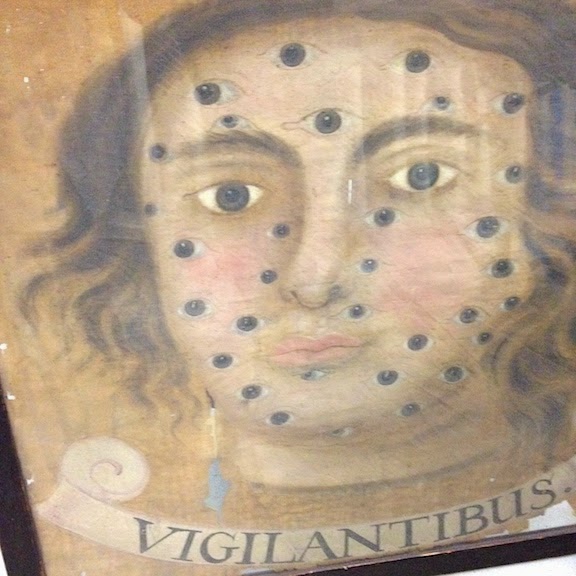
My visit to the Massachusetts Historical Society last week was not all lovely gowns. Anne E. Bentley, Curator of Art & Artifacts, had this military standard, or banner, to show us, too. Because the standard is now preserved behind glass, it was difficult to photograph, so I'm including the black-and-white image from the Society's collection for the overall view, and the iPhone photos so you can see that he's blue-eyed (all of them) and pink-cheeked.

Painted on both sides on silk that has split in places, the standard features a man's disembodied head that belongs in a Wes Craven movie. At first glance, the face appears to be covered with spots, but if you look more closely, you'll see that those spots are eyes. I counted over 30 of them, eyes that are complete with curling eyelashes and looking up, down, and sideways. Beneath the face is emblazoned "Vigilatibus",  Latin for be vigilant, or watchful, which would certainly be easier with all those eyes.

The mystery: no one today is quite sure of the standard's history or allegiance. Here's the MHS catalogue description:

A framed painted silk standard, double-sided, of a face with multiple eyes, believed by the donor to have been taken by British or Colonial New England forces from the French during the period 1756-1763. Efforts to substantiate this information have been unsuccessful. Given by Walter Gilman Page on July 14, 1900.

In other words, while Mr. Page made his gift (no doubt purposefully) on Bastille Day, Vigilantibus might have flown as a banner over French, British, or colonial American troops. Regardless of the the standard's owners, it certainly would have made an impression glimpsed through the smoke of battle or rising up in the New England woods during the French & Indian War.

So here's the mystery for our ever-knowledgeable readers around the world. Have any of you ever come across an 18th c. British or French regiment or military organization with "vigilantibus" as its slogan? Have you ever seen a similar many-eyed man in an 18th c. print or painting that might have inspired the banner? If you have, please let us know. After all, he's watching.

Once again, many thanks to Anne E. Bentley and the Massachusetts Historical Society.

Above: Vigilantibus standard, silk, 18th c. From the Collections of the Massachusetts Historical Society.
Below: Vigilantibus standard, photograph ©2015 by Kimberly Alexander.

Thursday, April 30, 2015

Fashionable Survivor: A Rare Silk Damask Gown, 1777

Thursday, April 30, 2015
Isabella reporting,

This week I visited the wonderful Massachusetts Historical Society in Boston with one of our blog's good friends, Kimberly Alexander of the historic clothing blog Silk Damask. We had an appointment with Anne E. Bentley, Curator of Art & Artifacts, to see a certain pair of 1747 emerald green damask wedding shoes. We swooned over the shoes (as true Nerdy History folk do) and I wondered aloud whether the shoes had matched the bride's dress.

"They did," replied Ms. Bentley. "I know, because we have the dress, too."

Out came the long, over-sized archive box that is always a sign of marvels to come. There were three beautiful dresses inside that box, nested together in their tissue-paper cocoons: a silvery-green 1840s silk dress and matching pelerine, the emerald silk wedding dress (more about that in a future blog) worn by Rebecca Tailer for her 1747 Boston wedding to Rev. Mather Byles, and the dress shown here, long ago incorrectly identified by family tradition as having belonged to Rebecca Tailer Byles' mother. It's more likely the wedding gown of Rebecca's daughter Abigail, who married Dr. Jon Clark VI in Halifax, NS, in 1777.

And it's so beautiful.

The silk damask is light and crisp and scattered with lavishly detailed flowers between pink patterned stripes. Most likely French, the silk would have been the highest fashion at the time, and it would have been expensive, too. In the middle of the American Revolution, this silk would have been imported in a merchant ship out-racing privateers, which would have added to its cost.

The dress is an open robe à l'anglaise, lined with linen. The front of the bodice closes not with straight pins (the traditional closure for most 18thc. women's clothing), but with the very modern fastenings of hooks and eyes, middle left. The low neckline would have been filled in with a fine linen neckerchief, and there are narrow bands of pleated trim with scalloped (pinked) edges at the cuffs of the sleeves, lower right.

With its open-front skirt, the gown would have been worn over either a matching petticoat or one of a contrasting color, a look that's common in French fashion plates of the 1770s. The skirt is longer in the back, suggesting that it was worn with a false rump. Kimberly and I also suspect that the skirts were worn looped up in the back for more fullness, although we didn't have time to hunt for the tell-tale signs of stitching for a cord or buttons inside the lining.

Abigail's mantua-maker was well aware of European fashion, and skilled in executing it. She took care to work with the striped pattern of the silk, cutting the sleeves on the cross-grain so that the stripes went around the arm. The back of the gown, upper left, is particularly well-done, using the pink stripes to accentuate the tapering of the waist.

By measuring the gown, we could also tell a bit about Abigail Tailer herself. We're guessing she was about 5' 4" or so in height, and the waist of the gown was 26", with some of that an allowance for her stays and shift - roughly a modern size 6.

The gown as it is now is preserved for study, not display, so I can only offer these detail photographs of it. On a mannequin, it would probably look much like this one, lower left, from LACMA's collections. There's another similar gown from the Manchester Museum featured in Janet Arnold's Patterns of Fashion 1.

What's the most exciting thing for me about Abigail Tailer's wedding gown? Learning that Kimberly and I were the first people outside the MHS to see it in more than forty years, and probably longer than that. It came to the MHS directly from Abigail's descendants, and it hasn't been featured in any exhibitions or books. It's been waiting patiently all that time in its tissue paper to be rediscovered.

I'd say it was well worth the wait....

Many, many thanks to Anne E. Bentley and the Massachusetts Historical Society!

Above: Gown, silk, 1777. Collection, Massachusetts Historical Society. Photographs ©2015 Susan Holloway Scott. 
Lower left: Robe, silk, 1775, Collection, LACMA.
 
Two Nerdy History Girls. Design by Pocket