Showing posts with label portraits. Show all posts

Tuesday, December 4, 2018

A White Silk Dress for a Special Portrait of Eliza Schuyler Hamilton, 1787

Tuesday, December 4, 2018
Susan reporting,

Sitting for a portrait was serious business in 18thc America. Professional artists were few and portraits were expensive, a luxury for only the wealthiest or most prominent of people. Even for them, a portrait was often a once-in-a-lifetime event.

When Elizabeth Schuyler Hamilton sat for her portrait in the winter of 1787, she was thirty years old. From a socially prominent New York family, Eliza was the wife of Colonel Alexander Hamilton, an up-and-coming young lawyer and Revolutionary War hero who was already playing an important role in shaping the new country's government. Alexander himself had already sat for several portraits, and now it was Eliza's turn.

The white silk gown that Eliza wears is the first to be recreated by historical mantua-maker and gown designer Samantha McCarty as part of the Fashioning Eliza program for the Museum of the American Revolution, Philadelphia, PA. It's all part of the museum's "Year of Hamilton" celebration that I've previously posted about here.

The white dress is the perfect choice to recreate, too. Eliza would have put a great deal of thought into what she chose to wear for this portrait. She was creating a lasting image of herself, a "selfie" for posterity. Her dress is stylish and appropriate for her status coming from a wealthy family and as Mrs. Alexander Hamilton, with costly imported silk and lace that displayed her husband's success. Her dark hair is frizzled and powdered white in a style made popular by Queen Marie Antoinette of France – a nod not only to French royal fashion, but also to the country that had helped America win its Revolution.

But Eliza pointedly wears only thin black ribbons tied around her wrists and throat instead of jewels or other ornaments. Simplicity in dress – and this dress is without any extra ruffles or fussiness – was praised, and considered patriotic. With Eliza's body shaped by stays (corset), it's easy to overlook the fact that she's pregnant in this portrait, and that she would give birth to the third Hamilton son, James Alexander, in the spring of 1788. Her white silk gown is the color of purity, truth, and virtue, excellent qualities for a woman of the new republic, and for the mother of new citizens as well.

Eliza may also have chosen a white gown for another reason, since this portrait resulted from an unusual act of charity by the Hamiltons. Alexander knew that the American-born portraitist Ralph Earl was imprisoned for debt in the New York City gaol. By the paradoxical laws of the time, the artist wouldn't be released until he'd paid his debts – impossible for him to do as long as he was imprisoned.

Alexander arranged for Earl to be given fresh paints, brushes, and canvas, and he also commissioned this portrait of his wife. Also happy to help the impoverished artist, Eliza sat for Earl in the gaol, her pristine white gown setting her apart from the sordid conditions nearby. Other New York ladies followed her example, and the artist was finally able to pay his debts and resume his career.

There's only one other portrait of Eliza from the years of her marriage, a pastel by James Sharples drawn around 1795. In this, too, she is shown wearing white. The choice of color is probably only a fashionable coincidence, and yet the two white dresses in these portraits stand out in comparison to what was to come. When Alexander died in 1804 of wounds following his fatal duel with Aaron Burr, Eliza immediately began dressing in black for mourning. In the fifty years of her widowhood, she never wore anything else.

A version of this post appeared previously on the website of the Museum of the American Revolution.
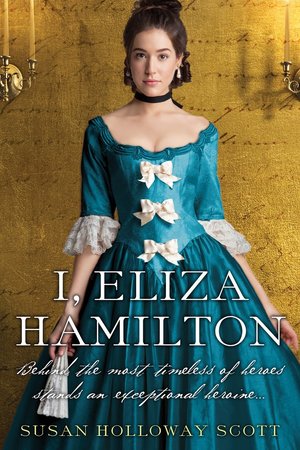
Read more about Elizabeth Schuyler Hamilton in my latest historical novel, I, Eliza Hamilton.

Top: "Elizabeth Schuyler Hamilton" by Ralph Earl, 1787, Museum of the City of New York.
Bottom: A museum educator dressed as Eliza Hamilton. Photograph by Kevin Rossi, Museum of the American Revolution.

Friday, October 19, 2018

Friday Video: Victorian Photographs in Color

Friday, October 19, 2018
Loretta reports:

When it comes to 19th and early 20th century fashion, as our readers are aware, it’s not all that easy to get a sense of what clothes looked like on real people. Fashion plates offer a simplistic idea of color but tend to be anatomically inaccurate (if not downright bizarre) and flat. Paintings show us color, texture, accessories, and so on, but they tend to be idealized, a sort of Photoshop version of the real person. Photography, once it gets going in the Victorian era, offers a degree of realism (they did doctor photos), but in black and white. Museums show us the actual clothing, but on mannequins often lacking accessories (and very often, underwear).

This video, featuring colorized Victorian and Edwardian photos, helps us get a real sense of real women in a range of clothing. Some of you will recognize at least a few of the women.


40 Amazing Colorized Photos of Victorian and Edwardian Women
Published by Yesterday Today

Image is a still from the video.

Readers who receive our blog via email might see a rectangle, square, or nothing where the video ought to be. To watch the video, please click on the title to this post (which will take you to our blog) or the video title (which will take you to YouTube).

Friday, September 21, 2018

Friday Video: Recreating Madame Récamier's Coiffure

Friday, September 21, 2018

Chinard, Mme Récamier
Loretta reports:

I have mentioned Madame Récamier before, mainly in connection with furniture (here and here). She is quite well known among Regency/Napoleonic era aficionados, both for her portraits and her salon.

The Gérard and David portraits of her will be familiar to many. However, being mainly interested in the chaise longue, I hadn’t really noticed the marble bust by Joseph Chirard, until I came upon Janet Stephens’s video. Ms Stephens has posted several YouTube videos explaining Greek and Roman hair styles, which in turn help us get a better sense of the powerful influence of Greek and Roman statuary on this period of fashion in Europe and America.


Image: Bust of Juliette Récamier by Joseph Chinard, in "Musée des Beaux-arts" of Lyon (France), photo by Philippe Alès, Creative Commons license.
Please click on images to enlarge.
Readers who receive our blog via email might see a rectangle, square, or nothing where the video ought to be. To watch the video, please click on the title to this post (which will take you to our blog) or the video title (which will take you to YouTube).

Sunday, August 19, 2018

The Queen(s) with the Pearl Earrings

Sunday, August 19, 2018
Susan reports:

I've written an earlier blog post about the large pearl that King Charles I wore in one ear. It seems only fair to write about an equally famous pair of pearl earrings worn by his queen, and several others besides. Many legendary jewels of the past have disappeared through wars and revolution, or have been broken up, re-cut, and reset until they bear no resemblance to their original design. But these magnificent earrings, left, have miraculously survived with both pearls and diamonds intact, and with a tantalizing history to match.

The earrings first appear as part of the dower jewels of Marie de' Medici (1575-1642), an Italian princess who left her native Florence to wed the French king, Henry IV (1552-1610). The de' Medici family was old, powerful, and very wealthy, and the jewels that Marie brought with her astonished the French court. At this time, pearls were the most valuable of precious gems, rare accidents of nature. The two almost perfectly matched droplet pearls in the new queen's favorite pair of pendant earrings were of a quality not been seen before in Paris. Other women at the court wore pearl drops (many ladies in 17th c. portraits are shown with them) but most of these pearls were coated glass. Marie's were real, and fit for a queen. She was painted wearing the earrings, right, in 1616 by Peter Paul Rubens.

When Marie's youngest daughter, the princess Henriette Marie (1609-1699), married the English King Charles I (1600-1649) in 1625, Marie gave the pearl earrings to her as a wedding gift. Henriette, too, was painted many times wearing the earrings, including this portrait of her as a young wife in 1632 by Sir Anthony van Dyck. Her marriage was a happy one, and blessed with many children. But the earrings brought Henriette no luck as the English queen. Her husband's unpopular politics eventually led to a disastrous civil war that cost him his life. Henriette was forced to flee the country in 1644 soon after giving birth to their last daughter, and leaving the baby behind. In exile in France with her sons, she was forced to gradually sell all her jewels first to help support her husband's army, and then, as a widow, to keep herself from poverty. Mementos of happier times, the pearl earrings were among the last jewels to go, finally being purchased by her nephew, the French King Louis XIV (1638-1714) in 1657.

The nineteen-year-old Louis had fallen desperately in love with eighteen-year-old Marie Mancini (1639-1715), the Italian niece of Cardinal Jules Mazarin, the king's primary minister. At first the match was approved both by the cardinal and Louis's widowed mother, and Louis presented the pearl earrings to Marie as his future queen. Marie's portrait, left, shows her wearing the pearls along with flowers in her hair. But politics intruded and the match was broken off, with Louis instead marrying the Spanish Infanta Maria Theresa, and Marie wed to the Roman Prince Lorenzo Onofrio Colonna. But Marie kept the king's pearls, and the earrings were by now so associated with her that they became known by her name, the Mancini Pearls.

No one is certain whether she left the earrings to one of her children, or sold them herself during her long and tumultuous life. In fact, there is no record of the pearls at all for nearly 250 years, until they appeared at Christie's auction house in New York in October, 1979. There they were sold to a private collector for $253,000, a price that almost seems reasonable considering all the history attached to them. They remain among the most famous jewels ever sold by Christie's.

Now I know that pearls, however beautiful, are inanimate objects, the work of an irritated oyster. But don't you wish these earrings could tell their story, and repeat even a few of the confidences and endearments, promises and secrets once whispered into the ears that wore them?

Sunday, June 10, 2018

The More Things Change....Every Mother's (Small) Nightmare, c1835

Sunday, June 10, 2018
Susan reporting,

One of the best things about the internet is how many smaller historical societies, libraries, archives, and historic sites are now able to share their collections with the world - a world that might not otherwise know they exist. Today I'm encouraging you to check out the Tumblr account of the Litchfield (CT) Historical Society. Named Fresh and Fashionable Goods, the account features all kinds of fascinating excerpts from the Elijah Boardman Papers. The Tumblr is funded by the National Historical Publications and Records Commission, National Archives, and for us Nerdy History Folk, this is taxpayer money absolutely well spent. The finding aid to the papers is here, and the digitized material is online here.

Some of the papers in the Society's collection represent familiar names like merchant, real estate investor, and politician Benjamin Tallmadge (1754-1835), better remembered as one of General George Washington's spymasters during the American Revolution.

Most, however, are the work of lesser-known men and women. To me, these papers are the most fascinating, because they offer such a clear glimpse into everyday life: what ordinary people ate, bought, grew, and used, what amused them and what didn't.

The hastily written note shown left (and here) is a wonderful example of how some aspects of that everyday life haven't changed one bit in the last 180 or so years. Caroline Maria Boardman Schroeder (1802-1853) was born into a prominent and prosperous Litchfield County family. In 1825, she married John Frederick Schroeder (1800-1857), a celebrated cleric, scholar, reformer, author, inventor, and educator. They had eight children, and their third daughter, Cornelia, is the one mentioned in this note. While the note is undated, it's a good guess that Cornelia (1831-1914) was quite young at the time, so Caroline's note probably dates from the mid-1830s. Here's the transcription:

My dear husband
We were all ready & waited some time & when the carriage came we all fixed ourselves & set out. We had not proceeded but a few steps, when little Cornelia was suddenly seized with violent vomiting, and I found my dress completely drenched. We of course returned, but she looks so pale that I dare not take her or leave her, so have concluded to send the carriage back empty. I think she has never had a similar attack before. Mary [Cornelia's older sister] is often taken sick in this way, but Cornelia never. I think her stomach was overloaded. I will stay with her, & wish you if possible to make apologies for me whenever it is necessary. Please get some of the best calcium magnesia as I have none. 
                                     Affectionately yours, 
                                     Caroline

While today this note would be sent as a harried text between parents, the scenario it describes is all too familiar to anyone with small children. Dad has gone ahead to some special event, Mom is running a little late, but has the kids dressed in their best clothes and finally loaded into the car, and then the youngest...explodes, leaving Dad to make excuses and stop by the drug store to pick up a fresh bottle of much-needed Pepto Bismal.

Still, Caroline's concerns for little Cornelia were sadly well-founded. Caroline and John had eight children. Their first two, Caroline and George, died as newborns, while scarlet fever later claimed their middle daughter Mary, 10, and son William, only three months. Caroline's mother, Mary Ann Whiting Boardman, wrote a concerned letter to her heartbroken daughter about the sorrowful loss of little Mary and the risk of grieving too much that you can read here.

I don't have a portrait of Caroline Boardman Schroeder, but I can't resist sharing the portraits of her parents, Mary Ann Whitman Boardman, right, (with her eldest son William Whiting Boardman) and Elijah Boardman, lower left, both by Ralph Earl. They're two of my favorite portraits from the era; I'm sure that many of the readers of this blog will fondly recognize merchant Elijah's portrait, because he's posed with bolts and bolts of fabric - a dream stash of 18thc textiles.

Many thanks to Linda Hocking, Archivist, Litchfield Historical Society for her assistance with this post.

Upper left: Note from Caroline Maria Boardman Schroeder to John Frederick Schroeder, n.d., Litchfield Historical Society.
Right: Mrs. Elijah Boardman and Her Son by Ralph Earl, c1796, The Huntington.
Lower left: Elijah Boardman by Ralph Earl, 1789, Metropolitan Museum of Art.

Wednesday, May 30, 2018

A Scandalous Sketch of Benjamin Franklin with a Lady, c1768

Wednesday, May 30, 2018
Susan reporting,

It's easy to think of America's Founders only through the images that are left of them, the stoic and often-idealized portraits painted by John Singleton Copley, Gilbert Stuart, and Charles Willson Peale. But regardless of how posterity venerates them, the Founders were a decidedly mixed group in their behavior, beliefs, and morals, as just about any group of white, English-speaking gentlemen from a sprawling colonial society in the 1770s were bound to be.

These sketches of Benjamin Franklin (1705-1790) - a writer, inventor, diplomat, printer, Freemason, scientist, and true polymath as well as a Founder - will probably bump those textbook images of him with his kite and printing press right out of your head. I saw the sketchbook on display last fall at the museum of the American Philosophical Society (Franklin was one of the founders of the Society, too, in 1743) as part of their wonderful Curious Revolutionaries: The Peales of Philadelphia exhibition. I've been meaning to feature the drawings in a blog post, and perhaps the last day of the merry month of May is appropriate.

Philadelphia artist Charles Willson Peale (1741-1827) was another 18thc man with many interests, and in the course of his long life became a soldier, artist, naturalist, scientist, collector, inventor, politician, museum-owner, and the pater familias of the artistic Peale clan. But in 1767, however, he was still an unknown young portrait painter learning his craft, newly arrived in London to study with fellow-American artist Benjamin West. Like most 18thc travelers, Peale hoped to build his network of connections and possible commissions by calling on other, more established Americans also in London. Among those was Benjamin Franklin, already a celebrated diplomat, philosopher, and bon vivant. Like all artists, Peale also carried his sketchbook with him wherever he went - including social calls.

Here's the APS caption for the above sketch:

While studying art in London, Charles Willson Peale called upon Benjamin Franklin uninvited. Peale accidentally witnessed the well-known Franklin engaging in promiscuous behavior with a lady. Instead of leaving, Peale secretly sketched the scandalous scene for future generations.

There's no record of the amorous lady's name; most likely Peale never learned it himself. He made two sketches on facing pages in in his sketchbook of the couple, right. In the APS records, one is titled as Sketch of Franklin and Lady, lower left, while the one above left is called Scandalous Sketch of Franklin with a Lady.

It's interesting to consider which one he drew first....

Above: Diary Sketch by Charles Willson Peale, c1768, American Philosophical Society.

Tuesday, May 29, 2018

The Regency's Duke of Cambridge

Tuesday, May 29, 2018
Duke of Cambridge 1806

Loretta reports:

Having recently reported on the present Duke of Sussex and the previous holder of that title, I thought it made sense to look at the man who last held Prince William’s title, Duke of Cambridge.

As in Prince Harry’s case, Prince Adolphus Frederick, the previous Duke of Cambridge (1774-1850), lived during the Regency and Victorian eras, and his life shows some parallels to Prince William’s. Prince Adolphus served in the military, was generally well-liked—including by his father, George III, who wasn’t crazy about his older sons. This royal duke, too, married a beautiful young woman, and had three children

With the death of the Princess Charlotte in 1817, he, like his other brothers, was obliged to find a wife. Of the royal dukes, Peter Pindar wrote:
Agog are all, both old and young
    Warmed with desire to be prolific
And prompt with resolution strong
    To fight in Hyman’s war terrific.
Within two weeks of his niece’s death, he sent a marriage proposal to the Princess Augusta, the Landgrave of Hesse-Cassel’s youngest daughter. She was twenty years old and  beautiful.

“This was the first of the three Royal marriages since Princess Charlotte married Prince Leopold that roused the romantic enthusiasm of the British public* ... “The Duke and Duchess had only to show themselves to be loudly cheered. The first Sunday after their arrival in England they were recognized strolling together in Hyde Park, and were at once surrounded and jostled by a large crowd, cheering and yelling ... On another occasion they were recognized in their carriage outside the famous City jewelers, Rundle and Bridge, and a great crowd came yelling round them, so that it was twenty minutes before their coachman dared move.”
Augusta, Duchess of Cambridge, 1818
Their first son, born in March 1819, was christened George, and was in line for the throne until Victoria was born, a few months later.
“And if the English public had good reason to be satisfied with the marriage, so had the Duke of Cambridge. He wrote of himself when he was first married: ‘I really believe that on the surface of the globe there does not exist so happy a Being as myself ... and Heaven grant that I may be deserving of it and not forfeit my happiness by any misconduct.’”
He became rather eccentric in later life—among other things, having gone deaf, he sat in front of the church and kept up a running, plainly audible, commentary—and was on very bad terms with Queen Victoria during her early years on the throne. But in a time of rampant anti-Semitism, he remained sympathetic to Jews. He was the only one of George III’s sons who lived within his income. “He was certainly most generous with his time, and equally generous with his money to an almost incredible number of charitable causes.”

Quotations and other information from Roger Fulford’s Royal Dukes.

*Let’s just say that the other couples were rather less attractive.
Images: E. Harding, Duke of Cambridge 1806; Sir William Beechey, Augusta, Duchess of Cambridge, 1818.

Clicking on the image will enlarge it.  Clicking on the caption will take you to the source, where you can learn more and enlarge images as needed.

Thursday, May 24, 2018

The Duke of Sussex, Then and Now

Thursday, May 24, 2018

Prince Augustus Frederick, Duke of Sussex
Loretta reports:

As everybody who follows royal doings now knows, the Queen has made Prince Harry the Duke of Sussex. This may puzzle some people who watched the video I posted not long ago, The Last of the Dukes. There we were told that we could not look forward to any new dukes.

However, a royal duke is a different article. He’s a member of the royal family who happens to be a prince, upon whom the sovereign has bestowed the title—as the Queen did in the cases of her sons as well as her grandsons. For further details, such as how long the title remains royal and where these royal dukes stand in precedence, I recommend this Wikipedia article. It offers a fairly easy-to-understand and, I think, fascinatingly nerdy account.

As a nerdy history girl, what I found interesting, was this particular choice of title. The last Duke of Sussex was a gentleman I wrote about last October, where I quoted a description of him as “the most consistently Liberal-minded person of the first half of the nineteenth century.” You can read more about him here at the Georgian Era blog.
Prince Harry, Duke of Sussex

Of course I have no idea why the Queen chose the Sussex title for Prince Charles’s second son. However, in light of the choice of bride; the wedding celebration, including the clergy and guests; and the causes the gentleman has espoused, I like to think of it as a nod to her progressive ancestor as well as to the new duke and the future we hope for him (excluding the problematic relationships with women, of course).

Images: Prince Augustus Frederick, Duke of Sussex, by Guy Head, National Portrait Gallery NPG 648.

Prince Harry, Duke of Sussex, speaks during the opening ceremonies of the 2017 Invictus Games (edited), Creative Commons License, Author DoD News.

Clicking on the image will enlarge it.  Clicking on the caption will take you to the source, where you can learn more and enlarge images as needed.

Thursday, May 17, 2018

From the Archives: Jane Austen's Surprising Aunt Philadelphia

Thursday, May 17, 2018
Susan reporting,

With my manuscript deadline drawing ever-closer, here's another favorite post from the archives about a woman who could certainly inspire a book of her own.

In 18thc Britain, it wasn't only younger sons who went out to India in search of fortune and adventure. English women also made the arduous journey in the hopes of finding fortune, adventure, and, most importantly, husbands in a male-dominated land where the odds would be much in their favor.

One of these adventuresome women was Philadelphia Austen Hancock, who in her later years became a favorite aunt to novelist Jane Austen. As a child, however, Philadelphia was no one's favorite. Born in 1730, she soon lost her mother in 1733, and her father in 1737. Her stepmother had no interest in raising either Philadelphia or her younger brother and sister, and as was sadly common at the time, the three young siblings were separated and sent to live with other relatives.

While the two younger children were sent to Austen family members, Philadelphia was given to members of her mother's family, the Hampsons. The Hampsons had both money and position - Philadelphia's uncle was a baronet - but they seemed to have shared little of it with the inconvenient little girl. While Philadelphia's brother George was sent to Oxford to become a clergyman, Philadelphia was apprenticed at fifteen to a London milliner named Hester Cole. No doubt the Hampsons considered their familial obligations done.

Some modern Austen-fans choose to interpret Philadelphia's occupation as a euphemism for prostitution, jumping to the conclusion that because many milliners (and seamstresses, and mantua-makers, and parlor-maids, and just about every other trade that a young woman might attempt in 18thc. London) were so underpaid that they turned to prostitution to support themselves. The fact that Mrs. Cole's shop was in Covent Garden also makes it tempting to speculate about Philadelphia's real trade. But however disinterested the Hampsons may have been in her, it seems unlikely they'd send her to a bawdy house, nor is there any historical proof of Philadelphia earning her living in any less-than-honorable way.

Whatever the case, Philadelphia must not have found millinery to her taste, because at twenty she sailed for India, her passage paid by a relative. No one knows if she went boldly through her own choice, or was perhaps sent away by the Hampsons (another hint of scandal?) Either way, it must not have been an easy decision, and it's hard to imagine a young woman making such a desperate journey alone, and without any real prospects or friends waiting for her in a very foreign land. Without a dowry, her face really would have been her only fortune.

But Philadelphia's gamble paid off.  After a short time in India, she did marry, quite respectably, to Tysoe Saul Hancock, who was a surgeon with the East India Company. They had one daughter, Eliza. Again the centuries-old whispers appear, hinting that Eliza's real father was her wealthy godfather Warren Hastings, the future Governor General of India. Again, too, there is no real proof to substantiate the rumors, but Philadelphia had chosen her daughter's godfather - or her own lover - well: Hastings provided Eliza with a substantial legacy of £10,000.

In any event, Philadelphia and her daughter returned to London, while Hancock continued to toil in India. Eliza was raised as a lady, with a full compliment of lessons in dancing, French, and the harp, and all the advantages that Philadelphia hadn't had for herself. When Dr. Hancock died, the two women found London too expensive for the fashionable life they wished to live, and they went instead to Paris, where they were quickly swept up into the gay life of the French society in the last days before the Revolution. Wanting the security for Eliza that she couldn't provide herself, Philadelphia urged her towards a marriage with a French count, who died on the guillotine. (Eliza's second marriage, to her cousin Henry Austen, was both longer and happier.) While Philadelphia's decisions might not always seem today to have been the wisest for her or her daughter, she made them as a woman of her time, with limited options and resources.

Regardless of the shadows in her past, Phila (as she was known in the family) was welcomed at the home of her brother George, now a clergyman, and she was with George's wife when their daughter Jane was born. It's easy to imagine why Aunt Phila became Jane's favorite aunt: not only was she a trusted member of the family, but she also carried with her that hint of mystery and scandal, along with the exoticism of India and the sophistication of Paris - all in short supply in the home of a country clergyman.

When I look at the little miniature of Philadelphia shown here, I see only an elegantly attractive lady, with a fashionable hairstyle and a genteel smile. That little half-smile only makes me long to know the truth about her personal history, and to fill in all those scandalous gaps that time (and perhaps the well-meaning and more respectable George) have glossed over. Ahh, Jane, if only you'd written your aunt's story!

Top: Miniature portrait ring of Philadelphia Austen Hancock, by John Smart, c1768. Private collection. Photograph copyright Rowan & Rowan.

Thursday, April 26, 2018

What Ordinary People Wore in the Early 1800s

Thursday, April 26, 2018
1808 Woman Churning Butter
Country Fair 1808
Loretta reports:

Given comments on my last blog, it seemed like a good time to look at resources for what working people wore. Susan and I have written about tradespeople and servants here, here, here, here, here, and elsewhere.

They are rarely the subjects of portraits, although they might be included in scenes of, say, a great estate. Also, a few employers actually had at least some of their servants’ portraits painted. Later in  the 1800s, Victorian servants appear in quite a few photographs. But for those of us who are looking at English dress before photography, there are other ways to get an understanding of what ordinary people wore.

William Henry Pyne is one of my go-to illustrators. I have two reprints of his work dealing with this subject: Picturesque Views of Rural Occupations in Early Nineteenth-Century England and Pyne's British Costumes.

Online, there’s also his Etchings of rustic figures, for the embellishment of landscape.

Rustic figures
Rustic figures
Other sources include satirical prints. Though we need to be aware of exaggerations, they generally seem to get the clothing details right. Images in Ackermann’s Microcosm of London show ordinary people as well as those of the upper orders.

In some cases, we see a distinctive uniform for a trade or profession. The watermen or firemen, for instance. Others might wear a certain type of vest. Many professions and trades required badges. Whether one’s clothes were in fashion or not would depend on one’s business. A dressmaker, for instance, would need to look up-to-date. For haymakers, it was another case entirely.

Images:
14. A woman churning butter with a cloth apron tied about her waist and a mob-cap on her head, another woman milking a cow beyond. Title page lettered "The Costume of Great Britain. Designed, Engraved , and Written by W. H. Pyne." "London: Published by William Miller, Albermarle-Street. 1808." Courtesy the British Museum
Couple at fair looking at a clown and a bell ringer, W.H. Pyne, [1808], courtesy Library of Congress Prints and Photographs Division Washington, D.C. 20540 USA
Rustic figures from Pyne, Etchings of rustic figures, for the embellishment of landscape.

Rowlandson, Thames Watermen from Miseries of London 1807I courtesy the Metropolitan Museum of Art.

Clicking on the image will enlarge it.  Clicking on the caption will take you to the source, where you can learn more and enlarge images as needed.

Monday, April 23, 2018

Fashions for Mature Women in the 1800s

Monday, April 23, 2018
Lady Anne Hamilton at age 49
Loretta reports:

A reader asked, “Do you have any fashion plates of older women?”
The answer is no. Whether it’s the 1800s or the 1900s or the 2000s, fashion is most usually displayed on younger women.

The fashions I post monthly seem to be mainly for married women. In France, for instance, unmarried young women were expected to dress with almost nunlike simplicity; and it’s my sense that young English women, while not dressing as severely as their French counterparts, generally did dress more demurely than matrons, at least through the Regency.

Still, there’s nothing matronly about the fashion prints. The images are always of young, slender women with, depending on the era, ridiculously tiny waists. I’ve yet to see older faces or plumper bodies. The fashion plates always show the idealized youthful image of the time.

Then as now, that is the way fashion is sold. A style blog focused on the over-forty woman offers an explanation that I believe is applicable to previous centuries of fashion merchandising.

Today, we do see the occasional exception. A few brands will feature 40+ models and/or fuller-figured women in their advertising. But these are rare. Rarer still are mature and/or fuller-figured models on the runways. This always seems to be the case, even though older women are buying the clothing.

To get an idea of what older women wore in earlier eras, we need to turn to portraits. It's possible that the subject isn’t necessarily wearing the latest fashion. Then as now, a woman might have stuck with a style she found comfortable and believed becoming. However, when it comes to royals and aristocrats, the portraits are generally very stylish, which makes sense: Since they could afford to buy new things all the time, and they weren't shy about showing off their wealth, they were more likely to wear the current fashion when they had their portrait painted.
Maria Amalia of Naples & Sicily about age 57

Let’s also not forget that well-off people were not buying their clothing ready-made. The fashion plate would be no more than a possible starting point. A lady would have her favorite dressmaker, who would adapt styles or create a distinctive look. Though the fashion plates featured young women, I suspect older women then would have had a better chance than we do of getting clothes that fit and flattered them. Dressmakers were far from rare, labor was cheap, and the competition for customers was fierce: It was simply good business to make the customer look great, no matter what her age or figure.

Images:
James Lonsdale, 1815 Portrait of Lady Anne Hamilton (1766–1846), lady-in-waiting to Queen Caroline1815
© Victoria and Albert Museum, London.

Louis-Édouard Rioult after Louis Hersent, Portrait of Maria Amalia of Naples and Sicily (1782-1866) about 1839
Current location Palace of Versailles 

Clicking on the image will enlarge it.  Clicking on the caption will take you to the source, where you can learn more and enlarge images as needed.


Thursday, April 12, 2018

The Neckcloth Part 1

Thursday, April 12, 2018
David, Pierre Sériziat, 1795
Loretta reports:

Not very long ago, a reader who’d happened upon Susan’s post about 18th C men’s shirts, asked what an English gentleman’s stock was made of, saying, “In painting of the era it seems to be of a very light material as there are multiple folds.”

I brought the question to Mark Hutter, Master Taylor in Colonial Williamsburg’s Historic Trades Department.

The answer, as is the case so often with fashion, is, “It depends.” But he did clarify further, as well as guiding me toward several resources for my investigation. A gentleman’s choice of fabric to put around his neck would depend on the time period as well as the occasion, his bank account, and his personal taste. As Mark pointed out to a visitor, there’s no “typical.”

Because it’s a huge subject, I’m picking one era, place, and financial situation, the one in my stories: early 19th C British gentlemen of the upper classes.

According to Ian Kelley’s Beau Brummell, the dandy’s neckcloth was “a triangle of fine Irish muslin, cut diagonally from a square yard and plainly seamed.” From what I can ascertain, fine Irish muslin would have been quite expensive.
Regency style neckcloth

It gets tricky, distinguishing between cotton and linen fabrics. Undergarments like shirts, neckcloths, collars would be referred to as “linen,” though they might be made of other material. Good cotton, however, as far as I can discover, wasn’t cheap. The famous muslin dresses Regency ladies wore were made of fabric imported from India, and like their miles-long cashmere shawls, displayed their wealth.

Mark mentioned lawn and cambric, terms some of our readers might have come across in their reading. According to Harmuth’s Dictionary of Textiles, lawn is “a plain woven, very light, soft, smooth and sheer cotton or linen wash dress goods ... similar to cambric but lighter.” Irish lawn is “very fine, plain woven, bleached lawn, made of pure, hard-spun ply linen yarn.”

To answer the reader’s question, then, the neckcloths in the portraits were of quite fine material, most likely of linen or muslin. The white neckcloth* we see so often in Regency portraits would have been lightly starched to allow one to create the correct folds. Too much starch would make it too stiff. Usually. A few styles, it turns out, demanded stiffer fabric. But that’s another topic.

In the next post, we’ll take a look at the incredibly tricky business of tying these things.

*They came in other colors, as well as in silk, but we’ll deal with that later, too. Eventually.

Image: Jacques-Louis David, Portrait of Pierre Sériziat, 1795, Louvre Museum
English: A Regency style neckcloth tied in a bow on a starched Grafton collar. Attribution: CharlieHuang at English Wikipedia

Clicking on the image will enlarge it.  Clicking on the caption will take you to the source, where you can learn more and enlarge images as needed.

Tuesday, March 20, 2018

Lord Rivers Drowns in the Serpentine—Was It an Accident?

Tuesday, March 20, 2018
Lord Rivers as a boy
Loretta reports:

Georgiana, Duchess of Devonshire, was addicted to gambling. The first Lord Holland’s sons ran up enormous gambling debts. Beau Brummell fled England to escape his. A lot of that going around.

The third Baron Rivers is another example I happened on. The trail started with the following in La Belle Assemblée for March 1831:
“The first act of the Duke of Sussex, on being appointed to the Rangership of Hyde-park, has been to give directions for the placing an adequate protection against the spot where the late Lord Rivers lost his life."
This was intriguing. Who was Lord Rivers and how did he die?

Wikipedia’s short entry only tantalized, sending me to the 1 April 1831 Gentleman’s Magazine obituary.
LORD RIVERS.
Jan. 23 Drowned in the Serpentine river, aged 53, the Right Hon. Horace William Pitt, third Baron Rivers, of Sudeley Castle in Gloucestershire (1802).
 ... As Mr. Horace Beckford he was for many years a distinguished member of the haut ton; and it was only after his succeeding to the title on the death of his maternal uncle, July 20, 1828, that he took the name of Pitt ... .
“Lord Rivers was first missed on the evening of Sunday Jan. 23 ... On Tuesday the Serpentine river was dragged, and in the afternoon his Lordship's body was found at the east end, near the waterfall.”
At the inquest, his steward and a footman insisted he’d been in good spirits: He was nearsighted and must have fallen into the river by accident. The superintendent of the Humane Society's Receiving House said the footpath there was so dangerous that ten people fell into the river on a recent foggy night.
“The Jury returned this verdict: ‘Found drowned near the public path at the head of the Serpentine River, considered very dangerous for want of a rail or fence, where many persons have lately fallen in.’—The rail has been since erected by direction of the Duke of Sussex, the new Ranger of Hyde Park.

Subsequently to the inquest ..., there has been considerable discussion in the newspapers regarding the cause of the occurrence; and it has been stated, with what truth we cannot say, that when the body was taken out of the water, his Lordship's hat was secured with a handkerchief under his chin, and that his umbrella was found on the bank, both which circumstances are considered indicative that his immersion was intentional; and it is added that on the Saturday night he had lost considerable sums at a gaming-house; and that this passion for play had for some years so far possessed him, that his uncle bequeathed to him only 4000l. a year, leaving the bulk of his property, amounting to 40,000l a year, to trustees for the benefit of his son, the present Peer.”
Nigel Cox, Serpentine Waterfall
It’s important to remember that suicide, being self-murder, was a capital offense. One could be tried and hanged for the attempt, and a suicide’s property was forfeit to the Crown. Up to a certain point in the early 19th C, those who’d committed suicide were buried at midnight at a crossroads without the offices of clergy. This is why coroner’s juries tended to find the deaths accidental or, when this was impossible, the victim of unsound mind.

Image: A print of the “youthful portrait of Mr. Horace Beckford, at full length in a Vandyke costume, painted by R. Cosway, R.A. and engraved in stipple by John Conde, 1792", courtesy the Metropolitan Museum of Art

Photo of Serpentine Waterfall by Nigel Cox. Another image here.

Clicking on the image will enlarge it.  Clicking on the caption will take you to the source, where you can learn more and enlarge images as needed.

Tuesday, March 13, 2018

High Style in Rural New Hampshire, c1835

Tuesday, March 13, 2018

Susan reporting,

This week I'm visiting Colonial Williamsburg to attend the Costume Society of America's annual meeting. If any of you are attending as well, I hope you'll say hi.

I saw this portrait yesterday in CW's DeWitt Wallace Decorative Arts Museum, and felt she definitely deserved a post. Loretta has written many posts (and books!) that feature the exaggerated fashions of the 1830s - an era of big hair, bigger skirts, and the biggest sleeves. You can see examples here, here, and here, all from trend-setting English magazines of the time.

But American women have always possessed a stylish flair and a gift for making European fashions their own. Fashion magazines and trends traveled across the Atlantic as swiftly as clipper ships could bring them. The young woman in this portrait isn't from Paris or London, but from Milton Mills, New Hampshire, a village on the Salmon River bordering Maine.

Martha Spinney Simes (1808-c1883) was in her early twenties when this portrait was painted. She's shown sitting on an elegant (if a bit strangely proportioned) red sofa - the matching portrait of her husband has him sitting on a similar sofa or chair, facing her - that serves to enhance the emerald green of her dress. Her hair is pinned into the most fashionable of glossy knots and twists, with a short braid over one side of her forehead ending in a corkscrew curl.

And her jewelry! Martha has clearly embraced the idea of "more is more." In addition to two cuff bracelets and multiple rings, she wears an elaborate double-strand of glossy black beads, perhaps jet, and what is likely a cameo brooch. Her drop earrings are the real stars, however, over-sized gold drops with pale blue stones (opals, chalcedony, or agate?) that frame her face and help to balance her hair.

What I like best about this portrait is how all this finery doesn't overshadow Martha. Unlike the fashion plates and many European portraits of the time, she doesn't simper or glance sideways. Instead her expression seems forthright, direct, and intelligent, with just a hint of a smile. She's fabulous, and she knows it. And who's going to argue?

Portrait of Martha Spinney Simes (Mrs. Bray Underwood Simes), artist unknown, c1835, Colonial Williamsburg Foundation.

Tuesday, February 27, 2018

How Young Was America's Founding Generation in 1776?

Tuesday, February 27, 2018
Susan reporting,

A version of this post originally appeared on my other blog, but it seems so appropriate now that I'm sharing it here, too.

This miniature portrait of Lt. Colonel John Laurens is one of my favorite paintings in the Portrait Gallery in the Second Bank, part of the Independence National Historic Park in Philadelphia. It's easy enough to overlook. Like so many 18thc miniatures painted in watercolors on ivory, this one needs to be protected from light to keep from fading, and unless a visitor pushes aside the dark cloth shrouding its glass case (which you're invited to do; I didn't break any rules!), it will be missed. It's also tiny, the most miniature of miniatures. Including its frame of enamel work and cut garnets, it measures only 1-3/4" high.

But that's not a face meant to be forgotten. John Laurens was born in Charleston, SC in 1754, into a family remarkable for its power and privilege, and wealth created on the backs of enslaved men and women. Tall and handsome, well-spoken and intelligent, Laurens was educated abroad and destined for a career in law. The Revolution changed that, and against his father's wishes, he joined the staff of Commander-in-Chief Gen. George Washington as an aide-de-camp in 1777. He was 23. He became close friends with both the Marquis de Lafayette and Alexander Hamilton, who considered Laurens his dearest friend in the military.

Known for his daring and impetuous courage in battle, Laurens was equally daring in his beliefs. Despite being the son of a slave owner and seller, Laurens believed that all Americans, regardless of race, should be equal in the new republic, and he campaigned for the enlistment of enslaved men in the Continental Army as a way for them to earn their freedom - an unpopular idea that was never put into action.

Laurens made his mark on both the battlefield and as a statesman, serving as a special minister to France with Benjamin Franklin to help secure French aid for America. He fought in the last major battle of the war at Yorktown and survived, only to be killed in a meaningless skirmish in 1782, weeks before British troops finally left America for good. He was only 27, his immense promise cut short.

This miniature was a copy of an earlier portrait by the same artist, and was painted after Laurens' death as a memento for one of his former comrades, Maj. William Jackson. The Latin motto around the miniature's frame reads "Dulce et Decorum est pro patria mori" ("It is a sweet and honorable thing to die for one's country." A noble sentiment, indeed. But Laurens' good friend Alexander Hamilton was devastated, and in one of those historical "what if's" it's impossible not to wonder what both men would have achieved together if Laurens had lived.

All of which made me think, too, of how young so many of the major figures of the American Revolution were when the Declaration of Independence was signed on July 4, 1776. My two main characters in I, Eliza Hamilton were among the youngest: Alexander Hamilton was around 21 (his birthdate is uncertain), while his future wife Elizabeth Schuyler was 18. John Laurens was 21, and Aaron Burr 20. The Marquis de Lafayette was 18, Betsy Ross 24, Henry Lee III 20,  James Monroe  18, and James Madison 25. For fans of the TV series TURN, John Andre was 26, Benjamin Tallmadge 22, Robert Townsend 22, Abraham Woodhull 26, and Peggy Shippen a mere 16. Slightly older (though not exactly greybeards) were Abigail Adams at 31, Thomas Jefferson 33, John Hancock 39, Thomas Paine 29, and John Adams 40. Even George Washington, the future Commander-in-Chief, was only 44, and his nemesis King George III was 38.

They were young men and young women brimming with enthusiasm, dedication, and fierce devotion to their ideals and dreams, and to making their world a better place. Consider how our current government is one of the oldest in American history: the average age for members of the House of Representative is 57 and for Senators 61, with a president who's 71. I, for one, am glad to see that revolutionary youth and spirit once again rising up today among those who born around the turn of the 21st century. Who knows what brave new things they, too, can accomplish?

Above: Miniature Portrait of John Laurens by Charles Willson Peale, c1784, Independence NHP.

Monday, February 26, 2018

A Duke's Household

Monday, February 26, 2018
Morris, Woburn Abbey 1866
Loretta reports:

In A Duke in Shining Armor, my heroine says, “It’s good to be a duke.”

Though dukes, by and large, are nothing like as numerous or as attractive as we paint them in romance novels (as I describe at RT Book Reviews), and any number have fallen on hard times in the past and present, things were not so bad for the 11th Duke of Bedford.

Reading Lucy Lethbridge’s Servants: A Downstairs History of Britain from the Nineteenth Century to Modern Times, I came upon this:

“At Woburn Abbey, the eleventh Duke of Bedford maintained until his death in 1940 not only a household of at least sixty indoor servants to attend solely to his wife and himself, but two separate, fully staffed residences in Belgrave Square, including four cars and eight chauffeurs; the Woburn parlourmaids were all Amazonian at over five foot ten, as had always been the Bedfords’ stipulation.”

According to the 13th Duke, (who sounds like a pip, and whose books I intend to read):
“‘Guests never travelled with your suitcase, that was not considered the thing to do. It had to come in another car, so you had a chauffeur and a footman with yourself, and a chauffeur and a footman with the suitcase, with another four to meet you. Eight people involved in moving one person from London to Woburn.’”
11th Duke of Bedford in Coronation Robes
While other noble families changed or economized as the times demanded, the Bedfords continued in the lavish late Victorian/Edwardian style until 1940. “The [11th] Duke always started meals with his own cup of beef consommé and a plate of raw vegetables served to him on a three-tiered dumb-waiter. The Duchess’s secretary-companion had her own quarters that included a cook and a maid.” The duke’s mistress had her own rooms with her own staff—on the premises, I assume?

Apparently, the 11th Duke of Bedford is also responsible for the grey squirrel invasion of England.

Images: Woburn Abbey, from Francis Orpen Morris, The County Seats of the Noblemen and Gentlemen of Great Britain and Ireland 1866; 11th Duke of  Beford in Coronation Robes, Photo credit: Middlesex Guildhall Art Collection.

Clicking on the image will enlarge it.  Clicking on the caption will take you to the source, where you can learn more and enlarge images as needed.

Thursday, February 22, 2018

George Washington as Painted for a Scottish Earl, c1792

Thursday, February 22, 2018
Susan reporting,

Forget President's Day - today is the real birthday of George Washington, born on February 22, 1732 (Georgian calendar.) Two hundred eighty-six years later, he remains the best-known figure in American history: the commander-in-chief of the Continental Army during the American Revolution, the first president of the United States, and the white-haired gentleman on the one-dollar bill.

As can be imagined, Washington's image was much in demand, and over his lifetime, he sat for many portraits by many artists. The one shown here, however, is different. None of those other portraits were commissioned by a Scottish earl.

David Erskine, 11th Earl of Buchan (1742-1829) was a man of many interests. He encouraged engineers designing new kinds of bridges, and he published an essay honoring the controversial Scottish politician Andrew Fletcher of Saltoun. He served both as a diplomat, and as the Grand Master of Scottish Freemasons. His correspondents included Horace Walpole, George Dyer, and George Washington, whom he greatly admired.

When Scottish-born portraitist Archibald Robertson (1765-1835) decided to pursue his career in New York in 1791, Buchan commissioned him to paint a portrait of Washington "that I might place it among those whom I most honor." (You can read the earl's entire letter to Washington here; Buchan also entrusted Robertson with a special gift for Washington, a wooden box said to be made of the oak that sheltered William Wallace.)

In Philadelphia, Robertson painted miniatures of both George and Martha Washington. His portrait of Washington, lower right, shows the president as he likely appeared in late 1791: his hair receding, his cheeks hollowed, and the strain of his responsibilities clear in the general weariness of his expression.

But the portrait he painted at the same time for the Earl of Buchan, above, shows Washington as a younger man. Not only is he portrayed wearing his general's blue and buff uniform from the Revolution, but the years and the cares have been wiped away. His cheeks and hair are fuller, his expression alert and confident: it's the face of the commander-in-chief of the 1770s. Was this done at the request of the earl, or did Robertson decide a little judicious 18thc Photoshopping might make the portrait more agreeable to his patron?

No one now knows. But when Robertson completed the portrait, Washington himself wrote to the earl that:

"The manner of the execution does no discredit, I am told, to the Artist; of whose skill favorable mention had been made to me. I was further induced to entrust the execution to Robinson [sic] from his having informed me that he had drawn others for your Lordship and knew the size which would best suit your collection." 

Unfortunately, there's no record of Buchan's reaction to the painting, but one hopes it did find an honored place in the earl's collection. According to ArtUK, over time the portrait suffered damage, was repaired, and perhaps worst of all, became mislabeled as "A Naval Officer." A cataloguer in the 1930s correctly re-identified the portrait as Washington, and in 1951, the current Earl Buchan presented the painting to Sulgrave Manor, the English birthplace of Washington's ancestors, where it hangs today.

Above: George Washington as a Younger Man by Archibald Robertson, c1791-93, Sulgrave Manor.
Below: Miniature portrait of George Washington by Archibald Robertson, 1791-1792, The Colonial Williamsburg Foundation.
 
Two Nerdy History Girls. Design by Pocket